Showing posts with label Richard Brinsley Sheridan. Show all posts

Friday, May 29, 2026

Uncle Vanya

This summer, there are two free outdoor productions of Anton Chekhov's Uncle Vanya. Last night, I saw the first of them to begin performances, Hudson Classical Theater Company's staging by the Soldiers' and Sailors' Monument in Riverside Park. I can't speak for the other production that hasn't opened yet, but this one is definitely worth seeing.

Hudson Classical has done some great work in recent years, including Henrik Ibsen's The Lady From the Sea, William Shakespeare's Coriolanus, and Richard Brinsley Sheridan's The School for Scandal. This is their 23rd season presenting summer theatre, and Uncle Vanya is the 80th play they've produced. Audience members sit on the stone steps of the Monument, but fortunately there are cushions.

The unique setting adds to this production, since there is a natural backdrop of trees as the characters discuss the disappearing forests of Russia. Dr. Astrov, played by Jeff Dylan Garrett, speaks eloquently of his plans to restore nature to its former grandeur. Unfortunately, the beautiful Yelena, played by Silvia Bond, seems incapable of understanding him. Astrov remains fixed on Yelena, in spite of the attention paid to him by her stepdaughter young Sonya, played by Charlotte Nichols.

At the center of this whirling cast of characters is Sonya's depressed Uncle Vanya, played by Dan McVey. Vanya is also in love with Yelena, though she remains married to Professor Serebryakov, who is played in all his annoying petulance by John L. Payne. The professor, who writes virtually unread books about Realism and Naturalism without understanding a bit about art, remains to this day a biting attack on the inanity of certain academics.

Nicholas Martin-Smith directs the production to run swiftly from scene to scene in an intermission-free performance that gets to the heart of Chekhov's text with such rapidity the audience doesn't mind the cramped legroom on the Monument steps. The show runs through June 21st, so see it before it closes!

Monday, March 9, 2026

Back From Pittsburgh

In an earlier post, I blogged about the first day of the Mid-America Theatre Conference in Pittsburgh. Well, the conference has concluded, I’m back in New York, and my trip was quite eventful.

My own paper, delivered on Thursday, dealt with toy-theatre versions of Pizarro by Richard Brinsley Sheridan. People seemed interested by my handouts showing exotic, imagined visions of South America that were marketed to the youth of Britain.

Friday morning, I attended a session on the State of Pittsburgh Theatre, which featured Clare Drobot, Artistic Director of City Theatre Company and a fellow graduate of Carnegie Mellon University. She told us Pittsburgh audiences are getting fewer subscriptions these days, and are more likely to buy individual tickets. Fortunately, they can more easily find out what’s playing through the new website goseeashowpgh.com, which also includes discount codes.

Though I was accepted to the conference as part of the theatre history track, I was also interested in seeing some of the new plays being presented, so next I headed over to see the Dramatist Play Lab. Attendees presented staged readings of The Plagiarized Words of God Almighty by Nino Greene, Lysistrata Upstairs by Jen Plants, and Peanut Butter Androgyny by Johann Choi. My favorite was probably the first of these, which featured a neuro-atypical poet being left by the woman he loved.

In the afternoon, I attended a panel on Women in U.S. History. Richard Sautter delivered a paper on Ida Murdoch, the daughter of American actor James E. Murdoch, who was a contemporary of the famed Edwin Forrest. Rebecca Schmidt spoke about Maude Adams, who was a star of producer Charles Frohman and played Joan of Arc in a mammoth outdoor production of Friedrich Schiller’s The Maid of Orleans at Harvard Stadium. Last, Sidney Curran told us about the male impersonator Annie Hindle.

Later, at the American Nostalgia panel, Yuko Kurahashi gave her opinions of the musicals Hamilton, Parade, Suffs, and Floyd Collins. More informative was Ruby Dudasik’s paper on David Belasco’s Girl of the Golden West, which features a heroine who actually ends the play heading back east, away from the frontier. The most intriguing paper of the session was the one by Vicki Hoskins, which discussed a running feature in Playbill about “The Program Girl” which was printed in the first decades of the twentieth century.

I had intended to go to a talk in the evening on August Wilson, but other events intervened. Saturday, I caught the end of a panel on musical theatre, and then went to a session on Labor and Theatre-Making. Jennifer Sheier gave a fascinating talk on how union categorization has shaped how we think of stage management in the U.S. Alissa Bidwell then looked at children as a site of ideological struggle, focusing on the Depression-era children’s play The Revolt of the Beavers.

Sunday, I was able to catch up with some old friends, and now I’m back in New York. It was a whirlwind conference, to be sure.

Thursday, March 5, 2026

Mid-America Theatre Conference

I am currently in Pittsburgh for the Mid-America Theatre Conference which has the theme this year of Making and Remaking Americana.

This afternoon, I'll be delivering a paper for a panel about international perspectives on the Americas. My paper involves toy-theatre adaptations of the play Pizarro by Richard Brinsley Sheridan.

When Pizarro debuted in 1799, British audiences interpreted it as a parable for Britain's resistance to French aggression. At a time when people in Britain expected an imminent invasion by the French under the leadership of Napoleon Bonaparte, the tale of Inca warriors standing up bravely to Spanish colonizers made audiences associate themselves with the Inca underdogs.

However, I argue that over time this explicitly anti-imperialist play came to encourage fantasies about empire, especially among the juvenile audiences of toy theatres. I'll be sharing images by the publisher Skelt of toy-theatre versions of Pizarro which might have encouraged associations between the Spanish colonizers and the British and might have generated a desire to possess the sublime landscapes of an exoticised America.

This morning, I attended a very interesting panel on immersive theatre and performance, with two scholars discussing American nostalgia. Erin Bone Steele talked about the musical Showboat, which self-consciously depicted showboats only after that form of entertainment had essentially disappeared. Then Rebecca Jackson delivered a paper on how Confederate Civil War re-enactors perform the politics of belonging even as they embrace a very specific ideological point of view.

Tomorrow, I'm looking forward to a number of panels and programs, culminating in a discussion of August Wilson's legacy and future in American theatre. The conference concludes on Saturday, when we'll also all be assembling for a luncheon. It's good to be back in Pittsburgh!

Monday, June 10, 2024

Back from Dublin

Yesterday, I got back from Dublin, where I was attending the International Shaw Society's conference on Bernard Shaw's Ireland.

Wednesday morning, I woke up before 5:00 am, jet-lagged, so I walked around a bit before the conference started. That's when I went by the Smock Alley Theatre, the latest in a number of theatres that have been on that street since the 17th century.

The first Theatre Royal on Smock Alley was established by John Ogilby in 1662, not long after the Restoration brought a return of legal drama to Britain and Ireland. The original building was demolished and replaced in 1735.

That second theatre came to be managed by Thomas Sheridan, whose son Richard Brinsley Sheridan later became famous for penning such plays as The School for Scandal. Though the theatre featured such stars as Peg Woffington and Charles Macklin, it eventually closed in 1787.

The building was partially demolished, but some of it got incorporated into a new church beginning in 1811. That church building provides a home for the new Smock Alley Theatre, which opened in 2012. Though quite a long time has passed since the old theatre closed, the new company tries to pay homage to the site's heritage.

Bernard Shaw wasn't born until 1856, so he never attended performances on Smock Alley. Neither did his contemporary, Oscar Wilde, though objects related to both men were on display at the Museum of Literature Ireland, which provided the venue for the conference. It's worth a visit!

Sunday, December 31, 2023

Top Plays of 2023

Once again, I'm compiling a list of the top ten plays I saw in New York City that opened in 2023.

Last year, the musical Paradise Square topped my list, though critics were mixed in their reviews of the show, and it ended up closing at a financial loss.

Alas, I can't claim that this is the year theatre came back in New York, but a number of good shows did open in 2023, a couple of which are still running, so see them while you can!

10. The Smuggler - Irish Rep had an ambitious season this year, but the best thing I saw there was a very small show, Ronán Noone's one-man verse drama about a Massachusetts bar tender who ends up getting involved in human trafficking.

9. The School for Scandal - Hudson Classical Theatre Company continued its tradition this year of bringing solid productions of classical plays to the Soldiers' and Sailors' Monument in Riverside Park. This year's staging of Richard Brinsley Sheridan's The School for Scandal brought together delightful acting with a creative costume design.

8. The Mind Mangler - This year the team that brought us The Play That Goes Wrong opened a new show in their franchise featuring Henry Lewis as an inept mentalist. The show is funny, which I expected, but also successfully pulls off a couple of brilliant magic tricks, which I wasn't expecting. Best of all, though, it has a tremendous heart that is no illusion at all. (Still playing!)

7. Crumbs from the Table of Joy - Keen Company's revival of Lynn Nottage's break-out play from 1995 was another unexpected delight, in part due to the performance of Shanel Bailey as Ernestine, a young woman in 1950s New York struggling to deal with changes both in the world and in her own family. Bailey definitely had a good year in 2023, as she appeared in another great revival on my list as well.

6. The Knight of the Burning Pestle - I directed this Jacobean classic when I was in college, so I knew I'd have to see a co-production by Red Bull and Fiasco Theater. Paco Tolson led the cast as a grocer's apprentice who becomes the titular Knight of the Burning Pestle. What made the piece a sheer joy, however, was the interaction of the ensemble, including Ben Steinfeld, Royer Bokus, and Teresa Avia Lim.

5. Here We Are - Stephen Sondheim's collaboration with David Ives finally made it to the stage this year. Even with flawed direction, the piece soars with a cast that includes Jeremy Shamos, Amber Gray, Bobby Cannavale, Rachel Bay Jones, Steven Pasquale, Micaela Diamond, and David Hyde Pierce. Whether or not you've seen any of the surrealist films of Luis Buñuel that inspired the piece, you should be able to appreciate the play's existential musings on modern life. Hurry to see the show before it closes on January 21st.

4. Arms and the Man - Shanel Bailey came back to Theatre Row this fall to appear as Raina in Gingold Theatrical Group's magnificent production of Shaw's anti-war classic Arms and the Man. Director David Staller brought together a wonderful cast that also included Keshav Moodliar, Ben Davis, Delphi Borich, Thomas Jay Ryan, Evan Zes, and Karen Ziemba. As someone who is a fan of toy theatres, I also loved the set designed by Lindsay G. Fuori to resemble a paper stage from the Victorian era. I'm looking forward to seeing what GTG does next in 2024!

3. Hamlet - The Public Theater chose Kenny Leon to direct the last production of Shakespeare in the Park before the Delacorte Theatre is shut down for renovations. Beowulf Boritt's set playfully echoed the one he previously designed for Leon's Much Ado About Nothing. The biggest joy, though, was seeing famed Shakespearean actor John Douglas Thompson play the most engrossing Claudius I've ever seen. Ato Blankson-Wood was able to hold his own as young Prince Hamlet, and the cast also included Lorraine Toussaint as Gertrude, Daniel Pearce as Polonius, and Solea Pfeiffer as Ophelia.

2. The Great Gatsby - The immersive production of The Great Gatsby was criminally underrated. The piece contained a couple of more traditional scenes, such as the tea Jay Gatsby prepared for Daisy, where the entire audience was assembled in one place. What was most interesting, though, was the way we were all divided into small groups to wander through side scenes, having interactions with various characters, sometimes with other audience members, and sometimes one-on-one. The live music was an added bonus. Sadly, the show closed in New York, but there's a chance it might come back, if not here, in another city.

1. Becomes a Woman - My top choice this year is likely to surprise a lot of people, but the Mint Theater Company performed an immense service in bringing Betty Smith's long forgotten play to the stage at last. Before Smith penned her 1943 novel A Tree Grows in Brooklyn, she wrote Becomes a Woman, but this was 1931, and no theatre wanted to touch a play with a feminist bent so far ahead of its time. In the Mint's long overdue production, Emma Pfitzer Price starred as Francie Nolan, a character whose name Smith later used as the heroine of her classic novel. Other strong performances were delivered by Jeb Brown, Peterson Townsend, Gina Daniels, Jason O'Connell, and Duane Boutté.

So that's my list! I'm looking forward to more great theatre in 2024.

Sunday, September 10, 2023

Wallack's Theatre

I've been looking at some illustrations of American theatre that appeared in Harper's Weekly, a journal that began in 1857 and remained a staple for the rest of the 19th century.

In the 1850s when Harper's began, the theatre was an extremely popular art form in the United States. During the 1857-58 season, a financial panic hit the country, yet the New York Opera reported having its best season ever.

Launching along with Harper's in 1857 was the Broadway hit The Poor of New York, the melodrama by Dion Boucicault that dealt with good and wicked characters alike navigating the effects of financial panic. The show opened at Wallack's Theatre at 485 Broadway (near Broome Street) and immediately produced a sensation by reproducing a burning tenement building right on stage.

Wallack's Theatre was referred to in the press as an "exceedingly elegant little house" catering to those with "the most delicate taste". Over the years, though, fashionable society moved uptown, and so did the theatre. In 1861, the father-and-son team of James and Lester Wallack moved their company up to 844 Broadway at 13th Street. It was here that Boucicault's play The Shaughraun played for 143 performances.

As the center of New York continued to move northward, the company (now just run by Lester, following his father's death) moved uptown again, this time to the corner of 30th Street and Broadway. It is the Wallack's Theatre here (renamed the Germania, and later the Star) that hosted a famous production of The School for Scandal by Richard Brinsley Sheridan featuring John Gilbert as Sir Peter Teazle and Rose Coghlan as his wife Lady Teazle.

Here's a picture that ran in Harper's showing the famous screen scene in the play:

Tuesday, August 29, 2023

Robert Dighton's Caricatues

The author Dion Clayton Calthrop said in an article about the Regency-era artist Robert Dighton, “The essence of caricature is polite laughter and polished attack.” That description seems to fit Dighton’s theatrical portraits, which are well worth a look.

Dighton was born in 1752 and lived until 1814. He first exhibited his work at the Free Society of Artists when he was only seventeen, and he continued to exhibit from 1769 to 1773. In 1775 he exhibited some drawings at the prestigious Royal Academy, but his fame came from more popular works.

In December of 1806, Dighton published a portrait of Angelica Catalani, the famed opera singer who caused much controversy on the London stage. Rumored to be mistress to the brutal politician Lord Castlereagh, Catalani became a target of numerous xenophobic attacks. Dighton's hand-colored caricature of her is sympathetic, though, showing her in the opera Semiramide by Rossini.


Another famous caricature Dighton did was of the actor Stephen Kemble, who was famous for playing Falstaff without needing any extra padding for the role. Kemble allegedly weighed 18 stone, about 250 pounds. Sadly, Dighton's depiction of Kemble playing Hamlet is less than sympathetic.


By the way, Kemble was brother to both John Kemble and the enormously popular Sarah Siddons. Here's his vision of Siddons as Elvira in Richard Brinsley Sheridan's play, Pizarro:


Dighton's son Richard followed him into the print-making business. Richard Dighton later engraved a portrait of William Farren, an actor known as "The Cock Salmon" (don't ask) who famously appeared as Sir Peter Teazle in The School for Scandal, also by Sheridan.


Farren, by the way, essentially acted as stepfather to the Victorian actress Helen Faucit. Much to Faucit's embarrassment, Farren had carried on an illicit affair with her mother. The actor did eventually marry his live-in mistress, but only after Faucit's father died.

And you thought your parents were embarrassing....

Friday, July 21, 2023

The School for Scandal

Last night, I finally had a chance to see Hudson Classical Theater Company's production of The School for Scandal by Richard Brinsley Sheridan.

Susane Lee, executive artistic director of the company, adapted the script, which is mostly faithful to Sheridan's original, though it transforms Sir Oliver into Lady Olivia.

That role is played by veteran actor Roxann Kraemer, who portrayed both John of Gaunt and the Duchess of York last year in the company's excellent Richard II. Kraemer does an admirable job playing Oliver/Olivia in multiple disguises, including Mr. Premium and Mr. Stanley.

Much of the play revolves around Charles Surface (Cyrus Carrillo), who is attempting to reform himself from a dissipated life. Sheridan gives Charles and his friends a drinking song, which was executed wonderfully in this production, with Brendan Thomas Kane (who also plays the aptly named Benjamin Backbite) providing a guitar accompaniment.

My favorite role in the piece, however, is Lady Teazle, played in this production by Deborah Bjornsti. Lady Teazle is always a crowd pleaser, as she gets to argue hilariously with her husband Sir Peter, played here by Greg Horton (who I previously saw as Buddy in a great production of Follies). When we got to the iconic scene where Lady Teazle is caught hiding behind a screen, both actors milked their parts, in spite of the fact that the production's outdoor location didn't provide much space for the screen.

HCTC performs by the Soldiers' and Sailors' Monument in Riverside Park. It's a great location, as long as it doesn't rain, a factor that delayed my getting to see the production until the end of its run. Unfortunately, The School for Scandal closes this weekend, so if you haven't seen it yet, go while you still can!

Tuesday, June 20, 2023

Elizabeth Farren

Elizabeth Farren began her career as an actress, and ended up Countess of Derby. Along the way, her life was a pretty wild ride.

She was born in 1759 to an Irish father from Cork and an English mother from Liverpool. Her father was an apothecary, but he gave up medicine for the stage. As a girl, Farren was said to have beat a drum for his troupe of traveling players as they went from town to town.

After her father died, the family tried to support themselves with Elizabeth and her sister Peggy taking small roles on the stage. By the time she was 15, Elizabeth Farren was playing the role of Rosetta in Love in a Village, a ballad opera by Isaac Bickerstaffe and Thomas Arne.

In 1777, Farren appeared at the Haymarket Theatre in London as Kate Hardcastle in Oliver Goldsmith's She Stoops to Conquer. She lodged near the theatre with her mother. George Colman the Elder, who managed the Haymarket, allegedly gave her mother the nickname "Tin Pocket" after she gave her daughter a pocket lined with tin to hold hot boiled beef.

According to C.J. Hamilton, the turning point in Farren's career came when she was invited to perform at some private theatricals held by the Duke of Richmond. She acted together with the Earl of Derby, who was married at the time. Though the Earl was struck with Farren, she made a point of never being in his company unless in the presence of a third person for respectability's sake.

When Frances Abington retired in 1782, Farren took her place as the most prominent actress in London for depicting ladies of fashion. She played Mrs. Euston in Elizabeth Inchbald's comedy I'll Tell You What, and took on numerous Shakespearean roles, including Portia in The Merchant of Venice and Hermione in The Winter's Tale. All the while, Lord Derby followed her, now unhappily separated from his wife.

Lady Derby died in 1797, and the Earl proposed to Farren. She gave her farewell performance as Lady Teazle in Richard Brinsley Sheridan's A School for Scandal. She and Lord Derby had three children together, though only one daughter survived to adulthood.

Perhaps Farren's most famous legacy, though, was a portrait painted of her by Thomas Lawrence, now in the Metropolitan Museum of Art.

Friday, January 21, 2022

Harriet Smithson

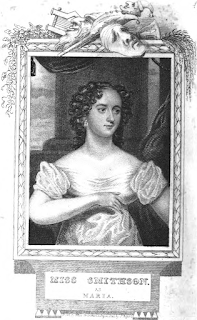
In 1833, composer Hector Berlioz married Harriet Smithson, but she had enjoyed a distinctive career on her own as an actress long before she became Madame Berlioz.

According to her entry in Oxberry's Dramatic Biography, Smithson was born on March 18th, 1800 in County Clare, Ireland, of English parentage. Her father, William Smithson, traced his ancestry back to Gloucestershire, but worked managing theatres in the Waterford and Kilkenny circuit.

At first, young Harriet's parents had great ambitions for her, and they actively kept her away from the stage, but after hard times fell upon the family, the young girl seemed their only hope. She made her stage debut in Dublin as Albina Mandeville in Frederick Reynolds's play The Will, and subsequently began to perform across Ireland.

In 1817, Smithson was introduced to Robert William Elliston, who was then manager of the Birmingham Theatre Royal. It was while performing in Birmingham that she caught the attention of the management of the Theatre Royal at Drury Lane in London. She made her debut at that theatre on January 20, 1818 as Letitia Hardy in Hannah Cowley's comedy The Belle's Stratagem.

Since her brother was manager of an English theatre in Boulogne, Smithson performed both there and in Calais. She made her Paris debut in 1827, performing the role of Lydia Languish in Richard Brinsley Sheridan's The Rivals. Charles Kemble's company, touring in France, then took her on to play Ophelia in Hamlet, and she made quite a stir with her mad scene. Kemble was apparently impressed, as he subsequently cast her opposite himself as they played the leading roles in Romeo and Juliet.

Berlioz saw Smithson perform as Ophelia in 1827 and promptly became obsessed with her. She was reportedly the inspiration for his Symphonie Fantastique, as well as other works of his. He also wrote her numerous love letters, which she failed to answer. Berlioz was three years younger than her, and not yet particularly well known. He also could just barely speak English. The young composer entreated her to meet with him. She declined.

Smithson returned to London, this time performing at the rival Theatre Royal at Covent Garden rather than Drury Lane. Unfortunately, the reviews were harsh. She toured a bit, joined the company of the smaller Haymarket Theatre, then eventually went back to Paris to set up her own troupe in 1830. She performed in English at the Théâtre-Italien, but the next year she broke her leg and had to put her whole career on hold.

Then, in 1832, there was a performance of Lélio, Berlioz's sequel to Symphonie Fantastique. She had missed Symphonie Fantastique's premiere in 1830, but this time she thought she'd give that mad Frenchman's music a try. That's when she figured out that this crazy twenty-something kid who'd been stalking her was a musical genius. She agreed to meet with him, and the next year they were married.

Sadly, their marriage was not the happiest. They never really got along with each other's families and friends. Plus, her career had already peaked, and his was just beginning. She became jealous of his success, not to mention of the mistress he picked up at the Paris Opera. Still, her performances were both inspired and inspiring, and for that, she should be remembered.

Wednesday, March 10, 2021

Frances Abington

Frances Abington, born Frances Barton in 1731, is probably best remembered for originating the role of Mrs. Teazle in Richard Brinsley Sheridan's play A School for Scandal. While that was one highlight of her career, she actually had a long and varied life upon the British stage.

According to biographer Austin Brereton, young Frances, known as "Nosegay Fan," could be seen daily as a girl selling flowers in St. James's Park. As she got older, she began reciting the works of Shakespeare and other authors in the piazza at Covent Garden. She later "became a servant to a French milliner in Cockspur Street, acquiring thereby a taste for dress, afterwards of great service to her," Brereton writes.

Numerous authors have remarked on the actress's fashion sense, which must have come in handy at a time when performers were usually asked to provide their own costumes. Miss Barton made her stage debut at the Haymarket Theatre in 1755, appearing as Miranda in Susanna Centlivre's comedy The Busybody. From there she went to Bath, and the following summer she played in Richmond, where someone from Drury Lane spotted her and hired her for London's most prestigious theatre company.

It was while working at Drury Lane that Miss Barton became Mrs. Abington, marrying James Abington, her music-master and one of the trumpeters in the Royal service. The marriage does not appear to have been a particularly happy one, and Frances left London for Dublin, where she acted at the Smock Alley Theatre, playing such roles as Mrs. Sullen in George Farquhar's The Beaux' Stratagem and Kitty in James Townley's High Life Below Stairs. While acting these parts, "so nice was her taste in dress that the 'Abington cap' was the rage among the Dublin ladies," Brereton claims.

In 1762, Abington returned to Drury Lane, but she clashed with the theatre's manager, David Garrick. In 1782 she went over to the rival patent theatre at Covent Garden. She made her last public appearance on stage there on April 12, 1799, when she acted as Lady Racket in Arthur Murphy's comedy Three Weeks After Marriage in a benefit performance for Alexander Pope (the actor, not the poet).

Abington excelled in numerous Shakespeare roles, including Beatrice in Much Ado About Nothing, Portia in The Merchant of Venice, and Olivia in Twelfth Night. Here's an engraving of her playing Rosalind in As You Like It.

Tuesday, February 16, 2021

The Debut(s) of Sarah Siddons

When David Garrick heard about "a Mrs. Siddons" who might "be a valuable acquisition to Drury Lane" he sent his friend the Reverend Bate to scout her.

Bate's letter to Garrick, dated August 21, 1775, praised the beauty of the actress, but spent more time emphasizing her magnificent control of her body and voice:

Her face, if I may judge from whence I saw it, is one of the most beautiful for stage effect ever I beheld; but I shall surprise you when I shall assure you that these are nothing to her action and general stage deportment, which are remarkably pleasing and characteristic--in short, I know no woman who marks the different passages and transitions with so much variety, and, at the same time, propriety of expression.

It's interesting to note that according to Bate's letter, Sarah Siddons's voice itself was "rather dissonant" and perhaps even "grating" at times. That seems amazing to us, who now think of the Siddons voice as legendary. We also generally think of Siddons's appearances as Hamlet as coming late in her career, but Bate claimed even back in 1775 that the actress "plays Hamlet to the satisfaction of the Worcestershire critics."

Garrick wrote back that Bate should "secure the lady" to appear at Drury Lane after she had her "lie in," as Siddons was heavily pregnant at the time. He also requested a list of roles that the actress had played, and Bate obliged, naming such parts as Jane Shore, Roxana (presumably from The Rival Queens), Calista (presumably in The Fair Penitent), and a number of Shakespearean roles, including Juliet, Cordelia, Horatio, Portia, and Rosalind, the last of which Bate had seen her perform.

In November, Siddons gave birth to a girl, apparently a bit earlier than expected. At the end of the following month, she made her debut at Drury Lane, billed as "A Young Gentlewoman" playing Portia in The Merchant of Venice. Unfortunately, the debut was not a success, and reviews were hostile. She later appeared as Lady Anne in Richard III, but the press attacked her again.

Garrick retired in 1776, and the new manager of Drury Lane, Richard Brinsley Sheridan, unsurprisingly chose not to reengage Siddons. It was years later that Sheridan's father Thomas saw Siddons performing in a provincial theatre. The decision was made to give the actress another chance, and her second debut at Drury Lane was set for October 10, 1782. She would be playing the leading role of Isabella in Garrick's adaptation of The Fatal Marriage by Thomas Southerne.

Two days before the big night, Siddons reportedly "was seized with a nervous hoarseness." Her voice came back on the morning of the performance, though, and so thorough was her triumph that by the end of the play "every speech was interrupted by bursts of applause," according to accounts. The rest is history.


Monday, August 3, 2020

The Black Doctor

Ira Aldridge is one of those remarkable people we've known about for a long time, but who has been in recent years increasingly getting the attention he deserves.

Aldridge was born in 1807 in New York, though he later claimed to be from Africa, probably in a bid to appeal to European audiences who wanted to view him as a more "exotic" foreigner than just another American ex-patriot.

His father sold straw for a living, but also was a lay preacher. Later scholars have speculated that young Ira might have gotten his first vocal training from his father, who not only had to have a strong voice to preach, but who also hawked his straw from a cart he took around New York City, which meant he must have needed a strong voice to attract customers.

Aldridge's real theatrical training came from the African Grove Theatre, though. William Alexander Brown founded the theatre in 1821 to perform amateur productions of plays by Shakespeare and others, including Brown himself, whose play King Shotaway was sadly lost. The actors were of African ancestry, including William Hewlett, the star of the company, who was particularly famous for playing Richard III.

At the African Grove Theatre, Aldridge played such parts as the Inca warrior Rolla in Richard Brinsley Sheridan's Pizarro, but the company did not last long. The year the African Grove Theatre began offering their performances in downtown Manhattan, the Park Theatre was rebuilt in the same neighborhood.

The Park Theatre offered professional performances by white actors for a predominately white audience, though African Americans like Aldridge did watch shows from the upper balcony. When white audience members saw how good the productions at the African Grove were, though, they started patronizing the amateur company, and this was too much for the managers of the Park Theatre to take. They began to harass Brown's company, and the African Grove Theatre was eventually burned down, likely at the instigation of the management of the Park Theatre.

Aldridge probably saw that if he was going to have any success as an actor, it wasn't going to be in his home country. He emigrated to Britain, and had some success playing roles including Othello. That's when the most famous portrayer of Othello on the British stage, Edmund Kean, collapsed during a performance playing opposite his son Charles and died a couple months later. The theatre needed a new Othello, and Aldridge was chosen for the part.

What happened next is recounted in Lolita Chakrabarti's wonderful play Red Velvet. Reviews of Aldridge's Othello were mixed, and some were openly hostile and explicitly racist. Aldridge ended up leaving London, instead touring provincial theatres in Britain as well as larger venues on the European continent. There, he won great renown not just in Othello, but also Richard III, The Merchant of Venice, and King Lear, as well as dramas by Matthew G. Lewis, Charles Robert Maturin, and others.

In 1846, the hack dramatist Auguste Anicét-Bourgeois wrote a play called Le Docteur Noir. Anicét-Bourgeois seems to have written the play together with Philippe François Pinel Dumanoir, a melodramatist who would go on to adapt Uncle Tom's Cabin for the Théâtre de l'Ambigu-Comique in Paris. Le Docteur Noir might not have been great literature, but it did provide moments for great acting, and it appeared on the London stage in a translation by John Vilon Bridgeman and further adapted by Thomas Hailes Lacy.

In Bath, Bristol, and Dublin, Aldridge began performing another adaptation of the play by Thomas Archer. Aldridge's adaptation of The Black Doctor gives particular emphasis to race and class, according to theatre scholar Keith Byerman, who did a thorough analysis of different texts.

The play begins on the Isle of Bourbon, now known as Réunion, in the Indian Ocean near Madagascar. In the first scene, we hear of Pauline de la Reynerie, a French noblewoman whose life was saved by Fabian, the titular black doctor played by Aldridge. Pauline's mother was on a ship that is assumed to be wrecked, but it was her mother's wish that Pauline marry the Chevalier St. Luce. Meanwhile, Fabian has mysteriously disappeared, though some say "he has been observed wandering on the cliffs, but always avoiding anyone who appeared to seek him."

Scene Two takes place in Fabian's hut, where Pauline tracks him down and gives him a purse full of gold to distribute to the poor since he has refused payment for his services. She also tells him that a mysterious man has been sighted near her house, and we understand that the stranger is Fabian himself, who is in love with her. Pauline's mixed-race foster sister Lia is in love with a white clerk, and when Pauline says she will help her to marry the man in spite of racial prejudice, Fabian begins to have hope for his own prospects.

The brief third scene concerns some minor characters, and prepares the audience for the thrilling climax of the act, illustrated on the first page of the published play. Fabian, hearing that Pauline has been betrothed to St. Luce, takes her to a grotto down by the sea, hoping the ocean will kill them both when the tide comes in and floods the grotto.

Wait... the doctor who saved her is now going to murder her? Well, it isn't much different from Othello killing Desdemona, is it? Unlike Othello, though, Fabian takes pity on his victim. Pauline, thinking she will die, confesses, "I have long, long loved you!" Hearing this, Fabian carries her to a rock where they are saved by a passing ship.

Act Two takes place at the house of Pauline's family in Paris. It turns out that her mother the Marchioness is not dead after all. Fabian and Pauline have been secretly married, but he is officially employed by her family as a servant, and the Marchioness clearly thinks very little of him. Instead, she wants Pauline to marry St. Luce so she can become a lady of honor to the Queen. (This is presumably Marie Antoinette, as the next act takes place at the outset of the French Revolution.) Pauline, distraught, tries to take poison rather than abandon her husband, but Fabian grabs the poison from her and flees from the room, promising the Marchioness he will restore her daughter to her since that is the only way to save his beloved Pauline.

The dramatic curtain at the end of the second act is exceeded in drama by a third act that takes place in the Bastille on the historic day of its storming in 1789. Both St. Luce and Fabian have been imprisoned in different cells in the Bastille. St. Luce is portrayed as a stuck-up fop, enraged that he can't get luxuries while in prison. Fabian, on the other hand, has been living in misery and trying to communicate with his friend Andre to get news of what is happening outside the prison. Revolutionaries storm the Bastille, freeing the prisoners, but it is too late for Fabian. Thinking Pauline is dead, he falls into an insanity, and the act ends with the cannons of the revolution sounding.

In the fourth and final act, we are transported forward to the year 1793, during the Reign of Terror. Pauline is considered an enemy of the people, since it was her family who was responsible for crimes against Fabian, the good black doctor who is now revered. Andre has been taking care of Fabian, who is still insane. When the mad doctor sees Pauline, it looks like she will be saved from the mob, but then Fabian sees St. Luce beside her, as well as a portrait of the Marchioness. Still thinking the Marchioness is alive and will kill Pauline if they are together, Fabian denies being her husband. A man in the mob fires a gun at Pauline, but Fabian throws himself in front of her, taking the bullet. With his dying strength, Fabian produces the proof of their marriage, saving Pauline at the cost of his own life.

If the play sounds melodramatic, well, it is in fact a melodrama, even including a musical chord at the moment Pauline sees her husband in the final act. Aldridge might not have been a great playwright, but he was a great actor, and the play he adapted no doubt provided a suitable vehicle to display his own talents.

Monday, September 9, 2019

Drury Lane

Earlier this year, the Theatre Royal Drury Lane shut down for renovations, including making all levels accessible by elevator.

That wasn't what it was like when I first went there. Since I'd bought a ticket way up in the cheap seats, I couldn't even enter through the lobby. Instead, I had to go around the corner to the side entrance--the one that had been built for servants during the 19th century--and walk up seemingly endless rows of stairs. And, personally, I wouldn't have had it any other way.

Don't get me wrong. It's important that we make theatres accessible for everyone. I'm just glad I had a chance to see Drury Lane the old-fashioned way, the way servants and other working-class folks saw it during the Regency period when the building first opened in London. The building that's there now goes back to 1812, though it's legacy goes back even farther.

During the Restoration, Thomas Killigrew got a patent from King Charles II to set up a theatre troupe known as the King's Company. At first, they just performed in a tennis court, as was sometimes done in France at that time, but in 1663 Killigrew opened a theatre on Bridges Street near Drury Lane. The flat area near the stage, what we today would call the orchestra, was known as the pit, and around it were boxes for wealthier patrons.

Originally, the pit was uncovered, but later the management added a glazed dome to (try to) keep out the rain. Unlike audience members in the pit of Shakespeare's Globe who stood, the audiences in the pit of Killigrew's theatre sat on backless benches. Even upper-class men would sit there to get a better view of the action. Respectable ladies, on the other hand, tended to stay in their boxes, as they didn't want to be mistaken for the infamous "orange girls" who sold refreshments (and sometimes other things) to audience members.

The rival Duke's Company had set up a magnificent theatre in a former tennis court located at Lincoln's Inn Fields. It included elaborate stage machinery hidden by a proscenium arch. Not to be outdone, Killigrew's theatre contained a proscenium and shutter-and-groove system for changing scenery. Actors weren't used to this setup, though, and continued to perform on the large apron in front of the proscenium. It was on this stage that Nell Gwyn began her career and attracted the attentions of the king himself. Unfortunately, the building was destroyed by fire in 1672.

A replacement opened in 1674 and was referred to as "Drury Lane" since that street ran along the east side of the building, though the audience still entered through a passage from Bridges Street. Again, there was a pit surrounded by boxes. There were also two galleries of cheap seats above the boxes. This inexpensive part of the theatre was the "eighteen-penny place" alluded to in William Wycherley's The Country Wife. We don't know exactly what this building looked like, but the Theatre Royal Bristol was partially based on it when that theatre was built in 1766, so we have at least a general idea.

By the end of the 18th century, the Theatre Royal at Drury Lane seemed cramped and outdated, so it was torn down and replaced by a brand-new structure in 1794. It was huge, capable of holding up to 3,600 people. Richard Brinsley Sheridan managed the theatre and bore most of the expenses for its construction. It was a gamble, but he was a gambling man. As long as he packed the auditorium each night, he would be able to not only make his money back, but to make a fortune. Then, on February 24, 1809, the theatre burned down--only fifteen years after it had opened. Sheridan pretty much lost everything.

The present-day theatre opened at the same location in 1812 with a production of Hamlet. Its renovations are probably necessary, but I do hope they retain a bit of the history of the place. For me, Drury Lane will always be special.

Saturday, December 30, 2017

Kelton House Commedia

I recently got back from celebrating Christmas in Ohio, and while I didn't see any theatre in Columbus, I managed to stumble across some theatrical memorabilia.

While visiting the historic Kelton House, I was surprised to see in a bookcase the complete works of Hannah More. Today, More is rarely remembered, but her 1777 drama Percy (which opened the same year as The School for Scandal by Richard Brinsley Sheridan) was the most successful English verse tragedy of its era.


Even more exciting was a glass case filled with ceramic figurines of commedia dell'arte characters. Such porcelain miniatures of stage actors were popular during the nineteenth century. How they got to the house and whether or not they were collected by the Kelton family (which incidentally also ran a stop on the underground railroad) I don't know.


Next to the case of miniatures was a series of prints of commedia actors modeled off of the illustrations done by Jacques Callot. In the 1620s, Callot did a series of etchings he called Balli di Sfessania. These etchings give us an idea of how commedia performers dressed in the seventeenth century.


Here we see Captain Zerbino and Scapino. Zerbino is one of many braggart soldier figures popular in commedia, but Scapino is particularly famous for inspiring the character of Scapin that Moliere frequently played. To see these treasures and other curiosities of the past, take a tour of Kelton House Museum in Columbus. It's worth a visit!


Tuesday, October 3, 2017

The Age of Garrick

Though the Licensing Act of 1737 kept politics off the stage in Britain for much of the eighteenth century, British theatre continued to make tremendous artistic strides, particularly in acting.

The provincial actor David Garrick moved to London the very year the Licensing Act was passed, and had the good fortune to be coached by Charles Macklin, an actor renowned for his performances as Shylock in William Shakespeare's The Merchant of Venice. At first, Garrick performed at a theatre of dubious legality known as Goodman's Fields, but in 1742 he made his debut at Drury Lane, one of the two patent theatres with a near monopoly on drama in London.  He soon began a long and productive artistic partnership with Peg Woffington, the leading actress with the Drury Lane company. Such was his success, that in 1747 Garrick took over the management of Drury Lane and instituted a number of reforms.

The most important of these reforms came in 1762, when Garrick banned spectators from the stage. Wealthy patrons had traditionally paid extra to sit on the stage itself and be seen as well as watch the actors. The practice was common before the English Civil War, and while it abated during the Restoration period when expensive new scenery was being introduced, theatres at the beginning of the 18th century placed benches onstage for the audience. Garrick abhorred the practice and eliminated the onstage benches. This allowed for greater realism, both in scenery and in acting. He also raised ticket prices to pay for the fancy new sets he was commissioning.

In 1771, Garrick hired the French-born artist Philippe de Loutherbourg to design sets at Drury Lane. De Loutherbourg also made numerous innovations in lighting, which made his sets even more impressive. His sets moved as well, so clouds could drift across the sky, and miniature ships could appear to sail through the water in the distance. Eventually, de Loutherbourg created a miniature stage he called the Eidophusikon, which controlled the lighting and scenery to an extreme degree, but had no room for actors. People paid money simply to watch the brilliant moving pictures, and the Eidophusikon attempted to compete with the theatre itself. Fortunately, the Eidophusikon never put Drury Lane out of business.


Garrick wasn't satisfied with the new plays being written, however, so he began writing his own. He collaborated with the playwright George Coleman the Elder (best known for his hilarious but misogynistic comedy The Jealous Wife) to write The Clandestine Marriage, which was based loosely on a series of satirical pictures by William Hogarth. Garrick's plays might not have been terribly original, but they were entertaining and remained popular well after his retirement. In 1769, Garrick held a massive celebration of William Shakespeare in the Bard's hometown of Stratford-upon-Avon. Though it was a little late for the bicentennial of Shakespeare's birth five years earlier, Garrick spared no expense in arranging a Jubilee celebration, which featured a pageant of Shakespeare's most popular characters. Unfortunately, heavy rains flooded a special tent for the occasion, and all Stratford was covered with mud. Not to be put out, Garrick wrote a play about the event, called it The Jubilee, and performed it at Drury Lane along with the procession of characters.

Garrick's most important contribution, however, came in raising the standards of acting in the eighteenth century, not just in England, but on the European continent as well. The French philosopher Denis Diderot after seeing Garrick wrote a famous essay called "The Paradox of the Actor" in which he tried to determine what made a great actor's performances so engaging. According to Diderot, great actors like Garrick display the illusion of feeling without feeling strong emotions themselves. The paradox is that the more emotional an actor becomes, the less able he is to convey emotions consistently on stage, while the more rational he is, the better he is to show different emotions night after night. Intelligence was what a great performer needed, not feeling.

Though Drury Lane dominated London's theatre scene under Garrick, the rival theatre at Covent Garden scored a palpable hit in 1773 with a play by Oliver Goldsmith called She Stoops to Conquer. Goldsmith loathed the sentimental comedies that had become popular in the eighteenth century and considered his play a "laughing comedy" since the crazy antics of the characters provoked outright guffaws rather than the knowing smiles of earlier works.

Though not as bawdy as Restoration comedy, She Stoops to Conquer captures much of the energy of earlier comic works, and it helped to pave the way for another playwright, Richard Brinsley Sheridan. In 1775, Covent Garden produced Sheridan's play The Rivals, about a man who creates an alter-ego for himself to be his own rival for the love of the woman he wants to marry. The play features a duel, which had special interest for the audience, since Sheridan himself had fought two widely publicized duels over the honor of his fiancée and later wife, the singer Elizabeth Ann Linley.

In 1776, Garrick retired from the stage, and the newly successful Sheridan bought his stake in Drury Lane. He soon took over the theatre, and tailored his next play, The School for Scandal, to perfectly suit the strengths of the actors in the Drury Lane company. The play was a massive hit, and Sheridan later used his fame to launch a successful bid for parliament. From 1780 onward, he enjoyed a dual career as both a theatre manager and a politician. The mild-mannered Age of Garrick was over, and increasingly the theatre was becoming politically charged.

Thursday, June 8, 2017

Almeyda, Queen of Granada

Sophia Lee's tragedy Almeyda, Queen of Granada ran for five nights at Drury Lane in 1796. That might not seem like a long time, but plenty of tragedies had shorter runs in the preceding decades, and the London stage hadn't seen a truly remarkable tragedy since Hannah More's Percy in 1777.

The success of Almeyda (such as it was) came largely from its leading lady, Sarah Siddons, who played the titular queen. Lee dedicated the printed version of the play to Siddons, and said she never would have written a second play (after her 1780 foray into comedy The Chapter of Accidents) if it hadn't been for the great actress.

"Not all the various charms you dignify the Drama with, can equal those of your sympathizing mind, and unassuming manners," Lee wrote in her dedication to Siddons. In a special advertisement to the reader, Lee went on to say that one "must have wanted taste and feeling, not to have been animated, by the exquisite talents of Mrs. Siddons" and that she was proud to have been "the means of displaying, in a new point of view, her various powers."

Though Lee created an original story for Almeyda, she acknowledged a debt to the Caroline playwright James Shirley. The play's prologue, written by Lee's sister Harriet, plays homage to other tragic writers as well, including William Shakespeare, Nicholas Rowe, and Thomas Otway. It urges the audience to cherish the "spark divine" of tragedy which had been all but extinguished in recent years:

                    Ah! gently fan the flame! lest fashion's breath
                    O'er the pale promise send the blast of death;
                    Nor let the wreath Thalia only wear,
                    Her sister muse deserves so well to share.

Thalia is the muse of comedy, and the comic works of Richard Brinsley Sheridan, Oliver Goldsmith, and John Gay continued to hold the stage even as tragedy had languished. However, according to Harriet Lee, tragedy "mends the morals while it fills the heart." Using strikingly gendered terms, the prologue urges the audience to not just enjoy making fun of folly and vice in comedy, but to "own the manly privilege to feel."

The title character in Almeyda is a Moorish princess who was raised in the court of Castile after the Spanish conquest of Granada. She converts to Christianity and falls in love with Alonzo, son of the King of Castile. However, at the start of the play, international politics call for Granada to be returned to the Moors, and for Almeyda to be installed as queen there. She remains devoted to Alonzo, but wonders if he will continue to love her, or if his patriotic duty to Castile will triumph:

                    Ah, no! For nature here makes distinction;
                    Forms man's large heart for many a various duty,
                    And blends his passions into a republic--
                    While woman, born for love and softness only,
                    Delights to feel love's absolute dominion!

This may sound sexist, and indeed it is, but perhaps not in the way it first appears. Remember, this was first performed in 1796, when the British monarchy was at war with Republican France. Patriotic audiences in London might well have cheered on the "absolute dominion" of woman while scorning the "republic" that represents the fickle heart of man.

Almeyda's uncle Abdallah seeks to control the throne of Granada by marrying her to his son, Orasmyn. Though Orasmyn is in love with his cousin Almeyda, he is too honorable to accept a forced marriage and hopes to truly win her heart. She, however, does not trust the policy of men. She recognizes that her honesty is not prudent, but she gains strength from the seeming foolishness of straight-forward sincerity:

                    --I would like you be guarded, prudent, selfish;
                    Preserve a silence might ensure my safety,
                    And rest upon the future.--But my soul
                    Disdains the mean, the temporising wisdom,
                    Nor knows to tremble in the cause of truth.

In Act III, we meet Alonzo, who was originally played by John Philip Kemble, the younger brother of Siddons. Like Almeyda, he is more passionate than judicious, and sneaks into the enemy palace at Granada in order to see his love. As he explains:

                    In vain would time, or distance, wrest her from me,
                    She, she alone, can shield me in the war,
                    Or nerve my arm at the fierce battle's onset.

Abdallah catches him though, and secure in the knowledge that no one knows Alonzo snuck into Grenada, imprisons him in a dungeon without fearing retribution from the Castilians. Orasmyn, out of both his own sense of honor and the love he has for Almeyda, rescues his rival Alonzo. Unfortunately, when Almeyda descends into the dungeon with her own rescue plan, she finds it empty and concludes that Alonzo has been cast into a gaping chasm. Her uncle appears, and she again uses honesty as her weapon against him, claiming:

                    I will have such revenge!--From thy black heart,
                    At once I'll pluck away its worldly veil,
                    And punish thee in mere sincerity.

In the final act, Abdallah realizes he will never get Almeyda to marry his son. He tries to get her to abdicate, and when that fails, he poisons her and then himself. As she is dying, Almeyda reconciles Alonzo and Orasmyn:

                    Orasmyn's gen'rous heart is virtue's temple!
                    Alonzo, dear Alonzo! honour--love him...
                    --And now, indeed, farewel!--A hand for each.
                    This gives away my crown; and this, oh! this,
                    The faithful heart that's in it!--I am cold;
                    And these dim eyes seek vainly for Alonzo!

Though Almeyda did not make its way into the permanent repertoire of Drury Lane, the performance of Siddons drew positive reviews. Lee's tragedy, even if it never became famous, added to the fame of Siddons by giving her acting a chance to shine.

Friday, February 24, 2017

The Rise of the English Actress

I just finished reading Sandra Richards's book The Rise of the English Actress. By its nature, the book is a rather general study, but it gives a wonderful history of women on the British stage.

Women appeared on stage during the middle ages, but by the Renaissance they were official banned from taking part in the public performances of plays in England. There were some exceptions, such as the infamous "Moll Cutpurse" who acted illegally, and the French actresses who were hissed at the Blackfriars Theatre in 1629.

It wasn't until the Restoration that actresses became the norm in England, and they quickly became an attractive novelty. Richards points out that in 1664 Thomas Killigrew staged an all-female performance of his play The Parson's Wedding. All-female casts were still being used a decade later when John Dryden's Secret Love was revived with only women on the stage.

By the early eighteenth century actresses were using playwrights to pen works especially for them. Richards cites Henry Fielding's Deborah and The Intriguing Chambermaid, written for Kitty Clive, and Colley Cibber's The Careless Husband and The Provok'd Husband, both vehicles for Anne Oldfield. Such collaborations did not always go well, though. Samuel Jonson blamed the failure of his play Irene on a sub-standard performance by Hannah Pritchard.

Perhaps the most celebrated eighteenth-century role created for a specific actress was Lady Teazle in Richard Brinsley Sheridan's The School for Scandal. According to Richards, Sheridan wrote the part especially for Frances Abington. It was Abington who made the mob cap fashionable after she wore it on stage in James Townley's two-act farce High Life Below Stairs. The role she played, Kitty, was originally played by Kitty Clive, but Abington used it to create a fashion sensation that came to be known as the Abington Cap.

Women were instrumental in the creation of the benefit performance, and their earnings could top those of male actors. Richards notes that in 1792 the top-grossing benefit night belonged to Dora Jordan. That year, Jordan earned 540 pounds, while the tragic actress Sarah Siddons earned 490 pounds, and the leading male actor, John Philip Kemble, earned only 480 pounds. The Jordan-Siddons rivalry mirrored a debate over whether comedy or tragedy was the superior genre. The Dramatic Magazine in 1788 sided with Jordan, declaring she "fairly beat Melpomene out of the field."

The late eighteenth century also saw the remarkable career of Mary Robinson, the actress who in 1775 began publishing her poems under the patronage of the Duchess of Devonshire. Unfortunately, her 1794 play Nobody struck a nerve, and was hissed off the stage when it exposed the gambling habits of a number of prominent society ladies. Robinson allegedly dictated her poem "The Maniac" while under the influence of opium. As one might expect, Samuel Taylor Coleridge saw a kindred spirit in her and in 1800 declared Robinson "a woman of undoubted genius."

Robinson was famously painted by the major artists of the day, and as Richards puts it, it was in the eighteenth century that actresses "now became a means of establishing a painter's reputation when they allowed themselves to be portrayed." Portraits of actresses "were offered to the market by painters satisfying a public demand, and reflected how audiences saw female players." Richards specifically cites Thomas Lawrence, whose 1790 portrait of Elizabeth Farren catapulted the painter into fame and royal favor.

The great tragic actress of the late eighteenth century was of course Sarah Siddons, and Richards devotes an entire chapter to her. Drawing on Siddons's biography by Thomas Campbell, Richards points out that Siddons strove to be "natural" but by "natural" she meant credible for the character, rather than what we today might consider naturalistic. Siddons famously studied Egyptian and Greek sculpture, using it to help her achieve the exact poise and muscle tension she wanted to have.

In spite of her generally acknowledged superiority over her brother, John Philip Kemble, Siddons could not always enjoy her stardom. While Kemble was given a public dinner at the occasion of his farewell performance, Siddons received no such honor. She remarked to Samuel Rogers, "Well, perhaps in the next world women will be more valued than they are in this." Still, she left her mark on plays, and Richards notes that "Siddons's personality and bearing unquestionably informed and determined the role" of Jane de Monfort in Joanna Baillie's play De Monfort, which premiered in 1800.

Eliza O'Neill succeeded Siddons as the great British tragedienne of the early nineteenth century. O'Neill retired from the stage in 1819, though, and in the early Victorian period actresses like Helen Faucit and Siddons's niece Fanny Kemble took the reins. In 1837, Fanny Kemble wrote An English Tragedy, but William Charles Macready refused to stage the play, in spite of recognizing that it was "full of power, poetry and pathos."

The most famous Victorian actress was Ellen Terry, and Richards gives Terry her own chapter. Terry was most renowned for playing Lady Macbeth, wearing "a gown of soft green silk and blue tinsel edged with rubies and diamonds, draped by a heather velvet cape and decorated with flaming griffins and real beetle wings of green to achieve a metallic dazzle.” John Singer Sargent painted a portrait of Terry wearing the dress, helping it to become, in Richards's words, "the most famous costume in stage history."

Sybil Thorndike was one of the great British actresses of the early twentieth century. Richards considers her production of Percy Shelley's The Cenci in 1922 to be one of the most important of the actress's career. According to Richards, "Sybil's Beatrice established her firmly as a great tragic actress and Shelley as a great dramatist." At the time, George Bernard Shaw was trying to determine who should play the title character in his new play Saint Joan. After seeing Thorndike as Beatrice Cenci, Shaw informed his wife, "I have found my Joan." Thorndike later became closely associated with the role of Joan of Arc, which she did indeed originate in Shaw's play.

Richards continues the story of the English actress past Thorndike, writing for instance about Peggy Ashcroft, who played Desdemona opposite Paul Robeson in Othello. She goes right up to the present, discussing Harriet Walter, who I just saw play Prospero in an all-female production of The Tempest. All in all, this is a wonderful book for anyone interested in the history of British acting.