Showing posts with label Richard III. Show all posts

Saturday, September 6, 2025

Remorse and Shakespeare

I previously blogged about theatre articles that appeared recently in The Byron Journal. Today, I want to write about an article in The Coleridge Bulletin.

Samuel Taylor Coleridge is best known today as a poet, but by his own account, he made more money off of his verse drama Remorse than all of his other poetry combined.

Dominik Laciak wrote an article called "Coleridge's Remorse and the Haunting Shadow of Shakespeare" which argues that Coleridge's playwriting and Shakespeare criticism informed one another, which definitely makes sense. Remorse opened at Drury Lane in January of 1813, and throughout the rehearsal process Coleridge was also delivering lectures on Shakespeare.

Laciak concentrates on three Shakespeare villains who likely influenced the character of Ordonio in Remorse: Macbeth, Richard III, and Iago. Like Macbeth, Ordonio feels guilt but tries to pretend that he doesn't. Like Richard III, he is constantly posturing. Like Iago, he takes pride in his intellect.

I wrote about Remorse in my book Romantic Actors, Romantic Dramas. It's nice to see other scholars writing about the play as well.

Monday, August 9, 2021

The First Duchess

When John Webster's play The Duchess of Malfi was first published in 1623, it did something extraordinary for the time: it listed the names of the actors who had played various roles.

Now 1623 was also the year two actors first published a folio edition of the work of William Shakespeare, and that edition contained a list of "The Names of the Principall Actors in all these Playes." However, that list didn't tell readers which actor had played which role.

In contrast, when the quarto edition of The Duchess of Malfi lists "The Actors Names" it actually gives the play's characters followed by which actor played each part. According to the play's title page, the piece had been performed both at the indoor Blackfriars Theatre as well as at the outdoor Globe. It also appears to have been performed in different years, since some roles list two different performers, the first one generally a bit older than the second.

Only one actor, however, is listed for the title character, and that is R. Sharpe, presumably Richard Sharpe, who was born around 1602, and so would have been only about 12 years old when the play premiered (before the end of 1614). The second set of actors appear to have taken over their roles sometime after the death of Richard Burbage in 1619. So if we hypothesize a revival around 1621, Sharpe would have been only about 19 then, still young enough to play female roles in the Jacobean theatre.

While little is known about the life of Sharpe, there is a wealth of material about his co-star in the premiere of The Duchess of Malfi, Burbage. Known for such roles as Richard III, Hamlet, Othello, and King Lear, Burbage played the character of Ferdinand, twin brother to the Duchess of Malfi. The twins' younger brother, a Cardinal, was initially played by Henry Condell, who was one of the two actors who compiled Shakespeare's First Folio. While he lived until 1627, he might have taken on more of a managerial position in the company later on, and he was replaced in his role by Richard Robinson. Joseph Taylor replaced Burbage as Ferdinand, and both Taylor and Robinson were listed as "Principall Actors" of Shakespeare, as well.

One of the most curious things about the quarto of Webster's play is that it first lists Bosola, a comparatively lower-class character who would generally be placed after the upper-class folks. However, Bosola is a central figure in the play, and he was apparently quite competently played by John Lowin (listed in the First Folio as "John Lowine"). Known for playing the title characters in Shakespeare's Henry VIII and Ben Jonson's Volpone, Lowin might have distinguished himself so well in the part of Bosola as to earn top billing for himself.

Antonio, who marries the Duchess in the first act, was initially played by William Ostler, who died in December of 1614. (That's how we know the play must have premiered before then.) He was replaced by Robert Benfield.

It is the Duchess herself, however, who fascinates audiences the most in the play. It would have been interesting to have seen a young boy like Sharpe originating the role!

Saturday, July 10, 2021

Cataracts and Hurricanoes!

Tuesday, I was supposed to see New York Classical Theatre Company's production of King Lear in Central Park. I was particularly excited because rather than doing the classic version by William Shakespeare, they promised they would be performing the happy ending by Nahum Tate!

Well, unfortunately, they called off the show due to weather. I had already walked down to the park, so I ended up getting drenched on the way home. Fortunately, the company offered to reschedule my reservation for a different date. I asked them to rebook me for Saturday, tonight.

Well, they got through quite a bit of the play this time, bur as Lear was calling out "You cataracts and hurricanoes, spout / Till you have drench'd our steeples, drown'd the cocks!" the audience was feeling drops of rain start to come down on us. It wasn't too much, so the actors soldiered on. Gloucester got his eyes gouged out, and then the director made an announcement: The show was canceled. As I walked home, I got drenched yet again.

Is the third time a charm? Well, Lear didn't have much luck with his first two daughters, and then along came Cordelia... so... maybe?

I've made a reservation to see the show when it will be playing in Castle Clinton later this month. Come to think of it, the last time I saw New York Classical perform King Lear, it was also at Castle Clinton, but that was with the original ending. I want the happy ending, dang it!

New York Classical isn't the only company performing free Shakespeare in the parks this summer. Classical Theatre of Harlem is doing an adaptation of Richard III by Will Power called Seize the King, Greenhouse Ensemble is doing a production of Twelfth Night, and the Public Theater is doing Jocelyn Bioh's adaptation of The Merry Wives of Windsor. In addition, Shakespeare in the Parking Lot is doing Shakespeare's collaboration with John Fletcher, The Two Noble Kinsmen.

Outdoor theatre is always a challenge, but I'm hoping the rains let up so I can see at least some of these upcoming shows!

Tuesday, June 29, 2021

The Wolves of Kean

The actor Edmund Kean was notoriously associated with wolves, and in fact presided over a social group known as the "Wolves Club" that drank heavily and mocked the pretensions of the aristocracy.

Kean's infamous Wolves Club allegedly met at a pub known as the Coal Hole, which I visited in London back when the United Kingdom was still open to foreigners. In 1815, members of the club gave Kean a gold medal featuring an image of a lone wolf.


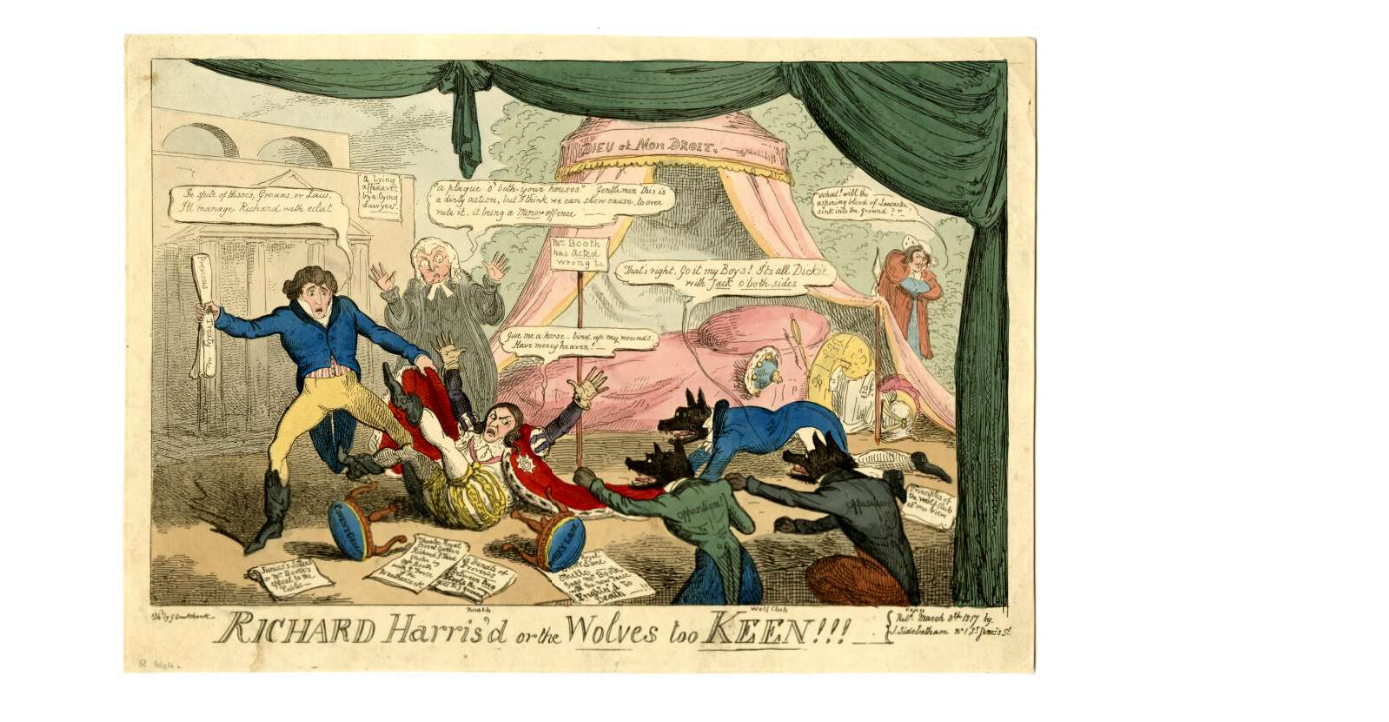
The Wolves Club had stopped meeting by 1817 when Junius Booth tried to star in a production of Richard III at Covent Garden. Unfortunately, a few nights earlier, Booth had disappointed a packed audience at Drury Lane, where he had been scheduled to act opposite Kean in Othello. Kean's fans took this as a slight, especially since Richard was a role associated with their hero, so they all showed up at Covent Garden, less than pleased.

Apparently, Booth couldn't even be heard amid all the uproar. He tried to apologize to the audience, but they refused to be quiet long enough for him to do so. Eventually, he came out wearing a placard stating "I have acted wrong..." The disaster was the talk of the theatre world, and a great embarrassment for Thomas Harris, the manager of Covent Garden. The artist George Cruikshank created a satirical print making fun of the whole affair, showing the theatre fans as well-dressed wolves.


Two years later, another satirical print came out making fun of a dispute Kean and Drury Lane's manager, Alexander Rae, had with the playwright Charles Bucke. Poor Bucke's tragedy The Judgement of Brutus had been a failure, but then Kean starred in a suspiciously similar piece by John Howard Payne called Brutus; or, The Fall of Tarquin. Bucke kept at it, and submitted a play called The Italians which had a role explicitly written for Kean. While the play was in rehearsal, however, Kean refused to proceed, stating he would rather pay a thousand pounds than have to perform the role. Three wolves guard Kean in a rather funny cartoon on the matter.


Later, when Kean got embroiled in a lawsuit over his affair with Charlotte Cox, Cruikshank's brother Isaac Robert created a print showing a whole audience full of wolves watching Kean perform on stage. As you can see, wolf imagery was frequently associated with Kean and his fans.


Tuesday, February 16, 2021

The Debut(s) of Sarah Siddons

When David Garrick heard about "a Mrs. Siddons" who might "be a valuable acquisition to Drury Lane" he sent his friend the Reverend Bate to scout her.

Bate's letter to Garrick, dated August 21, 1775, praised the beauty of the actress, but spent more time emphasizing her magnificent control of her body and voice:

Her face, if I may judge from whence I saw it, is one of the most beautiful for stage effect ever I beheld; but I shall surprise you when I shall assure you that these are nothing to her action and general stage deportment, which are remarkably pleasing and characteristic--in short, I know no woman who marks the different passages and transitions with so much variety, and, at the same time, propriety of expression.

It's interesting to note that according to Bate's letter, Sarah Siddons's voice itself was "rather dissonant" and perhaps even "grating" at times. That seems amazing to us, who now think of the Siddons voice as legendary. We also generally think of Siddons's appearances as Hamlet as coming late in her career, but Bate claimed even back in 1775 that the actress "plays Hamlet to the satisfaction of the Worcestershire critics."

Garrick wrote back that Bate should "secure the lady" to appear at Drury Lane after she had her "lie in," as Siddons was heavily pregnant at the time. He also requested a list of roles that the actress had played, and Bate obliged, naming such parts as Jane Shore, Roxana (presumably from The Rival Queens), Calista (presumably in The Fair Penitent), and a number of Shakespearean roles, including Juliet, Cordelia, Horatio, Portia, and Rosalind, the last of which Bate had seen her perform.

In November, Siddons gave birth to a girl, apparently a bit earlier than expected. At the end of the following month, she made her debut at Drury Lane, billed as "A Young Gentlewoman" playing Portia in The Merchant of Venice. Unfortunately, the debut was not a success, and reviews were hostile. She later appeared as Lady Anne in Richard III, but the press attacked her again.

Garrick retired in 1776, and the new manager of Drury Lane, Richard Brinsley Sheridan, unsurprisingly chose not to reengage Siddons. It was years later that Sheridan's father Thomas saw Siddons performing in a provincial theatre. The decision was made to give the actress another chance, and her second debut at Drury Lane was set for October 10, 1782. She would be playing the leading role of Isabella in Garrick's adaptation of The Fatal Marriage by Thomas Southerne.

Two days before the big night, Siddons reportedly "was seized with a nervous hoarseness." Her voice came back on the morning of the performance, though, and so thorough was her triumph that by the end of the play "every speech was interrupted by bursts of applause," according to accounts. The rest is history.


Monday, August 3, 2020

The Black Doctor

Ira Aldridge is one of those remarkable people we've known about for a long time, but who has been in recent years increasingly getting the attention he deserves.

Aldridge was born in 1807 in New York, though he later claimed to be from Africa, probably in a bid to appeal to European audiences who wanted to view him as a more "exotic" foreigner than just another American ex-patriot.

His father sold straw for a living, but also was a lay preacher. Later scholars have speculated that young Ira might have gotten his first vocal training from his father, who not only had to have a strong voice to preach, but who also hawked his straw from a cart he took around New York City, which meant he must have needed a strong voice to attract customers.

Aldridge's real theatrical training came from the African Grove Theatre, though. William Alexander Brown founded the theatre in 1821 to perform amateur productions of plays by Shakespeare and others, including Brown himself, whose play King Shotaway was sadly lost. The actors were of African ancestry, including William Hewlett, the star of the company, who was particularly famous for playing Richard III.

At the African Grove Theatre, Aldridge played such parts as the Inca warrior Rolla in Richard Brinsley Sheridan's Pizarro, but the company did not last long. The year the African Grove Theatre began offering their performances in downtown Manhattan, the Park Theatre was rebuilt in the same neighborhood.

The Park Theatre offered professional performances by white actors for a predominately white audience, though African Americans like Aldridge did watch shows from the upper balcony. When white audience members saw how good the productions at the African Grove were, though, they started patronizing the amateur company, and this was too much for the managers of the Park Theatre to take. They began to harass Brown's company, and the African Grove Theatre was eventually burned down, likely at the instigation of the management of the Park Theatre.

Aldridge probably saw that if he was going to have any success as an actor, it wasn't going to be in his home country. He emigrated to Britain, and had some success playing roles including Othello. That's when the most famous portrayer of Othello on the British stage, Edmund Kean, collapsed during a performance playing opposite his son Charles and died a couple months later. The theatre needed a new Othello, and Aldridge was chosen for the part.

What happened next is recounted in Lolita Chakrabarti's wonderful play Red Velvet. Reviews of Aldridge's Othello were mixed, and some were openly hostile and explicitly racist. Aldridge ended up leaving London, instead touring provincial theatres in Britain as well as larger venues on the European continent. There, he won great renown not just in Othello, but also Richard III, The Merchant of Venice, and King Lear, as well as dramas by Matthew G. Lewis, Charles Robert Maturin, and others.

In 1846, the hack dramatist Auguste Anicét-Bourgeois wrote a play called Le Docteur Noir. Anicét-Bourgeois seems to have written the play together with Philippe François Pinel Dumanoir, a melodramatist who would go on to adapt Uncle Tom's Cabin for the Théâtre de l'Ambigu-Comique in Paris. Le Docteur Noir might not have been great literature, but it did provide moments for great acting, and it appeared on the London stage in a translation by John Vilon Bridgeman and further adapted by Thomas Hailes Lacy.

In Bath, Bristol, and Dublin, Aldridge began performing another adaptation of the play by Thomas Archer. Aldridge's adaptation of The Black Doctor gives particular emphasis to race and class, according to theatre scholar Keith Byerman, who did a thorough analysis of different texts.

The play begins on the Isle of Bourbon, now known as Réunion, in the Indian Ocean near Madagascar. In the first scene, we hear of Pauline de la Reynerie, a French noblewoman whose life was saved by Fabian, the titular black doctor played by Aldridge. Pauline's mother was on a ship that is assumed to be wrecked, but it was her mother's wish that Pauline marry the Chevalier St. Luce. Meanwhile, Fabian has mysteriously disappeared, though some say "he has been observed wandering on the cliffs, but always avoiding anyone who appeared to seek him."

Scene Two takes place in Fabian's hut, where Pauline tracks him down and gives him a purse full of gold to distribute to the poor since he has refused payment for his services. She also tells him that a mysterious man has been sighted near her house, and we understand that the stranger is Fabian himself, who is in love with her. Pauline's mixed-race foster sister Lia is in love with a white clerk, and when Pauline says she will help her to marry the man in spite of racial prejudice, Fabian begins to have hope for his own prospects.

The brief third scene concerns some minor characters, and prepares the audience for the thrilling climax of the act, illustrated on the first page of the published play. Fabian, hearing that Pauline has been betrothed to St. Luce, takes her to a grotto down by the sea, hoping the ocean will kill them both when the tide comes in and floods the grotto.

Wait... the doctor who saved her is now going to murder her? Well, it isn't much different from Othello killing Desdemona, is it? Unlike Othello, though, Fabian takes pity on his victim. Pauline, thinking she will die, confesses, "I have long, long loved you!" Hearing this, Fabian carries her to a rock where they are saved by a passing ship.

Act Two takes place at the house of Pauline's family in Paris. It turns out that her mother the Marchioness is not dead after all. Fabian and Pauline have been secretly married, but he is officially employed by her family as a servant, and the Marchioness clearly thinks very little of him. Instead, she wants Pauline to marry St. Luce so she can become a lady of honor to the Queen. (This is presumably Marie Antoinette, as the next act takes place at the outset of the French Revolution.) Pauline, distraught, tries to take poison rather than abandon her husband, but Fabian grabs the poison from her and flees from the room, promising the Marchioness he will restore her daughter to her since that is the only way to save his beloved Pauline.

The dramatic curtain at the end of the second act is exceeded in drama by a third act that takes place in the Bastille on the historic day of its storming in 1789. Both St. Luce and Fabian have been imprisoned in different cells in the Bastille. St. Luce is portrayed as a stuck-up fop, enraged that he can't get luxuries while in prison. Fabian, on the other hand, has been living in misery and trying to communicate with his friend Andre to get news of what is happening outside the prison. Revolutionaries storm the Bastille, freeing the prisoners, but it is too late for Fabian. Thinking Pauline is dead, he falls into an insanity, and the act ends with the cannons of the revolution sounding.

In the fourth and final act, we are transported forward to the year 1793, during the Reign of Terror. Pauline is considered an enemy of the people, since it was her family who was responsible for crimes against Fabian, the good black doctor who is now revered. Andre has been taking care of Fabian, who is still insane. When the mad doctor sees Pauline, it looks like she will be saved from the mob, but then Fabian sees St. Luce beside her, as well as a portrait of the Marchioness. Still thinking the Marchioness is alive and will kill Pauline if they are together, Fabian denies being her husband. A man in the mob fires a gun at Pauline, but Fabian throws himself in front of her, taking the bullet. With his dying strength, Fabian produces the proof of their marriage, saving Pauline at the cost of his own life.

If the play sounds melodramatic, well, it is in fact a melodrama, even including a musical chord at the moment Pauline sees her husband in the final act. Aldridge might not have been a great playwright, but he was a great actor, and the play he adapted no doubt provided a suitable vehicle to display his own talents.

Wednesday, June 5, 2019

The Importance of Being in the Park

This year, The Public Theater is producing three big-budget plays at the Delacorte in Central Park: Much Ado About Nothing, Coriolanus, and a stage adaptation of the Disney movie Hercules, the last of the three done as part of the theater's Public Works program. However, there are plenty of other great shows to see in the parks this summer, including New York Classical Theatre's delightful new production of The Importance of Being Earnest.

Last night, I saw the classic Oscar Wilde comedy at the north end of in Central Park. Ushers greet you at the entrance at 103rd Street and Central Park West. Bring a blanket or a low folding chair, but make sure it's easy to carry, as you'll be moving from place to place. Each act is performed at a different location around the pond.

And be prepared for a potential surprise. I saw the show with the manly Ademide Akintilo playing Algernon while the charmingly feminine Connie Castanzo played Cecily. However, every other performance, they switch roles, so he plays Cecily, and she plays Algernon. All the other cast members switch roles as well, so every other performance is gender-swapped, which must be rather interesting, to say the least.

The Importance to Being Earnest is only playing until June 16th in Central Park. From June 18th to 23rd, the production will move to Brooklyn Bridge Park at Pier 1. Then, from June 25th through 30th, they'll be at Carl Schurz Park at East 86th Street in Manhattan. You can get more information and sign up for rain cancellation notices here.

Wherever you see it, and whether with a traditional cast or with the roles reversed, do make sure you get to the show. The cast, which includes Jed Peterson and Kristen Calgaro as Jack and Gwendolen, and Tina Stafford and Clay Storseth as Miss Prism and Dr. Chasuble, is excellent. I saw Kate Goehring as a wonderful Lady Bracknell and John Michalski as a deadpan Merriman, but they might be just as good when they switch roles!

William Shakespeare is a perennial favorite for outdoor productions, and tomorrow night Hudson Warehouse is opening a new production of Antony and Cleopatra at the Soldiers' and Sailors' Monument in Riverside Park at 89th Street. As is the case with New York Classical Theatre, they pass a basket, and it's pay-what-you-can. Starting July 4th in the same location, Hudson Warehouse will be putting on a stage adaptation of the Alexandre Dumas novel The Man in the Iron Mask, and in August they'll be back to Shakespeare with The Merry Wives of Windsor.

If Coriolanus and The Merry Wives of Windsor aren't your cup of tea, and you're looking for more familiar Shakespeare territory, Black Henna Productions is doing Hamlet, Viking Prince of Denmark in parks throughout Manhattan, Queens, and Brooklyn this month. Also, Smith Street Stage will be doing Romeo and Juliet in Carroll Park, and starting in July Hip to Hip Theatre Company will be doing traveling productions of A Midsummer Night's Dream and Richard III.

For those who are tired of work by that upstart crow Shakespeare, The Classical Theatre of Harlem is doing a real classic, The Bacchae by Euripides this July in Marcus Garvey Park. Last summer, they did a great job with Sophocles's Antigone, so it should be worth seeing, and once again, donations are appreciated, but there is no admission charged. For those who complain that theatre is too expensive in New York, this summer offers an appropriate response.

Monday, August 27, 2018

Colley Cibber


"Though every poet-laureat must be expected to attract a considerable portion of envy, few have been so severely handled as this ingenious man," said one biographer of the actor and dramatist Colley Cibber.

Cibber was born in London on November 6, 1671, the son of the sculptor Caius Cibber and Jane Cibber, whose maiden name--Colley--provided the given name for their first child. The parents sent the boy to grammar school at The King's School,Grantham, in Lincolnshire. The school continues in operation to this day, and includes Isaac Newton among its alumni.

Originally, Cibber prepared to enter university, intending on a career in the church, but all that changed with the Glorious Revolution of 1688. Cibber joined the service of the Earl of Devonshire in taking up arms in favor of the invading William of Orange, whose forces drove out King James II. Fortunately, this occurred without blood being spilled, but the political turmoil disrupted young Cibber's studies, and he looked about for something else to do.

By his own account Cibber had felt an early inclination for the stage, so he took a position as an actor with a meager salary of ten shillings a week. On the recommendation of the playwright William Congreve, Cibber performed the part of Lord Touchwood, in Congreve's The Double Dealer. Later, also on the playwright's recommendation, he played the role of Fondlewife in Congreve's The Old Bachelor.

When Cibber wrote his first play, Love's Last Shift, he also performed in it as the character Sir Novelty Fashion, gaining a reputation for himself of playing fops. The play shows the reformation of a rake named Loveless by a good woman, but it has been largely overshadowed by a sequel written by John Vanbrugh called The Relapse. In the sequel, Loveless goes back to his old rakish ways. Cibber seems not to have minded, as he appeared in Vanbrugh's play, reprising his role of Sir Novelty Fashion, who in the sequel has bought the title of "Lord Foppington."

As I previously wrote about in this blog, Cibber rewrote William Shakespeare's Richard III in 1699, appearing in the title role himself. The production was not a success, but Cibber's adaptation went on to become popular in the eighteenth century, essentially replacing the original play in the repertoire. Most people consider Cibber's best play to be The Careless Husband, which he wrote in 1704, but he apparently made more money off of an adaptation of Moliere's play Tartuffe called The Nonjuror, which won the approval of King George I and a royal present of 200 pounds.

After the success of The Nonjuror in 1717, Cibber's star continued to rise, and in 1730 King George II named him poet laureate. The government approved of his anti-Catholic sentiments, but the Catholic poet Alexander Pope was unimpressed. Even before Cibber was named poet laureate, Pope began composing The Dunciad making fun of inferior poets, with Cibber as the foremost of the Dunces. In one particularly brutal passage, Pope quipped:

                         In merry old England it once was a rule,
                         The King had his Poet, and also his Fool:
                         But now we're so frugal, I'd have you to know it,
                         That Cibber can serve both for Fool and for Poet.

Even after Cibber officially quit the stage, he still made occasional performances, for instance acting in Papal Tyranny in the Reign of King John based of the KingJohn of Shakespeare. Cibber lived well into his 80s, dying in December of 1757.


Thursday, March 29, 2018

The Henriad

In the mid-1590s, Shakespeare began work on a tetralogy of history plays telling the story of the English monarchy from the abdication of Richard II to the triumphs of Henry V. Since all four plays lead to the ultimate victory of Henry, they are often referred to collectively as the Henriad.

Shakespeare's first tetralogy had actually taken place after the events of the Henriad. It consisted of three plays covering the reign of Henry's son, Henry VI, and then one covering the rise and reign of a hero-villain: Richard III. In a final play the Duke of Gloucester--who rose through the ranks in the previous plays--triumphs and falls in his own villainy.

The Henriad was to be quite different. Subtler and containing greater psychological realism, it begins with the reign of Richard II, who abdicated in favor of his cousin, Henry Bolingbroke, and was later murdered. I've always found the play Richard II to be difficult, in part because it relies on an unexplained dispute between Bolingbroke and Thomas Mowbray, the Duke of Norfolk.

Shakespeare's audience might have been familiar with the dispute from an anonymous play called Woodstock, about Thomas Woodstock, the king's uncle and the first Duke of Gloucester (long before the time of the more famous Richard of Gloucester). Woodstock's wife was the elder sister of Bolingbroke's bride, so the two were brothers-in-law as well as kinsmen. Woodstock rebelled against Richard II, was imprisoned, and later ended up dead. No one knows who killed him, but speculation has always pointed to Mowbray.

In Richard II, the king tries to get the two nobles to drop their dispute, counseling:

                         Wrath-kindled gentlemen, be rul'd by me,
                         Let's purge this choler without letting blood.
                         This we prescribe, though no physician;
                         Deep malice makes too deep incision.
                         Forget, forgive, conclude and be agreed,
                         Our doctors say this is no month to bleed.

Unable to resolve the dispute, the king banishes both men for a time, but when Richard tries to seize lands belonging to Bolingroke in the nobleman's absence, Bolingbroke returns. With the help of the Percy family who dominated the northern part of England, he successfully rebels against the king. Ultimately, Richard meets the same fate as Woodstock. He is imprisoned in a castle and then murdered under suspicious circumstances.

As King Henry IV, Bolingbroke had a troubled reign given his own past behavior and uncertain claim to the crown. In The First Part of Henry IV Shakespeare portrays him as also worried about his son, Prince Hal. Young Hal has fallen under the influence of as untrustworthy nobleman. Historically, that had been Sir John Oldcastle, a knight who supported the Lollard heresy and who later rebelled against his old protege once Hal had become king.

In the 1590s, though, many Protestants, particularly of the extremist Puritan variety, hailed Sir John Oldcastle as a martyr for their cause--in spite of the fact that Protestantism didn't actually exist yet when Oldcastle was executed. Shakespeare ended up changing the name of Hal's unsavory mentor to Sir John Falstaff.

In The Second Part of Henry IV, Hal becomes distanced from Falstaff, and he ultimately must banish him from his presence. This rejection of his former mentor is necessary, as Falstaff has set himself up as a master of misrule, a criminal and thief who will oppose order and justice. Still, many audiences today are shocked by the harsh language Hal uses to assert his own authority:

                         I know thee not, old man, fall to thy prayers.
                         How ill white hairs becomes a fool and jester!
                         I have long dreamt of such a kind of man,
                         So surfeit-swell'd, so old, and so profane;
                         But being awak'd, I do despise my dream.

Shakespeare's audience, however, would have been aware of the fact that Hal as Henry V became one of the greatest national heroes England had ever known. After escaping a conspiracy that involved one of his closest friends, he is shown in Henry V invading France and winning a spectacular battle against all odds near the castle of Agincourt.

Henry V does not end with that famous victory, though. It goes on to show the English king wooing Princess Katherine, the daughter of the King of France. After their marriage, France recognized Henry as heir to the crown of France. All he had to do was outlive his father-in-law and he would be the undisputed master of both sides of the English channel.

However, he wasn't able to do it. Two years later, he died of dysentery, and his infant son was crowned King Henry VI. The young king's uncles tried to run both England and France, but ultimately failed to hold the two together (in no small part due to the leadership the French found in Joan of Arc). The play Henry V alludes to the troubles to come in an epilogue which states:

                         Henry the Sixt, in infant bands crown'd King
                         Of France and England, did this king succeed;
                         Whose state so many had the managing,
                         That they lost France, and made his England bleed;
                         Which oft our stage has shown...

With those words, the Henriad points back towards Shakespeare's earlier tetralogy, and the bloody reign of Richard III.

Tuesday, February 27, 2018

Reimagining Richard

Yesterday, I mentioned the 1993 film version of Shakespeare's Much Ado About Nothing. Today, I want to write about the film version of Richard III that came out two years later.

Ian McKellen had starred in a stage production directed by Richard Eyre that reimagined the chronicle play as taking place in Fascist-era Europe. The idea was to create a parallel reality in which Britain had gone the way of Germany and Italy and embraced totalitarianism. The concept worked.

McKellen himself wrote the screenplay, with help from the film's director, Richard Loncraine. It doesn't so much adapt Shakespeare's play as put it in a blender and turn it into a delicious new concoction. Scenes are rearranged, lines attributed to new characters, and completely new contexts created that will shock and amuse those familiar with the play.

I remember how when I was in college, I came into New York City to see the film at a discount movie theatre complex (now New World Stages). After the opening sequence in which Richard kills the former Prince of Wales and King Henry VI, we see a celebration for King Edward, complete with gorgeous 1930s-era ball gowns, a big band, and the vocalist Stacey Kent singing... there was a wave of laughter that came over the audience as people recognized what it was!

One of the more interesting (and appropriate) choices was to make Edward's queen and her family Americans. At first, I was skeptical of what seemed like a ploy to attract mainstream audiences with Hollywood stars like Annette Bening and Robert Downey, Jr., but the idea works. Elizabeth Woodville, who married Edward IV, was an outsider, a widow of one of Edward's opponents who did not come from royal stock. Making her family Americans makes sense.

The film also makes great use of unexpected locations. The ballroom scene was actually filmed in St. Cuthbert's Church in London. (The pillars are quite striking.) The bathroom of that fictitious ballroom, however, was actually the Holbein Room at Strawberry Hill! The real Tower of London seemed too familiar to be used as the Tower in the world of the film, so instead the Tower scenes were shot in gritty, industrial buildings.

If you've never seen the movie, definitely take a look. It's well worth viewing.

Thursday, August 3, 2017

Notes on Restoration Drama

With the outbreak of the English Civil War in 1642, dramatic production in Britain came to a virtual standstill. Drama was seen as royalist, and the members of parliament taking up arms against the king viewed it with deep suspicion. Not only that, but the parliamentary forces tended to belong the religious movement known as puritanism. Puritans wanted to "purify" the Church of England of any remnants of Catholicism, and their proposed moral reforms reached into all aspects of life. They hated the theatre not just for its association with royalty, but also for its alleged immorality.

An ordinance of parliament passed in 1642 suppressed all theatre in Britain not just due to the civil unrest, but to "avert the Wrath of God." Rather than attending plays, parliament suggested that people engage in "profitable and seasonable Considerations of Repentance, Reconciliation, and peace with God." A few plays were put on during this period, but the government tore down the Globe and other public playhouses. Companies of players were disbanded, and many acting traditions either went underground or simply disappeared. Shakespeare's old company, the King's Men, was no more, as soon the king would be, too.

In 1649, parliament charged King Charles I with treason and executed him outside the famed Banqueting House designed by Inigo Jones. A consummate actor, the king upheld his dignity on the way to the execution block. The crowd watched in silence as he was beheaded. Oliver Cromwell, a leader of the puritan faction in parliament, became known as Lord Protector of the Realm, but Britain had no king. With the king dead and the rulers of the country decidedly opposed to theatre, the drama, too, seemed to have died.

In defiance, though, a few brave groups staged private theatricals. The most famous of these was a play written by William Davenant called The Siege of Rhodes. The play utilized music and spectacle, and the producers even managed to get government permission to stage the piece as a musical performance rather than as a play. Elaborate sets and costumes proved this was a legal fiction, though. The Siege of Rhodes was clearly a play, and it was being performed right under the nose of authorities. Its success was a sign that things were about to change.

The Restoration

After Oliver Cromwell died, his son Richard became Lord Protector, but he lacked the confidence of the army. Within months, he was deposed, and Charles I's son living in exile in France made overtures of peace, offering to pardon those who had opposed the monarchy so long as they recognized him as king. Eventually, parliament invited the executed king's son to return. After years in France, he arrived back in London on his 30th birthday, May 29, 1660, and was proclaimed King Charles II. The monarchy had been restored, and soon the theatre would be as well.

Though Charles did not make good on his promises of pardon, and in fact executed those responsible for his father's death, he cultivated a much more agreeable public persona than the former king. While Charles I had seemed cold and aloof, Charles II paraded about with his pet dogs and his favorite mistresses, chatting light-heartedly with whomever he met. Some people were scandalized by the king's seemingly insatiable sexual appetite, but others were relieved that after years of civil war and puritanism, the world seemed to be getting back to normal. As part of that return to normalcy, Charles II decreed that the public theatres could be opened again. The golden age of English drama was gone, however, and when the theatres did reopen, they were quite different from what they had been before two decades of civil strife.

Within months of taking the throne, Charles II issued two royal patents granting a duopoly to a pair of companies with the exclusive right to perform plays in London. The two patent companies continued to dominate the British stage into the reign of Queen Victoria. The first patent was given to Thomas Killigrew, who had joined Charles II on the ship back from France. His troupe, known as the King's Company, set up shop in an indoor tennis court, a practice common to many French theatre companies of the time. The second patent went to Davenant, who had already made a name for himself with The Siege of Rhodes. Davenant found his own indoor tennis court in the neighborhood of Lincoln's Inn Fields. The open-air playhouses so popular with Elizabethan and Jacobean audiences were destined to become a thing of the past.

Indoor Jacobean theatres had utilized chandeliers to light the stage, but Restoration theatres also placed candles right on the edge of the stage as footlights to illuminate the action. The sophisticated stage machinery of France began to appear on the English stage, and lavish backdrops previously only been seen in masques became more common. To change the scenery, Restoration stages used a shutter-and-groove system in which two halves of the scenery slid through grooves in the floor of the stage and met in the middle. The two halves (or "shutters") could then be pulled apart again, revealing a new scene behind them. To help hide scenery not being used at the moment, the new theatres utilized a proscenium that created a frame around the stage. The proscenium had been used in Italy since the Renaissance, but British actors did not quite know what to make of this illusory staging technique. Instead of using the theatre architecture as a frame separating the audience from the action, the British put doors in the side of the proscenium and tended to act on the forestage near the audience, leaving the scenery far in the background.

The physical theatre was not the only thing to change during the Restoration. Charles II had gotten used to watching actresses in France, and though a few male actors continued to perform female roles, he let it be known that he preferred the real thing. Actresses such as Margaret Hughes and Mary Saunderson became stars, much to the amusement of the King. The actress who amused him the most, however, was Nell Gwyn. Gwyn got her start selling concessions at the theatre for Mary Megs, who was known as "Orange Moll" since oranges were one of the favorite snacks of Restoration audiences. She caught Killigrew's eye, and he gave her a chance to act on stage. Gwyn soon became one of the king's mistresses, baring two sons he acknowledged as his own.

In 1674, the King's Company moved to a new theatre on Drury Lane. Though that theatre was demolished in 1791 and its successor burned down in 1809, one theatre or another has occupied that spot since the seventeenth century, and today the Theatre Royal at Drury Lane still entertains theatre goers. The original Drury Lane theatre had an area in front of the stage known as the "pit" in which audience members who paid three shillings sat on benches to watch the show. Upper-class theatre goers could pay a couple shillings more to sit in lavish boxes, while those of lesser means could pay two shillings to sit in the elevated gallery. Above the gallery was an upper gallery available to poorer audience members for just a single shilling.

The audience for the Restoration stage was considerably smaller than that for the Globe and other outdoor theatres of Shakespeare's day. Also, the more expensive ticket prices meant the very poor were shut out entirely, and only the wealthy had the money and spare time to attend plays regularly. Consequentially, playwrights aimed at a more aristocratic audience, and aristocrats themselves began dabbling in writing plays for the stage. The styles, manners, and ethos of Charles and his court were reflected onstage at Drury Lane and at the rival playhouse in Lincoln's Inn Fields. The peculiar preferences of a select group had a profound impact not just on the theatre of the 1660s and 1670s, but on British plays for a long time to come.

Restoration Comedy

After the closure of the public theatres, acting companies needed short works that could be performed on small, clandestine stages without drawing the attention of authorities. They frequently turned to short sketches borrowed from popular plays of the past. These sketches, known as drolls, continued to be performed after the Restoration, and many were collected together in a book called The Wits, or Sport upon Sport, edited by Francis Kirkman. These influenced the early full-length comedies of the Restoration period, which emphasized witty dialogue and stock characters already familiar to the audience. As the stock characters developed, however, they began to reflect the tastes and prejudices of the court.

The typical Restoration comedy has as its hero a rake, a lascivious young man who--like the king at the time--was more interested in getting into the good graces of pretty women than in tending to his own business affairs. The rakish hero might be interested in one particular woman, or like the king he might be pursuing multiple women at the same time. In spite of his actions, he had a good heart. The audience could overlook his flaws because he was emotionally sympathetic. He respected those who deserved respect and disdained those who deserved disdain.

Chief among those who deserved his disdain was the fop. A fop was fashionable to a fault, caring so much about clothes, fads, and reputations as to become ridiculous. In Thomas Shadwell's 1668 play The Sullen Lovers, the protagonist is so beset with fops he longs to retire from the world and be free from those who foolishly pursue fashion and nothing else. Fortunately, he finds his soul-mate in a melancholy woman who hates such fools as much as he does. The archetypal fop is Sir Fopling Flutter, who appears in The Man of Mode, a 1676 comedy by George Etherege. So entertaining is Sir Fopling that he overshadows the rakish protagonist in the play.

If the hero's emotional sensibilities were to protect him from becoming a modish fop, his refinement was supposed to protect him from being a bumpkin, a character from the country with little idea about how the court and high society functioned. William Wycherley provided examples of rude country innocence in his comedy The Country Wife. One of the bawdiest plays to be performed during the Restoration, The Country Wife involves a naive young woman who is easily seduced in spite of the efforts of her appropriately named husband Mr. Pinchwife. One of Pinchwife's strategies to protect the innocence of his new bride is to dress her up as a man so no one will seduce her. The disguise, however, fools nobody, including the audience, which delighted in seeing actresses cross-dress in tightly fitted breeches and stockings, displaying their shapely legs.

The appearance of women on the Restoration stage was accompanied by women writing for the stage as well. While a number of women became playwrights during the reign of Charles II, the most famous was Aphra Behn. By producing plays, poems, novellas, and other writings, Behn was able to support herself financially with her writing, and is likely the first Englishwoman in history to do so. Her most famous play, The Rover, deals with English aristocrats living in exile in Italy during the period of puritan rule. The play was so popular she wrote a sequel to it (with the same name) several years later. Behn was on good terms with the actress and royal mistress Nell Gwyn and dedicated to Gwyn her 1679 comedy The Feigned Courtesans. Her last play, The Emperor of the Moon, was largely sung and showed Behn reaching out toward opera, which was a new form for her.

The Emperor of the Moon self-consciously uses theatricality, as do many of the plays of the period. Meta-theatricality probably reached its apex for the Restoration in 1671 with the staging of an anonymous play called The Rehearsal, probably written by George Villiers (who was the Duke of Buckingham) along with a group of his well-connected friends. Like Moliere's comedy The Rehearsal at Versailles, the play makes fun of the theatre of its time, but without the good humor employed by Moliere. The play was a biting criticism of Restoration drama, and many people joined the piece in rushing to critical judgment against any play they deemed inferior. After his comedy The Country Wife received multiple attacks, Wycherley employed a meta-theatrical device to defend his work. In The Plain Dealer, a comedy that appeared three years after The Country Wife, Wycherley has some particularly detestable characters attack the earlier play, showing his critics to be nothing but hypocritical snobs.

Though Charles II was not overly tolerant of his political enemies, he wanted the nation to be tolerant of own flaws and foibles as a leader, to view him as the rakish hero with a heart of gold. Excessive criticism, whether of a play or of a protagonist, could be seen as going against the lenient attitude advanced by the court. Truly bombastic plays and outrageous fops were fair game, but writers were not supposed to attack heroes who were genuine in their affections, even if they weren't always faithful in them. How then could a rakish hero be distinguished from both an insincere fop and an ignorant country bumpkin? The answer was that an audience had to see into their hearts, and conclude that like the king, the proper heroes had right sentiments and intentions. While the protagonists of Jacobean revenge tragedies employed devious stratagems to achieve their ends, the heroes of Restoration comedies simply had to employ the correct outlook on life, and fate would guarantee for them a happy ending.

Heroic Tragedy

While happy endings were not in store for the heroes of Restoration tragedies, sentiment likewise played a key element in these dramas as well. The tragedies of the period focused on protagonists with keen senses of honor, frequently having multiple duties which contradicted one another. John Dryden, though he is better known today for his comedy Marriage a la Mode, helped to set the standard for Restoration tragedy. While comedies of the period were written mostly in prose, Dryden wrote his two-part tragedy The Conquest of Granada not just in verse, but in a series of rhyming couplets. When couplets are written in iambic pentameter (as is the case with The Conquest of Granada) they are known as heroic couplets. Thus, serious Restoration dramas became known as heroic tragedies.

Of course, rhyming couplets can sound rather ridiculous in English, which has more word endings than other languages, making rhymes sound less natural than they do in Italian, Spanish, or French. What worked for Moliere's comedies sounded absurd in some of Dryden's tragedies. For instance, Dryden wrote in the second part of The Conquest of Granada:

  So two kind turtles, when a storm is nigh,
  Look up, and see it gath'ring in the sky;
  Each calls his mate to shelter in the groves,
  Leaving in murmurs, their unfinished loves;
  Perched on some drooping branch, they sit alone,
  And coo, and hearken to each other's moan.

The anonymous play The Rehearsal picked up on the unintentional comedy of passages like this, and made Dryden a laughingstock. The Dryden-like playwright in The Rehearsal recites:

  So boar and sow, when any storm is nigh,
  Snuff up, and smell it gath'ring in the sky;
  Boar beckons sow to trot in chestnut groves,
  And there consummate their unfinished loves.
  Pensive, in mud, they wallow all alone,
  And snore and gruntle to each other's moan.

After the success of The Rehearsal, heroic couplets became difficult to recite without causing snickering, so later tragedies tended to use different verse forms.

Dryden's more mature tragedy All For Love opted for unrhymed iambic pentameter, or blank verse, instead of couplets. The play reworks Shakespeare's Anthony and Cleopatra, changing the play from a wide-ranging adventure taking place all across the Mediterranean world to a neoclassical model of restraint written in five stately acts, all taking place on a single day in the same temple. Unfortunately for Dryden, it pales in comparison to Shakespeare's original. The tragedies of Thomas Otway proved to have much greater staying power. Otway wrote his first play Alcibiades in heroic couplets, but like Dryden he later switched to blank verse. Otway's The Orphan contains some lovely passages, but its central scene, with a man sneaking into bed with his brother's wife on the couple's wedding night, has proved too revolting for many audiences. Perhaps most surprisingly, The Orphan still seeks to hew close to the heroic ideals of Restoration tragedy by having the villainous brother express remorse and die with tragic dignity.

The one tragedy from the Restoration period to most successfully work its way into the standard repertoire was Otway's Venice Preserved. First staged in 1682, it featured Elizabeth Barry, the leading tragic actress of her day, as Belvidera, a Venetian noblewoman whose father has disinherited her. Belvidera's husband Jaffeir, fed up with the corrupt aristocratic Senate that rules Venice, decides to take part in the overthrow of the government. When he tells his wife, however, Belvidera talks him out of treason and convinces him to betray his conspirators to the Senate. Jaffeir is placed in an impossible position, having saved his honor by preserving Venice, but stained it by turning on his friends. The play ends in madness and death, providing great opportunities for its leading actors to show off their talents. Venice Preserved displays tragic figures who--like Charles II--appear to be well-intentioned even if their actions are sometimes questionable. Just as importantly, it argues forcefully against the overthrow of a government, no matter how debauched and decadent its leaders might be. After the bloody English Civil War, this message must have resonated with a number of people.

Drama After the Restoration Period

Charles II died in 1685, and his brother James succeeded him as King James II. However, James was a Roman Catholic, and the protestant ruling class had no intention of seeing Britain go back to its previous religion. The king proclaimed he wanted to extend freedom of religion to all, not just to Catholics and members of the state-sanctioned Anglican Church, but to protestants who did not conform to the official church. This included the puritans who had overthrown his father, Charles I. Rather than calming fears, the king's tolerant views on religion made many people uneasy.

After two unsuccessful rebellions against his rule, James II enlarged the country's army, stoking concerns that he might resort to the strong-handed rule of Charles I. The king's relationship with parliament was strained at best, but those who opposed him could take comfort in the fact that his heir was a protestant daughter, Mary, who was married to an even more staunchly protestant Dutch prince known as William of Orange. In 1688, however, when the king and his catholic wife had a son, protestants panicked. A group of nobles invited William of Orange to invade and claim the throne for himself. When William's forces landed, much of the king's army defected to the invaders' side. The king tried to flee. Dutch forces captured him but then released him so he could travel to France.

Parliament declared that by leaving the country and abandoning his responsibilities, James II had abdicated the throne. They declared William and Mary co-rulers and the political sea-change that happened without bloodshed came to be known as the Glorious Revolution. A wave of optimism swept over the country, and this was reflected in the theatre as well. Drama flourished, but in spite of the comparatively low-key couple that had taken over the throne, it was the rake-hero given birth under the reign of the flamboyant Charles II that still held the stage.

At the end of the seventeenth century, the playwright William Congreve took the elements of Restoration comedy and wove them together into plays that surpassed most of the work by playwrights who were active during the reign of Charles II. His 1695 play Love for Love presents a lovable rake-hero who has fallen into debt, in part due to his having an illegitimate child. The heiress Angelica sees he has a heart of gold, however, and marries him anyway. An even bigger hit with modern audiences is Congreve's masterpiece The Way of the World. The play's brilliant wit and charming characters delight theatre-goers to this day.

Yet The Way of the World was a flop when it was first produced in 1700. Two years earlier, the clergyman Jeremy Collier had published a pamphlet called A Short View of the Immorality and Profaneness of the English Stage. Though certainly no puritan (he in fact still supported the exiled James II), Collier railed against what he saw as the excesses of the British theatre. He attacked the leading playwrights of the day, including John Vanbrugh, whose play The Relapse acted as a sequel to a previous play that had a happy ending. The Relapse shows a rake who had once given up his sinful ways then return to them once more. This was too much for Collier. Unlike the puritans, Collier did not attack the theatre itself, which he acknowledged was a useful tool for transmitting values. However, he found the present stage so deprived it was "but one Remove from worshipping the Devil."

At first playwrights fought back, with Vanbrugh and other dramatists publishing responses. Gradually, though, Collier's inappropriately titled 288-page Short View won over the public. After the failure of The Way of the World, plays tended to reign in their heroes. In the early eighteenth century George Farquhar gave the protagonists of plays like The Recruiting Officer and The Beaux' Stratagem rakish qualities but pulled back from making them truly sinful. Susanna Centlivre produced similarly cleaned-up comedies with The Busie Body, The Wonder: A Woman Keeps a Secret, and her 1718 masterpiece A Bold Stroke for a Wife.

At the same time, tragic writers were coming up with new ways to portray heroics that met the standards of the new morality sweeping the country. The dramatist Nicholas Rowe focused on the good deeds of unfortunate women, creating a genre that he dubbed "she-tragedy" as if women hadn't been the protagonists of tragedies before his innovations. Rowe reworked an older play called The Fatal Dowry into a modern tragedy he titled The Fair Penitent. The play's villain, Lothario, has all of the characteristics of a rake, but remains unambiguously despicable. Rowe's best play, Jane Shore, imitates Shakespeare, but takes a minor character in Richard III who doesn't even have lines and literally gives her a voice. The next year, Rowe wrote Lady Jane Grey, another she-tragedy that did not do well with audiences but solidified the author's reputation for respectability and refinement.

In 1715, the same year he staged Lady Jane Grey, Rowe became Poet Laureate to the new King George I. No longer was it acceptable to have rake-heroes whose heart was in the right place. The public expected new standards of morality, and older dramas were either rewritten to comply with the times or dropped from the repertoire. Still, the emphasis on feeling and sentiment continued. Protagonists were expected to inherently intuit good from bad. What was different was that now they had to be purely good, or suffer consequences for any sins they might commit.