With the outbreak of the English Civil War in 1642, dramatic production in Britain came to a virtual standstill. Drama was seen as royalist, and the members of parliament taking up arms against the king viewed it with deep suspicion. Not only that, but the parliamentary forces tended to belong the religious movement known as puritanism. Puritans wanted to "purify" the Church of England of any remnants of Catholicism, and their proposed moral reforms reached into all aspects of life. They hated the theatre not just for its association with royalty, but also for its alleged immorality.
An ordinance of parliament passed in 1642 suppressed all theatre in Britain not just due to the civil unrest, but to "avert the Wrath of God." Rather than attending plays, parliament suggested that people engage in "profitable and seasonable Considerations of Repentance, Reconciliation, and peace with God." A few plays were put on during this period, but the government tore down the Globe and other public playhouses. Companies of players were disbanded, and many acting traditions either went underground or simply disappeared. Shakespeare's old company, the King's Men, was no more, as soon the king would be, too.
In 1649, parliament charged King Charles I with treason and executed him outside the famed Banqueting House designed by Inigo Jones. A consummate actor, the king upheld his dignity on the way to the execution block. The crowd watched in silence as he was beheaded. Oliver Cromwell, a leader of the puritan faction in parliament, became known as Lord Protector of the Realm, but Britain had no king. With the king dead and the rulers of the country decidedly opposed to theatre, the drama, too, seemed to have died.
In defiance, though, a few brave groups staged private theatricals. The most famous of these was a play written by William Davenant called
The Siege of Rhodes. The play utilized music and spectacle, and the producers even managed to get government permission to stage the piece as a musical performance rather than as a play. Elaborate sets and costumes proved this was a legal fiction, though.
The Siege of Rhodes was clearly a play, and it was being performed right under the nose of authorities. Its success was a sign that things were about to change.
The Restoration
After Oliver Cromwell died, his son Richard became Lord Protector, but he lacked the confidence of the army. Within months, he was deposed, and Charles I's son living in exile in France made overtures of peace, offering to pardon those who had opposed the monarchy so long as they recognized him as king. Eventually, parliament invited the executed king's son to return. After years in France, he arrived back in London on his 30th birthday, May 29, 1660, and was proclaimed King Charles II. The monarchy had been restored, and soon the theatre would be as well.

Though Charles did not make good on his promises of pardon, and in fact executed those responsible for his father's death, he cultivated a much more agreeable public persona than the former king. While Charles I had seemed cold and aloof, Charles II paraded about with his pet dogs and his favorite mistresses, chatting light-heartedly with whomever he met. Some people were scandalized by the king's seemingly insatiable sexual appetite, but others were relieved that after years of civil war and puritanism, the world seemed to be getting back to normal. As part of that return to normalcy, Charles II decreed that the public theatres could be opened again. The golden age of English drama was gone, however, and when the theatres did reopen, they were quite different from what they had been before two decades of civil strife.
Within months of taking the throne, Charles II issued two royal patents granting a duopoly to a pair of companies with the exclusive right to perform plays in London. The two patent companies continued to dominate the British stage into the reign of Queen Victoria. The first patent was given to Thomas Killigrew, who had joined Charles II on the ship back from France. His troupe, known as the King's Company, set up shop in an indoor tennis court, a practice common to many French theatre companies of the time. The second patent went to Davenant, who had already made a name for himself with
The Siege of Rhodes. Davenant found his own indoor tennis court in the neighborhood of Lincoln's Inn Fields. The open-air playhouses so popular with Elizabethan and Jacobean audiences were destined to become a thing of the past.
Indoor
Jacobean theatres had utilized chandeliers to light the stage, but Restoration theatres also placed candles right on the edge of the stage as footlights to illuminate the action. The sophisticated stage machinery of France began to appear on the English stage, and lavish backdrops previously only been seen in masques became more common. To change the scenery, Restoration stages used a shutter-and-groove system in which two halves of the scenery slid through grooves in the floor of the stage and met in the middle. The two halves (or "shutters") could then be pulled apart again, revealing a new scene behind them. To help hide scenery not being used at the moment, the new theatres utilized a proscenium that created a frame around the stage. The proscenium had been used in Italy since the Renaissance, but British actors did not quite know what to make of this illusory staging technique. Instead of using the theatre architecture as a frame separating the audience from the action, the British put doors in the side of the proscenium and tended to act on the forestage near the audience, leaving the scenery far in the background.

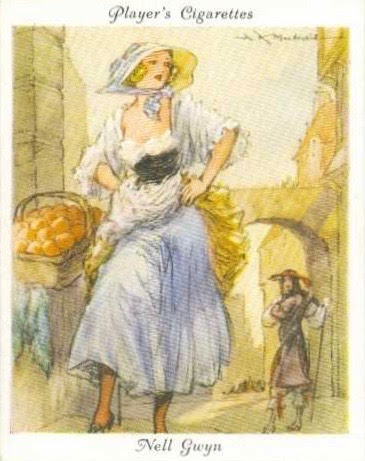
The physical theatre was not the only thing to change during the Restoration. Charles II had gotten used to watching actresses in France, and though a few male actors continued to perform female roles, he let it be known that he preferred the real thing. Actresses such as Margaret Hughes and Mary Saunderson became stars, much to the amusement of the King. The actress who amused him the most, however, was
Nell Gwyn. Gwyn got her start selling concessions at the theatre for Mary Megs, who was known as "Orange Moll" since oranges were one of the favorite snacks of Restoration audiences. She caught Killigrew's eye, and he gave her a chance to act on stage. Gwyn soon became one of the king's mistresses, baring two sons he acknowledged as his own.
In 1674, the King's Company moved to a new theatre on Drury Lane. Though that theatre was demolished in 1791 and its successor burned down in 1809, one theatre or another has occupied that spot since the seventeenth century, and today the Theatre Royal at Drury Lane still entertains theatre goers. The original Drury Lane theatre had an area in front of the stage known as the "pit" in which audience members who paid three shillings sat on benches to watch the show. Upper-class theatre goers could pay a couple shillings more to sit in lavish boxes, while those of lesser means could pay two shillings to sit in the elevated gallery. Above the gallery was an upper gallery available to poorer audience members for just a single shilling.
The audience for the Restoration stage was considerably smaller than that for the Globe and other outdoor theatres of Shakespeare's day. Also, the more expensive ticket prices meant the very poor were shut out entirely, and only the wealthy had the money and spare time to attend plays regularly. Consequentially, playwrights aimed at a more aristocratic audience, and aristocrats themselves began dabbling in writing plays for the stage. The styles, manners, and ethos of Charles and his court were reflected onstage at Drury Lane and at the rival playhouse in Lincoln's Inn Fields. The peculiar preferences of a select group had a profound impact not just on the theatre of the 1660s and 1670s, but on British plays for a long time to come.
Restoration Comedy
After the closure of the public theatres, acting companies needed short works that could be performed on small, clandestine stages without drawing the attention of authorities. They frequently turned to short sketches borrowed from popular plays of the past. These sketches, known as drolls, continued to be performed after the Restoration, and many were collected together in a book called
The Wits, or Sport upon Sport, edited by Francis Kirkman. These influenced the early full-length comedies of the Restoration period, which emphasized witty dialogue and stock characters already familiar to the audience. As the stock characters developed, however, they began to reflect the tastes and prejudices of the court.
The typical Restoration comedy has as its hero a rake, a lascivious young man who--like the king at the time--was more interested in getting into the good graces of pretty women than in tending to his own business affairs. The rakish hero might be interested in one particular woman, or like the king he might be pursuing multiple women at the same time. In spite of his actions, he had a good heart. The audience could overlook his flaws because he was emotionally sympathetic. He respected those who deserved respect and disdained those who deserved disdain.
Chief among those who deserved his disdain was the fop. A fop was fashionable to a fault, caring so much about clothes, fads, and reputations as to become ridiculous. In Thomas Shadwell's 1668 play
The Sullen Lovers, the protagonist is so beset with fops he longs to retire from the world and be free from those who foolishly pursue fashion and nothing else. Fortunately, he finds his soul-mate in a melancholy woman who hates such fools as much as he does. The archetypal fop is Sir Fopling Flutter, who appears in
The Man of Mode, a 1676 comedy by George Etherege. So entertaining is Sir Fopling that he overshadows the rakish protagonist in the play.
If the hero's emotional sensibilities were to protect him from becoming a modish fop, his refinement was supposed to protect him from being a bumpkin, a character from the country with little idea about how the court and high society functioned. William Wycherley provided examples of rude country innocence in his comedy
The Country Wife. One of the bawdiest plays to be performed during the Restoration,
The Country Wife involves a naive young woman who is easily seduced in spite of the efforts of her appropriately named husband Mr. Pinchwife. One of Pinchwife's strategies to protect the innocence of his new bride is to dress her up as a man so no one will seduce her. The disguise, however, fools nobody, including the audience, which delighted in seeing actresses cross-dress in tightly fitted breeches and stockings, displaying their shapely legs.
The appearance of women on the Restoration stage was accompanied by women writing for the stage as well. While a number of women became playwrights during the reign of Charles II, the most famous was Aphra Behn. By producing plays, poems, novellas, and other writings, Behn was able to support herself financially with her writing, and is likely the first Englishwoman in history to do so. Her most famous play,
The Rover, deals with English aristocrats living in exile in Italy during the period of puritan rule. The play was so popular she wrote a sequel to it (with the same name) several years later. Behn was on good terms with the actress and royal mistress Nell Gwyn and dedicated to Gwyn her 1679 comedy
The Feigned Courtesans. Her last play,
The Emperor of the Moon, was largely sung and showed Behn reaching out toward opera, which was a new form for her.
The Emperor of the Moon self-consciously uses theatricality, as do many of the plays of the period. Meta-theatricality probably reached its apex for the Restoration in 1671 with the staging of an anonymous play called
The Rehearsal, probably written by George Villiers (who was the Duke of Buckingham) along with a group of his well-connected friends. Like
Moliere's comedy
The Rehearsal at Versailles, the play makes fun of the theatre of its time, but without the good humor employed by Moliere. The play was a biting criticism of Restoration drama, and many people joined the piece in rushing to critical judgment against any play they deemed inferior. After his comedy
The Country Wife received multiple attacks, Wycherley employed a meta-theatrical device to defend his work. In
The Plain Dealer, a comedy that appeared three years after
The Country Wife, Wycherley has some particularly detestable characters attack the earlier play, showing his critics to be nothing but hypocritical snobs.
Though Charles II was not overly tolerant of his political enemies, he wanted the nation to be tolerant of own flaws and foibles as a leader, to view him as the rakish hero with a heart of gold. Excessive criticism, whether of a play or of a protagonist, could be seen as going against the lenient attitude advanced by the court. Truly bombastic plays and outrageous fops were fair game, but writers were not supposed to attack heroes who were genuine in their affections, even if they weren't always faithful in them. How then could a rakish hero be distinguished from both an insincere fop and an ignorant country bumpkin? The answer was that an audience had to see into their hearts, and conclude that like the king, the proper heroes had right sentiments and intentions. While the protagonists of Jacobean revenge tragedies employed devious stratagems to achieve their ends, the heroes of Restoration comedies simply had to employ the correct outlook on life, and fate would guarantee for them a happy ending.
Heroic Tragedy
While happy endings were not in store for the heroes of Restoration tragedies, sentiment likewise played a key element in these dramas as well. The tragedies of the period focused on protagonists with keen senses of honor, frequently having multiple duties which contradicted one another. John Dryden, though he is better known today for his comedy
Marriage a la Mode, helped to set the standard for Restoration tragedy. While comedies of the period were written mostly in prose, Dryden wrote his two-part tragedy
The Conquest of Granada not just in verse, but in a series of rhyming couplets. When couplets are written in iambic pentameter (as is the case with
The Conquest of Granada) they are known as heroic couplets. Thus, serious Restoration dramas became known as heroic tragedies.
Of course, rhyming couplets can sound rather ridiculous in English, which has more word endings than other languages, making rhymes sound less natural than they do in Italian, Spanish, or French. What worked for Moliere's comedies sounded absurd in some of Dryden's tragedies. For instance, Dryden wrote in the second part of
The Conquest of Granada:
So two kind turtles, when a storm is nigh,
Look up, and see it gath'ring in the sky;
Each calls his mate to shelter in the groves,
Leaving in murmurs, their unfinished loves;
Perched on some drooping branch, they sit alone,
And coo, and hearken to each other's moan.
The anonymous play
The Rehearsal picked up on the unintentional comedy of passages like this, and made Dryden a laughingstock. The Dryden-like playwright in
The Rehearsal recites:
So boar and sow, when any storm is nigh,
Snuff up, and smell it gath'ring in the sky;
Boar beckons sow to trot in chestnut groves,
And there consummate their unfinished loves.
Pensive, in mud, they wallow all alone,
And snore and gruntle to each other's moan.
After the success of
The Rehearsal, heroic couplets became difficult to recite without causing snickering, so later tragedies tended to use different verse forms.
Dryden's more mature tragedy
All For Love opted for unrhymed iambic pentameter, or blank verse, instead of couplets. The play reworks Shakespeare's
Anthony and Cleopatra, changing the play from a wide-ranging adventure taking place all across the Mediterranean world to a neoclassical model of restraint written in five stately acts, all taking place on a single day in the same temple. Unfortunately for Dryden, it pales in comparison to Shakespeare's original. The tragedies of Thomas Otway proved to have much greater staying power. Otway wrote his first play
Alcibiades in heroic couplets, but like Dryden he later switched to blank verse. Otway's
The Orphan contains some lovely passages, but its central scene, with a man sneaking into bed with his brother's wife on the couple's wedding night, has proved too revolting for many audiences. Perhaps most surprisingly,
The Orphan still seeks to hew close to the heroic ideals of Restoration tragedy by having the villainous brother express remorse and die with tragic dignity.
The one tragedy from the Restoration period to most successfully work its way into the standard repertoire was Otway's
Venice Preserved. First staged in 1682, it featured Elizabeth Barry, the leading tragic actress of her day, as Belvidera, a Venetian noblewoman whose father has disinherited her. Belvidera's husband Jaffeir, fed up with the corrupt aristocratic Senate that rules Venice, decides to take part in the overthrow of the government. When he tells his wife, however, Belvidera talks him out of treason and convinces him to betray his conspirators to the Senate. Jaffeir is placed in an impossible position, having saved his honor by preserving Venice, but stained it by turning on his friends. The play ends in madness and death, providing great opportunities for its leading actors to show off their talents.
Venice Preserved displays tragic figures who--like Charles II--appear to be well-intentioned even if their actions are sometimes questionable. Just as importantly, it argues forcefully against the overthrow of a government, no matter how debauched and decadent its leaders might be. After the bloody English Civil War, this message must have resonated with a number of people.
Drama After the Restoration Period
Charles II died in 1685, and his brother James succeeded him as King James II. However, James was a Roman Catholic, and the protestant ruling class had no intention of seeing Britain go back to its previous religion. The king proclaimed he wanted to extend freedom of religion to all, not just to Catholics and members of the state-sanctioned Anglican Church, but to protestants who did not conform to the official church. This included the puritans who had overthrown his father, Charles I. Rather than calming fears, the king's tolerant views on religion made many people uneasy.
After two unsuccessful rebellions against his rule, James II enlarged the country's army, stoking concerns that he might resort to the strong-handed rule of Charles I. The king's relationship with parliament was strained at best, but those who opposed him could take comfort in the fact that his heir was a protestant daughter, Mary, who was married to an even more staunchly protestant Dutch prince known as William of Orange. In 1688, however, when the king and his catholic wife had a son, protestants panicked. A group of nobles invited William of Orange to invade and claim the throne for himself. When William's forces landed, much of the king's army defected to the invaders' side. The king tried to flee. Dutch forces captured him but then released him so he could travel to France.
Parliament declared that by leaving the country and abandoning his responsibilities, James II had abdicated the throne. They declared William and Mary co-rulers and the political sea-change that happened without bloodshed came to be known as the Glorious Revolution. A wave of optimism swept over the country, and this was reflected in the theatre as well. Drama flourished, but in spite of the comparatively low-key couple that had taken over the throne, it was the rake-hero given birth under the reign of the flamboyant Charles II that still held the stage.
At the end of the seventeenth century, the playwright William Congreve took the elements of Restoration comedy and wove them together into plays that surpassed most of the work by playwrights who were active during the reign of Charles II. His 1695 play
Love for Love presents a lovable rake-hero who has fallen into debt, in part due to his having an illegitimate child. The heiress Angelica sees he has a heart of gold, however, and marries him anyway. An even bigger hit with modern audiences is Congreve's masterpiece
The Way of the World. The play's brilliant wit and charming characters delight theatre-goers to this day.
Yet
The Way of the World was a flop when it was first produced in 1700. Two years earlier, the clergyman Jeremy Collier had published a pamphlet called
A Short View of the Immorality and Profaneness of the English Stage. Though certainly no puritan (he in fact still supported the exiled James II), Collier railed against what he saw as the excesses of the British theatre. He attacked the leading playwrights of the day, including John Vanbrugh, whose play
The Relapse acted as a sequel to a previous play that had a happy ending.
The Relapse shows a rake who had once given up his sinful ways then return to them once more. This was too much for Collier. Unlike the puritans, Collier did not attack the theatre itself, which he acknowledged was a useful tool for transmitting values. However, he found the present stage so deprived it was "but one Remove from worshipping the Devil."
At first playwrights fought back, with Vanbrugh and other dramatists publishing responses. Gradually, though, Collier's inappropriately titled 288-page
Short View won over the public. After the failure of
The Way of the World, plays tended to reign in their heroes. In the early eighteenth century George Farquhar gave the protagonists of plays like
The Recruiting Officer and
The Beaux' Stratagem rakish qualities but pulled back from making them truly sinful. Susanna Centlivre produced similarly cleaned-up comedies with
The Busie Body,
The Wonder: A Woman Keeps a Secret, and her 1718 masterpiece
A Bold Stroke for a Wife.
At the same time, tragic writers were coming up with new ways to portray heroics that met the standards of the new morality sweeping the country. The dramatist Nicholas Rowe focused on the good deeds of unfortunate women, creating a genre that he dubbed "she-tragedy" as if women hadn't been the protagonists of tragedies before his innovations. Rowe reworked an older play called
The Fatal Dowry into a modern tragedy he titled
The Fair Penitent. The play's villain, Lothario, has all of the characteristics of a rake, but remains unambiguously despicable. Rowe's best play,
Jane Shore, imitates Shakespeare, but takes a minor character in
Richard III who doesn't even have lines and literally gives her a voice. The next year, Rowe wrote
Lady Jane Grey, another she-tragedy that did not do well with audiences but solidified the author's reputation for respectability and refinement.
In 1715, the same year he staged
Lady Jane Grey, Rowe became Poet Laureate to the new King George I. No longer was it acceptable to have rake-heroes whose heart was in the right place. The public expected new standards of morality, and older dramas were either rewritten to comply with the times or dropped from the repertoire. Still, the emphasis on feeling and sentiment continued. Protagonists were expected to inherently intuit good from bad. What was different was that now they had to be purely good, or suffer consequences for any sins they might commit.