Showing posts with label Dickens. Show all posts

Sunday, June 7, 2026

David Copperfield

Yesterday was the final monthly meeting this season of The Friends of Dickens New Yorkat which we discussed the final chapters of A Tale of Two Cities.

As I've previously blogged, A Tale of Two Cities was adapted for the stage almost immediately after it was published. After our meeting, though, many of us headed to an adaptation of a different Dickens novel, David Copperfield.

The play, adapted by Abigail Pickard Price, Sarah Gobran, and Matt Pinches, was originally produced by Guildford Shakespeare Company and is playing now at 59E59 Theaters (memorably located at 59 East 59th Street in Manhattan).

Performances last for two hours and 15 minutes, including the intermission, which means much has to be cut from the massive novel. (Barkis might have been willin' but still didn't make it into the show.) Eddy Payne plays David, while Luke Barton and Louise Beresford perform everybody else.

The costumes, designed by Neil Irish and Anett Black, help to distinguish the characters, but mostly the performers relate character through voice and body language (and occasionally through puppets). Price, who directed the play as well as being one of the adaptors, skillfully helms the production, making sure the audience keeps up with the action.

If you want to go, the play is still running until June 28th. If you're interested in The Friends of Dickens New York, we'll be taking a break for the summer, but will be meeting again in September, beginning discussions of a new novel, Hard Times.

Tuesday, April 28, 2026

Revolutionary Drama

Tonight, I'm having a private reading of my play Combustion with American Renaissance Theater Company.

The play tells the story of Marie-Anne and Antoine Lavoisier, who revolutionized chemistry around the same time a political revolution was happening in France.

Megan Greener will be reading the part of Marie-Anne, who figured out the mechanics of how to perform experiments that changed the way we think about matter. Frank Hankey will be playing her husband, Antoine, who was more focused on theory than the actual experiments.

A third character in the play, being read by Eric Percival, is the ghost of Jean-Paul Marat, a key figure in the French Revolution who sparred with the Lavoisiers and ended up getting assassinated in his own bathtub. (This later became the subject of a famous painting by Jacques-Louis David.)

The French Revolution has always inspired great drama. In fact, re-enactments of the storming of the Bastille were staged soon after that event took place. Throughout the revolution, playwrights like Olympe de Gouges wrote about current events for the stage. The Bastille and the Terror later had important roles in the play The Black Doctor which became a star vehicle for Ira Aldridge.

Perhaps the most memorable depiction of the French Revolution is in A Tale of Two Cities, Charles Dickens's novel which was first adapted for the stage in 1860 by Tom Taylor. The events of the revolution keep resurfacing though, such as in the 21st-century playwright David Adjmi's Marie Antoinette, which I recently saw at Marymount Manhattan College.

My own play adds to this tradition, but also brings focus to the unique partnership of two scientists who tried to change the world, but got caught up in the world changing without them. I hope to be able to share this piece with the public soon in a full production.

Saturday, February 7, 2026

The Plays of Charles Dickens

Today is the 214th birthday of Charles Dickens, which is as good a time as any to mention that my review of The Plays of Charles Dickens ran in the most recent issue of Dickens Quarterly.

Joanna Hofer-Robinson and Pete Orford edited this wonderful collection that includes both plays Dickens authored solo and collaborations he did with friends like Wilkie Collins, as well as prologues he wrote for plays including The Lighthouse and The Patrician's Daughter, and a closing scene he wrote for Elizabeth Inchbald's farce Animal Magnetism.

Dickens himself didn't always have a high opinion of his plays, and he came to regret writing the libretto to the operetta The Village Coquettes, which had music by John Pyke Hullah. His comic burletta The Strange Gentleman has some fun moments, but it is essentially the same as his prose sketch "The Great Winglebury Duel." Is She His Wife? is perhaps Dickens's most unlucky play, since it was after seeing it that his sister-in-law Mary Hogarth collapsed and later died. (Probably not from the play, though.)

Having all of Dickens's plays together with the in-depth notes provided by the editors is quite useful. In the early part of his career, Dickens went back and forth between the stage and the page. His play The Lamplighter, for instance, was originally penned for William Charles Macready, but after the actor rejected it, Dickens turned it into a short story for Sketches by Boz. Dickens also wrote with his friend Mark Lemon a farce called Mr. Nightingale's Diary, which included characters suspiciously similar to ones in Pickwick Papers and Martin Chuzzlewit.

Perhaps Dickens's most famous play today is The Frozen Deep, a melodrama officially authored by Collins, but very much a collaboration between the two authors. Dickens supplied the subject for the play, Collins wrote the first draft, and then Dickens substantially reworked it, tailoring the part of Richard Wardour for himself. He indeed played the role in an amateur performance, and then for a charity production, where he met his future love, Ellen Ternan. (You can read about the two of them in my own play, Capital.)

More successful in his own lifetime was another melodrama he wrote with Collins, No Thoroughfare, which was based on a tale the two had written together and published in the journal All the Year Round. The editors of The Plays of Charles Dickens note that Dickens even wrote an alternate ending to the play for a French production, though sadly it is not included in the book.

Saturday, October 25, 2025

Monsters, Monsters, Monsters!

It been a spooky season, and I've been watching a lot of spooky films. Last night, I saw The Phantom Carriage, directed by Victor Sjöström, who also plays the protagonist in the 1921 silent.

The film uses double exposure to create haunting images, and seems strongly influenced by A Christmas Carol. By the 20th century, I imagine that not only Charles Dickens's novella but several stage versions of it had become widely known in Sweden, where the film was made. The movie's plot revolves around not Christmas but New Year's, which makes the film also reminiscent of another supernatural piece by Dickens, The Chimes.

Recently, I was curious to learn of a dark Tennessee Williams film adaptation, The Fugitive Kind. It's based on Orpheus Descending, which reworked a previous Williams play, Battle of Angels. I had to look the film up after I found out it was directed by Sidney Lumet with a host of great actors, including Marlon Brando, Anna Magnani, Joanne Woodward, and Maureen Stapleton. Brando was paid a million dollars to be in the film, which was unheard of in 1960 when the movie was released.

In spite of Brando's star appeal, the film lost money. It did better than Battle of Angels, though, which closed during tryouts in Boston. The reworked version, Orpheus Descending, did much better, running for 68 performances at the Martin Beck on Broadway. Stapleton played the female leading role of Lady on stage, but was replaced with Magnani in the film, taking on instead the substantial but smaller role of Vee. The story, in all of its iterations, is a Southern Gothic tale of lust, revenge, and murder.

This evening, I watched another spooky movie, Guillermo del Toro's new adaptation of Frankenstein by Mary Shelley. Like A Christmas Carol, that novel has been adapted for the stage over and over again. In fact, next weekend I'll be seeing a new stage version at Shakespeare Theatre of New Jersey. Monsters, figurative or literal, tend to do well on stage, especially this time of year.

Tuesday, August 19, 2025

Tom Taylor's Two Cities

The British dramatist Tom Taylor is most famous for writing Our American Cousin, the comedy Abraham Lincoln was watching when he was assassinated.

However, Taylor also wrote the first adaptation of the Charles Dickens novel A Tale of Two Cities to be staged in London after the book was finished. (Adaptations of some other Dickens novels, such as Nicholas Nickleby, were sometimes staged even before the book was completed, when it was still coming out in installments.)

Taylor's adaptation begins with a prologue in 1762, in which the audience sees events that are only narrated in a document that appears much later in the book. Doctor Manette (originally played by James Vining) is summoned to an old house outside of Paris where he meets the Marquis of St. Evremond (Walter Lacy) and his disgraceful younger brother.

Both Manette and the Marquis show up again later in the play, somewhat older, but portrayed by the same actors in the original production. What I find interesting is that the actor playing the Marquis's brother then doubled as that character's son, Charles Darnay. An innocent victim of the aristocrats, Colette Dubois, was played by the famous actress Madame Celeste, who reappeared later as Colette's sister, the vengeful Madame Defarge.

Celeste was the manager of the Lyceum Theatre, where Taylor's play was first performed on January 30, 1860. According to publicity for the show, Dickens himself "in the kindest manner superintended the production." How much of a role Dickens actually played, I'm not sure, but Taylor definitely takes considerable liberties with the source material.

The first act shows Manette "recalled to life" in 1783, not 1775, as in the novel. The second act shows the height of the French Revolution in 1793, where Sydney Carton delivers his famous line about "a far, far better thing" while still imprisoned, not from the scaffold.

Still, the adaptation hits many of the high points in the book, even though it irons out a lot of its complexities and ambiguities.

Wednesday, July 23, 2025

Back from Boston

I enjoyed the Dickens Symposium at Boston University last week, where I delivered a paper on theatrical audiences in the works of Charles Dickens.

Boston was a great location to have the symposium, as it was the American city Dickens was fond of most. It's also the birthplace of Edgar Allan Poe, author of the play Politan, as well as some more famous works. The city now has a statue of Poe across the street from Boston Common.

Most of the papers at the conference had nothing to do with drama, though a couple of them did relate Dickens to Poe. Elizabeth Bridgham related the Master Humphrey character who frames The Old Curiosity Shop to Poe's story "A Man of the Crowd" while Katie Bell related another tale published in Master Humphrey's Clock to the famous story "The Tell-Tale Heart."

It was also nice to meet Meoghan Cronin, who was able to tell me about theatre KAPOW in New Hampshire, and to meet up with some old acquaintances, including Jennifer Heine, Claire Woods, Jude Nixon, and Lillian Nayder. I also got to see some of my old stomping grounds in Boston, from when I lived there a quarter century ago. The city has changed, but not as much as New York has over that time.

After getting back from Boston, I was able to squeeze in some theatre, Melissa Maney's Hungry Women at SoHo Playhouse, and Death Becomes Her on Broadway. Tomorrow, I'm off to another symposium, this one sponsored by the International Shaw Society.

Saturday, July 12, 2025

The Village Coquettes

Charles Dickens did not have fond memories of The Village Coquettes, an operetta he wrote with composer John Pyke Hullah.

When he was later asked if he owned a copy of it, he reportedly replied, "if I knew it was in my house and could not get rid of it in any other way, I would burn the wing of the house where it was."

Dickens's previous play, The Strange Gentleman, had been a success at the St. James Theatre, then under the direction of the famous tenor John Braham. That had been based on one of his stories in Sketches by Boz, though. The Village Coquettes was doing something decidedly different from his previous work.

The play takes place in an English village in the autumn of 1729. Setting the play more than a hundred years in the past allowed Dickens to present customs and mores considerably different from those of his own days. The plot involves two charming village girls who slight their accepted beaux in favor of a local squire and his foppish friend, Flam.

The character of Lucy was played by the soprano Elizabeth Rainforth, a relatively unknown actress who gained considerable attention for her performance. Lucy is betrothed to the humble farmer George, but gains the attentions of the squire. He urges her to forget George, but she still loves him, and sings some touching lyrics:

        Love is not a feeling to pass away,
        Like the balmy breath of a summer day;
        It is not--it cannot be--laid aside;
        It is not a thing to forget or hide.
        It clings to the heart, ah, woe is me!
        As the ivy clings to the old oak tree.

Lucy's cousin Rose is attached to another young man of humble origins, John, but is flattered by Flam, who is the villain of the piece. Rose admits she enjoys "a little flirtation as much as anyone" and defends her youthful enthusiasm for men in the song "Some Folks Who Have Grown Old."

Eventually, both young women come to realize that they're better off with simple men from the country rather than the rich squire and his unscrupulous city friend. Lucy later tells the squire "call me coquette, faithless, treacherous, deceitful, what you will" but she now sees that George is the "noblest heart, that ever woman won."

For his part, the squire realizes that his life has been dissipated by visits to crowded cities and sings "A Country Life" which has a pleasant and sentimental melody. This elevation of country life over urban values seems strange for Dickens, who wrote so memorably about cities.

After the plot resolves itself and Flam is sent on his way, the play ends with a dance and musical finale. Though the operetta is quite different from the novels that made Dickens famous, it speaks to the engagement the author had with the theatre.

Incidentally, I will be attending a symposium by the Dickens Society next week in Boston, and delivering a paper on the writer's portrayal of audiences. More on that to come!

Friday, February 7, 2025

Coming Soon!

I have lots of events coming up over the next several months related--in various ways--to the theatre, both past and present.

Today, February 7th, is the birthday of Charles Dickens, and the Friends of Dickens New York will be having a special luncheon tomorrow, including a reading from Dickens's novella The Chimes. That story has been frequently adapted for the stage, including at the Adelphi Theatre the very year it was first published.

Later this month, I'll be directing a reading of scenes from Mark Levine's play Evicting the Rabbit Goddess for American Renaissance Theatre Company. This will just be a private reading, and not even of the whole play, but Mark has expressed a desire for getting the full play read in the future. We have a great cast, with Nick Walther and Pëtra Denison both performing.

Then, next month, I'll have my own work performed in Clifton Park, New York by Bunbury Players. Today, I met with the director, Ro Dell'Acqua. Ro will be staging as a 10-minute play the beginning of After an Earlier Incident. I've been developing the piece as a full-length play, but the first scene can also be performed on its own. It will be presented as part of Bunbury Players' Festival of One-Acts at Clifton Park-Halfmoon Public Library, March 28-30.

Later this year, I plan on going to Boston for the 2025 Dickens Symposium, where I am slated to deliver a paper called "'Dirt and Discomfort': Theatrical Audiences in Dickens." Much attention has been given to Dickens’s representations of actors in novels, but this talk will examine the author’s portrayal of audiences.

That's quite a bit happening soon, so perhaps I will get to see you, dear reader, at one of these upcoming events!

Wednesday, January 8, 2025

The Battle of Life

I was browsing some playbills in the online collection of the British Library, when I came across an interesting poster advertising a stage adaptation of the Charles Dickens novella The Battle of Life and the melodrama The Black Doctor, a play later made famous by Ira Aldridge.


It's been the season for Dickens, who followed up A Christmas Carol in 1843 with a new Christmas book, The Chimes, the following year. After The Chimes was likewise a bestseller, Dickens wrote The Cricket on the Hearth to be sold at Christmastime in 1845 and The Battle of Life in 1846.

A Christmas Carol is divided not into chapters but five staves, like the staves of a poem or song. The Chimes is broken up into four quarters, like the quarters of an hour, and The Cricket on the Hearth has three chirps. Perhaps Dickens had grown weary of this humorous conceit, as The Battle of Life is simply divided into three parts.

Those three parts do correspond well to the three acts of a play, which might have made the piece ripe for adaptation to the stage. The playbill from the Theatre Royal in Bath announces the closing of both shows on January 7, 1847, which means the adaptation must have been written soon after Dickens had published the book the previous month.

Dickens purposely set The Battle of Life about a hundred years in the past. As with Robert Browning's play A Blot in the 'Scutcheon, which Dickens had championed, the 18th-century setting was necessary to portray certain values that had already become obsolete by the Victorian era. Rather than being set in the city, like many of Dickens's novels, the story takes place in the countryside, in a town near a famous battle site.

After setting up the action, the story moves forward three years. It is this second part that takes place around Christmastime, and in fact the main event of the narrative occurs during a Christmas ball, when the beautiful Marion mysteriously disappears. She does not return until the third part, which occurs another six years later. Though The Battle of Life is by no means Dickens's most famous work, I can see why it would be tempting to adapt it for the stage, since the three parts correspond so well to the three-act structure preferred in many plays of the period.

The Black Doctor, however, was originally divided into seven acts when it was written in French by Auguste Anicét-Bourgeois and Philippe François Pinel Dumanoir under the title Le Docteur Noir. It was later turned into a four-act play translated by John Vilon Bridgeman and further adapted by Thomas Hailes Lacy. It is this version that seems to have been advertised on the playbill, rather than the adaptation by Thomas Archer that Aldridge later appeared in and made famous.

I would have liked to have seen that evening of plays produced in Bath! Having just read The Battle of Life and having a long-standing interest in The Black Doctor, I would be intrigued to see how the company handled both works.

Sunday, December 1, 2024

The Holidays Begin

I'm pleased to announce that my short play Burns Night has passed into the semifinalist round of the Holiday Playwright Contest held by Kinsman Quarterly.

The play premiered in 2019 at the Secret Theatre in Queens, which is now one of many companies doing productions of A Christmas Carol throughout the five boroughs of New York and beyond.

While I don't know that I'll be able to get out to see that production before it closes on December 22nd, I plan on going to see another production closer to home. On December 3rd and 4th, Sean Coffey will be performing his one-person adaptation of Charles Dickens's story at the historic Van Cortlandt House Museum in the Bronx.

John Kevin Jones will be performing his own one-person version of the tale in Manhattan at the Merchant’s House Museum in Manhattan through December 29th. If you're in the mood for a larger production, head over to Staten Island, where Sundog Theatre is producing a large-cast musical version of the tale on December 7th, adapted by Cash Tilton, with original songs by Susan Mondzak.

Most exciting to me, though, is a puppet version of A Christmas Carol performed by Drama of Works on December 19th at Rubulad in Brooklyn. Drama of Works founder Gretchen Van Lente is sponsoring a “XMAS CAROL” puppet slam, breaking up Dickens’s story into six parts, each performed by a different puppetry troupe. Gretchen designed the puppets for my own adaptation of the story in 2007, so I'm expecting great things.

Across the river, the Shakespeare Theatre of New Jersey is producing a stage version of A Christmas Carol in Madison, adapted by Neil Bartlett, which plays until December 29th. Yes, that's a lot of Carols! It so happens, I am regarded as enough of an expert on these things that I will be co-hosting the last episode of the Rosenbach Library's "Monsters and Ghosts" online program on December 16th, discussing the legacy of a Dickensian Christmas.

So however you celebrate this month, I wish you a very merry holiday season!

Friday, November 1, 2024

Coming Soon!

Tomorrow night, November 2nd, Bara Swain's The Boob Tube Plays opens at The Tank, featuring a short play that I'm directing, Beyond a Reasonable Doubt.

The Boob Tube Plays consists of five short works, all by Swain, all inspired in one way or another by television. Beyond a Reasonable Doubt features Megan Greener as a woman who's watched way too much Law & Order: SVU, and Nick Walther as her terrified husband-to-be.

If you miss the show on Saturday, you'll have two more chances to see it: on Thursday, November 7th and on Friday, November 8th. All shows are at 7:00pm and tickets are $22. The evening is produced by American Renaissance Theater Company (ARTC) and includes work by directors Kim T. Sharp and Vincent Scott, in addition to one play directed by Swain herself.

Next month, we will be entering the season of A Christmas Carol, and I'll be appearing on a virtual program hosted by the Rosenbach Library, speaking about the legacy of Charles Dickens's beloved novella. There have been countless stage adaptations of the classic, including my own, which was produced by the Epiphany Theater Company in New York and Passage Theatre Company in New Jersey.

And if you happen to be in Brazil in December, the short film The Rainbow, for which I wrote the screenplay, has been chosen as an official selection for FINTCH - Festival Internacional de Cinema de Humor in Rio de Janeiro. More information on that coming soon!

Wednesday, July 31, 2024

The Lighthouse

The novelist and playwright Wilkie Collins began writing a melodrama called The Storm at the Lighthouse in September of 1854, finishing it in May of the following year.

His friend and mentor Charles Dickens staged the play at his own home, Tavistock House, on June 18, 1855, printing up playbills for a private performance that probably had no more than 25 people in the audience.

Collins himself acted in the play, as did Mark Lemon and Augustus Egg. Dickens played the role of the head light-keeper, Aaron, acting under the stage name of Mr. Crummles, a character of his own creation from Nicholas Nickleby. Dickens also roped his daughter and his sister-in-law into acting.
 
The title of the play was shortened to just The Lighthouse. Collins later cut the play down, and the edited version was translated into French and published in 1856. The original version wasn’t widely available until 2013, when it was published in Dickens Studies Annual. The play, based loosely on a short story by Collins called “Gabriel’s Marriage,” was notable in part due to its scenery, which was painted by Clarkson Stanfield.

Taking place on a remote island in 1748, the play opens with two keepers of a lighthouse, Martin and Jacob, discussing the fact that storms have kept a provision boat from delivering food. They are thus in the process of dying from starvation. Martin, we learn, is engaged to Jacob’s daughter, Phoebe, though both are now despairing of the marriage ever taking place. Even more distraught is Martin’s father, Aaron, who laments his own uneasy conscience.

Years ago, a wealthy woman took shelter in Aaron’s home, but his servant Benjamin stabbed the woman. Rather than turning Benjamin in to the law, Aaron helped hide her body in a cave. The woman, he later learned, was so kind to everyone that she was known simply as The Lady Grace. Though her death is deemed an accident, Aaron can’t forgive himself for the role he played in her murder. Thinking his own death is near, he unburdens his conscience by telling the story of her demise to his son.

Miraculously, a boat then arrives, carrying not only provisions, but Martin’s beloved Phoebe. She feeds broth to the men to bring back their strength, but just as they are recuperating, a ship appears coming in from the sea, and clearly in distress. As the ship is wrecked, Phoebe reads out the name painted on its stern. To Aaron’s horror, the name of the ship is “The Lady Grace.” The curtain then falls, ending Act I.

In the second act, we learn that a female passenger was one of the people saved from The Lady Grace. Phoebe, sensing that something is wrong with Martin, decides that this mysterious woman might be able to uncover the secret that her beloved refuses to share with her. Aaron, however, now that he no longer fears death by starvation, denies the story he told Martin previously. Just then, the mysterious passenger appears… The Lady Grace!

It turns out that Lady Grace had not been murdered after all, but survived Benjamin’s attack and was rescued by sailors from the cave where the two men had stashed her limp body. She forgives Aaron, and Martin—relieved of the burden of his father’s secret guilt—goes off to marry Phoebe.

The play gave a chance for Dickens’s trusted sister-in-law, Georgina Hogarth, to appear as the all-forgiving Lady Grace. His daughter Mamie played Phoebe, while Collins (who was considerably younger than Dickens) played Martin.

It seems fitting that Dickens, who was haunted by his own past working in a blacking factory, should have played Aaron. His acting was reportedly top notch.

Monday, June 24, 2024

Stirling's Nickleby

The novels of Charles Dickens have been adapted for the stage over and over again, but one of the earliest adaptations was a two-act version of Nicholas Nickleby first staged at the Adelphi Theatre on November 19, 1838.
 
Edward Stirling adapted the script, which was later published by B. Webster as part of the series Webster’s Acting National Drama, offered to the public under the auspices of the Dramatic Authors’ Society. Though the script was printed cheaply and sold for only 6 pence, it contained a wood engraving by Pierce Egan the Younger done from a drawing of the Adelphi’s production.
 
O. Smith, who was famous for starring in melodramas, played Newman Noggs, a fine character part, but hardly the show’s lead. Noggs appears in the opening scene, wanting to expose his employer, Ralph Nickleby, but unable to find the courage to do so. Instead, he merely gives a letter to Nicholas, who is being introduced to Mr. Squeers, the proprietor of the aptly named school Dotheboys Hall.
 
The rest of the first act then proceeds in parallel scenes showing Kate Nickleby at Mantilini’s (spelled Mantalini in the novel) millinery and her brother Nicholas at Dotheboys Hall. This resembles the first half of the novel, which moves back and forth between Kate in London and Nicholas in Yorkshire. In spite of the novel’s title, Kate is given just as much prominence as her brother for much of the narrative, and the scenes with Kate crackle with comedy in the script.
 
It is the play’s second act that diverges from the book—and with good reason—as Dickens had not yet finished the novel when the play was first performed. Instead of dying, Smike inherits a fortune in the play, and all ends happily.

Back in 2020, I saw a Zoom reading of the play, but it was nice to get hold of the script and read it for myself.

Sunday, January 7, 2024

MLA in Philadelphia

Sunday was the last day of the Modern Language Association's annual convention, held this year in Philadelphia. I delivered a paper on Lord Byron and modern drama, and also presided at a session on Charles Dickens and D.H. Lawrence.

The first session I attended was on Byron's legacy. Sadly, none of the panelists talked much about Byron's dramas, but Ghislaine Gaye McDayter gave an interesting talk on his poem "The Waltz" and Matt Sandler discussed the influence of "She Walks in Beauty" on the poem "Harlem Shadows" by Claude McKay.

Later in the afternoon, I went to a session on Eugene O'Neill, so there was much more discussion of drama. Bess Rowen spoke, comparing the stage directions in O'Neill's The Emperor Jones with those in Marita Bonner's The Purple Flower. Next, Nicole Tabor made some interesting comments on the representation of Standard Oil in A Moon for the Misbegotten. Reagan Venturi gave a comparison between O'Neill's Long Day's Journey Into Night and the Tracy Letts play August: Osage County. The last speaker, Donald Gagnon, compared O'Neill with August Wilson.

Friday morning, I delivered my paper, beginning with an overview of Byron's reception during the Victorian era, and then looking at his impact on 20th- and 21st-century dramatists. O'Neill, of course, was one of the playwrights to be strongly impacted by Byron, and his play A Touch of the Poet quotes Byron numerous times. Romulus Linney put Byron on stage as the opium-induced hallucination of his daughter in Childe Byron, and Howard Brenton portrayed him with other Romantics in Bloody Poetry. Byron appears as an off-stage character in Tom Stoppard's play Arcadia, and more recently, he provided the namesake of Johnny "Rooster" Byron in Jez Butterworth's Jerusalem.

After my session, I was able to catch a panel on "Disabling Environments of the Romantic Era." Unfortunately, there wasn't much talk about Romantic drama, but Diana Little made some nice observations on the sonnets of Charlotte Smith, and Jane Kim linked the Korean poet Yun Dong-Ju with Mary Shelley's novel Frankenstein. Next, I went to a session on Victorian gaslighting inspired by Patrick Hamilton's play Gaslight. After that, I attended an interesting panel on Pan-European Romanticism, which included Jonathan Gross talking about Alexander Pushkin, Martin Prochazka discussing the Czech poet K.H. Macha, Andra Bailard comparing Byron and George Sand, and and Omar Miranda speaking on Madame de Staël.

While Dickens and Lawrence both wrote plays, there wasn't much talk about their dramas at the convention. Still, I very much enjoyed a panel on Lawrence and Affect sponsored by the D.H. Lawrence Society of North America. That organization co-sponsored with the Dickens Society the panel I presided at on Saturday morning. Bridget Chalk and Tara Moore both gave excellent papers. Unfortunately, Holly Laird was ill and wasn't able to come, but I read her abstract for her, along with Lawrence's poem "Dreams Old" which mentions characters from David Copperfield.

It's been a while since I last attended the MLA convention, but I enjoyed seeing people I knew as well as meeting new folks.

Monday, December 4, 2023

Advent of the Carol

Yesterday was the first Sunday of Advent, which means the season of A Christmas Carol is upon us yet again.

For the past couple of years, Passage Theatre Company in Trenton has performed my adaptation of the classic Charles Dickens story. This year, they are instead having a holiday singalong, but if you want to get your Carol on, you can see a costumed reading this Wednesday at the Penn Club.

The Friends of Dickens New York is sponsoring the reading, which features Warren Wyss as Scrooge. Warren previously acted with Phylicia Rashad in The Public Theater's production of A Midsummer Night's Dream. Other readers include Lynn Manuell, Kitty Loving, and myself. Yes, I adapted the script, and will also be performing.

Celebrations commence at a 6:00 reception. Around 6:15, we'll begin caroling, and the reading itself will be at 6:30. The event is for Penn Club members and their guests, but Su Quinn, who is a member of the club as well as a Friend of Dickens, says anyone interested can contact her at: suyapaquinn@me.com

Tickets for non-members are $25 and include complimentary drinks. If you're interested, please come!


Tuesday, October 31, 2023

Adelphi Screamers

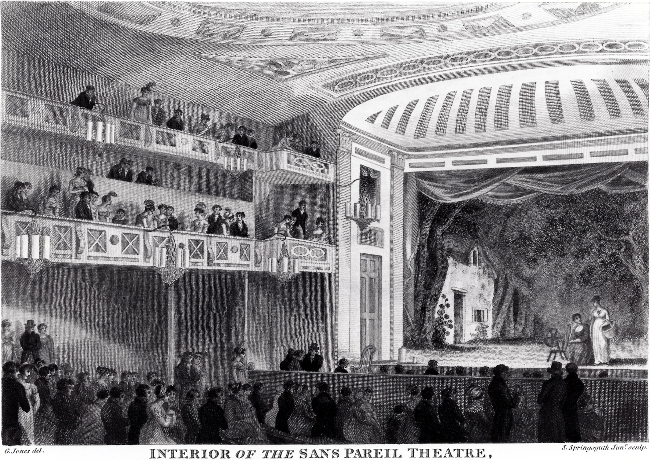
On this All Hallow's Eve, I wanted to write about a theatre that has been home to some of the spookiest dramas of all time, London's Adelphi Theatre, formerly known as the Sans Pareil.

Founded in 1806, the Sans Pareil was located on the Strand, which runs from Trafalgar Square down toward Temple Bar. Near Adam Street, prospective playgoers would see a theatre front that looked like this:


Technically the theatre was founded by John Scott, but it was really run by his daughter Jane, actress, producer, director, and author of such melodramas as Asgard the Demon HunterThe Old Oak Chest, and Camilla the Amazon. The stage looked something like this:


Scott retired from the theatre after getting married in 1819, and that's when the Sans Pareil changed its name to the Adelphi under new management. The theatre frequently performed adaptations of the works of Charles Dickens. These included an adaptation John Baldwin Buckstone did of Dickens's early sketch "The Bloomsbury Christening." Buckstone would later adapt Dickens's goblin story The Chimes for the theatre.

It was stories of goblins, ghosts, and sensational crimes that got the theatre's plays nicknamed "Adelphi Screamers." This was true even after the building was demolished and rebuilt in 1858. The rebuilt theatre became a home to hits by Dion Boucicault, including The Colleen Bawn and later The Octoroon. In 1862, Boucicault adapted Dickens's The Cricket on the Hearth under the title Dot, winning another huge success for the Adelphi.

Today, the theatre is home to big-budget musicals, most recently Back to the Future. It seems the Adelphi's role as a temple of popular culture continues even today.

Saturday, October 28, 2023

Romantic Futures

Today I went to the Stuart Curran Symposium on "Romantic Futures" and got to meet up with various people and hear about the novel behind an important play of the early nineteenth century.

I've previously written about W.H. Murray's melodrama Obi; or, Three-Fingered Jack, which is based on the story of the Jamaican folk-hero Jack Mansong. The piece was later published in the Dicks' Standard Plays series, and I've also seen illustrations of the play for the toy theatre.

Kristina Huang gave a paper at the symposium about the play's source text: Obi; or the History of Three-Fingered Jack. The 1800 novel by William Earle is written as a series of letters from a resident in Jamaica to a friend living in England. The novel was adapted as a pantomime by John Fawcett prior to Murray's adaptation, and Murray's printed text attributes its plot and principle incidents to the pantomime.

Later at the symposium, we heard from the editors of The Routledge Handbook to Global Literature and Culture in the Romantic Era. Those editors include Arif Camoglu, whom I had only met virtually, when we were both on a Zoom panel on Lord Byron last year.  The other editors are Bakary Diaby, Omar F. Miranda, Gaura Narayan, and Kate Singer

Next up on my academic calendar is the Modern Language Association's convention in Philadelphia this January. I'll be delivering a paper on Byron and modern drama, as well as chairing a panel on Charles Dickens and D.H. Lawrence.

Saturday, September 23, 2023

The Strange Gentleman

I just finished taping an episode of Pickwick Monthly for the Rosenbach Museum and Library, where Ed Pettit and I discussed (among other things) The Strange Gentleman, the first play author Charles Dickens had professionally produced.

The two-act play--technically a "comic burletta"--debuted on September 29th, 1836 at the St. James Theatre run by John Braham. I was disappointed in the play when I first read it, but when I re-read it last night in preparation for the show, it wasn't quite as bad as I remembered.

Dickens himself came to dislike the piece, claiming he wouldn't want it performed again for a thousand pounds. (Originally, he received only 30 pounds for the copyright.) Still, the first production was successful, and the play was later performed in both New York and Philadelphia.

The story comes from Dickens's own sketch "The Great Winglebury Duel" which was included in Sketches by Boz. The play was published as being authored by "Boz" as well, as Dickens was still using that pen name. Since the St. James's Theatre did not hold a royal patent, the play had to be performed with songs to receive the "burletta" designation.

While the script calls for occasional pieces of music, they seem detached from the action. The plot, such as it is, follows several young people planning to run off to Gretna in Scotland where they can legally marry without the consent of their parents. The most interesting character is not one of the young lovers, but the "boots" Tom Sparks who works in the inn where they are staying.

Dickens scholar Michael Slater called Tom Sparks "a sort of prototype for Sam Weller without the 'Wellerisms'" since he is a comical servant like Weller in Pickwick Papers but doesn't have the witty comments that Sam has. Ultimately, everything ends well for the lovers, and Tom hopefully receives a generous tip.

If you're interested in reading the play yourself, you can find it on the Internet Archive.

Thursday, July 6, 2023

Returning to Oz

I just saw Michael Raabe and Eric Davis's new musical Oz, produced by FreeFall Theatre Company in St. Petersburg. This clever and moving piece about the life of L. Frank Baum after he wrote The Wonderful Wizard of Oz deserves to be seen by more people.

As the play makes clear, Baum started out as a dramatist and actor, but he never truly found success until he penned what would go on to become one of the greatest children's books of all time. Illustrated by W.W. Denslow (who also appears as a character in the play), The Wonderful Wizard of Oz became an astounding success when it was published in 1900 and spawned numerous sequels.

When the play Oz opens, Baum is already famous for his Oz books. His collaboration with Denslow is recounted in the tuneful number "On the Same Page" which gets a reprise as the two license their story out to Broadway to become a musical spectacular. Director Julian Mitchell delivered a hit, but with a completely re-written script that bore scanty resemblance to the story Baum had written. All this gets conveyed in Oz quite economically with a toe-tapping number the audience loved.

After his disappointment with the stage version of his book, Baum turned to writing sequels, including The Marvelous Land of Oz and Ozma of Oz, which delighted children. However, he had ambitions of being a "serious" writer who wrote politically important books for adults. This is the part of Baum's life that Oz focuses on--his continued attempts to break free of children's books and write serious literature. In a hilarious couplet he sings: "No more talking chickens / I could be the next Dickens!"

The thing is, Baum's genius was for children's literature, and in particular for that one amazing place in the sky where Dorothy had her adventures. Though he tried to end the series forever, cutting the Land of Oz off from our own world once and for all, he ultimately had to return to Oz in his writing. Raabe and Davis's musical does a great job telling this story, aided by a game cast led by David Foley, Jr. as Baum himself.

Oz is only running through July 9th, so if you haven't seen it yet, get your tickets now!

Saturday, June 10, 2023

Presenting on Saint Joan

Today was the second day of the International Shaw Society's "Shaw and Heroism" conference at the College of William and Mary in Williamsburg, Virginia.

We opened with some video presentations delivered over Zoom. David Staller spoke about his experiences running Gingold Theatrical Group which will be performing Arms and the Man this fall.

After David spoke, Jean Reynolds gave a paper on Getting Married. She noted that Mrs. George's trance in the play prefigures the trance in Shaw's later drama Heartbreak House. She also likened the play to Great Expectations by Charles Dickens, since both stories feature a stopped clock and an uneaten wedding cake.

Next, Vishnu Patel spoke about heroism and desire in Pygmalion. He discussed an Indian adaptation of the play in which caste replaces class. The Eliza character in that version is named Manjula, and like in the musical adaptation My Fair Lady, it is hinted at the end that she might marry the professor who taught her how to speak and act in a new way.

My own presentation was also today. I discussed how the actor Sybil Thorndike came to embody heroism in the London premiere of Shaw's masterpiece Saint Joan. Shaw had originally gotten to know Thorndike when she understudied the leading role in a touring production of Candida. It was after he saw her in a different role, that of Beatrice in Percy Shelley's The Cenci, that he reportedly remarked, "I have found my Joan."

The first woman to play Joan in Shaw's play was not Thorndike, but the American actor Winifred Lenihan. John Corbin, critic for the New York Times, was unimpressed with Lenihan, though fortunately ticket sales for the play remained strong. Thorndike played the role when the play opened in London, and she seems to have put her own distinctive mark on the piece.

After my presentation, we had a discussion with the cast of the staged reading of Saint Joan we saw yesterday. The actor who played the lead commented that Joan is earnest and authentically herself, while everyone else is acting out roles assigned to them by society. (By the way, this is also a major theme in my own play about Joan of Arc, Dark Night of the Soul.)

The last speaker today was Miki Matsumoto, who discussed the film Mournful Indifference, which reimagines Shaw's play Heartbreak House. The Russian film directed by Aleksandr Sokurov in 1987 was interpreted at the time as relating to Perestroika in the Soviet Union, but Miki also related it to the present war in Ukraine.

Tomorrow, Mary Christian will be speaking on Shaw's true and false prophets. It promises to be quite interesting!