Showing posts with label Dion Boucicault. Show all posts

Sunday, July 5, 2026

Under the Gaslight

Augustin Daly's 1867 melodrama Under the Gaslight first provided the stage with the image of a helpless victim tied to the railroad tracks.

Who was that helpless victim? A beautiful damsel in distress? Nope. He was a one-armed Civil War veteran who was trying to thwart the villain's wicked plans.

The damsel in distress was the one who takes a hatchet, brakes out of the railroad station where she is locked up, and saves the man. This scene was hardly apolitical, as the veteran remarks after being saved: "And these are the women who ain't to have a vote!"

Under the Gaslight catapulted Daly to success when it first opened at the New York Theatre under the management of the Worrell Sisters. It followed a rich gentleman named Ray Trafford who is in love with Laura Courtland. She appears to be from a good family, though Ray later learns that as a young child Laura was rescued from a life of crime as a six-year-old pickpocket in the employ of a criminal named Mother Judas.

When the secret gets out, Laura runs away, wanting to save her sweetheart from a socially disastrous marriage. The audience gets to see various well-known New York locations onstage, including Delmonico's Restaurant, the "Tombs" jail and courthouse, and a pier looking out over Jersey City. At one point, Mother Judas throws Laura off of the pier, and Ray leaps in after her. The audience must have been on the edge of their seats.

It is the next act that contains the play's true sensation scene, though. It opens in Long Branch, New Jersey, where the fashionable rich New Yorkers have all assembled. They are being shadowed, however, by Mother Judas and the villainous Byke, who claims to be Laura's father (though this turns out to be a lie). Snorkey, who like many disabled veterans at the time was making his living as a messenger, tracks Byke to a railroad station at Shrewsbury Bend. It is there he is overpowered and tied to the tracks.

Onstage trains nearly missing their victims became a staple of melodrama. The year after Under the Gaslight opened, Irish dramatist Dion Boucicault tried to go one better, and have a near-miss with an underground train in London in his play After Dark. Daly sued Boucicault, claiming that scene infringed on his copyright.

Under the Gaslight doesn't get revived very much these days, unlike some Boucicault plays, including The Streets of New York. Still, it's great fun!

Friday, October 25, 2024

Sardanapalus

Last night, Red Bull Theater produced a staged reading of George Gordon Byron's Romantic tragedy Sardanapalus.

The play remained unperformed during Byron's lifetime, but it premiered in 1834 with William Charles Macready in the title role. Ellen Tree played Myrrha, a Greek slave who inspires the Assyrian emperor to rise to new heights.

At the time, no one in England had any idea what an Assyrian looked like, but excavations of Nineveh in the 1840s meant that ruins began to go on display at the British Museum. When Charles Kean staged a revival of the play in 1853, he could employ designers to meticulously reproduce Nineveh with a new level of historical accuracy never before seen.

Sketches for the sets--which were designed by William Gordon, J. Dayes, and Frederick Lloyds--can be found today in the collection of the Victoria and Albert Museum. Gordon painted scenery for the first and second acts of the play, showing an ancient city on the shores of a river. A second set, designed by Dayes, showed a chamber in the Royal Palace. Lloyds' image of the Great Hall of Nimrod shows the final scene of the play before the whole set appeared to burst into flames.


How the designers achieved this effect is a mystery. We do know that four years later the dramatist and theatre manager Dion Boucicault achieved a similar effect in his play The Poor of New York using quick burning "flash torches" which illuminated a large piece of fabric on which flames had been painted. This cloth was kept in constant motion to make the flames appear as realistic as possible.

However it was that set designers managed the feat, it was realistic enough to cause the insurers of the Princess's Theatre where the show was playing to send investigators to verify that the bursts of flames and falling rafters seen on stage did not actually constitute a threat to the building. Sadly, Red Bull did not have the resources to achieve such technical effects for a staged reading.

Still, the reading was quite enjoyable. Amir Arison played Sardanapalus while Shayvawn Webster took on the role of Myrrha. When she recited the monologue in Act III beginning "Now I am alone" (an echo from Act II, scene ii of Hamlet) I was entranced. From that moment on, the play seemed to move quickly from plot point to plot point right up to the grand finale.

This morning, I spoke on a roundtable about the play with noted scholar Michael Gamer and chaired by Omar Miranda. This was a part of the annual Stuart Curran Symposium. Mariam Wassif also delivered a great paper on the play there, noting how Byron's drama presented its protagonist as both an alternative to modernity and a warning about empire.

Sardanapalus has a lot to say to us here in the 21st century. I hope Red Bull will do a full production of it in the future. If they do, you won't want to miss it!

Friday, June 7, 2024

Bernard Shaw's Ireland

Today was the last day of the International Shaw Society's conference on Bernard Shaw's Ireland, held by University College Dublin.

On Wednesday, Nelson O'Ceallaigh Ritschel delivered a keynote on Shaw and the 1920s London-Irish Theatre. He noted that the 1919 revival of Arms and the Man began a post-war renewal of interest in Shaw's work on the London stage. This continued throughout the decade with frequent revivals, and in 1929 the Court Theatre premiered a new Shaw play, The Apple Cart.

Next, David Clare chaired a panel on Shaw and Socialism that included Marie Hewelt discussing Pygmalion and Eamon Jordan talking about Widowers' Houses. Audrey McNamara chaired a second session that included Lisa Robertson on John Bull's Other Island and Kumar Parag on Candida. We also had a performance of the discarded defense Shaw wrote for the Irish rebel Roger Casement, and in the evening Paddy O'Keefe performed his one-man show Shaw Invites You.

Thursday morning, Lauretta Lenker delivered a plenary on Shaw and Virginia Woolf, who both coincidentally lived at different times at 29 Fitzroy Square in London. She spoke about Woolf's novel Between the Acts and Shaw's drama Saint Joan. That play was featured prominently in the next talks given by Doborah Payne and Ellen Dolgin, as did Shaw's Geneva. After we broke for lunch, Dorothy Hadfield delivered a second plenary on Charlotte Shaw, and then we heard from Brad Kent and Loic Wright.

I presented my own paper on John Bull's Other Island on Friday morning, accompanied by Mary Christian who discussed The Dark Lady of the Sonnets and Julie Sparks who spoke on Shaw's sequel to A Doll's House by Henrik Ibsen. Tony Roche then delivered a plenary on how Dion Boucicault influenced Shaw, who in turn influenced Brian Friel's play Translations. In the afternoon, both Vishnu Patel and Tae-Yong Eom discussed post-humanism in Back to Methuselah.

The venue for the conference was the Museum of Literature in Ireland, which had some great displays. Tomorrow, I look forward to seeing some of Dublin and then catching a play at the famed Gate Theatre.

Tuesday, October 31, 2023

Adelphi Screamers

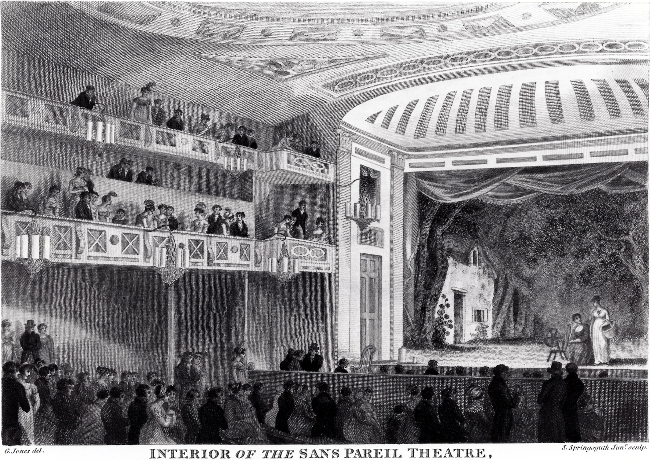
On this All Hallow's Eve, I wanted to write about a theatre that has been home to some of the spookiest dramas of all time, London's Adelphi Theatre, formerly known as the Sans Pareil.

Founded in 1806, the Sans Pareil was located on the Strand, which runs from Trafalgar Square down toward Temple Bar. Near Adam Street, prospective playgoers would see a theatre front that looked like this:


Technically the theatre was founded by John Scott, but it was really run by his daughter Jane, actress, producer, director, and author of such melodramas as Asgard the Demon HunterThe Old Oak Chest, and Camilla the Amazon. The stage looked something like this:


Scott retired from the theatre after getting married in 1819, and that's when the Sans Pareil changed its name to the Adelphi under new management. The theatre frequently performed adaptations of the works of Charles Dickens. These included an adaptation John Baldwin Buckstone did of Dickens's early sketch "The Bloomsbury Christening." Buckstone would later adapt Dickens's goblin story The Chimes for the theatre.

It was stories of goblins, ghosts, and sensational crimes that got the theatre's plays nicknamed "Adelphi Screamers." This was true even after the building was demolished and rebuilt in 1858. The rebuilt theatre became a home to hits by Dion Boucicault, including The Colleen Bawn and later The Octoroon. In 1862, Boucicault adapted Dickens's The Cricket on the Hearth under the title Dot, winning another huge success for the Adelphi.

Today, the theatre is home to big-budget musicals, most recently Back to the Future. It seems the Adelphi's role as a temple of popular culture continues even today.

Sunday, September 10, 2023

Wallack's Theatre

I've been looking at some illustrations of American theatre that appeared in Harper's Weekly, a journal that began in 1857 and remained a staple for the rest of the 19th century.

In the 1850s when Harper's began, the theatre was an extremely popular art form in the United States. During the 1857-58 season, a financial panic hit the country, yet the New York Opera reported having its best season ever.

Launching along with Harper's in 1857 was the Broadway hit The Poor of New York, the melodrama by Dion Boucicault that dealt with good and wicked characters alike navigating the effects of financial panic. The show opened at Wallack's Theatre at 485 Broadway (near Broome Street) and immediately produced a sensation by reproducing a burning tenement building right on stage.

Wallack's Theatre was referred to in the press as an "exceedingly elegant little house" catering to those with "the most delicate taste". Over the years, though, fashionable society moved uptown, and so did the theatre. In 1861, the father-and-son team of James and Lester Wallack moved their company up to 844 Broadway at 13th Street. It was here that Boucicault's play The Shaughraun played for 143 performances.

As the center of New York continued to move northward, the company (now just run by Lester, following his father's death) moved uptown again, this time to the corner of 30th Street and Broadway. It is the Wallack's Theatre here (renamed the Germania, and later the Star) that hosted a famous production of The School for Scandal by Richard Brinsley Sheridan featuring John Gilbert as Sir Peter Teazle and Rose Coghlan as his wife Lady Teazle.

Here's a picture that ran in Harper's showing the famous screen scene in the play:

Sunday, September 4, 2022

After Dark

The Irish playwright Dion Boucicault was a master of melodrama. He is perhaps most famous for his American-set plays The Poor of New York and The Octoroon, but he placed the London underworld on stage (literally) in his 1868 drama After Dark.

Boucicault's plays were frequently freely adapted from French melodramas, and he credited Eugene Grange and Adolphe Philippe Dennery's Birds of Prey as the source for After Dark. The play it more closely resembles in terms of staging, though, is Augustin Daly's Under the Gaslight.

That play featured an on-stage train hurtling toward a man tied to the tracks. Boucicault decided to go one better, and have the train be a part of the rapidly developing London Underground. The city had opened an underground train between Paddington and Farringdon in 1863, and in 1868, the year the play premiered, a new line debuted running from South Kensington to Westminster.

Not surprisingly, the play was adapted for film in 1915 by the Canadian-born director Frederick A. Thomson. I mean, come on--how can you pass up a train scene, and one underground at that!?!

Friday, December 31, 2021

Best Productions of 2021

New York City theatre isn't completely back yet, especially with omicron scares cancelling shows right and left, but at least things are better than last year, when I had to write a list of the top 10 shows I did NOT get to see.

So now I'm back to my annual tradition of coming up with a list of the top shows I saw that opened this year in New York City. Obviously, my own adaptation of A Christmas Carol doesn't count, since it was in Trenton, and neither do virtual performances, though some of them were quite fun.

Here are my picks, in reverse order:

10. The Alcestiad - Magis Theatre Company lived up to its name with this magical outdoor production on Roosevelt Island this summer. Thornton Wilder's take on a Greek myth involving death and plague came alive with the ruins of a smallpox hospital providing the backdrop. It was a joy to behold.

9. King Lear - New York Classical Theatre decided to do William Shakespeare's most depressing tragedy this year, but with the happy ending rewritten by Nahum Tate. Once again, the outdoor setting added to the experience, though it also meant that my first two attempts to see the show were cancelled due to rain. The third time was a charm, and this show was nothing if not charming.

8. The Book of Moron - Robert Dubac's one-man show was closer to a stand-up comedy routine than your typical Off-Broadway fare, but it rose beyond simple jokes to become an engaging and thought-provoking piece of theatre. This was in part due to flawless direction by comedy legend Garry Shandling and a surprisingly innovative set designed by Melissa Burkhardt Moore. I'm glad I saw it.

7. Trouble in Mind - Alice Childress at last made it (posthumously) to Broadway with Roundabout's production of her most famous play, a backstage drama about actors rehearsing a dreadful script by a conveniently absent playwright. During intermission, I overheard one audience member say, "Chuck Cooper makes everything he's in even better." How true! Cooper's performance in the play is not to be missed, so if you haven't seen it yet, get your tickets. It's still playing, but only through January 9th!

6. Merry Wives - Jocelyn Bioh's adaptation of The Merry Wives of Windsor was the Public Theater's sole offering at the Delacorte this summer, but it was worth seeing, if for no reason other than Jacob Ming-Trent, who played the larger-than-life character of Falstaff. Bioh appropriately adjusted the text to make Shakespeare's comedy of rural life in England work when reset among African immigrants in contemporary Harlem. The sight of Ming-Trent as an overgrown man-child playing video games was not only a witty sight gag--it was amazingly appropriate for the character of Sir John Falstaff.

5. Flying Over Sunset - When James Lapine has a new play, it's usually worth seeing, and when it's got music by Tom Kitt and lyrics by Michael Korie, you definitely want to be there. This imagined meeting of Aldous Huxley, Clare Boothe Luce, and Carey Grant at a rented Malibu beach house where they go on LSD trips together delivers both soaring melodies and beautiful stage pictures. It also features innovative choreography by tap master Michelle Dorrance. Harry Hadden-Paton, Carmen Cusack, and Tony Yazbeck all provide stellar performances that go beyond mere impressions of celebrities. This show is still playing at Lincoln Center, so get your tickets while you can!

4. Mrs. Warren's Profession - Gingold Theatrical Group scored again with their production of Bernard Shaw's devastating comedy about capitalism and prostitution, which turn out to be pretty much the same thing in this play. Karen Ziemba was able to shine in the title role, even when sharing the stage with other acting stalwarts like Raphael Nash Thompson and Robert Cuccioli. The more challenging roles in the play, however, go to the younger performers playing Vivie and Frank. Nicole King made her Off-Broadway debut as Vivie Warren, a "New Woman" whose enigmatic intelligence Shaw explored but thankfully never tried to solve. She was complimented by David Lee Huynh as Vivie's caddish love interest, Frank. Director David Staller made certain this production was just as charming as GTG's 2019 offering, Caesar and Cleopatra.

3. The Disciple - Thirdwing is a relative newcomer to NYC theatre. Their productions--which are sometimes live, sometimes virtual, and sometimes both--can be hit or miss. The Female Genius, a series of filmed shorts by Rachel Carey, provided the basis for this full-length play about author and philosopher Ayn Rand and her devoted much younger lover, Nathaniel Branden. Unlike some other plays about sexual exploitation by the famous and powerful, The Disciple finds nuance, in part by flipping traditional gender politics on their head, and showing a woman who is willing to be just as selfish and brutal as any man. Maja Wampuszyc is perfect as Rand, and Cameron Darwin Bossert plays Branden with both humanity and humor. Alas, the in-person show came and went without much fanfare, but fortunately, you can still see a filmed scene from it streamed through Thirdwing's website.

2. The Alchemist - The funniest new play of 2021 was Ben Jonson's old Jacobean comedy The Alchemist, made new again in a brilliant adaptation by contemporary dramatist Jeffrey Hatcher. Red Bull Theater Company, which has been remarkably active online during the pandemic, thankfully returned to the live stage with this side-splitting production directed by Jesse Berger. The cast featured Jacob Ming-Trent--who was so hilarious as Falstaff in this summer's Merry Wives--as well as Manoel Feliciano, Reg Rogers, Teresa Avia Lim, Nathan Christopher, Carson Elrod, Allen Tedder, Louis Mustillo, and Jennifer Sanchez (who literally shimmered in a costume designed by Tilly Grimes). Jonson's play is hysterical, but its cast of 12 (plus assorted extras) makes it difficult to produce for a professional company. Hatcher did a great job getting to the core of the humor while also reducing the cast size and making the play feel topical for those of us living through the plague of the 21st century.

1. The Streets of New York - Of all the New York companies that took their work to the virtual world to keep theatre alive during the pandemic, none were more prolific and innovative than Irish Repertory Theatre, which experimented boldly with the online format, and frequently with great success. I intensely looked forward to their return to the live stage, though, and was greatly pleased when they announced that they would be performing Dion Boucicault's The Streets of New York, especially after they had done such a magnificent revival of the same author's comedy London Assurance. What I was not expecting was for the show to be a musical! Director Charlotte Moore provided a number of delightful songs to transform Boucicault's classic melodrama into a holiday treat. She couldn't have done it, however, without a delightful cast that includes Ben Jacoby, David Hess, Justin Keyes, Jordan Tyson, Ryan Vona, Delaney Westfall, and (most winningly) Amanda Jane Cooper. It's still playing until January 30th, so be sure to grab tickets.

That's my list! Honorable mentions go to Blackbird, Radium Girls, and The Overcoat. Let's hope the virus recedes soon, and we can have a more robust season in 2022!

Sunday, December 5, 2021

The Streets of New York

Last night, I was privileged to attend the first preview of the magnificent revival of The Streets of New York now at Irish Repertory Theatre.

Dion Boucicault originally wrote the play in 1857. He was already famous for penning such comedies as London Assurance and Used Up when he set about adapting a French melodrama called The Poor of Paris by Edouard-Louis-Alexandre Brisbarre and Eugene Nus. He reset the story in New York City and opened it as The Poor of New York at Wallack's Theatre on Broadway.

The action of the play begins during the Panic of 1837, then jumps ahead 20 years to the Panic of 1857, a crisis that was still ongoing when the show opened. This present adaptation, known as The Streets of New York (as most other revivals of the play have been called) includes original songs by director Charlotte Moore that turn it into a full-blown musical. And when did Irish Rep last stage the show? Why, 20 years ago, in 2001!

In a program note by Moore and Irish Rep's producing director, Ciaran O'Reilly, the theatre states that they first did the show in the wake of 9/11, and now faced with the challenge of our present crisis, they "have chosen to meet it head-on and celebrate with music and fun and laughter." None of those things--music, fun, and laughter--are in short supply in the present production, which stars Ben Jacoby as our hero, Mark Livingston, and David Hess as the villainous banker, Gideon Bloodgood.

The production does not shy away from its melodramatic origins. There is even a song called "Villains" with Bloodgood and his accomplice Badger (played magnificently by Justin Keyes) all but twirling their mustaches. Instead of being embarrassed by the over-the-top dramatics, however, the audience eats it up and asks for seconds. When Badger collapsed unconscious right before revealing the location of a vital document, the audience last night burst into applause.

Moore even manages to improve upon the original play with the introduction of Dixie Puffy (played by Jordan Tyson), the pistol-toting daughter of the the beloved bakers in the play who becomes a love-interest for Paul Fairweather, best friend of the hero and brother to the virtuous heroine Lucy Fairweather. Ryan Vona and Delaney Westfall do great jobs as the Fairweather siblings, but Amanda Jane Cooper threatens to steal the show as Alida Bloodgood, the villain's spoiled and scheming daughter.

The production is only playing until January 30th, so get your tickets now!

Thursday, November 25, 2021

Giving Thanks Again

This time of year, it's always good to give thanks for all that we've received. With the devastation we've all witnessed in the past couple of years, it can sometimes feel like there isn't much left to be grateful for, but the fact is there are many out there trying to make the world a better place, and using theatre to do that.

So first and foremost, I'm grateful to Passage Theatre Company, which will be performing my adaptation of A Christmas Carol next month in Trenton, New Jersey. C. Ryanne Domingues is directing the two-hander about Scrooge's visitation by his deceased partner and a trio of other spirits. It will be a one-night holiday event on December 11th.

I'm also grateful for Actors' Theatre in Santa Cruz, California. Their 8 Tens @ 8 Festival, billed as the longest running short play festival in America, will be including my short play Kew Gardens next year. The festival runs from January 14th to February 6th. Bill Peters is directing this one-woman show that stars Sienna Thorgusen.

Closer to home, Gingold Theatrical Group is another group I'm grateful to have around, not just for their wonderful production of Mrs. Warren's Profession, but also for kindly inviting me to take part in a panel discussion about the play earlier this month. They also will be having a special staged reading of Bernard Shaw's Village Wooing next month.

During the height of the pandemic, it was scrappy companies like Irish Repertory Theatre that did the most to keep theatre alive, putting many of the larger organizations in New York City to shame. I'm grateful to Irish Rep both for all of the virtual performances they put on and for their coming return to live performance with a production of Dion Boucicault's The Streets of New York.

The nights are getting longer, but there is a light in the darkness, and the dark has not overcome it. Let's be grateful for that as we try to build back something better than what we had before.

Saturday, August 28, 2021

Used Up

The Irish dramatist Dion Boucicault had his first big hit in 1841 with London Assurance, which opened at Covent Garden, managed at that time by Lucia Elizabeth Vestris and her husband Charles Mathews.

Though the play was a success, Vestris spent lavishly on the production, as well as on subsequent plays, including Boucicault's own The Irish Heiress. In 1842, only a year after the triumph of London Assurance, Vestris and Mathews lost their lease on the Theatre Royal at Covent Garden.

In 1844, Vestris and Mathews opened a new Boucicault comedy, Used Up, at the Haymarket Theatre. The piece was based on a French farce by Félix Auguste Duvert and Augustin-Théodore de Lauzanne. Mathews, who played the leading role of Sir Charles Coldstream, contributed much of the dialogue, and his acting was largely responsible for the play's success.

Sir Charles is a wonderful role, and the novelist Charles Dickens later performed it in an amateur production. Dickens's friend, the artist Augustus Egg, even painted a portrait of the writer in the part, which you can see here, courtesy of ArtUK and the Charles Dickens Museum. Boucicault himself played the role in the U.S., first in New York in 1854, and later in New Orleans.

In the play, the spoiled Sir Charles is so bored with life that he resolves to propose marriage to the next woman he meets. That woman ends up being his neighbor, Lady Clutterbuck, who in a rather unlikely turn of events, was previously married to a blacksmith hired to install a balcony outside a window in Sir Charles's house. Even the prospect of marriage doesn't relieve the young aristocrat's boredom, but he begins to feel alive again as he fights the blacksmith, and the two topple out of the window and into a river.

In the second act, both Sir Charles and the blacksmith are presumed dead. Both, however, are alive but in hiding, fearing they'll be charged with one another's murder. While disguised as a simple plough-boy, Sir Charles falls in love with Mary Wurzel, the niece of one of his tenant farmers. Eventually, he learns his lesson, which he sums up for the audience in true Boucicault fashion:

...a man's happiness, after all, lies within himself--with employment for the mind, exercise for the body, a domestic hearth, and a mind at ease...

Even if that sentiment feels a little trite today, the play is a great deal of fun, and it helped Boucicault learn his craft so he could go on to pen better plays, including The Poor of New York.

Sunday, March 14, 2021

The Poor of New York

Dion Boucicault's play The Poor of New York was a hit when it opened at Wallack's Theatre in New York City in 1857, just as a financial panic had taken hold of the United States.

The play begins twenty years in the past, during the Panic of 1837. In the opening scene, the banker Gideon Bloodgood is preparing to skip town before his firm collapses. His irresponsible clerk Badger is more than happy to let his boss leave quietly, provided he gets a sizable bribe to keep quiet.

"In business there are two ways of getting rich, one hard, slow, and troublous: this is called labor;" Badger says. "The other easy, quick and demanding nothing but a pliant conscience and a daring mind--is now denominated financiering--but when New York was honest, it was called fraudulent bankruptcy...." This line continues to resonate today, when a supposed titan of finance can declare bankruptcy after bankruptcy, never pay more than a pittance in taxes, and still call himself rich.

The first act of the play ends with a certain Captain Fairweather depositing $100,000 with Bloodgood and then dying in his office. The banker pockets the money, his clerk picks the receipt off of the floor, and the story moves ahead twenty years to the present year of 1857. That year marked a turning point in economic history, because 1857 was the first time a financial panic could spread as quickly as electricity, since newly installed telegraph lines now carried news of financial collapse at lightning speed. While the Panic of 1837 gradually moved across the country, audiences in 1857 had seen a spectacular collapse that began with a bang and quickly enveloped the entire nation.

Act II of the play opens with the formerly wealthy Mark Livingstone lamenting how in the course of three months he has lost nearly everything. In a tour-de-force monologue he explains who the true poor of New York really are:

The poor!--whom do you call the poor? Do you know them? do you see them? they are more frequently found under a black coat than under a red shirt. The poor man is the clerk with a family, forced to maintain a decent suit of clothes, paid for out of the hunger of his children. The poor man is the artist who is obliged to pledge the tools of his trade to buy medicines for his sick wife. The lawyer who, craving for employment, buttons up his thin paletot to hide his shirtless breast. These needy wretches are poorer than the poor, for they are obliged to conceal their poverty with the false mask of content--smoking a cigar to disguise their hunger--they drag from their pockets their last quarter, to cast it with studied carelessness, to the beggar, whose mattress at home is lined with gold. These are the most miserable of the Poor of New York.

This speech gets Livingstone arrested for making a public oration in the park. In the third act he resolves to kill himself if he cannot recover his honor and marry the woman he loves, none other than Captain Fairweather's daughter Lucy. Bloodgood's own daughter, Alida, plots to have Livingstone's debts forgiven so she can marry him herself and gain entrance to fashionable society. Into this mess walks Badger, returned from California and ready to blackmail his former employer. The act ends with Livingstone distraught, Lucy in tears, and Badger being hauled off by the police.

In Boucicault's plays the fourth act generally provided a sensation scene, and The Poor of New York delivers. The play takes us to a dilapidated apartment building at 19 and a half Cross Street in Five Points. Cross Street was one of the five streets that converged in one place, giving the notorious neighborhood of Five Points its name. The street was not only in the heart of the worst neighborhood of New York City, but the address of 19 and a half indicates that a single lot had been divided into two. Badger lives on the fifth floor in the back. Buildings were not supposed to be higher than five stories, with rents decreasing the more flights tenants had to climb. Front apartments were naturally more desirable than the rear, so fifth floor rear of 19 and a half Cross Street is pretty much the worst apartment in all of New York City!

Badger lives in an adjoining room to the domicile of the Fairweather family. (The building, already subdivided, seems to have split in two its very worst apartment!) The Fairweathers, who are starving and crowded into this squalid living space, have become desperate. Both Lucy and her mother separately decide to commit suicide by sealing the apartment and burning charcoal to suffocate themselves. Lucy's brother Paul arrives just in time to save them, but the fumes poison Badger in the next room. He has concealed the receipt proving the $100,000 deposit with Bloodgood, but before he can reveal the hiding place, he falls unconscious.

In the climactic fifth act, Bloodgood sets fire to the tenement building in an attempt to destroy the concealed receipt. Badger returns to retrieve it, and the whole structure goes up in flames on stage. Boucicault later wrote an article for Scientific American in which he explained how he had created the fire effect. Quick burning "flash torches" illuminated "a very large endless towel upon which is printed a mass of flames." This huge piece of cloth was "kept in constant motion" behind the facade of the on-stage tenement building and could be glimpsed through the windows.

The large cast, including firemen, added to the effect, and a period print records what the scene looked like on stage. The Poor of New York made such a sensation that Boucicault rewrote the piece over and over again, changing the place names to add new local color, and produced The Poor of Liverpool, The Poor of Manchester, The Poor of London.... 


No one seemed to mind the derivative nature of these works. After all, Boucicault had himself adapted the play from a melodrama called The Poor of Paris by Edouard-Louis-Alexandre Brisbarre and Eugene Nus. It also contained contributions by a fellow dramatist and two local journalists, but Boucicault is usually credited as the sole playwright.

Wednesday, December 30, 2020

English Melodrama

Melodrama began in France and Germany, arriving in England only after it had already been developed abroad. In France, a "melo-drame" referred to a work that used music and dumbshow, while in Germany a melodrama was a piece with spoken dialogue accompanied by musical underscoring.

It was in England, though, that melodrama developed, expanded, and was eventually exported all around the world. The Cambridge Companion to English Melodrama, edited by Carolyn Williams, aims to establish England's centrality in the emergence of the genre, containing essays contributed from top scholars, including Michael Gamer, Peter Brooks, and Juliet John.

Jim Davis has a great essay in the collection looking at the various theatres where melodrama was performed in England during the nineteenth century. Thomas Holcroft's A Tale of Mystery is often considered the first English melodrama, since Holcroft was the first person to use that term in describing his work, calling his play "A Mélo-Drame In Two Acts." It premiered at the Theatre Royal, Covent Garden in 1802.

Though Covent Garden continued to produce numerous melodramas, the form was associated more with the minor theatres rather than the huge houses at Covent Garden and Drury Lane that held royal patents. The West End theatre that really drew audiences in for melodramas was the Adelphi, previously known as the Sans Pareil when under the direction of Jane Scott. The theatre was demolished and rebuilt twice, once in 1858 and once in 1901. It was in the second building that Dion Boucicault staged his play The Colleen Bawn with it's sensational scene showing a woman being rescued from drowning.

Over in the East End, the Pavilion Theatre in Whitechapel opened in 1826 and served a working-class audience that typically included a number of sailors who walked over from the docks. Not surprisingly, the Pavilion was known for its nautical melodramas. It burned down in 1856, but was rebuilt two years later. During its earlier years, it provided a home for melodramas penned by Elizabeth Polack, including the biblically inspired play Esther the Royal Jewess.

On the south side of the Thames was the Royal Coburg, later renamed the Royal Victoria, and today known as the Old Vic. It had to compete with a slew of other theatres in the neighborhood, though, including the Surrey Theatre, which premiered Douglas Jerrold's play Black-Eyed Susan in 1829. The Surrey also produced Edward Fitzball's 1833 crime melodrama Jonathan Bradford, which featured a set that showed four rooms simultaneously.

There was plenty of English theatre outside of London, too, and Davis includes a section on provincial theatres that did melodrama as well. One, the Sheffield Theatre Royal, staged Joseph Fox's controversial melodrama The Union Wheel in 1870, causing an outcry in the press, with some critics considering the piece to be an incitement to strike.

Thursday, December 26, 2019

Top Plays of 2019

I've come up with this year's list of the top plays I saw that opened in New York in 2019.

Of course some plays didn't qualify, like What the Constitution Means to Me, which opened last year Off-Broadway, or Timon of Athens, which I actually saw in England.

Last year, Travesties and Twelfth Night topped the list, and this year included pieces produced by Roundabout and The Public Theater as well. Here's this year's top ten, in reverse order:

10. Antony and Cleopatra - Hudson Warehouse provides a mixed bag of free classical theater in Riverside Park, but this year's modernized production of one of the great tragic love stories of all time was definitely worth seeing.

9. The Importance of Being Earnest - Another great free outdoor production this year was New York Classical Theatre's clever take on Oscar Wilde's The Importance of Being Earnest. This year they performed the play in both traditional and gender-swapped versions.

8. Midsummer: A Banquet - Food for Love Productions turned Shakespeare's A Midsummer Night's Dream into a tasty treat with this immersive production directed and choreographed by Zach Morris. The Art Nouveau aesthetic worked brilliantly, but it was the remarkable acting that sold the show.

7. Cyrano - Yes, this musical adaptation of Cyrano de Bergerac by the New Group was all over the place, but it still managed to make me cry... a lot. If they end up releasing a cast album, definitely buy it. And yes, Peter Dinklage can sing. (We already knew Jasmine Cephas Jones and Grace McLean could.)

6. King Lear - Glenda Jackson gave a performance of a lifetime in this Broadway production of Shakespeare's bleakest tragedy. Sam Gold's direction was problematic at times, but a supporting cast including Jayne Houdyshell and Ruth Wilson made up for it, and the production was thoroughly enjoyable, if rather long.

5. Caesar and Cleopatra - Gingold Theatrical Group scored a hit again this year with their Off-Broadway revival of an epic historical comedy by George Bernard Shaw. Director David Staller's imaginative staging featured seven amazing actors and one hysterical puppet. I'm looking forward to seeing what GTG does next year!

4. Hillary and Clinton - Lucas Hnath's play about the 2008 presidential primary had already been making the rounds before landing on Broadway this year. His writing is always clever, but Broadway audiences had the added benefit of seeing Laurie Metcalf and John Lithgow in the title roles.  The play succeeded by eschewing historical accuracy in favor of a more metaphorical truth.

3. Much Ado About Nothing - The stand-out Shakespeare production of the year was undoubtedly The Public Theater's production of Much Ado About Nothing in Central Park. Director Kenny Leon assembled an incredible cast, and fortunately their performance was recorded and aired on PBS to be shared with the entire nation. If you missed it in the park, make sure you see the recorded version.

2. Scotland, PA - A lot of people have been crowing about Hadestown, which I saw both Off-Broadway and in London, though I have not yet seen in its new Broadway incarnation. The best new musical that I saw this year was Adam Gwon's Scotland, PA, a brilliant adaptation of the 2001 film, which was itself based on a certain Scottish Play. Alas, Roundabout has closed this production, but it deserves to have a longer life elsewhere.

1. Juno and the Paycock - Though I'm not a huge fan of Sean O'Casey, this spring Irish Repertory Theatre presented his three Dublin plays in rep, which is an opportunity not to be missed. Of the three, Juno and the Paycock is O'Casey's best play, and this production was masterfully directed by Neil Pepe to navigate the layers of comedy and tragedy for maximum effect. Irish Rep has a great line-up of shows for the coming year, including Dion Boucicault's classic farce London Assurance, which is running now.

I'm looking forward to that and lots of other great shows in 2020!

Thursday, November 28, 2019

Grateful

On this day of giving thanks, I am grateful for some of the wonderful theatre companies in New York City that keep going in spite of the difficulties of this day and age.

I am grateful for Gingold Theatrical Group, which has managed not only to keep its Project Shaw reading series going in lean times, but to continue to produce excellent fully staged work as well. This fall's production of Caesar and Cleopatra brought an epic to life on a shoe-string budget. We need more work like that: dedicated, daring, and filled with enthusiasm.

Though I didn't get out there as much as I would have liked to this year, I'm grateful that Irish Repertory Theatre is still with us, too. Their production of Sean O'Casey's trilogy of Dublin plays was not to be missed, and I particularly loved Juno and the Paycock. They'll soon be opening one of my favorite under-produced plays, London Assurance by Dion Boucicault. Thank you yet again, Irish Rep!

Theatre in the parks is always hit-or-miss, which is why I'm particularly grateful to New York Classical Theatre for consistently providing quality outdoor theatre for the masses. This summer's production of Oscar Wilde's The Importance of Being Earnest was a delight. I hope what they have to offer us next summer will likewise entertain and provide food for thought.

Finally, I'm grateful to Urban Stages for bringing new work to life and being one of the few New York theatres left to take unsolicited scripts. It's a pity we don't have more theatres in this city with the type of open-door policy that has helped Urban Stages discover truly new voices.

Some of the larger theatre institutions in New York frequently get applause for their good work, but it's smaller companies like these that really keep New York theatre alive and vibrant!