Showing posts with label Clare Boothe Luce. Show all posts

Friday, December 31, 2021

Best Productions of 2021

New York City theatre isn't completely back yet, especially with omicron scares cancelling shows right and left, but at least things are better than last year, when I had to write a list of the top 10 shows I did NOT get to see.

So now I'm back to my annual tradition of coming up with a list of the top shows I saw that opened this year in New York City. Obviously, my own adaptation of A Christmas Carol doesn't count, since it was in Trenton, and neither do virtual performances, though some of them were quite fun.

Here are my picks, in reverse order:

10. The Alcestiad - Magis Theatre Company lived up to its name with this magical outdoor production on Roosevelt Island this summer. Thornton Wilder's take on a Greek myth involving death and plague came alive with the ruins of a smallpox hospital providing the backdrop. It was a joy to behold.

9. King Lear - New York Classical Theatre decided to do William Shakespeare's most depressing tragedy this year, but with the happy ending rewritten by Nahum Tate. Once again, the outdoor setting added to the experience, though it also meant that my first two attempts to see the show were cancelled due to rain. The third time was a charm, and this show was nothing if not charming.

8. The Book of Moron - Robert Dubac's one-man show was closer to a stand-up comedy routine than your typical Off-Broadway fare, but it rose beyond simple jokes to become an engaging and thought-provoking piece of theatre. This was in part due to flawless direction by comedy legend Garry Shandling and a surprisingly innovative set designed by Melissa Burkhardt Moore. I'm glad I saw it.

7. Trouble in Mind - Alice Childress at last made it (posthumously) to Broadway with Roundabout's production of her most famous play, a backstage drama about actors rehearsing a dreadful script by a conveniently absent playwright. During intermission, I overheard one audience member say, "Chuck Cooper makes everything he's in even better." How true! Cooper's performance in the play is not to be missed, so if you haven't seen it yet, get your tickets. It's still playing, but only through January 9th!

6. Merry Wives - Jocelyn Bioh's adaptation of The Merry Wives of Windsor was the Public Theater's sole offering at the Delacorte this summer, but it was worth seeing, if for no reason other than Jacob Ming-Trent, who played the larger-than-life character of Falstaff. Bioh appropriately adjusted the text to make Shakespeare's comedy of rural life in England work when reset among African immigrants in contemporary Harlem. The sight of Ming-Trent as an overgrown man-child playing video games was not only a witty sight gag--it was amazingly appropriate for the character of Sir John Falstaff.

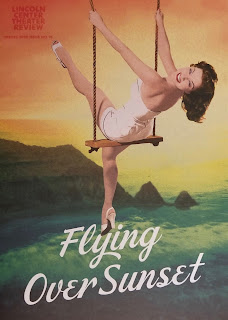
5. Flying Over Sunset - When James Lapine has a new play, it's usually worth seeing, and when it's got music by Tom Kitt and lyrics by Michael Korie, you definitely want to be there. This imagined meeting of Aldous Huxley, Clare Boothe Luce, and Carey Grant at a rented Malibu beach house where they go on LSD trips together delivers both soaring melodies and beautiful stage pictures. It also features innovative choreography by tap master Michelle Dorrance. Harry Hadden-Paton, Carmen Cusack, and Tony Yazbeck all provide stellar performances that go beyond mere impressions of celebrities. This show is still playing at Lincoln Center, so get your tickets while you can!

4. Mrs. Warren's Profession - Gingold Theatrical Group scored again with their production of Bernard Shaw's devastating comedy about capitalism and prostitution, which turn out to be pretty much the same thing in this play. Karen Ziemba was able to shine in the title role, even when sharing the stage with other acting stalwarts like Raphael Nash Thompson and Robert Cuccioli. The more challenging roles in the play, however, go to the younger performers playing Vivie and Frank. Nicole King made her Off-Broadway debut as Vivie Warren, a "New Woman" whose enigmatic intelligence Shaw explored but thankfully never tried to solve. She was complimented by David Lee Huynh as Vivie's caddish love interest, Frank. Director David Staller made certain this production was just as charming as GTG's 2019 offering, Caesar and Cleopatra.

3. The Disciple - Thirdwing is a relative newcomer to NYC theatre. Their productions--which are sometimes live, sometimes virtual, and sometimes both--can be hit or miss. The Female Genius, a series of filmed shorts by Rachel Carey, provided the basis for this full-length play about author and philosopher Ayn Rand and her devoted much younger lover, Nathaniel Branden. Unlike some other plays about sexual exploitation by the famous and powerful, The Disciple finds nuance, in part by flipping traditional gender politics on their head, and showing a woman who is willing to be just as selfish and brutal as any man. Maja Wampuszyc is perfect as Rand, and Cameron Darwin Bossert plays Branden with both humanity and humor. Alas, the in-person show came and went without much fanfare, but fortunately, you can still see a filmed scene from it streamed through Thirdwing's website.

2. The Alchemist - The funniest new play of 2021 was Ben Jonson's old Jacobean comedy The Alchemist, made new again in a brilliant adaptation by contemporary dramatist Jeffrey Hatcher. Red Bull Theater Company, which has been remarkably active online during the pandemic, thankfully returned to the live stage with this side-splitting production directed by Jesse Berger. The cast featured Jacob Ming-Trent--who was so hilarious as Falstaff in this summer's Merry Wives--as well as Manoel Feliciano, Reg Rogers, Teresa Avia Lim, Nathan Christopher, Carson Elrod, Allen Tedder, Louis Mustillo, and Jennifer Sanchez (who literally shimmered in a costume designed by Tilly Grimes). Jonson's play is hysterical, but its cast of 12 (plus assorted extras) makes it difficult to produce for a professional company. Hatcher did a great job getting to the core of the humor while also reducing the cast size and making the play feel topical for those of us living through the plague of the 21st century.

1. The Streets of New York - Of all the New York companies that took their work to the virtual world to keep theatre alive during the pandemic, none were more prolific and innovative than Irish Repertory Theatre, which experimented boldly with the online format, and frequently with great success. I intensely looked forward to their return to the live stage, though, and was greatly pleased when they announced that they would be performing Dion Boucicault's The Streets of New York, especially after they had done such a magnificent revival of the same author's comedy London Assurance. What I was not expecting was for the show to be a musical! Director Charlotte Moore provided a number of delightful songs to transform Boucicault's classic melodrama into a holiday treat. She couldn't have done it, however, without a delightful cast that includes Ben Jacoby, David Hess, Justin Keyes, Jordan Tyson, Ryan Vona, Delaney Westfall, and (most winningly) Amanda Jane Cooper. It's still playing until January 30th, so be sure to grab tickets.

That's my list! Honorable mentions go to Blackbird, Radium Girls, and The Overcoat. Let's hope the virus recedes soon, and we can have a more robust season in 2022!

Wednesday, December 29, 2021

Flying Over Sunset

Before our entire society shut down in 2020, I had been looking forward to seeing James Lapine's new musical Flying Over Sunset.

I mean Lapine, who had collaborated with Stephen Sondheim on Sunday in the Park with George, Into the Woods, and Passion had a new musical? Sign me up!

With music by Tom Kitt, who wrote Next to Normal? Of course I'm coming. You don't have to tell me what it's about! Wait, it's about Aldous Huxley, Clare Boothe Luce, and Carey Grant on an acid trip? Seriously? As they say, take my money, already!

Huxley has been a fascination of mine ever since I read Brave New World when I was in high school. I even wrote a play called The Four Doctors Huxley that was produced by a theatre in Jersey City. As for Luce, it's hard not to admire the technical brilliance of her play The Women, even if her right-wing politics tended to be revolting. And Grant? Who doesn't love Carey Grant, perhaps the greatest leading man Hollywood ever produced?

Well, the collapse of civilization as we knew it prevented the show from opening in 2020, but it's back now at Lincoln Center, and I finally got a chance to see it last night. The audience was sparse, due to the twin disasters of an omicron spike and bad reviews, but I enjoyed myself thoroughly. Choreographer Michelle Dorrance provides percussive movements that supplement Kitt's score, and the set by Beowulf Boritt works magic on stage.

What we're really here to see, though, is this trio of celebrities--so very different, yet so alike in many ways--interact with each other while tripping on a psychedelic drug. The problem is, people on psychedelic drugs don't necessarily interact. The journeys they go on are journeys within, which doesn't always lend itself to interpersonal connections. This means that Flying Over Sunset is about three individuals, not about finding community, which might make it an appropriate show for an individualistic society where community is considered suspect unless modified by the word online.

The first act in fact presents our three protagonists separately. First we meet Huxley, played by Harry Hadden-Paton, experiencing LSD for the first time while on a mundane trip to an L.A. drug store. He spots an art book being displayed alongside a plethora of other objects on sale, and his gaze at Botticelli's Judith with the Head of Holofernes becomes the operatic musical number "Bella Donna Di Agonia." Instead of dropping us immediately into a surreal hallucination, the show slowly builds to stranger and stranger visions, then gradually brings us back, much like the effects of a drug that build, peak, and fade.

Grant is the next to trip, taking the drug in a psychiatrist's office at the behest of his wife, Betsy Drake. This provides Dorrance with the opportunity to choreograph her most compelling tap number of the show, "Funny Money," in which Grant, played by Tony Yazbeck, dances with his younger self, played by Atticus Ware. Yazbeck has a particular challenge, playing the iconic Grant, since we all know the face of the man he is playing, but his dancing chops encourage us to suspend our disbelief and indulge in the fantasy. In real life, Grant famously described an acid trip he once had in which he imagined he was a giant penis launching into space. Naturally, the musical later stages this moment in the song "Rocket Ship."

The real star of the show, though, is Carmen Cusack, who plays Luce. We see Luce, by then a former congresswoman as well as the former ambassador to Italy, as she faces hearings in the U.S. Senate to be confirmed as ambassador to Brazil. No longer exuding the confidence she once had, though, Luce turns down the ambassadorship. At her estate in Connecticut, she takes LSD under the guidance of the writer and guru Gerald Heard (played by Robert Sella) and stops the show with her rendition of the title song "Flying Over Sunset."

At the end of the first act, the three protagonists meet up at the legendary Brown Derby restaurant in Los Angeles and decide to have an experience together at Luce's Malibu beach house. It is there, in a psychedelic garden, that Luce encounters her dead mother and daughter, both in "heaven" but different heavens, since her virginal daughter and not-so-virginal mother could never occupy the same astral plane in Luce's mind.

Flying Over Sunset, for all its pyrotechnics, is ultimately a quiet, simple show, about simple moments rather than grand gestures. Perhaps it is no coincidence that the moments of true connection between the characters happen only after the effects of LSD have abated. In our own world, fragmented and isolated by politics, disease, and other traumas, those moments of connection are more important than ever.

Sunday, April 6, 2014

Back from Baltimore

I had a great time at this year's Comparative Drama Conference in Baltimore. This was my first year attending, and I was honored to be a part of a session sponsored by the International Shaw Society.

Thursday morning, Beck Holden from Tufts spoke about Charles Kean's 1858 production of The Merchant of Venice, and David Muller gave a fascinating talk about the effects of weather on theatre attendance at the Comedie Francaise. In the late 17th and early 18th centuries, Louis Morin took meticulous weather observations in Paris, and Muller compared Morin's weather reports with the ticket receipts at the theatre. Contrary to Muller's expectations, when it got colder outside, theatre attendance actually increased, though it did go down a bit when things got very, very cold. Excessively high temperatures also somewhat lowered theatre attendance, but Muller said he was surprised by how hardy audiences at the time were.

In another session later that morning, Shehzad Ghias of Brooklyn College spoke about women on stage in Pakistan. Some theatre historians claim women did not act in that country until Mary Fenton started appearing in Parsi dramas in the late 19th century. However, Ghias argues this includes only a very narrow vision of theatre. Women always acted in folk dramas, he said, though in those cases, the genders were segregated, with women performing for other women and men performing for other men. During Sufi festivals, women also danced publicly, even in the company of men, but these were religious celebrations, and not eroticized. Of course, erotic dance has also been around in Pakistan since time immemorial, including today in the so-called "Diamond Market," the red-light district of Lahore.

During the same session, Ariel McClanahan Watson of Saint Mary's University spoke about the Iranian playwright Nassim Soleimanpour's provocative piece White Rabbit Red Rabbit. Though Soleimanpour in unable to travel outside of Iran, his plays can, and the piece has been performed all over the world. Elif Bas also came to the session from Bahcesehir University in Istanbul to speak about the state of theatre censorship in Turkey.

That afternoon, Rick DesRochers of Long Island University chaired a session on exceeding boundaries and resisting traditions in U.S. theatre. He spoke about the school plays of the Marx Brothers, many of which had routines that made it into the movie Horsefeathers. Kathryn LeTrent talked about another play that transitioned to being a film, Clare Boothe Luce's The Women. Sound designer Yu-Yun Hsieh also gave a paper on the use of silence in Annie Baker's Circle Mirror Transformation and Suzan Lori-Parks' Topdog/Underdog.

After chatting with Rick for a while, I snuck into the Faust session, where Goethe scholars Downing Cless, Jan Hagens, and Birte Giesler had a very stimulating conversation. Jan made the interesting point that Goethe includes the Prelude in the Theatre with the dramatic poet before he shows the Prologue in Heaven. The effect, he said, was to show that even God is subordinate to the creative mind of the Poet. Now that's truly Romanticism with a capital R!

My own session was not until the late afternoon. I gave my paper on Back to Methuselah and Jesse Hellman gave a fascinating comparison between Lady Hamilton and Eliza Doolittle from Pygmalion. Both, of course, were born in the gutter, then trained and coached to fit in with the highest levels of society. Shaw wrote the part of Eliza for Pat Campbell. Prior to that, we were all interested to learn, Campbell appeared onstage as Lady Hamilton in a play called Nelson's Enchantress. The script for that play mysteriously disappeared, but some of Jesse's friends recently tracked down a misfiled copy at the British Library. I would love to read it!

There were a number of Shavians at the conference, and Jesse and I fielded some great questions from Tony Stafford of the University of Texas at El Paso, Christopher Innes of York University, and Mary Christian of Indiana University. That evening, I got to have dinner with them all, and then we headed over to Center Stage for Gavin Witt's production of Shakespeare's Twelfth Night. It was delightful.

Unfortunately, I had to head back to New York the next morning for a rehearsal of Moby-Dick. IATI Theater will be doing a staged reading of my adaptation on Tuesday with Montgomery Sutton, Gordon Stanley, Richard Dezmond, and Doug Rossi. Dev Bondarin is directing. Come out to see it if you can!