Showing posts with label Eugene O'Neill. Show all posts

Sunday, October 19, 2025

No Emperors

Yesterday there were "No Kings" protests throughout the United States, and at the Joyce Theater in New York City the anti-monarchal ballet The Emperor Jones by the Limón Dance Company.

I went due to the connection of the dance piece with its source material, the play The Emperor Jones by Eugene O'Neill. The play, with its extensive stage directions and overwhelming focus on a central character whose internal fears are made manifest around him, seemed already halfway to being ballet when José Limón first adapted it to dance in 1956.

O'Neill wrote the play in 1920, and the Provincetown Players premiered it at the Provincetown Playhouse in New York City, starring Charles Sidney Gilpin. The show was a hit and had to be moved to a larger theatre to accommodate the large crowds who wanted to see it. It then toured the United States, providing many people in the U.S. with their first contact with Expressionism on stage.

When the play was revived on Broadway in 1925, it starred the previously unknown actor Paul Robeson, who went on to star in it in London and then on film in the 1933 movie version. The piece was thus already famous when Limón turned it into a showpiece for his own virtuosic dancing, taking on the role of Brutus Jones, who after rising to become emperor over a Caribbean island, disintegrates psychologically and is ultimately killed by a silver billet.

O'Neill's stage directions indicate that "Little Formless Fears creep out from the deeper blackness of the forest." The Little Formless Fears danced excellently in this production, though the forest was transformed into an urban jungle of skyscrapers. The company's revival kept Limón's original choreography, but adapted the costumes and sets to turn it into a parable about capitalism. They also allowed women to dance some of the roles, though Limón originally envisioned an all-male cast.

The piece was suitably creepy, though, which set the mood for the show I saw in the evening, Stephen Smith's One Man Poe, which he performed at Poe Cottage in the Bronx. Seeing Smith perform virtually every word of "The Black Cat" and "The Raven" in the house where Poe once lived was a real treat.

If you missed him, don't worry! He plans to be back with more Poe stories next October!

Monday, June 30, 2025

Where the Cross is Made

Whaling voyages can make certain men a little obsessed. That's what we learn in Moby-Dick, anyway, a novel I myself have adapted for the stage.

The obsessions of whaling captains also show up in the early plays of Eugene O'Neill. For instance, in O'Neill's play Ile (a New England Yankee pronunciation of "oil") a captain becomes so preoccupied with going after more whale oil that he drives his wife mad.

However, Captain Isaiah Bartlett in O'Neill's Where the Cross is Made has a different obsession. He was on a whaling voyage when he was shipwrecked in the Indian Ocean. There, he and a handful of survivors found a treasure, buried it, and created a map marking the location with a cross.

Bartlett not only obsesses over the treasure, but after the other survivors are killed trying to get it, he passes his obsession on to his son Nat, though his daughter Sue is immune to the madness. O'Neill implies that the treasure exists, but is fake. A bracelet Bartlett returned with turns out to be made of brass with paste jewels rather than real ones. The play makes Bartlett's dream of fortune manifest onstage, though, by having actors playing the drowned crew members cross the stage like ghosts.

Where the Cross is Made premiered in 1918 by the Provincetown Players. Ida Rauh, who directed the production as well as playing Sue, apparently had difficulty staging the ghostly effect that really makes the play stand out as something special. "You'll have to do something about the ghosts, Gene," she reportedly said. "The boys never can look like ghosts, you know it. The audience will simply laugh at them." O'Neill stuck to his vision, and the ghosts stayed.

O'Neill later turned the one-act play into a full-length work called Gold. It opened on Broadway in 1921, but closed after only 13 performances.

Saturday, January 18, 2025

In the Zone

Mariner Theatrical, a new company dedicated to producing works onboard ships and in buildings along the waterfront, just launched its maiden voyage with a production of Eugene O'Neill's one-act play In the Zone.

The play, which takes place in the forecastle of a ship, was appropriately performed in the sailor's quarters of the historic ship Wavertree at South Street Seaport. Audience members had a choice of watching from a seat or lying down in a bunk.

Some of the bunks had to be reserved for the actors, though, making this production truly immersive. (Though perhaps "immersive" isn't a word one wants to use when performing literally out on the water!) Andy Sowers directed the production, which featured live music by the Irish folk group Faoileán, led by Nathan Bishop.

Since sight-lines could be... challenging in this space, some of the play's stage directions were read aloud, which helped the audience to follow the story. That story, by the way, involves crew members sailing a ship full of ammunition into the war zone of the North Atlantic during the First World War. One crew member starts acting suspiciously, making the others wonder if he might be a spy and saboteur.

This is an O'Neill play, so of course there are multiple allusions to alcoholism in the piece. To help the audience get in the mood, Mariner Theatrical provided some hard cider, which was quite nice. After the performance I attended, O'Neill scholar Robert Richter gave a free talk on the dramatist's relationship to seafaring.

If you missed it, keep an eye out for Mariner Theatrical in the future. They appear to be a company to watch!

Thursday, August 29, 2024

Unmasking Electra

Last night, I attended a virtual talk on Eugene O'Neill's trilogy Mourning Becomes Electra by the mother-daughter team of Carole and Beth Wynstra.

Beth, who is an associate professor at Babson College, noted that her mother Carole, the co-president of the Eugene O'Neill Foundation Board, is a much better parent than the character of Christine in the play. Carole said that's a pretty low bar, being that Christine is an adulterous and murderous fiend.

Masks come up frequently in the play, including in the stage directions. Not only were masks used by actors in ancient Greece, but O'Neill originally intended the play to be performed masked, as was his earlier play The Great God Brown when it premiered in 1926. Later, O'Neill decided to discard the mask idea, and when Mourning Becomes Electra premiered in 1931, it was performed unmasked.

O'Neill based the work on another trilogy, The Oresteia by Aeschylus. However, the story of Electra was also told by other Greek dramatists. Both Wynstras agreed that the version by Sophocles is probably the best. Euripides also wrote a play called Electra, though, which goes a little off the rails in spots. In his version of the story, Electra is forced to marry a peasant, but is later rescued by her brother Orestes and his friend Pylades.

In O'Neill's telling of the story, that doesn't happen, but there's still plenty of room for other varieties of familial dysfunction. As the Mannon family tears itself apart, the action is commented upon by the community. In Greek plays, this would have been done by the chorus. While O'Neill did not introduce a chorus per se, he did provide the character of Seth to provide a choral element, along with several minor characters. Carole noted that the singing of the song "Shenandoah" also adds to the feel of a chorus.

Beth pointed out that the actress who originally played Christine, the Clytemnestra figure in O'Neill's work, also appeared in soap advertisements at the same time as she was featured in the play on Broadway. The actress, Alla Nazimova, seemed to be playing with her own image, both on and off stage, emphasizing her own good looks even as she acknowledged that she was an older woman. Nazimova, by the way, went on to perform other important roles on Broadway, including the Priestess in Bernard Shaw's The Simpleton of the Unexpected Isles.

The Electra-like role of Lavinia was originally played on Broadway by Alice Brady, who later performed in numerous Gilbert and Sullivan operettas. Apparently, she and Nazimova did not get along. (Neither did their characters, as Lavinia plans her own mother's murder.) Carole mentioned that there was also a film made in 1947 with Rosalind Russell as Lavinia.

Next month, the play is scheduled to run at the Eugene O'Neill Festival in Danville, California. Tickets are already sold out, though, so you'll have to settle for the movie, or perhaps reading the play.

Thursday, July 11, 2024

Suffs

Last night I saw Suffs, the emotionally moving and often infuriating new musical by Shaina Taub about the struggle to pass the 19th amendment.

Taub is one of New York City's most talented songwriters, and has long been supported by The Public Theater, which produced her musical adaptations of Twelfth Night and As You Like It in Central Park.

The Public Theater staged Suffs Off-Broadway prior to its transfer to the Music Box on 45th Street. The same company originated Hamilton, and comparisons between Suffs and that show are inevitable. Both musicals opted to feature their creators onstage as the play's protagonist and both utilized history in order to talk about contemporary politics.

While Hamilton was born out of the multi-cultural optimism of the Obama years, Suffs speaks to the anger, impatience, and exhaustion of our present moment. Taub stars as Alice Paul, the Quaker activist who both drove and divided the women's suffrage movement, engaging in militant protests and hunger strikes to try to embarrass the very politicians her movement needed to pass a constitutional amendment.

Suffs shows Paul first idolizing then clashing with Carrie Chapman Catt, played brilliantly by Jenn Colella. A mentee of the great Susan B. Anthony, Catt patiently built a movement that gathered support state by state, making slow and steady progress toward needed reform. In the show's opening number, "Let Mother Vote," she engages in folksy, non-threatening rhetoric aimed at winning over the American mainstream.

Though Catt welcomes the firebrand Paul into the feminist fold, it doesn't take long for Paul to George Clooney her mentor in the back. Paul forms her own National Woman's Party, funded by the multi-millionaire socialite Alva Belmont, played by Emily Skinner. Belmont happily bankrolls a team of professional activists, including Polish-American socialist Ruza Wenclawska, played by Kim Blanck. Historically, by the way, Wenclawska later appeared on Broadway in Eugene O'Neill's Desire Under the Elms.

A combination of left-wing extremism, elite monied interests, and showbiz glamor isn't attractive to everyone. Paul and her mostly white organization fails to win over Ida B. Wells, the legendary African-American journalist played powerfully by Nikki M. James. Though Wells is absolutely right about basically everything, her my-way-or-the-highway attitude mirrors that of the racist white Southerners she opposes and makes compromise impossible. A different (and perhaps more productive) course is charted by Mary Church Terrell, played by the wonderful Anastacia McCleskey.

Terrell, a graduate of Oberlin College, when told that because of her race she can't march with her state delegation at a national event, instead marches with a contingent of collegiate groups. This creative solution allows her to maintain her dignity (and get in a not-so-subtle dig against the racists) while neither engaging in nor provoking a pointless boycott. It's the type of political pragmatism that seems all-too-lacking in contemporary America.

In the play, Terrell notes that she assisted in the founding of the Delta Sigma Theta Sorority at Howard University, which her daughter Phyllis (played by Laila Erica Drew) attended. When McCleskey said this onstage, a cheer erupted from a part of the audience, presumably Delta Sigma Theta sisters.

Suffs boldly presents the bitter infighting that characterized much of the American suffrage movement. It also gives voice to those who callously dismiss its achievements as limited and thus, to many, meaningless. Still, that cheer from Delta Sigma Theta filled me with hope.

Friday, March 8, 2024

Provincetown Players

I was supposed to see Jeffery Kennedy speak on the Provincetown Players earlier this week, but circumstances intervened, and I missed his talk.

Fortunately, Kennedy's talk is now available on YouTube. He spoke about material in his new book, Staging America: The Artistic Legacy of the Provincetown Players.

On the cover of the book is a recently rediscovered painting by Charles Ellis showing  a number of the original players, including Christine Ell, George Cram Cook, James Light, Eugene O'Neill, and O'Neill's childhood friend, Hutchinson Collins.

It was Cook who founded the Provincetown Players and led a group of people that included Edna St. Vincent Millay, Louise Bryant, John Reed, Djuna Barnes, and others. He had been at a theatre in Chicago in 1913 that performed The Playboy of the Western World, barely escaping a riot due to the piece's controversial subject matter. He immediately knew he wanted to create an American theatre that had the same energy as that exciting performance.

After marrying the writer Susan Glaspell, Cook put his ambitions into action, starting the Players in 1915. The first plays they produced were Neith Boyce's Constancy and Suppressed Desire by Glaspell and Cook, both presented at a vacation house in Provincetown, Massachusetts with sets designed by Robert Edmond Jones.

The performance was so popular, that the plays were staged again at a wharf, and two more plays were done that summer. Over the following year, the participants drummed up interest in Greenwich Village where they lived. The next year, a whole slew of artists vacationed in Provincetown, including O'Neill. At the wharf that summer, O'Neill's play The Moon of the Caribbees was performed for the first time. Other plays by O'Neill followed, including Bound East for Cardiff and Thirst.

In 1916, the group decided to produce a season in New York City as well. They converted the first floor of a brownstone into a very small theatre with extremely uncomfortable benches for seating. The stage was only 10 feet by 14 feet, but it played host to some of the great plays of the early American theatre.

The Provincetown Players' first full-length play was Cook's The Athenian Women, inspired by Aristophanes' old comedy Lysistrata. The play premiered on March 1, 1918, with a full 33 people packed onto the tiny stage in Greenwich Village. Eventually, the company moved into a larger space, an old stable that had recently been used for bottling wine.

On November 22nd, 1918, the new theatre opened, only days after the Armistice that ended World War I. It was here that the company premiered such break-through plays as Millay's Aria da Capo and O'Neill's The Emperor Jones.

By 1922, the company had premiered nearly a hundred new American plays and opened new opportunities for African Americans on stage. While short lived, it had a permanent impact on the American stage. 

Sunday, January 7, 2024

MLA in Philadelphia

Sunday was the last day of the Modern Language Association's annual convention, held this year in Philadelphia. I delivered a paper on Lord Byron and modern drama, and also presided at a session on Charles Dickens and D.H. Lawrence.

The first session I attended was on Byron's legacy. Sadly, none of the panelists talked much about Byron's dramas, but Ghislaine Gaye McDayter gave an interesting talk on his poem "The Waltz" and Matt Sandler discussed the influence of "She Walks in Beauty" on the poem "Harlem Shadows" by Claude McKay.

Later in the afternoon, I went to a session on Eugene O'Neill, so there was much more discussion of drama. Bess Rowen spoke, comparing the stage directions in O'Neill's The Emperor Jones with those in Marita Bonner's The Purple Flower. Next, Nicole Tabor made some interesting comments on the representation of Standard Oil in A Moon for the Misbegotten. Reagan Venturi gave a comparison between O'Neill's Long Day's Journey Into Night and the Tracy Letts play August: Osage County. The last speaker, Donald Gagnon, compared O'Neill with August Wilson.

Friday morning, I delivered my paper, beginning with an overview of Byron's reception during the Victorian era, and then looking at his impact on 20th- and 21st-century dramatists. O'Neill, of course, was one of the playwrights to be strongly impacted by Byron, and his play A Touch of the Poet quotes Byron numerous times. Romulus Linney put Byron on stage as the opium-induced hallucination of his daughter in Childe Byron, and Howard Brenton portrayed him with other Romantics in Bloody Poetry. Byron appears as an off-stage character in Tom Stoppard's play Arcadia, and more recently, he provided the namesake of Johnny "Rooster" Byron in Jez Butterworth's Jerusalem.

After my session, I was able to catch a panel on "Disabling Environments of the Romantic Era." Unfortunately, there wasn't much talk about Romantic drama, but Diana Little made some nice observations on the sonnets of Charlotte Smith, and Jane Kim linked the Korean poet Yun Dong-Ju with Mary Shelley's novel Frankenstein. Next, I went to a session on Victorian gaslighting inspired by Patrick Hamilton's play Gaslight. After that, I attended an interesting panel on Pan-European Romanticism, which included Jonathan Gross talking about Alexander Pushkin, Martin Prochazka discussing the Czech poet K.H. Macha, Andra Bailard comparing Byron and George Sand, and and Omar Miranda speaking on Madame de Staël.

While Dickens and Lawrence both wrote plays, there wasn't much talk about their dramas at the convention. Still, I very much enjoyed a panel on Lawrence and Affect sponsored by the D.H. Lawrence Society of North America. That organization co-sponsored with the Dickens Society the panel I presided at on Saturday morning. Bridget Chalk and Tara Moore both gave excellent papers. Unfortunately, Holly Laird was ill and wasn't able to come, but I read her abstract for her, along with Lawrence's poem "Dreams Old" which mentions characters from David Copperfield.

It's been a while since I last attended the MLA convention, but I enjoyed seeing people I knew as well as meeting new folks.

Tuesday, July 4, 2023

Mourning Becomes Electra

It's the Fourth of July, so I want to blog about a great American playwright, Eugene O'Neill, whose trilogy Mourning Becomes Electra says a lot about this country.

Set just after the Civil War, the play tells the story of a proud New England family whose history echoes that of the House of Atreus in Greek mythology. As the title suggests, Mourning Becomes Electra loosely reworks the first great surviving trilogy of plays, The Oresteia by Aeschylus.

The first part of the trilogy, Homecoming, portrays the return of the victorious Brigadier-General Ezra Mannon. (Get it? Ezra Mannon? Agamemnon?) His wife Christine hates him, though, and has fallen in love with a ship captain named Adam Brant, whom O'Neill describes as having "a romantic Byronic appearance." Needless to say, things do not go well for Ezra Mannon.

Christine is in constant conflict with her daughter Lavinia, the Electra figure of the trilogy. Even in Homecoming Lavinia wears a "plain black dress," but in the next play, The Hunted, the whole household has gone into mourning. Lavinia's brother Orin returns, and she and Christine battle each other trying to win him over. Lavinia proves the truth to Orin about their mother and Adam Brandt, and things don't go well for Brandt, or for Christine, either.

The third part of the trilogy, The Haunted, departs the most from Aeschylus's version of the story. While the ancient Greek writer ends the myth with forgiveness and redemption, O'Neill portrays an America where such things are impossible. Christian theologians identify pride as the deadliest of all sins, in part because sinners indulging in pride can think so much of their transgressions as to believe forgiveness of them is impossible. They cannot comprehend of a force greater than their own wickedness.

This is where O'Neill's play seems to intersect with American Exceptionalism. Traditionally, we think of American Exceptionalism being about America's inherent goodness, and how no country on earth could ever be better. The flip side, however, is a pathological focus on the wickedness of America. No other country has ever had slavery! No other country has ever fought such a bloody civil war! No other country has been as treacherous and deceitful as the United States of America! All of this is hogwash, of course. In terms of evil, Hitler's Germany, Stalin's Russia, and Mao's China can all give us a run for our money.

But the characters in Mourning Becomes Electra are so focused on their own crimes that they can't even imagine redemption. While Orestes is given mercy in the original, O'Neill's Orin denies himself peace, in spite of the saintly Hazel seemingly ready to forgive anything out of her love for him. Lavinia is beloved by Peter, who if he knew the truth, would probably marry her anyway and be happy about it. "Love isn't permitted to me," Lavinia says. And why not? Lavinia explicitly states that she will not ask God or anyone else for forgiveness. Instead, she says she will forgive herself.

That is something she cannot do. Only by going beyond the self can we ever find forgiveness, and to say that no one else can forgive us is a tremendous act of pride, the sin of the entire Mannon family.

Friday, March 3, 2023

Reviewing Eugene O'Neill

I recently joined the Eugene O'Neill Society, and yesterday my first issue of The Eugene O'Neill Review arrived in the mail.

The journal includes my own review of a production Irish Repertory Theatre did last year of O'Neill's A Touch of the Poet, starring Robert Cuccioli and Belle Aykroyd.

It's an honor to have my review included. This issue has some fascinating stuff, including an article about an unperformed adaptation of The Hairy Ape by Shirley Graham originally written for the Federal Theatre Project, and another article on the influence Maxim Gorky's The Lower Depths had on O'Neill.

Many thanks to the journal's editor, Alexander Pettit, for putting together such a lovely publication, and to Bess Rowen for asking me to review Irish Rep's production for the issue. I hope to have more work published in the journal in the future.

Right now, though, my attention is on earlier dramatists, as I am giving a paper at the end of the month on Olympe de Gouges and Ira Aldridge for a conference by the North American Society for the Study of Romanticism.

I don't know if O'Neill was familiar with the work of de Gouges and Aldridge, but I imagine he would have liked their plays!

Monday, January 2, 2023

The America Play

Currently, Suzan-Lori Parks’s play Topdog/Underdog is playing on Broadway, but that piece has roots in an earlier work by Parks called The America Play.
 
Originally commissioned and developed by Theatre for a New Audience, The America Play had workshops at Arena Stage and Dallas Theater Center in 1993 and premiered the next year at Yale Rep under the direction of Liz Diamond.
 
The play focuses on a character named The Foundling Father, who dresses as Abraham Lincoln and re-enacts scenes from the president's life at a theme park, which is itself an imitation of another theme park imitating history. Of course, the most popular part of Lincoln’s life for tourists to re-enact is his assassination, so The Foundling Father is repeatedly shot by the attraction’s visitors (a detail that comes back in Topdog/Underdog.)
 
Another parallel with Topdog/Underdog is the play’s examination of family. The Foundling Father has a son named Brazil in The America Play. Just as we, as children of history, struggle to remember a past we might never have truly known, Brazil struggles to remember his father, who died when he was a small child. He knows his father’s history, but only through the stories of his mother, which might or might not be true anyway.
 
For those who study the history of theatre, The America Play offers another treat. Parks imagines scenes from Tom Taylor’s comedy Our American Cousin as they might have played out on the night Lincoln was assassinated. John Wilkes Booth, the brute who murdered Lincoln, was an actor himself, so he knew just which moment would have the audience in uproarious laughter. As spectators broke into guffaws, Booth shot, and the crowd’s noise covered up the sound of the gun. He then leapt from the President’s box onto the stage below, and the rest—as they say—is history.
 
Parks reminds us that the play that night starred Miss Laura Keene, a celebrity in her own day, but virtually forgotten today. Keene and her fellow actors were in the midst of a play, an imitation of life, when life overtook that play. Similarly, the entertainments of the historical re-enactments in The America Play get overshadowed by the human drama of Brazil seeking to connect with his dead father, a stand-in for our own efforts to connect with history.
 
Many American dramatists have been fascinated by history, including Eugene O’Neill, whose late play A Touch of the Poet sought to understand the country’s past. Parks remains a part of that tradition, even if her post-realist style seems very different from that of O’Neill.

Wednesday, December 28, 2022

Best Plays of 2022

As the end of the year approaches, I am once again making my list of the best productions I saw in New York City that opened this year.

If I were being just, I would include My Fellow Americans due to the amazing performance of Rebecca Ana Peña, but as the play's author, I'm probably a bit too close to it, so I'm disqualifying it.

Also disqualified is the virtual production of Kew Gardens as well as the live and virtual versions of A Christmas Carol at Passage Theatre Company. They weren't in New York City, anyway, nor were the productions of King Lear and Only Fools and Horses I saw in London.

Last year was rather lackluster in New York, though a couple good shows rose to the top of my list, including The Alchemist and The Streets of New York. It seems 2022 wasn't quite the year that theatre in this city got back into full swing, but at least there were a lot more good shows opening than there were in 2021.

So without further ado, here is my top-ten list in reverse order:

10. Cymbeline - New York Classical Theatre's outdoor production of Cymbeline was a blast, in large part due to Aziza Gharib, who played the show's heroine, Imogine.

9. Richard II - Another enjoyable outdoor production of Shakespeare was Hudson Classical Theater Company's Richard II at the Soldiers' and Sailors' Monument in Riverside Park. Nathan Mattingly played the title role.

8. Made By God - Ciara Ni Chuirc's new play that opened at Irish Rep at the beginning of this year has stayed with me. This meditation on the changing law regarding abortion in Ireland doesn't run away from tough issues of faith and society's shared responsibility for all of its members.

7. As You Like It - Generally, this is one of my least favorite Shakespeare plays, but Shaina Taub and Laurie Woolery's musical adaptation was a delight this summer in Central Park. The songs perfectly captured the goofy, conflicted nature of the play's characters. I'd like to see regional theatres pick this one up for the future.

6. Ohio State Murders - Adrienne Kennedy finally made her Broadway debut this year, with help from the star power of Audra McDonald. Playing Suzanne Alexander, a fictionalized version of the playwright herself, McDonald takes us on a harrowing journey where small things take on terrifying aspects by pointing toward much darker ends. (Still playing!)

5. Candida - Gingold Theatrical Group's magnificent production of one of Bernard Shaw's most delightful comedies did not disappoint. Avanthika Srinivasan starred in the title role, while R.J. Foster and Avery Whitted played the two very different men who are in love with her. The production also featured the best set I saw in New York all year, wonderfully crafted by Lindsay Genevieve Fuori.

4. A Touch of the Poet - Irish Rep scored another hit with their revival of Eugene O'Neill's powerful exploration of one moment in American history. Robert Cuccioli was brilliant as Con Melody, but the real discovery was Belle Aykroyd, who played Con's daughter Sara. I'll have a full analysis of the production coming out next year in The Eugene O'Neill Review. The author never saw the play performed in his lifetime, but I think he would have appreciated this staging of it.

3. Downstate - In the past, I've not been a fan of the work of Bruce Norris, but Downstate, still playing through January 7th at Playwrights Horizons, deserves to be seen. The cast, including Glenn Davis, K. Todd Freeman, and Francis Guinan as convicted sex offenders living together in a group home in downstate Illinois while overseen by a parole officer (portrayed brilliantly by Susanna Guzman), is absolutely excellent. Even more important, though, is the way Norris interrogates a culture of victimhood and portrays what it might look like for people to truly take responsibility for their actions.

2. Leopoldstadt - Tom Stoppard's latest play is more conventional than most of his work, but it packs an emotional wallop, especially in these times of rising ethnic nationalism. I spoke about the production on CUNY TV, sharing my long-time love of Stoppard's plays. Though the storytelling is mostly straightforward, its enormous cast of characters would be impossible to follow were it not for the deft direction of Patrick Marber, who makes sure we understand the steady march of time through the most terrifying decades of the 20th century. Tickets are currently on sale until the beginning of July, so if you haven't seen it yet, go.

1. Paradise Square - My top choice will no doubt be controversial, but in spite of its many problems, Larry Kirwan's reimagining of Five Points during the infamous Civil War draft riots captured what contemporary theatre can be if it has the courage to try. Choreographer Bill T. Jones did an exceptional job, and Joaquina Kalukango brought down the house singing the brilliant number "Let It Burn." The music, which is inspired by the work of Stephen Foster, deserves the cast recording we've been promised, but alas, the financial mismanagement of producers could mean this show never again sees the light of day. That would be a shame, as it deserves a much larger audience than it received during its abbreviated run on Broadway.

Here's to an even better year in 2023!

Tuesday, September 20, 2022

Four Saints in Three Acts

Gertrude Stein is one of those authors whose work often seems difficult and dense, until one hears it performed, after which its playfulness can be downright delightful.

I remember hearing a recording of Stein herself reciting her poem "If I Told Him: A Completed Portrait of Picasso." It was a revelation. "Oh," I suddenly realized, "it's supposed to be funny!"

Audience members who come see David Greenspan performing Stein's play Four Saints in Three Acts might be in for a similar revelation. Stein's script, which was famously used as the libretto for an opera by Virgil Thomson, can be puzzling to read, in part because it contains more than four saints and is longer than three acts.

The piece is not meant to be simply read, however, but performed, and Greenspan is a winning choice to interpret difficult materiel for a contemporary audience. Fans of experimental musicals might remember his portrayal of "Other Mother" in Stephin Merritt's stage adaptation of Neil Gaiman's novel Coraline. More recently, he performed a solo-version of Eugene O'Neill's epic drama Strange Interlude.

Though Four Saints in Three Acts is being presented by the Lucille Lortel Theatre, it isn't performed at the Lortel's storied Off-Broadway theatre in Greenwich Village. Instead, Greenspan performs the work in a smaller, more industrial-feeling space, The Doxsee, recently opened by Target Margin in Brooklyn. Though the theatre's block on 52nd Street south of Sunset Park is mostly filled with warehouses and auto-repair shops, scenic and lighting designer Yuki Nakase Link has made the space feel as homey as possible with an enormous carpet and draping white curtains.

With a nearly bare stage inside a bare-bones theatre, the focus is all on the performer. Greenspan, working together with director Ken Rus Schmoll and dramaturg Jay Stull, has clearly gone over every inch of Stein's text to try to make it as accessible as possible. How accessible can one make lines like "Four saints it makes it well fish"? Well, I'm not sure, but it's fun to watch someone at least try, especially an actor as warm and good-humored as Greenspan.

When I saw the play last night, the audience seemed hesitant to laugh at parts. After all, Stein is a serious writer, isn't she? Being serious doesn't mean one can't have a sense of humor, though, and I imagine Stein would encourage us to embrace her play's sheer silliness.

And that, I think, would definitely make it well fish.

Photo credit: Steven Pisano

Monday, August 22, 2022

Notes on Post-War Drama

Singing and Dancing Through War

As disastrous as the First World War was, the Second World War was even more devastating for humanity. Eight and a half million soldiers died in World War I, the majority of them in the trenches of Europe. Civilian casualties were even higher, especially when factoring in a world-wide pandemic of influenza, spread by the massive deployment of soldiers. During World War II, however, the distinction between military and civilian deaths became almost irrelevant, as both sides targeted cities in massive bombing campaigns. Perhaps ten times as many people died during World War II than perished on the battlefields of World War I.

Moreover, the end of the war in Europe brought the revelation of what had been going on inside the concentration camps set up by Germany's Nazi government. Prisoners who weren't worked to death, starved, or summarily shot had been ushered into gas chambers to be murdered, and their bodies cremated at an astounding rate. This purposeful liquidation of human life shocked people not so much because of its cruelty, but because of the cold, calculating manner in which it had been carried out by people who had once been the friends and neighbors of many of their victims. Then, the end of the war came, not with a whimper, but with two terrifying atomic blasts over the Japanese cities of Hiroshima and Nagasaki. The world learned that more than a hundred thousand people could be killed by a single bomb.

Throughout all of this, the theatre not only continued, but thrived. For the most part, theatre produced through the war was unabashedly escapist. In Europe this meant that variety acts and musical reviews predominated, while in the United States, where the civilian population was relatively safe from the ravages of war, the musical dramas that had developed before the war became ever more sophisticated, integrating song and dance ever more into a fully imagined storyline. The idea of having an integrated musical with song and dance serving to advance plot and characterization rather than just provide entertainment, was hardly new. Playwright Oscar Hammerstein II and composer Jerome Kern had been able to do that in their 1927 musical Showboat, and George and Ira Gershwin had even won a Pulitzer Prize for drama with the politically themed Of Thee I Sing which opened in 1931.

After the Second World War broke out over Germany's invasion of Poland, however, the still neutral United States churned out musical after musical featuring toe-tapping tunes that were in the service of something far more serious than just selling sheet music. In 1940 lyricist Lorenz Hart and composer Richard Rodgers opened the musical Pal Joey based on the popular short stories of John O'Hara. Songs like "Bewitched, Bothered, and Bewildered" brought a new level of sophistication to the musical genre while helping to establish vibrant characters on stage. Having to flee Europe, Kurt Weill made a new home on Broadway, penning integrated musicals like Lady in the Dark in 1941. Rodgers and Hammerstein then teamed up to write Oklahoma!, which opened in 1943, two years after the U.S. had officially entered the war. The dark yet still nostalgic look at frontier life seemed to fit the mood of the country perfectly, and the show was a hit, in no small part due to choreography by Agnes DeMille that communicated story and character through dance.

While the war was still raging, Rodgers, Hammerstein, and DeMille opened a new show, Carousel, which went even further both in integrating song and dance with story, and in dealing with serious and even disturbing themes. Based on the Hungarian playwright Ferenc Molnar's play Liliom, the musical Carousel addresses domestic violence, suicide, and speculations about the afterlife. After the war ended, Rodgers and Hammerstein turned their attention to telling the stories of those who had fought it, adapting James A. Michener's book Tales of the South Pacific into the musical South Pacific. The play opened in 1949, just a few years after the events it recounts. In the years that followed, Rodgers and Hammerstein continued to have hits with the musicals The King and I, Flower Drum Song, and The Sound of Music.

Questioning Society

As serious as those musicals were, they still tried to create a happy ending that could reconcile audiences to the disturbing aspects of the world they presented. Other dramatists, however, having lived through the horrors of World War II, used the theatre to openly question a society that could create such death and destruction. Eugene O'Neill, who rose to fame as a writer of expressionist dramas, wrote his most famous plays during the war, though they were not performed until later. O'Neill's The Iceman Cometh was completed in 1939 when World War II first broke out, and returns to a much more realistic style than many of his previous plays. The play opened on Broadway in 1946, and was followed the next year by another play O'Neill had written during the war, A Moon for the Misbegotten. That piece includes a character from the previously written Long Day's Journey into Night, a play considered by many as O'Neill's masterpiece, but which the author did not allow to be performed until after his death in 1953. 

Tennessee Williams, who rose to fame during the war with his memory play The Glass Menagerie, continued to challenge the conventions of society after the war with A Streetcar Named Desire and Cat on a Hot Tin Roof, both of which make allusions to the forbidden topic of homosexuality. While Williams was questioning conventional sexuality, Arthur Miller was questioning economic and political assumptions with plays like All My Sons, Death of a Salesman, and The Crucible. Miller's plays, which were basically realistic, but included harsh social comedy, helped to inspire similar American plays in the 1950s that urged reform. These included William Inge's popular dramas Come Back, Little Sheba, Picnic, and Bus Stop. The professional theatre in New York also began to open up more to African-American dramatists, allowing Alice Childress to have an Off-Broadway success with Trouble in Mind and Lorraine Hansberry to reach Broadway with A Raisin in the Sun.

The American theatre, while pushing boundaries in terms of subject matter, tended to remain very conventional in terms of form. Occasionally, plays like The Glass Menagerie or Death of a Salesman might utilize flashbacks and memory sequences, but they still remained essentially realistic. European writers were more adventurous. The poet T.S. Eliot had already had moderate success with verse dramas in Britain, including Murder in the Cathedral and The Family Reunion, when he wrote The Cocktail Party, a modern drama inspired by Alcestis by Euripides. The play premiered at the Edinburgh Festival in 1949, later transferring to London and New York.

By that time, the French playwright Jean Genet had already shocked audiences with his 1947 play The Maids. Though based on a real-life murder, the play brought a non-realistic sensibility to its subject matter, portraying servants who role-play their employer in a sado-masochistic game. Genet followed up that play with his prison drama Deathwatch. Though the play has elements of realism, it purposefully pushes characters to outrageous extremes to show the venality and purposelessness of mundane ordinary life. In his most famous play, The Balcony, Genet pushed these ideas to a new level, blurring the identities of authority figures including judges, generals, and bishops, and the ordinary people who merely pretend to occupy these roles. Life's meaning itself seemed to be flexible and uncertain, an idea picked up upon by a new movement in the theatre.

Theatre of the Absurd

When the critic Martin Esslin wrote his 1960 essay on Theatre of the Absurd, he was looking back over more than a decade of drama that had mystified audiences. Esslin focused on three playwrights who entertained crowds in spite of the fact that their plays seemed to lack any sort of coherent plot. These authors were the Irish writer Samuel Beckett, the Armenian writer Arthur Adamov, and the Romanian writer Eugene Ionesco. All three seemed to write not so much plays as "anti-plays" in which neither the time nor the place of action is ever clear. Rather than telling a traditional story these plays are pure theatre, creating a magic on the stage that exists completely outside of any normal framework of conceptual reality. Works of Theatre of the Absurd portray the world as an incomprehensible place where dialogue moves in circles and full meaning is never revealed.

Beckett's 1953 play Waiting for Godot draws upon vaudeville acts and circus performances to tell the story of two tramps waiting for a man who might or might not show up to meet them. To call the play an allegory about mankind's search for meaning is not incorrect, but the play does not present clearly identifiable allegorical figures, as a work like Everyman does, or as might be found in expressionistic drama. Instead, the characters are individualistic and highly idiosyncratic. Their dialogue frequently repeats, and they face the world with incomprehension. Beckett's subsequent plays, including Endgame, Krapp's Last Tape, and Happy Days, all follow a similar vein, presenting fascinating characters in dreamscapes where little makes sense.

Arthur Adamov's works have largely faded from the theatre's collective memory, but his 1955 play Ping Pong managed to entertain audiences with nothing other than philosophical conversations about the nature of pinball machines. Ionesco's plays have had a greater staying power. His early one-act plays The Bald Soprano, The Lesson, and The Chairs make little sense, yet continue to entertain. In fact, The Bald Soprano and The Lesson have been playing continually at the Theatre de la Huchette in Paris since 1957. With his 1959 play Rhinoceros, Ionesco married the absurd with the political. The play shows a succession of ordinary people as each transforms into a titular pachyderm. For audience members who had seen many of their friends and neighbors embrace murderous totalitarian ideologies during the Second World War, the relevance of the absurd play to their own lives was clear.

Peter Brook and Director's Theatre

One of the most towering figures of theatre during the post-war era was not a playwright, but a director, Peter Brook. His career began with productions of Shakespeare and other classic authors in the 1940s, but his re-interpretations of classic plays were far from traditional. When asked to direct the Richard Strauss opera Salome, based on the play of the same name by Oscar Wilde, Brook commissioned sets by the surrealist painter Salvador Dali. His production of Shakespeare's Titus Andronicus in 1955 utilized ritual techniques to have ribbons of red fabric stand in for the play's infamous bloodshed. Brook brought his non-realistic stagings even to the works of playwrights generally known for their realism, as when he directed the premiere of Arthur Miller's A View from the Bridge, complete with a choral character providing narration as if the play were an ancient tragedy. Brook also introduced a number of foreign experimental playwrights to English-language audiences, including the Swiss writer Friedrich Durrenmatt, whose play The Visit Brook directed in 1958.

Brook was heavily influenced by the theories of Antonin Artaud and attempted to bring his hypothetical Theatre of Cruelty to life on the stage. This included performing Artaud's play The Spurt of Blood for the first time, albeit in a modified version. In 1964, Brook combined the theories of Artaud with the Epic Theatre of Bertolt Brecht in a production of a play by the German writer Peter Weiss called The Persecution and Assassination of Jean-Paul Marat as Performed by the Inmates of the Asylum of Charenton Under the Direction of the Marquis de Sade, often called Marat/Sade for short. Based on the fact that the notorious pornographer Donatien de Sade frequently did stage plays that were enacted by his fellow inmates in an insane asylum, the drama imagines what one of those performances might have been like if it had portrayed the assassination of a famous leader of the French Revolution. Though the play takes place in 1808, and the play-within-the-play is set in 1793, both reflect on the conditions of a society in the shadow of the Holocaust and nuclear warfare.

Some of Brook's productions departed from the written text, occasionally replacing words with shrill screams or intense physical movement. Though he frequently had productive relationships with playwrights, actors, and designers, critics tended to hail Brook as the genius behind the productions he staged. Other directors followed Brook's lead in taking a strong hand in the work they staged, frequently leaving their own unique stamp on a piece, whether it was a revival of a classic or a brand new play. This was true of the Polish directors Tadeusz Kantor and Jerzy Grotowski, as well as other directors later on, including Ariane Mnouchkine in France and Peter Stein in Germany. For better or for worse, Brook paved the way for theatre moving away from the spoken word and toward a total experience of the senses.

Theatre of the 1960s

The 1960s were a tumultuous decade for the theatre, as well as for the world in general. Durrenmatt, in his 1962 play The Physicists, pictured the world as an asylum, just as Marat/Sade would do later. What made The Physicists so powerful was its overwhelming pessimism, predicting that mad, evil individuals would gain ever greater power. The following year, Durrenmatt premiered Hercules and the Augean Stables, which had begun its life as a radio play. Like The Physicists, it was strikingly pessimistic, portraying an environmental catastrophe for which there is simply no solution.

In the United States, dramatists frequently blended pessimism together with optimism, as was the case in Edward Albee's play Who's Afraid of Virginia Woolf? During the Black Arts Movement, African-American authors brought the civil rights movement to the stage in plays like Blues for Mister Charley by James Baldwin. LeRoi Jones, who later changed his name to Amiri Baraka, captured the spirit of the era in his short play Dutchman. The same year Dutchman premiered, Adrienne Kennedy pushed African-American drama further away from realism with her play Funnyhouse of a Negro, which fractured one woman's personality into a variety of characters played by different actors. She followed that play up with The Owl Answers and A Rat's Mass, which pushed boundaries of form even further by combining the human world with the animalistic.

The British stage was still subject to censorship until 1968, but some playwrights like Joe Orton tried to bring forbidden topics to the stage in spite of government prohibitions. Orton's early play Entertaining Mr. Sloane was a financial failure, though it drew praise from some critics. Orton's break-out play was Loot, a hysterical farce set in a funeral parlor. The work refuses to honor anything, even the dead. Orton's last play, What the Butler Saw, premiered after the abolition of censorship in Britain, so it was able to be even more outrageous. Unfortunately, the production was posthumous, as Orton had been murdered by his lover two years previous to the premiere.

Censorship was also a problem with theatre in Eastern Europe. The Polish writer Slawomir Mrozek began writing Theatre of the Absurd, and his first play The Police was performed in Warsaw and subsequently abroad as well. As Mrozek's work became more political, however, the communist government in Poland became less amenable. His play Tango premiered in the small town of Bydgoszcz rather than in Warsaw, and many of his subsequent works had difficulty getting past censors. In Czechoslovakia, the absurdist writer Vaclav Havel had even greater problems with censorship. His 1965 play The Memorandum made fun of constant changes in language and the government's efforts to spy on its citizens. Though the play managed to get by censors, many of his later plays were not so fortunate, and the writer endured multiple imprisonments for speaking out against the government. Later, however, after the fall of communism, Havel was elected his nation's president.

Friday, April 1, 2022

More Stately Mansions

If you haven't yet seen A Touch of the Poet at Irish Rep, you should go. It's a chance to see a magnificent production of a classic play by Eugene O'Neill.

Originally O'Neill envisioned A Touch of the Poet as part of a cycle of plays dealing with American history. It was to be followed by a play called More Stately Mansions. Before he died, O'Neill destroyed his latest manuscript of that play, but an earlier typescript remained, which was published posthumously.

More Stately Mansions takes its title from the poem "The Chambered Nautilus" by Oliver Wendell Holmes. The play even quotes the final stanza of the poem:

          Build thee more stately mansions, O my soul,
          As the swift seasons roll!
          Leave thy low-vaulted past!
          Let each new temple, nobler than the last,
          Shut thee from heaven with a dome more vast,
          Till thou at length art free,
          Leaving thine outgrown shell by life’s unresting sea!

Two characters, Sara and Deborah, spend the play urging their beloved Simon to build more stately mansions, but of very different kinds. Sara, Simon's wife, is focused on his commercial success, and a literal mansion he is to build. Simon's mother, Deborah, is focused instead on mansions of the imagination, even if they ultimately lead to death and madness.

The poet who truly holds sway, however, is not Holmes, but Lord Byron, whom the characters quote at length, just as Sara's father Con quoted him in A Touch of the Poet. Simon once tried to be a poet, though he probably would only have ended up being a second-rate Byron, writing poetry derivative of what he read in his youth. Instead, he turns to the figure of Napoleon, a man Byron once admired, but Simon attempts to be a Napoleon of business rather than a general.

Ultimately, his business ventures fail, and Simon and his family end up in the cabin on the farm where he first met Sara. O'Neill implies that this is where Simon belonged all along, living the simple life in touch with nature and detached from earthly greed.

Had O'Neill lived longer and been in better health, he probably would have revised the play and trimmed some of its longer passages. As it currently exists, it is far too long for production, and even a cut version staged on Broadway in 1967 proved too excessive for audiences.

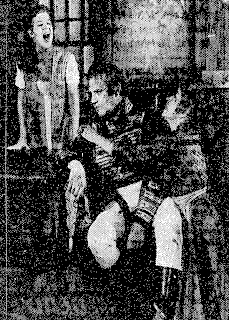
That production did boast performances, though, by Ingrid Bergman, Arthur Hill, and Coleen Dewhurst, pictured below. That must have been quite a show to see!

Sunday, February 27, 2022

A Touch of the Poet

Last night, I saw Irish Rep's production of A Touch of the Poet, a long-delayed production of a long-delayed play by Eugene O'Neill.

At the beginning of 2020, I was very much looking forward to seeing the show on stage. Then COVID-19 changed everyone's plans. The world was placed in lockdown, and live theatre suddenly became illegal.

While most of New York City's wealthy and prestigious arts organizations went into mothballs, shutting down completely, and laying off all but their most privileged and highly paid employees, little Irish Rep decided to throw themselves into doing everything they could to keep theatre alive.

Virtual performance seemed the only option, but how do you stage A Touch of the Poet in little rectangles? It seemed impossible, but Irish Rep managed to stretch the medium, providing a virtual background, costumed performers, and innovative camera work to try to make it appear that actors were in the same room when in reality they might be on opposite sides of the country.

The results were mixed. Some moments, like when Con (played by Robert Cuccioli) stared into the mirror, were brilliant, while others labored under the difficulties of virtual performance. Still, it would be churlish to fault the artists, who in the midst of a disastrous pandemic were giving their all. It was great to see those same performers now able to act with their full bodies and to interact with one another viscerally in a way they couldn't in cyberspace.

Cuccioli, who was so devilishly good the previous fall in Mrs. Warren's Profession, perhaps had the least difficulty with the virtual performance, since in the play Con keeps himself so aloof from the other characters. Other performers were not quite so lucky. James Russell, who had an opportunity to shine in Irish Rep's production of The Shadow of a Gunman, got lost in those little rectangles, but he gives a memorable performance onstage as the barkeep Mickey Maloy.

As Con's daughter Sara, Belle Aykroyd had an even greater challenge trying to give a virtual performance, but now she is able to soar. Sara passionately throws her arms around her father in a way that simply was not possible when actors were being Zoomed onto a virtual stage.

I plan to write a full review of the production for The Eugene O'Neill Review, so I won't say much more about the show now (other than that you should go see it). However, I think it's worth reflecting on not just how this production took so long to get to the stage, but how the play itself had such a difficult journey from when O'Neill first finished writing it in 1942 to when it finally received its world premiere in 1958.

O'Neill had originally conceived of the work as a part of a massive cycle of plays telling the story of one family across American history. After completing the plays, though, O'Neill was unsatisfied with his work, and he destroyed all but two of them, A Touch of the Poet and its sequel More Stately Mansions. It was not until after he died in 1953 that anyone could even get a look at the unpublished masterpieces he had left behind him.

Among his plays left unpublished at his death was O'Neill's most famous work, Long Day's Journey into Night, which premiered in 1956. A Touch of the Poet was published the following year, and the New York Times wrote that in comparison to Journey it seemed "a temperate play." Well, that's only in comparison, since O'Neill's Poet is filled with emotional fireworks.

The world premiere of the play occurred at the Royal Dramatic Theatre in Sweden, and the piece subsequently opened on Broadway at the Helen Hayes Theatre with Eric Portman as Con and Hayes herself as Con's wife Nora. Reviews exalted the long-delayed work, though O'Neill himself seems to have had doubts about it.

So Irish Rep's delay of nearly two years in bringing A Touch of the Poet to the stage has a precedent. Fortunately, it was well worth the wait.

Saturday, July 17, 2021

The Devil's in the Details

Today I presented my paper "Comic and Tragic Adultery in Shaw and O'Neill" at the Shaw Summer Symposium online.

The talk was inspired by the fact that the Shaw Festival in Niagara-on-the-Lake is this season producing both Bernard Shaw's comedy The Devil's Disciple and Eugene O'Neill's tragedy Desire Under the Elms, which both ask if an illicit relationship could be more authentic than a legal marriage.

Alas, the border with Canada remains closed, and the festival advised the International Shaw Society that they would not be able to host their annual conference this year. Instead, the symposium went virtual for the second time in a row. I was happy to speak, though, as part of a panel that included both Ellen Dolgin and Brigitte Bogar, two of my favorite people in the Shaw world.

After a lunch break, there was another panel, in which Mary Christian drew links between Shaw's Major Barbara and George Eliot's novel Romola. She was joined by Oscar Giner, who talked about devil figures and rebellion in both The Devil’s Disciple and Lope de Vega's Fuenteovejuna. The final speaker on the panel was Jean Reynolds, who discussed language issues in Shaw's Pygmalion.

Brad Kent gave a brief presentation on the Oxford World's Classics Shaw volumes, and then there was a roundtable discussion on editing and publishing scholarship on Shaw in academic journals. We were fortunate enough to have the editors of Shaw: The Journal of Bernard Shaw Studies, Modern Drama, and Victorian Studies. The day concluded with a reading of the play Pygmalion Continued, by John McInerney.

Tomorrow, there will be panels on Shaw and Ireland and Shaw's international reception. The conference is free, but you do have to register if you want to attend any of the events.


Thursday, July 15, 2021

A Certain Club

Tomorrow, the International Shaw Society begins its virtual conference. Attendance is free, but you do have to register.

I will be speaking on Saturday about links between Bernard Shaw's The Devil's Disciple and Eugene O'Neill's Desire Under the Elms. Both of them portray potentially adulterous relationships, but in radically different ways.

As part of my preparation for the talk, I went to the Players Club, which houses the Hampden-Booth Theatre Library. archives. They had a great deal of information, including a mammoth scrapbook dedicated to the 1950 Broadway revival of The Devil's Disciple starring Maurice Evans.

The collection also has correspondence from Charles Rann Kennedy to Walter Hampden. Kennedy played Anthony Anderson in the 1907 London production of The Devil's Disciple, though he's probably better known today as a playwright. His first big success didn't come until the following year with The Servant in the House. He went on to write such plays as The Winter Feast, The Necessary Evil, and The Rib of Man. Walter Hampden is probably best known for playing the Archdeacon in the 1939 film version of The Hunchback of Notre Dame.

Going into the research at the Players Club, I wasn't quite sure what I would find, but the archivist was wonderfully helpful, and it's fun just to be able to go into the club. There's so much history there, and now that I know how friendly they are to researchers, I'll definitely be back in the future.

This evening, I also got to see some live theatre. Greenhouse Ensemble is doing an outdoor production of William Shakespeare's Twelfth Night in Central Park. I got there a few minutes late, so I missed the beginning, but the show's a great deal of fun. If you have a chance, make sure to see it!

Friday, June 11, 2021

The Drama Book Shop

Today, I got a chance to visit the newly reopened Drama Book Shop in Midtown. It was great to finally be able to return!

The Drama Book Shop used to be over on West 40th Street, but it shut down when the landlords figured they could make more money leasing the space to a high-end clothing store. A group of investors, including Lin-Manuel Miranda, bought the remaining stock of the bookstore and promised to reopen is somewhere in the same neighborhood.

Well, there were the inevitable delays, and then COVID hit, so the reopening has been a long time coming. The selection on hand looked about the same as it has always been, though I noticed they also had a section in the front for "Bestsellers" that included novels, poetry, and other books that had nothing to do with the theatre, which I don't remember from the past.

There used to be a theatre downstairs from the bookstore, where I had a reading of a selection from The Mysteries of the Castle of the Monk of Falconara as part of the book launch for The Best American Short Plays: 2005-2006. I was down there more recently for a talk given by the director Ivo van Hove. The new location of the Drama Book Shop has a roped-off staircase leading down to... dare we hope a theatre?

The new location also has a cafe, so you can get snacks and beverages. Currently, management is recommending that you make a reservation to be sure you can get inside, since capacity is capped. When I showed up on a Friday afternoon, though, they just waived me in without checking my reservation, so it looks like they're taking walk-up browsers, provided the store isn't too full.

I bought a volume of some Eugene O'Neill plays while I was there, and I look forward to spending more time reading this summer. Thank goodness the Drama Book Shop is open again for hungry readers like me!

Thursday, December 31, 2020

Top Shows (that I missed) in 2020

In past Decembers, I have come up with a list of the best shows I saw that opened in New York City that year. Well, for 2020, that list would have to be pretty short.

Sure, I could talk about Blessed Unrest's Battle of Angels, and Irish Rep's Lady G, and end with Roundabout's standout production of A Soldier's Play, but for the most part, 2020 was a total loss when it came to live theatre.

Instead, I'm going to write about ten shows I missed, plays I was looking forward to seeing live, but couldn't experience because massive government incompetence turned a completely predictable (and predicted) outbreak into the worst health crisis since the influenza of 1918-1920.

This year was supposed to be one of world travel for me, rather than confinement to mostly just four small rooms. That's why my list is not restricted to just New York City this year. Here are ten shows I should have seen, would have seen, and likely would have loved, had it not been for the dumpster fire of 2020:

10. A Touch of the Poet. Okay, this one is partially my fault, since Irish Rep went ahead and produced this Eugene O'Neill play digitally. I was looking forward to seeing it live, though, and Zoom fatigue combined with the added work of trying to teach classes online meant that I missed the virtual performance. I still blame 2020.

9. Hangmen. Was Martin McDonough's latest play going to be a masterpiece? Maybe. Maybe not. But New York never got to find out, because it was still in previews when COVID-19 shut down theatres. Some shows vowed to reopen once the crisis passed, but as it became clear that the shutdown would last for weeks and then months, producers had to pull the plug on this one.

8. Man of La Mancha. The Astoria Performing Arts Center had planned a revival of this classic musical, to be directed by Dev Bondarin, whose work I've always loved. Fortunately, APAC is still going, though other theatre companies have been forced to fold. Theatre in Queens took a big hit when the Secret Theatre announced its closure this year. The one bright spot is that APAC will be taking over the space they've vacated.

7. As You Like It. The Public Theater has experienced tremendous success with its Public Works productions in Central Park, bringing together professional artists and amateurs in a celebration of all that's great about New York City. Shaina Taub did an excellent job composing music for 2019's production of Twelfth Night, and I was looking forward to hearing her score for As You Like It. It looks like I'll have to wait a bit longer now.

6. Richard II. The Shakespeare in the Park production I was really looking forward to seeing this year, though, was Richard II. Though I've seen multiple filmed versions of the play this is the only one in the Shakespeare canon I've never experienced live. After the shutdown, director Saheem Ali organized a radio version of the piece that aired on WNYC. You can listen to each of the four episodes, which are available as podcasts, though it's certainly not the same thing.

5. The Prince of Egypt. After attending a Shaw conference in Spain this May, I was supposed to spend some time with my sister in London. She had already gotten us tickets to see the stage adaptation of Stephen Schwartz's The Prince of Egypt at the Dominion Theatre. The movie was delightful, and the score does seem to lend itself to a stage transfer, so I was looking forward to seeing how it works on stage, as well as spending some time with my sister. Instead, I've only been able to see her virtually this year.

4. Leopoldstadt. Even more exciting than The Prince of Egypt was the other show my sister had gotten us tickets to see. Tom Stoppard's new play Leopoldstadt opened this January in a production directed by Patrick Marber, who had done such a brilliant job directing Stoppard's Travesties. Of all the shows playing in London this year, this was the one I really, really wanted to see. It tells the stories of members of the Jewish community in Vienna during the first half of the 20th century. We had tickets, but now I don't know if I'll ever have a chance to see it.

3. The Devil's Disciple. Though the Shaw conference in Spain was cancelled due to COVID-19, I briefly entertained hopes of attending another Shaw conference in Niagara-on-the-Lake in Canada. Instead, that conference went virtual, and the Shaw Festival decided to postpone its summer season for the summer of 2021. That means I might still get a chance to see the Shaw play they were supposed to do this year, The Devil's Disciple. Incidentally, Gingold Theatrical Group had planned to produce the same play this autumn. Will it be possible in 2021? We're still not sure.

2. Great Expectations. This play isn't an adaptation of the work by Charles Dickens, though I would have been excited about that, too. No, this Great Expectations is a reworking of my own short play The Rainbow, but for two older actors. A friend of mine, Ellen DiStasi, approached me earlier this year about doing The Rainbow with Theater of Light, which brings live drama to communities of older folks here in New York. Ellen asked if I could update the script to be performed by more mature actors, so a woman who had recently had a break-up became a widow, and there were a few other changes as well. The biggest thing, though, was that Ellen wasn't sure that a long monologue about a D.H. Lawrence novel would work for her target audience, so I changed it to a monologue about Great Expectations instead, which naturally changed the title of the play as well. I'd love to be able to do this show in 2021, but a play performed by members of a vulnerable community for other members of a vulnerable community....

1. The Love Songs of Brooklynites. I've been working on a full-length version of my one-act play that was workshopped in 2019 at the Theatre of Western Springs. Meanwhile, the one-act version was accepted for the theatre trail at the Arundel Festival of the Arts in the United Kingdom. The Drip Action Theatre Company in Arundel says they want to do the show this upcoming year. That would be wonderful. Though I've had my work performed in Canada, Australia, and even Japan, I've never had a production in the U.K., and Arundel looks like an amazing place to visit. Perhaps I'll be able to go this August and see it. Whether that happens or not, I'm still holding out hope for the full-length version of The Love Songs of Brooklynites to have a New York production once the theatres reopen. That means we're all going to have to wear masks, limit unnecessary travel, and get vaccinated. It also means that the government needs to get its act together and actually distribute and administer the vaccines being produced. Only then are we going to be able to have great theatre back.