Showing posts with label Gothic. Show all posts

Thursday, April 30, 2026

Gothic Kennedy

Adrienne Kennedy has written a number of dark, brooding dramas, including Funnyhouse of a Negro and Ohio State Murders. Her 2018 play He Brought Her Heart Back in a Box, however, is truly Gothic.

One of the things I love about the play is its use of Christopher Marlowe's tragedy The Massacre at Paris, sometimes called Paris Massacre. In Kennedy's play, a group of school children are performing Marlowe's work just offstage, and the lines hauntingly comment upon the present action.

The Massacre at Paris is an odd play for a school to produce, but as Kennedy notes in her stage directions, the piece "was chosen for unknown reasons" by the man who controls the school's governing committee and who lurks in the shadows through much of the story. Kennedy's play opens with lines recites by the Duke of Guise in Marlowe's work:

Although my downfall be the deepest hell
For this I wake when others think I sleep
For this I wait that scorns attendance else
For this my quenchless thirst... whereon I Build...

Harrison Aherne, the Gothic villain who chose that play to be performed, is a builder, and has made sure that the town of Montefiore, Georgia, where much of the action takes place, will enforce strict racial hierarchies. Like the Duke of Guise, his thirst for power seems to know no limits. Later, we hear lines spoken by the Queen Mother, Catherine de Medici:

My noble son and Princely Duke of Guise,
Now have we got the fatal straggling deer
Within the compass of a deadly toil
And as we late decreed, we may perform.

What they plan to perform, of course, is the Saint Bartholomew's Day Massacre, when Roman Catholics slaughtered Protestants in the street. This is an ominous beginning to a play that deals explicitly with the Jim Crow South right before the U.S. entered World War II. Aherne's son, Christopher, shares Marlowe's first name, and like the playwright, he can sometimes be difficult to pin down on exactly how he feels about the events he describes.

Those events involve racial oppression and hints of murder, though many specifics remain tantalizingly elusive. I won't give away the play's shocking ending, but will note that it returns to Marlowe's words at its close.

Kennedy is once of our greatest living dramatists, and her works should be performed more often.

Sunday, February 15, 2026

The Castle Spectre

Matthew G. Lewis is best known as author of the Gothic novel The Monk, but he also wrote numerous dramas, including The Castle Spectre.

The play premiered in 1797, the year after Lewis published The Monk. While the novel featured numerous supernatural events, ghosts and spirits were frowned upon for the stage at the time. Consequently, most audience members probably didn't expect any spectre to appear, in spite of the play's title.

When the first playbills were issued, they neglected to mention any ghost in the cast. This no doubt encouraged audiences to take a more rationalistic approach to the drama. The play's fool Motley relates that there are numerous stories related to ghosts in the castle, commenting, "Had I minded all the strange things related of this Castle, I should have died of fright in the first half hour."

Toward the beginning of Act IV of the play, the conscious-stricken villain Osmond claims to have seen the ghost of Evelina, the woman he murdered many years ago. Since he is wracked with guilt, this might merely be his own hallucination, much like Lady Macbeth seeing her fair hands covered in blood. Osmond is also reminded of Evelina since her daughter Angela has now grown into a woman who much resembles her deceased mother, and Osmond in fact says he initially mistook the ghost for Angela.

Audiences had every reason to be shocked, then, when the spectre of Evelina did in fact appear on stage at the end of the act. Lewis's stage directions indicate an elaborate effect:

The folding-doors unclose, and the Oratory is seen illuminated. In its center stands a tall female figure, her white and flowing garments spotted with blood; her veil is thrown back, and discovers a pale and melancholy countenance; her eyes are lifted upwards, her arms extended towards heaven, and a large wound appears upon her bosom.

Evelina's ghost comes onstage again in the final act, coming between Osmond and her former husband who is about to be slain by him. It is then that Angela stabs Osmond, preventing the villain from committing any further murders.

Lewis's play was performed over and over again throughout the decades to come, both on real stages and in toy-theatre versions, like the one below, printed by the publisher Dyer. The drama's spooky effects apparently worked on multiple scales.


Incidentally, if you're interested in toy theatres, I recently wrote an article about them that ran in the most recent issue of Theatre Notebook.

Friday, January 30, 2026

Passion

The first Stephen Sondheim musical I ever saw on Broadway was Passion, his 1994 collaboration with director and book writer James Lapine.

In spite of winning the Tony Award for Best Musical, the play closed at the beginning of the next year, earning it a less-than-stellar reputation. Lately, however, I've found multiple students talking about the piece, having seen the filmed version of the original staging that aired on PBS and has subsequently become more widely available.

Recently, I picked up a used copy of the DVD of this version, which I watched today. It was my first time seeing Passion since 1994, though I've listened to the cast recording countless times. As some of the original artists mention on the commentary track of the DVD, the recording is one of the best ever done of a stage musical, in part because it was shot on film in an empty theatre after the show closed, so it was possible to get very high-quality close-up shots.

Passion famously opened with a nude scene.  The audience got to see the characters Giorgio and Clara in bed making love, with no attempt to cover up the woman's breasts with one of those odd, L-shaped sheets that seem only to exist on network television. For the filmed version, however, up comes the sheet, sparing the viewer the sight of Marin Mazzie's breasts. Mazzie went on to greater fame, playing Mother in Ragtime and appearing in a revival of Kiss Me Kate, but she was also stunning in Passion.

The more interesting part in the show, however, is Fosca, a role originated by Donna Murphy. I loved her when I first saw her in Passion, and was greatly impressed by her range when I later saw her in Wonderful Town. (Younger fans probably know her as the voice of Mother Gothel in Tangled.) The production also boasted Sondheim veteran Tom Aldridge, who had previously played the Narrator and Mysterious Old Man in the original production of Into the Woods. In Passion he plays a doctor who induces Giorgio to take an interest in the sickly Fosca, with some disastrous results.

Sondheim wanted to write the piece after seeing the Italian film Passione d'amore directed by Ettore Scola. The film was itself based on an 1869 novel called Fosca by the Gothic writer Iginio Ugo Tarchetti. The character of Fosca is remarkable both in how repulsive she is and how fascinating at the same time. In a pivotal scene, she shows up on a train in which Giorgio is trying to flee from her. I remember how when I saw the play on Broadway, she asked Giorgio if he wanted her to leave his compartment on the train, and the man behind me uttered under his breath, "YES."

It's the play's ability to elicit that kind of gut-level reaction that makes me really admire the piece. The good news is, a whole new generation is getting to experience it now, thanks to the availability of the filmed version.

Sunday, November 2, 2025

Frankenstein in Jersey

There have been numerous stage adaptations of Mary Shelley's novel Frankenstein, going back to Richard Brinsley Peake's Presumption in 1823.

The gothic tale has also provided plenty of material for film, beginning with a 1910 short made by the Edison studio, and continuing through to the Guillermo del Toro epic recently released by Netflix.

I was particularly keen to see the stage adaptation being performed now at Shakespeare Theatre of New Jersey. It uses a script penned by David Catlin for the Lookingglass Theatre Company in Chicago and is directed by STNJ's artistic director, Brian B. Crowe.

This adaptation uses as a framing device the famous story-writing contest at Villa Diodati in Switzerland in 1816. Mary Shelley (played by Amber Friendly) becomes Elizabeth, her common-law husband Percy (Sean-Michael Wilkinson) becomes Victor Frankenstein, and their friend George Gordon Byron (Jay Wade) appropriately emerges as the monster.

Also present during that fateful summer by Lake Geneva was Byron's personal physician John Polidori (Neil Redfield) who semi-plagiarized Byron's tale and published the first famous vampire story in English. Polidori goes on to enact a number of roles in this production, including Victor's friend Henry and the ship captain who encounters first Victor and then the mysterious creature.

We wouldn't know as much as we do about that summer at Villa Diodati were it not for Claire Clairmont (Brooke Turner), Mary Shelley's stepsister who kept a detailed journal that year while waiting for the birth of the child she had with Byron. Claire plays Victor's mother in this adaptation, among a number of other roles, and sometimes nearly steals the show.

The play is showing until November 16th at the F.M. Kirby Shakespeare Theatre in Madison, New Jersey. It's just a short distance from the train station in Madison, on the beautiful campus of Drew University, and it's well worth a trip!

Saturday, October 25, 2025

Monsters, Monsters, Monsters!

It been a spooky season, and I've been watching a lot of spooky films. Last night, I saw The Phantom Carriage, directed by Victor Sjöström, who also plays the protagonist in the 1921 silent.

The film uses double exposure to create haunting images, and seems strongly influenced by A Christmas Carol. By the 20th century, I imagine that not only Charles Dickens's novella but several stage versions of it had become widely known in Sweden, where the film was made. The movie's plot revolves around not Christmas but New Year's, which makes the film also reminiscent of another supernatural piece by Dickens, The Chimes.

Recently, I was curious to learn of a dark Tennessee Williams film adaptation, The Fugitive Kind. It's based on Orpheus Descending, which reworked a previous Williams play, Battle of Angels. I had to look the film up after I found out it was directed by Sidney Lumet with a host of great actors, including Marlon Brando, Anna Magnani, Joanne Woodward, and Maureen Stapleton. Brando was paid a million dollars to be in the film, which was unheard of in 1960 when the movie was released.

In spite of Brando's star appeal, the film lost money. It did better than Battle of Angels, though, which closed during tryouts in Boston. The reworked version, Orpheus Descending, did much better, running for 68 performances at the Martin Beck on Broadway. Stapleton played the female leading role of Lady on stage, but was replaced with Magnani in the film, taking on instead the substantial but smaller role of Vee. The story, in all of its iterations, is a Southern Gothic tale of lust, revenge, and murder.

This evening, I watched another spooky movie, Guillermo del Toro's new adaptation of Frankenstein by Mary Shelley. Like A Christmas Carol, that novel has been adapted for the stage over and over again. In fact, next weekend I'll be seeing a new stage version at Shakespeare Theatre of New Jersey. Monsters, figurative or literal, tend to do well on stage, especially this time of year.

Saturday, July 27, 2024

BARS 2024

I’ve been in the United Kingdom for the 2024 conference of the British Association for Romantic Studies in Glasgow.
 
The conference kicked off on Tuesday with a talk by Michelle Levy on women writers and publishing. Though we often think of authors in the 18th and 19th centuries as selling their copyrights outright, Levy noted that this often was not the case. She gave particular attention to the poet Phillis Wheatley, who appears to have received half of the print run of her poems to sell herself for her own profit.
 
Next, I chaired a panel on Faustian Romanticism. Three speakers addressed how the Faust dramas of Christopher Marlowe and Johann Wolfgang von Goethe influenced British Romantic writers. Martin Potter discussed Faustian elements in Mary Shelley’s Frankenstein, while also addressing the E.T.A. Hoffmann short story “The Sandman.” Liz Wan talked about how William Godwin’s novel St. Leon could be read as a Faust story, and Maddy Potter addressed Faustian elements in both John Polidori’s The Vampyre and Charles Robert Maturin’s Melmoth the Wanderer.
 
Later in the afternoon, I went to a panel on P.B. Shelley, since multiple speakers were scheduled to address Shelley’s play The Cenci, with which I have a particular interest. Anna Mercer compared the play to Mary Shelley’s novel Valperga, which also features a Beatrice who suffers a horrible fate. She mentioned that Mary Shelley even quoted from her husband’s play in her journal long after he had died. Nora Crook later went into detail about the various manuscripts that the Shelleys might have had access to that discussed the story of Beatrice Cenci. She also drew parallels between the play and G.E. Lessing’s Emilia Galotti.
 
The final panel I attended on Tuesday was on remediating the supernatural. Natalie Tal Harries mentioned that Walter Scott collected books on witchcraft and demonology and justified his use of superstition in a note on his poem The Lady of the Lake. Orianne Smith also discussed Scott, focusing on his novel Guy Mannering, a book from which Sarah Siddons often performed readings after her retirement from the stage. The character of Meg Merrilies in the book became a favorite in stage adaptations of the novel. Haya Alwehaib spoke last, comparing Mary Shelley’s Frankenstein with The Arabian Nights. We then headed over to Glasgow City Chambers for a drinks reception in a beautiful setting.
 
Wednesday there was a plenary roundtable with Elizabeth Edwards, Craig Lamont, and Tim Fulford. My big activity for the day, though was chairing a session on Romanticism’s legacies in fantasy literature. Will Sherwood talked about William Blake’s influence on J.R.R. Tolkien, noting that while most people focus on how Tolkien’s work as a medievalist influenced his fiction, he was greatly influenced by Romantic writers as well. Annise Rogers discussed the Romantic legacy in Ben Aaronovitch’s fantasy series The Rivers of London. Jason Whittaker then spoke on the influence William Blake had on Glasgow’s own Alasdair Gray, who like Blake was both a writer and a visual artists. That evening, the conference banquet was held at Òran Mór, a restaurant in a former church that is graced by murals designed by Gray.
 
My own paper was scheduled for Thursday. I began the day at a panel on the Gothic. Samiha Begum discussed Ann Radcliffe, a writer who appears as a character in my own play The Mysteries of the Castle of the Monk of Falconara. Radcliffe, who was influenced by the paintings of Claude Lorrain and Salvator Rosa, was propelled to fame with her novel The Romance of the Forest and received 500 pounds for her next book, The Mysteries of Udolpho at a time at which the average royalty payment for a novel was only 80 pounds. Interestingly enough, gossip recorded by Anna Seward held that Radcliffe had written Joanna Baillie’s anonymously published Plays on the Passions. I was also interested to hear Jakob Lipski speak on the 1803 historical novel Thaddeus of Warsaw and Laura Eastlake discuss links between vampires and volcanos.
 
In my completely neutral, unbiased, unprejudiced opinion, however, my panel was the best. It began with Bethan Elliott discussing the plays of Baillie (not Radcliffe). She quoted from an 1804 letter Baillie wrote to fellow dramatist William Sotheby. Though Sotheby (who had not had the success on stage that Baillie achieved) urged her to focus on “reading” plays rather than “acting” plays, Baillie held that the qualities that make a play good for acting also make it good for reading. Baillie was not snobbish about how her plays were performed, either, and in 1810 wrote to Walter Scott about being pleased that one of her plays had been performed at a fair. The one play Baillie wrote that she did not think was fit for performance was The Martyr, but that was because of its religious subject matter, not because she didn’t deem it an “actable” piece.
 
My paper was on J.H. Amherst’s play The Death of Christophe King of Hayti. Its depiction of armed women was naturally interesting to the third panelist, Sarah Burdett, who has written extensively on that subject. Her paper was on stage adaptations actresses had written of the poems of Walter Scott. Sarah Smith, who was a favorite of Scott’s, wrote adaptations of both The Lay of the Last Minstrel and The Lady of the Lake performed at the Crow Street Theatre in Dublin. Eliza Macauley, an actress who had a difficult relationship with the Crow Street Theatre, wrote an adaptation of Scott’s Marmion that took a character who only appears in a single Canto of the poem and made her the center of the adapted drama.
 
On Friday, conference delegates could opt for a trip to New Lanark and the Falls of Clyde, which provided some very dramatic landscapes. All in all, it was a wonderful conference!

Monday, September 5, 2022

Alice in Toytheatreland

When I was last abroad, I was thrilled to see an exhibit of gothic toy theatres at Strawberry Hill, the former home of Horace Walpole.

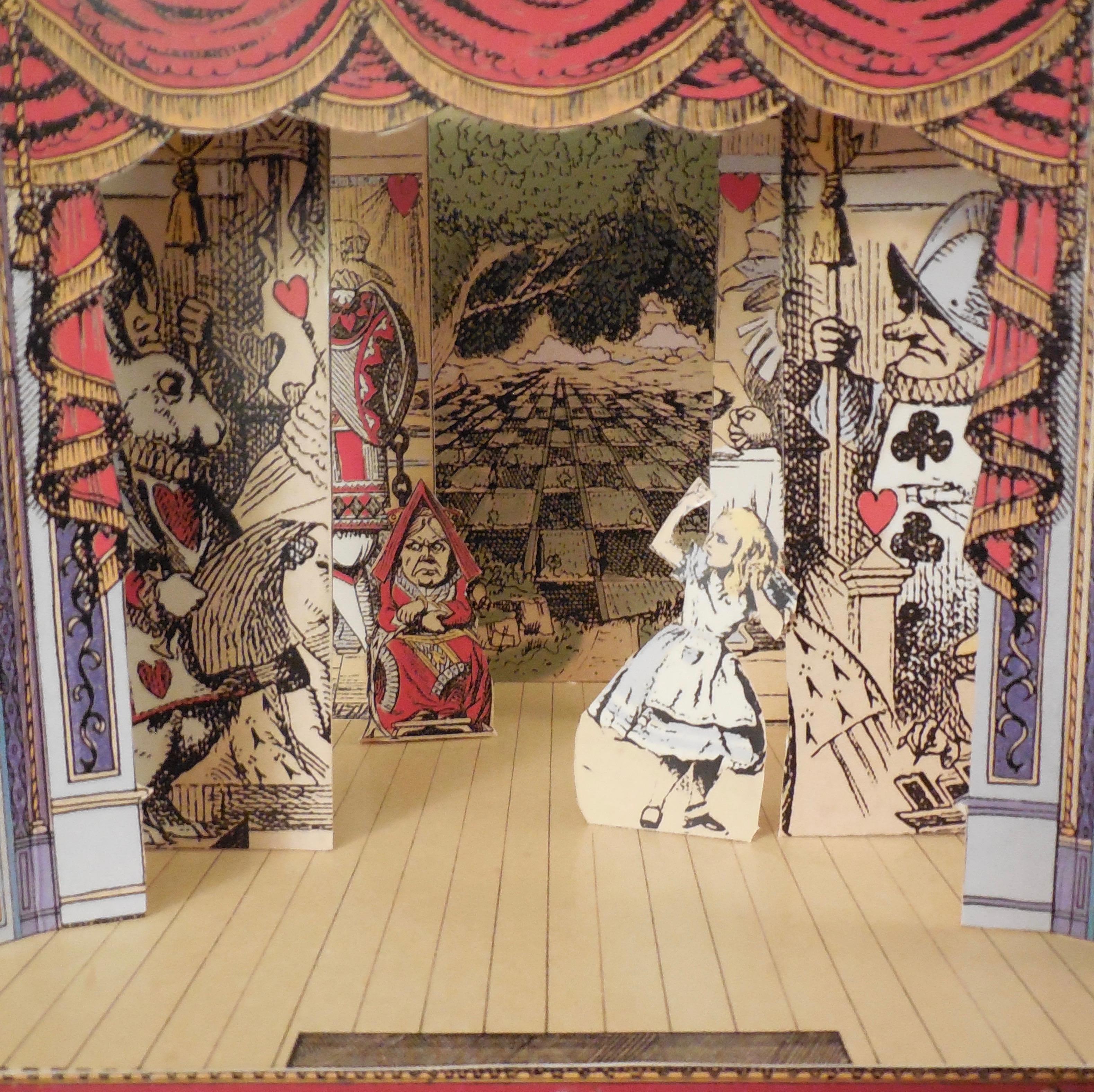
I'd previously built a toy theatre version of Charles Dickens's Great Expectations, but the gift shop had a kit for building a toy theatre for Alice in Wonderland.

As readers of this blog know, I wrote my own stage adaptation of the Alice books, so it will come as no surprise that I bought the kit. It came as a printed book with cardstock pieces that can be cut out and glued together into a miniature theatre.

When you assemble the toy theatre, it looks like this:


The audience gets the full experience: the orchestra in the pit, spectators in the side boxes, and a full proscenium. Then the curtain goes up, and as the show begins, we see Alice out in the woods:


What's that? A white rabbit with a pocket watch? Alice tries to follow him and falls down, down, down the rabbit hole. The white rabbit is nowhere to be seen, but she spies a little door with a tiny keyhole...


Finding a bottle with the label "Drink Me" Alice decides to take a sip. Remember, though, kids, you shouldn't drink strange things when you don't know where they come from, especially if they're labeled "POISON" because if you drink poison, it is almost certain to disagree with you sooner or later.


And look at what happened to Alice! She drank from the bottle and shrank down to a teeny tiny size. There was also a very small cake with the words "Eat Me" on it, and Alice, being Alice, decided to give it a try.


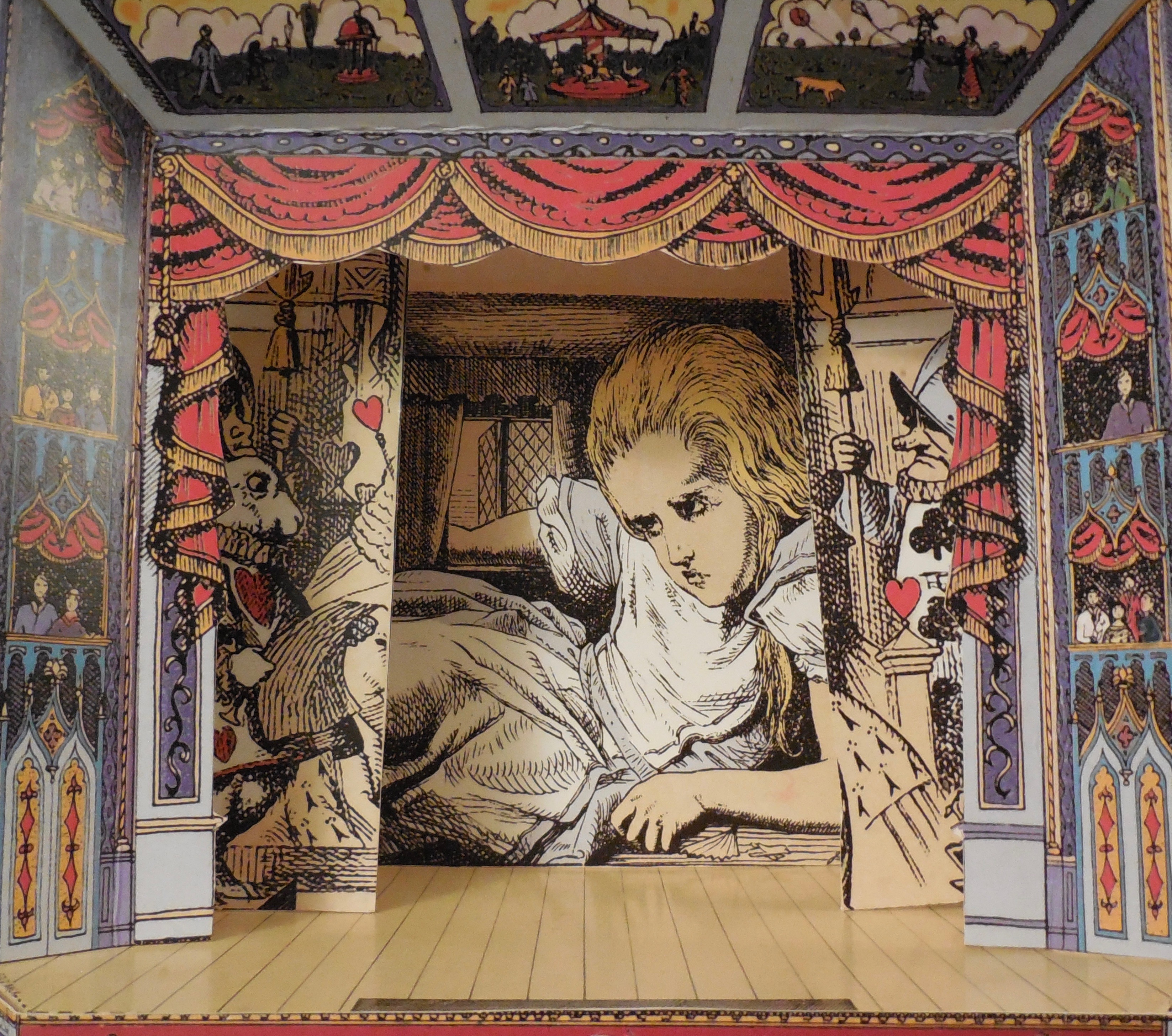
Wouldn't you know it? After eating a bit of cake, Alice began to grow. Pretty soon, she was back to her normal size. The only problem was, she didn't stop growing. Alice grew and grew until...


...she could hardly fit inside the theatre! Distraught by this turn of events, Alice began to cry, until she realized she could just take a swig from the bottle and shrink again. The only problem was, when Alice shrank, she was washed away by a sea of her own tears until she arrived in Wonderland...


The first creature Alice came across was a Caterpillar, sitting on a magic mushroom, and smoking something nasty-smelling out of a hookah. Fortunately, Alice had learned in school to Just Say No to Drugs, so she passed the Caterpillar right by...


Alice came across a Duchess holding a baby. Alice had never met a Duchess before (though she had met many babies). The Duchess offered to give the baby to Alice to nurse for a bit, since she had to go play croquet with the Queen.


As soon as Alice took the baby, however, it promptly turned into a pig! (Don't you hate it when they do that?) Alice decided to put the pig down beside a tree, but as the little pig ran away, she heard something purring up in the tree...


It was a Cheshire Cat, grinning from ear to ear. "Would you tell me, please, which way I ought to go from here?" asked Alice. "That depends a good deal on where you want to get to," said the Cat. "In that direction, lives a Hatter, and in that direction lives a March Hare. Visit either you like: they're both mad."


Alice didn't want to go among mad people. She'd seen Hatters before, but none quite like this one. He asked funny riddles and sang a silly song. It ended up being the stupidest tea party she ever was at in all her life!


Alice left the tea party and saw little men who looked like cards painting white roses red in order to please the Queen of Hearts. She thought this queen sounded like a rather unpleasant person, but she did love to play croquet...


"Who is this? What's your name, child?" the Queen asked her. "My name is Alice, so please your Majesty," said Alice, with a curtsy. "And why are you not bowing before me?" thundered the Queen. "Off with her head!"


Instead of executing Alice, the Queen handed her a croquet mallet. Imagine Alice's surprise when the croquet mallet turned out to be... a flamingo!


"Oh my fur and whiskers! She'll get me executed, as sure as ferrets are ferrets!" Alice turned and saw the White Rabbit. He was dressed in livery and blowing a trumpet to announce a new trial. Someone had stolen the Queen's tarts...


The first witness at the trial was the Mad Hatter. He hadn't stolen the tarts, he said, and even if he had, he was not guilty by reason of insanity.


Next, the Queen called for the Cheshire Cat to appear. The Cat was about as cooperative of a witness as you would expect a Cat to be. The Queen was irate, and yelled, "Off with his head!"


Then, the Cheshire Cat disappeared... except for his head! "They'll never be able to cut off a head unless there is a body to cut it off from," said the White Rabbit. "Nonsense!" roared the Queen. "Anything that has a head can be beheaded."


Unable to execute the Cat, the Queen ordered that Alice be executed instead. "You can't hurt me," said Alice. "You're all just a pack of cards!" With that, all of the cards shrank smaller and smaller. Either that, or Alice grew larger and larger, until...


She could hardly fit in the theatre again!


Alice then awoke to find herself back where the whole story began. Perhaps the whole thing had been a dream!


That's the show, folks. I hope you enjoyed it!

Friday, July 15, 2022

Gothic Toy Theatres

This week, I was supposed to have arrived back from London just in time to see the opening of my new play, My Fellow Americans.

Well, I got back in time, alright, but then tested positive for a pesky virus. Fortunately, I haven't been near cast and crew since my return. That means the show will go on, and hopefully I'll be testing negative soon and will be able to see it for myself!

Where did I catch the bug? Well, I can't be sure, but the United Kingdom seems to be following the example of their outgoing Prime Minister in taking infections with as little seriousness as possible. I tried to mask whenever I could, but you have to take a mask off to eat and drink, which means that eventually you'll be vulnerable.

While there, however, I did get a chance to go back to Horace Walpole's estate at Strawberry Hill, where there is an exhibition on gothic toy theatres. The exhibition is titled "Cardboard Gothic: Damsels, Demons, and Heroes" and it contains miniature theatres from Pollock's Toy Museum. I was thrilled to be able to see so many toy theatres in such an amazing setting. For instance, take a look at this one:


This modern toy theatre was made in collaboration with the Museum of Witchcraft and Magic in Cornwall. (Who knew there was such a place?) Though the design is modern, it was created using the same techniques used to print toy theatres all the way back in the Regency era. At Strawberry Hill, it is displayed at the foot of the grand staircase, leading up into Walpole's outlandish summer retreat.

During the early nineteenth century when toy theatres were popular, melodramas frequently dominated the stage, so it is no coincidence that many of these miniature stages enact melodramas. One example is the toy theatre version of The Mistletoe Bough by Charles A. Somerset. The play premiered at the Garrick Theatre on Leman Street in 1834. You can see here a toy version based on designs John Reddington executed sometime around 1859:


One of my favorite melodramas is Raymond and Agnes, also known as The Travelers Benighted, which retold the subplot of the Bleeding Nun from Matthew G. Lewis's novel The Monk. Here's a closeup of a toy theatre showing the key moment where the ghostly nun entreats the hero to protect the innocent heroine:


Horace Walpole's novel The Castle of Otranto has been adapted for the stage many times (including by me). On the toy theatre stage, however, it was generally seen in a spoofed version, Harlequin and the Giant Helmet, written by J.R. Planche. This toy theatre version issued by J.K. Green is currently on display in Walpole's library:


By far, the most popular toy theatre adaptations were of Isaac Pocock's melodrama The Miller and His Men. This 1813 play ended with a spectacular onstage explosion, which young theatre fans could re-enact in paper, looking something like this:


If you happen to find yourself in London between now and September 14th, when the exhibition closes, you'll definitely want to go to Strawberry Hill to see it. Just make sure you wear a mask! We need to try to keep the drama onstage...

Thursday, December 30, 2021

T. P. Cooke

In a recent post, I wrote about Margaret Somerville Bunn, one of the performers highlighted in The Biography of the British Stage in 1824. Today, I want to discuss an even more famous actor featured in that book: Thomas Potter Cooke.

A regular fixture in English melodramas of the early 19th century, Cooke was a former sailor who also excelled at playing sailors on the stage. According to his entry in The Biography of the British Stage, young Cooke attended a nautical spectacle when he was only around 10 years old and became fascinated by the sea. In 1796, he became a member of the Royal Navy and sailed on the H.M.S. Raven to Gibraltar, Toulon, and the Mediterranean.

It was on board the Raven that Cooke experienced an infamous shipwreck. Sailors spent two days and nights clinging to the remains of the ship. Though many of his fellow mariners died, Cooke managed to reach shore. After a long fever, it was deemed he was not fit to return to service, and he left the navy. So enthusiastic was he for the sea, however, that after he recovered, he set sail again, this time on board the H.M.S. Prince of Wales. He continued to serve on that vessel until the Treaty of Amiens temporarily ended hostilities in 1802.

Though the agreement at Amiens ended up being only a brief intermission rather than the end of the Napoleonic wars, Cooke this time gave up the sea, and in 1804 he made his debut as an actor at the Royalty Theatre in Whitechapel. Cooke then accepted a position at Astley's Amphitheatre "upon liberal terms" according to The Biography of the British Stage. Two years later, he moved to the Lyceum Theatre, but ultimately he left London for Dublin, appearing at an amphitheatre on Peter Street. He returned to England in 1809, and Robert William Elliston got him to help run the Surrey Theatre.

Minor and provincial theatres were all well and fine, but in the early 19th century, serious actors were supposed to perform at one of the two patent theatres at Covent Garden or Drury Lane. Beginning in 1816, Cooke did appear in a series of melodramas at Drury Lane, as well as at Covent Garden, the Royal Opera House, and the Royal Coburg. Cooke had the honor of originating some of the most famous Gothic roles of all time, appearing as the title role in The Vampyre, based on the novel by John Polidori, as well as the creature in Presumption, the first stage adaptation of Mary Shelley's novel Frankenstein.

It was for his appearances in nautical melodramas that Cooke was most famous, though. He appeared as a sailor in Edward Fitzball's The Pilot, Douglas Jerrold's Black-Eyed Susan, and John Thomas Haines's My Poll and My Partner Joe, among other plays. No doubt his experience as an actual sailor aided him in providing verisimilitude.

Monday, August 30, 2021

Happy Birthday, Mary Shelley!

Today is the birthday of Mary Shelley, the gothic novelist who gave the world Frankenstein, a book that has been adapted to the stage over and over again.

In 1823, Richard Brinsley Peake wrote the first stage adaptation of Shelley's novel, which he titled Presumption; or, The Fate of Frankenstein. Later that year, however, he wrote a parody of his own play, Another Piece of Presumption, which featured a tailor named Frankinstitch. At one point, Frankinstitch calls out:

Every moment lost sticks in my gizzard! Good gracious how I have been cogibundating since I read that wonderful peculiar romance--I have cut out many a gentleman's coat, waistcoat and breeches, but now my ambition is to manufacture a gentleman itself.

Other parodies followed, including the anonymous Frank-in-Steam; or, The Modern Promise to Pay, which features "a natural and experimental Philosopher--in love and debt."

Most of us today are more familiar with film adaptations of Frankenstein, though. A 1910 film made by the Edison studio was recently restored and is now available on YouTube.

You might consider watching it to celebrate Shelley's birthday. (She would be 224 if re-animated today.) If not, just raise a glass to the young lady who made monsters!

Tuesday, August 17, 2021

British Romantic Theatre Salon

Covid-19 has cancelled a number of conferences, or at least driven them online. Last week, the British Association for Romantic Studies began its International Digital Conference, which runs until this Friday.

I've already Zoomed in for a panel on "Poetic Reckonings" that discussed Joanna Baillie, a panel on "Communicative Powers" that covered letters between Fanny Brawne and Fanny Keats, a panel on "Appropriations and Reworkings" that examined how German heroines were adapted for the London stage, and a panel on "Weaving the Gothic" that addressed the gothic tales of Percy Shelley.

Today's virtual salon on Romantic Theatre was the best, though. Sarah Burdett, from St. Mary's University in Twickenham, did an excellent job hosting the event. I was happy to find that she has a great interest in Samuel Taylor Coleridge's play Remorse and the actress Julia Glover who helped to make it such a success. I was also pleased to hear of other people who have taught Baillie's play De Monfort.

Though opportunities to see live theatre are still relatively few and far between, there are performances available online right now, and I discovered at the salon that Yale University's staged reading of the Horace Walpole play The Mysterious Mother is currently available on YouTube. Francesca Saggini, who teaches at Università degli Studi della Tuscia in Italy, is planning on doing some virtual readings of plays by Fanny Burney, which could be a lot of fun.

On Thursday and Friday, there will be more panels, including one on scandals around Lord Byron, and one on "Visuality and Self" that will cover Mary Robinson as well as other figures. Though it hasn't been as fun as attending the BARS Conference in Nottingham in 2019, I'm glad I've at least had some contact with other scholars of Romantic drama this summer.

Wednesday, January 1, 2020

The Chimes

Charles Dickens is inevitably associated with Christmas, but one of his books, The Chimes, takes place on New Year's, and a display at the New York Public Library pays tribute to a theatrical production of this tale of the New Year.

The full title of Dickens's 1844 novella was The Chimes: A Goblin Story of Some Bells that Rang an Old Year Out and a New Year In. It followed one year after the publication of A Christmas Carol, and though it actually takes place on New Year's, it was the second of five so-called "Christmas Books" Dickens published, the others being The Cricket on the Hearth, The Battle of Life, and The Haunted Man.

In "A Dickens Christmas," the exhibit showing on the top floor of the NYPL's Main Branch on Fifth Avenue, there's a playbill for a stage production of The Chimes performed "by the special permission of Charles Dickens, Esq." The production went up right after the book was published. It was performed at the Theatre Royal, Adelphi, which had recently been freed up to present "legitimate" drama after the passage of the Theatres Act in 1843.

The Adelphi began its life as the Sans Pareil Theatre run by Jane Scott, who staged Gothic melodramas like The Old Oak Chest. After Scott retired from the stage in 1819, her father sold the theatre, and the new owners named it the Adelphi. It became known as a house of melodramas--sometimes called "Adelphi Screamers"--and continued to perform lush productions with ample amounts of music, even after the Theatres Act meant that it was no longer required to minimize dialogue in order to stay in business.

By the time The Chimes premiered at the Adelphi, the theatre's management had been taken over by Céline Céleste-Elliott, better known as Madame Céleste. A dancer and actress who specialized in mute roles in melodramas, Madame Céleste was also a capable manager, frequently producing the plays of John Baldwin Buckstone. For The Chimes, she commissioned scenery based on the book's original illustrations, which had been done by Daniel Maclise, John Leech, Richard Doyle, and Clarkson Stanfield, the last of whom had actually gotten his start as a stage scenery painter.

Music was also bound to be an important part of the production, and Madame Céleste got James Howard Tully to compose an original score for The Chimes. Dickens's friend Mark Lemon co-wrote the adaptation. Lemon, who was a founding editor of the popular magazine Punch, wrote a number of plays, including The Little Gypsy, Hearts are Trumps, and The Silver Thimble.

To see the original playbill, and some other choice objects of Dickensiana, make sure to get over the the library by Twelfth Night, as the exhibit ends on January 5th!


Wednesday, October 31, 2018

Presumption

Playwright Richard Brinsley Peake holds the distinction of writing the first stage adaptation of Mary Shelley's Gothic novel Frankenstein. He began writing dramatic sketches in 1817, and the following year wrote the notable operatic farce Amateurs and Actors.

Peake's main claim to fame, however, came in 1823, when he wrote Presumption; or, The Fate of Frankenstein. It had an initial run of 37 performances and remained in the repertoire of the English Opera House through the middle of the century. Leaflets distributed by picketers claimed the play was impious, but protesters apparently had never seen the show. Reviewers actually found the play to have an admirable moral, warning mankind not to pursue things beyond our scope.

The manuscript filed with the censor and a published version provide substantially different texts, and both depart tremendously from Shelley's novel. In the book, Elizabeth is Victor Frankenstein's adopted sister, but the two later fall in love and plan to marry. Peake makes them actual brother and sister, and gives both of them new love interests. Elizabeth is engaged to Victor's friend Clerval, and Victor is in love with Agatha De Lacey, a character from the narrative the Creature tells in the book.

And what does the Creature say in Peake's play? Absolutely nothing! Keeping with the tradition of mute characters in melodramas, the Creature expresses himself only through pantomime. In the original playbill, the part of the Creature was denoted simply by a dash. He was played by noted actor T.P. Cooke.