Showing posts with label Matthew G. Lewis. Show all posts

Sunday, February 15, 2026

The Castle Spectre

Matthew G. Lewis is best known as author of the Gothic novel The Monk, but he also wrote numerous dramas, including The Castle Spectre.

The play premiered in 1797, the year after Lewis published The Monk. While the novel featured numerous supernatural events, ghosts and spirits were frowned upon for the stage at the time. Consequently, most audience members probably didn't expect any spectre to appear, in spite of the play's title.

When the first playbills were issued, they neglected to mention any ghost in the cast. This no doubt encouraged audiences to take a more rationalistic approach to the drama. The play's fool Motley relates that there are numerous stories related to ghosts in the castle, commenting, "Had I minded all the strange things related of this Castle, I should have died of fright in the first half hour."

Toward the beginning of Act IV of the play, the conscious-stricken villain Osmond claims to have seen the ghost of Evelina, the woman he murdered many years ago. Since he is wracked with guilt, this might merely be his own hallucination, much like Lady Macbeth seeing her fair hands covered in blood. Osmond is also reminded of Evelina since her daughter Angela has now grown into a woman who much resembles her deceased mother, and Osmond in fact says he initially mistook the ghost for Angela.

Audiences had every reason to be shocked, then, when the spectre of Evelina did in fact appear on stage at the end of the act. Lewis's stage directions indicate an elaborate effect:

The folding-doors unclose, and the Oratory is seen illuminated. In its center stands a tall female figure, her white and flowing garments spotted with blood; her veil is thrown back, and discovers a pale and melancholy countenance; her eyes are lifted upwards, her arms extended towards heaven, and a large wound appears upon her bosom.

Evelina's ghost comes onstage again in the final act, coming between Osmond and her former husband who is about to be slain by him. It is then that Angela stabs Osmond, preventing the villain from committing any further murders.

Lewis's play was performed over and over again throughout the decades to come, both on real stages and in toy-theatre versions, like the one below, printed by the publisher Dyer. The drama's spooky effects apparently worked on multiple scales.


Incidentally, if you're interested in toy theatres, I recently wrote an article about them that ran in the most recent issue of Theatre Notebook.

Friday, July 15, 2022

Gothic Toy Theatres

This week, I was supposed to have arrived back from London just in time to see the opening of my new play, My Fellow Americans.

Well, I got back in time, alright, but then tested positive for a pesky virus. Fortunately, I haven't been near cast and crew since my return. That means the show will go on, and hopefully I'll be testing negative soon and will be able to see it for myself!

Where did I catch the bug? Well, I can't be sure, but the United Kingdom seems to be following the example of their outgoing Prime Minister in taking infections with as little seriousness as possible. I tried to mask whenever I could, but you have to take a mask off to eat and drink, which means that eventually you'll be vulnerable.

While there, however, I did get a chance to go back to Horace Walpole's estate at Strawberry Hill, where there is an exhibition on gothic toy theatres. The exhibition is titled "Cardboard Gothic: Damsels, Demons, and Heroes" and it contains miniature theatres from Pollock's Toy Museum. I was thrilled to be able to see so many toy theatres in such an amazing setting. For instance, take a look at this one:


This modern toy theatre was made in collaboration with the Museum of Witchcraft and Magic in Cornwall. (Who knew there was such a place?) Though the design is modern, it was created using the same techniques used to print toy theatres all the way back in the Regency era. At Strawberry Hill, it is displayed at the foot of the grand staircase, leading up into Walpole's outlandish summer retreat.

During the early nineteenth century when toy theatres were popular, melodramas frequently dominated the stage, so it is no coincidence that many of these miniature stages enact melodramas. One example is the toy theatre version of The Mistletoe Bough by Charles A. Somerset. The play premiered at the Garrick Theatre on Leman Street in 1834. You can see here a toy version based on designs John Reddington executed sometime around 1859:


One of my favorite melodramas is Raymond and Agnes, also known as The Travelers Benighted, which retold the subplot of the Bleeding Nun from Matthew G. Lewis's novel The Monk. Here's a closeup of a toy theatre showing the key moment where the ghostly nun entreats the hero to protect the innocent heroine:


Horace Walpole's novel The Castle of Otranto has been adapted for the stage many times (including by me). On the toy theatre stage, however, it was generally seen in a spoofed version, Harlequin and the Giant Helmet, written by J.R. Planche. This toy theatre version issued by J.K. Green is currently on display in Walpole's library:


By far, the most popular toy theatre adaptations were of Isaac Pocock's melodrama The Miller and His Men. This 1813 play ended with a spectacular onstage explosion, which young theatre fans could re-enact in paper, looking something like this:


If you happen to find yourself in London between now and September 14th, when the exhibition closes, you'll definitely want to go to Strawberry Hill to see it. Just make sure you wear a mask! We need to try to keep the drama onstage...

Monday, April 25, 2022

Rhetorical Gesture and Action

In 1807, the actor Henry Siddons, son of the famous tragedienne Sarah Siddons, published a treatise on acting--freely adapted from a German book--called Practical Illustrations of Rhetorical Gesture and Action.

In the "Advertisement" at the beginning of the book, Siddons defends his free adaptation of a work by Johann Jakob Engel. While a straight-forward translation of Engel's work might have proved "sufficient" Siddons argues that "as the application of his principles, in the original work, was adapted to the business of the German Stage, and as his references and examples were chiefly taken from the German drama, it became an essential duty of the Editor to Anglicise the matter, as well as translate the language of his author."

Siddons makes sure to give examples from English plays that were well known at the beginning of the 19th century, including Joanna Baillie's De Monfort, Matthew G. Lewis's The Castle Spectre, and William Congreve's Love for Love, as well as popular works by Shakespeare, such as Macbeth, Romeo and Juliet, and Hamlet. He also makes explicit reference to his mother. At one point,  he writes: "If the first actress now on our stage had never been present at the bed of a dying person, her acting, under such circumstances, might probably have lost one of its most natural and affecting traits." This was Siddons's trick of having her fingers twitch, but nothing else, as she had once seen in a person near death.

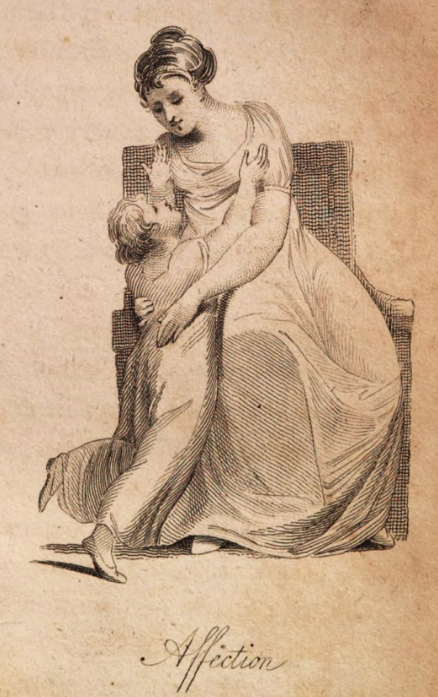
The book also includes illustrations, one of which is reminiscent of a painting of Sarah Siddons together with a very young Henry. That painting, Mrs. Siddons and Her Son in the Tragedy of Isabella by William Hamilton, shows a tall, stately mother with a small child to the left. Similarly, the illustration for "Affection" shows a mother and son, and the book draws attention to the fact that (as in the painting) the two figures are on different planes. Siddons writes: "First of all, my friend, let us suppose an object of desire placed more high than the person desirous of obtaining it; or what comes to the same point, that the personages are not of an equal height."

How much was Siddons's guide used as a practical tool for actors? It's difficult to tell, but in addition to being raised by the most famous actress of the era (not to mention being nephew to the actor John Philip Kemble), Henry Siddons was a famous performer himself. He was the leading man at the Theatre Royal in Edinburgh, where he originated the role of the Lord of Lorne in Baillie's The Family Legend.

Actors today might not want to follow the advice in the book, which as its title suggests is aimed at a rather rhetorical approach to performance, but it is a fascinating glimpse into the past.

Monday, May 31, 2021

Samuel Phelps

The Victorian actor Samuel Phelps was described by his biographer Richard Lee as "the last typical classic actor of the English theatre." Lee knew Phelps, and shortly before the great actor died, he had agreed to perform in a comedy Lee had written called Cent per Cent. Alas, he never performed that play, but he appeared in so many other great shows!

Born in 1806, Phelps was the son of a wine merchant. His family valued education, and his younger brother Robert eventually led Sidney Sussex College in Cambridge, and at one point even served as Vice-Chancellor of the university there.

Arriving in London as a young man, Phelps took a job in a printing office, where his foreman was Douglas Jerrold, who had not yet risen to fame writing such plays as Black-Eyed Susan and The Rent-Day. Phelps invited Jerrold to watch him act in an amateur production of The Castle Spectre by Matthew G. Lewis. According to Phelps, after the performance "Jerrold told me that by dent of hard study, luck, and patience I might in time act well enough to get thirty shillings a week."

Well, Phelps later made far more than that! His professional debut occurred in 1827 at the Queen's Theatre off of Tottenham Court Road, which later came to be know as the Prince of Wales's Royal Theatre. Phelps, then 21 years old, appeared as Captain Galliard in the farce XYZ. He then joined a company performing in the northern circuit, and according to Lee, Phelps "rapidly became a recognized stage favorite throughout the North of England, in Scotland, and, across St. George's Channel, at Belfast and Londonderry."

Ten years later, in 1837, Phelps made his debut at the Theatre Royal, Covent Garden in Thomas Otway's tragedy Venice Preserved. Phelps played Jaffier opposite the Pierre of William Charles Macready, an actor who would be both his colleague and his rival for many years to come. Phelps accompanied Macready when the star actor took over the management of the rival Theatre Royal at Drury Lane. It was there that Macready staged Robert Browning's tragedy A Blot in the 'Scutcheon with Phelps as the lead, and then abruptly cancelled it.

"Though its success was undoubted," Lee writes, the play "for reasons never publicly stated, disappeared from the bills after the third representation." Macready was jealous of Phelps's success, but he also had bigger things to worry about as manager of Drury Lane. In 1843, the theatre's owners declined to give him a decrease in rent, and Macready responded by petitioning parliament to end the monopoly the two patent theatres had on performing spoken-word drama. The result was the Theatres Act, which paved the way for the so-called minor theatres like Sadler's Wells to perform more serious fare than melodrama and burletta.

Phelps, together with Thomas L. Greenwood and the actress Mary Warner, took over the management of Sadler's Wells. At first, they planned to stage melodramas, as the house always had, and they even determined to get a fresh one written by Zachary Barnett to inaugurate their new management. When Barnett's melodrama was not forthcoming, however, and with the opening date of Sadler's Wells already advertised, the experienced, classical actors decided to begin with what they knew best. Instead of using a melodrama, they opened with Macbeth. Phelps and Warner played the two leads, and according to Lee, who was there that night, the audience "was hushed by its attention to the action of the tragedy to such perfect stillness as quickened the sense to hear the faintest whisper from the stage."

The trio of managers quickly abandoned their plans to produce melodramas. The Theatres Act now allowed Sadler's Wells to produce any type of show it liked without having to split legal hairs over exactly how many songs were needed to qualify a piece as melodrama or burletta. For a while, they did try to produce new works, but after three new plays in a row failed, and a fourth was not likely to be ready for production, they went back to the classics.

Phelps was particularly known for his stagings of works by William Shakespeare. Of the plays accepted to be in the Shakespeare canon at the time, Phelps staged all of them at Sadler's Wells except the Henry VI trilogy, Troilus and Cressida, and Richard II. Was he the last typical classic actor of the English theatre? I don't know, but he was probably one of the best.

Monday, August 3, 2020

The Black Doctor

Ira Aldridge is one of those remarkable people we've known about for a long time, but who has been in recent years increasingly getting the attention he deserves.

Aldridge was born in 1807 in New York, though he later claimed to be from Africa, probably in a bid to appeal to European audiences who wanted to view him as a more "exotic" foreigner than just another American ex-patriot.

His father sold straw for a living, but also was a lay preacher. Later scholars have speculated that young Ira might have gotten his first vocal training from his father, who not only had to have a strong voice to preach, but who also hawked his straw from a cart he took around New York City, which meant he must have needed a strong voice to attract customers.

Aldridge's real theatrical training came from the African Grove Theatre, though. William Alexander Brown founded the theatre in 1821 to perform amateur productions of plays by Shakespeare and others, including Brown himself, whose play King Shotaway was sadly lost. The actors were of African ancestry, including William Hewlett, the star of the company, who was particularly famous for playing Richard III.

At the African Grove Theatre, Aldridge played such parts as the Inca warrior Rolla in Richard Brinsley Sheridan's Pizarro, but the company did not last long. The year the African Grove Theatre began offering their performances in downtown Manhattan, the Park Theatre was rebuilt in the same neighborhood.

The Park Theatre offered professional performances by white actors for a predominately white audience, though African Americans like Aldridge did watch shows from the upper balcony. When white audience members saw how good the productions at the African Grove were, though, they started patronizing the amateur company, and this was too much for the managers of the Park Theatre to take. They began to harass Brown's company, and the African Grove Theatre was eventually burned down, likely at the instigation of the management of the Park Theatre.

Aldridge probably saw that if he was going to have any success as an actor, it wasn't going to be in his home country. He emigrated to Britain, and had some success playing roles including Othello. That's when the most famous portrayer of Othello on the British stage, Edmund Kean, collapsed during a performance playing opposite his son Charles and died a couple months later. The theatre needed a new Othello, and Aldridge was chosen for the part.

What happened next is recounted in Lolita Chakrabarti's wonderful play Red Velvet. Reviews of Aldridge's Othello were mixed, and some were openly hostile and explicitly racist. Aldridge ended up leaving London, instead touring provincial theatres in Britain as well as larger venues on the European continent. There, he won great renown not just in Othello, but also Richard III, The Merchant of Venice, and King Lear, as well as dramas by Matthew G. Lewis, Charles Robert Maturin, and others.

In 1846, the hack dramatist Auguste Anicét-Bourgeois wrote a play called Le Docteur Noir. Anicét-Bourgeois seems to have written the play together with Philippe François Pinel Dumanoir, a melodramatist who would go on to adapt Uncle Tom's Cabin for the Théâtre de l'Ambigu-Comique in Paris. Le Docteur Noir might not have been great literature, but it did provide moments for great acting, and it appeared on the London stage in a translation by John Vilon Bridgeman and further adapted by Thomas Hailes Lacy.

In Bath, Bristol, and Dublin, Aldridge began performing another adaptation of the play by Thomas Archer. Aldridge's adaptation of The Black Doctor gives particular emphasis to race and class, according to theatre scholar Keith Byerman, who did a thorough analysis of different texts.

The play begins on the Isle of Bourbon, now known as Réunion, in the Indian Ocean near Madagascar. In the first scene, we hear of Pauline de la Reynerie, a French noblewoman whose life was saved by Fabian, the titular black doctor played by Aldridge. Pauline's mother was on a ship that is assumed to be wrecked, but it was her mother's wish that Pauline marry the Chevalier St. Luce. Meanwhile, Fabian has mysteriously disappeared, though some say "he has been observed wandering on the cliffs, but always avoiding anyone who appeared to seek him."

Scene Two takes place in Fabian's hut, where Pauline tracks him down and gives him a purse full of gold to distribute to the poor since he has refused payment for his services. She also tells him that a mysterious man has been sighted near her house, and we understand that the stranger is Fabian himself, who is in love with her. Pauline's mixed-race foster sister Lia is in love with a white clerk, and when Pauline says she will help her to marry the man in spite of racial prejudice, Fabian begins to have hope for his own prospects.

The brief third scene concerns some minor characters, and prepares the audience for the thrilling climax of the act, illustrated on the first page of the published play. Fabian, hearing that Pauline has been betrothed to St. Luce, takes her to a grotto down by the sea, hoping the ocean will kill them both when the tide comes in and floods the grotto.

Wait... the doctor who saved her is now going to murder her? Well, it isn't much different from Othello killing Desdemona, is it? Unlike Othello, though, Fabian takes pity on his victim. Pauline, thinking she will die, confesses, "I have long, long loved you!" Hearing this, Fabian carries her to a rock where they are saved by a passing ship.

Act Two takes place at the house of Pauline's family in Paris. It turns out that her mother the Marchioness is not dead after all. Fabian and Pauline have been secretly married, but he is officially employed by her family as a servant, and the Marchioness clearly thinks very little of him. Instead, she wants Pauline to marry St. Luce so she can become a lady of honor to the Queen. (This is presumably Marie Antoinette, as the next act takes place at the outset of the French Revolution.) Pauline, distraught, tries to take poison rather than abandon her husband, but Fabian grabs the poison from her and flees from the room, promising the Marchioness he will restore her daughter to her since that is the only way to save his beloved Pauline.

The dramatic curtain at the end of the second act is exceeded in drama by a third act that takes place in the Bastille on the historic day of its storming in 1789. Both St. Luce and Fabian have been imprisoned in different cells in the Bastille. St. Luce is portrayed as a stuck-up fop, enraged that he can't get luxuries while in prison. Fabian, on the other hand, has been living in misery and trying to communicate with his friend Andre to get news of what is happening outside the prison. Revolutionaries storm the Bastille, freeing the prisoners, but it is too late for Fabian. Thinking Pauline is dead, he falls into an insanity, and the act ends with the cannons of the revolution sounding.

In the fourth and final act, we are transported forward to the year 1793, during the Reign of Terror. Pauline is considered an enemy of the people, since it was her family who was responsible for crimes against Fabian, the good black doctor who is now revered. Andre has been taking care of Fabian, who is still insane. When the mad doctor sees Pauline, it looks like she will be saved from the mob, but then Fabian sees St. Luce beside her, as well as a portrait of the Marchioness. Still thinking the Marchioness is alive and will kill Pauline if they are together, Fabian denies being her husband. A man in the mob fires a gun at Pauline, but Fabian throws himself in front of her, taking the bullet. With his dying strength, Fabian produces the proof of their marriage, saving Pauline at the cost of his own life.

If the play sounds melodramatic, well, it is in fact a melodrama, even including a musical chord at the moment Pauline sees her husband in the final act. Aldridge might not have been a great playwright, but he was a great actor, and the play he adapted no doubt provided a suitable vehicle to display his own talents.

Tuesday, October 31, 2017

The Rise of Melodrama

The playwright René-Charles Guilbert de Pixérécourt pioneered melodrama in France, with such dramas as The Ruins of Babylon and The Dog of Montargis. These plays gave equal billing to their composers, as they relied just as much on dramatic music and acting dumb shows as on dialogue.

In 1802, the British playwright Thomas Holcroft adapted Pixérécourt's play Coelina, or The Child of Mystery as A Tale of Mystery, calling it "A Mélo-Drame In Two Acts." The melodrama had arrived in England, and was haunting Germany as well, where J.W. Goethe's rival August von Kotzebue had a string of hits, including The Ruins of Athens, Misanthropy and Repentance, and The Spanish in Peru.

These plays were tightly plotted, with succinct, functional dialogue designed to help the audience follow the plot, but the language of melodrama attempts little else and lacks the poetic qualities of Romantic drama. Also, while melodrama can be political, it is usually aimed at leading the audience to simplistic conclusions. Romantic dramas, by contrast, dealt seriously with political and moral issues, often giving equal voice to opposing views. Also, Romantic dramas provided towering characters suited for actors like Edmund Kean. The melodramas that overtook Romantic plays forced actors into roles of virtuous heroes or conniving villains in an effort to get the audience to focus on sensationalistic plot twists instead.

In England, the actress and theatre manager Jane Scott turned the Sans Pareil Theatre into a powerhouse of melodrama. The Sans Pareil was known as a "minor theatre" since it was licensed to perform musical entertainments, but was not allowed to perform purely spoken drama. Scott penned a series of plays that incorporated music and song, getting around the monopoly on spoken drama enjoyed by the patent theatres in London. She wrote more than 50 plays in all, many of them designed to show off her own talents as the leading performer. Her most famous, The Old Oak Chest, was originally a star vehicle for herself, but unlike her other works it was published, which allowed it to continue to be performed long after Scott retired from the stage in 1819.

Melodramas frequently drew inspiration from the Gothic novels of the period. Gothic tales frequently had exotic or medieval settings. They could have supernatural events, like Matthew G. Lewis's hit play The Castle Spectre, or they could portray apparently supernatural occurrences that get explained rationally, as happens in The Old Oak Chest. The most famous Gothic novel, Mary Shelley's Frankenstein, was first adapted as a melodrama by Richard Brinsley Peakes in 1823 as Presumption, or The Fate of Frankenstein. The play initially ran for 37 performances and continued to be revived until the middle of the century.

Meanwhile, the official patent theatres in London saw their audiences dwindle, and they increasingly turned to melodrama themselves. The actor William Charles Macready took over the management of the patent theatre at Drury Lane in 1841 pledging to revive the drama to its former glory. Unable to compete with the minor theatres, however, he asked the owners of the theatre for a decrease in rent, and when they declined he petitioned parliament to end the monopoly held by the patent theatres. In 1843, parliament agreed and passed the Theatres Act, which kept censorship in place, but allowed minor theatres to perform any type of play they wanted. Rather than the minor theatres turning to spoken drama, however, the old patent theatres turned to melodrama, making it the dominant theatrical form of the nineteenth century.


Sunday, December 25, 2016

Falconara in California

It's official! The Conservatory Theater Ensemble at Tam High School in Mill Valley, California will be putting on my short play with a long title The Mysteries of the Castle of the Monk of Falconara.

The play will go up next month as part of the organization's winter one-act festival. The piece is generally popular with student directors (and student audiences), so I hope they have a fun time with it.

Originally produced as a part of a Halloween festival, the play depicts three real-life writers of Gothic fiction: Horace Walpole, Ann Radcliffe, and Matthew G. Lewis. In real life, the three probably never met in person. In this play, however, all three of them are summoned to a mysterious Italian castle on the eve of All Hallow's... where much comedy ensues.

The play was published in the anthology The Best American Short Plays: 2005-2006, and so gets periodically performed, mainly by high schools and colleges. Ken Kaissar directed the original production more than ten years ago.

I will have some other events to announce soon, but I'm mentioning this one now because the production agreement got delivered to my apartment on Christmas Eve. It's always a great Christmas present to find out that a production is official!

Saturday, January 2, 2016

Ann Radcliffe On Stage

I've always had a special place in my heart for Ann Radcliffe, the author of the Gothic novel The Mysteries of Udolpho. She even appears in my own play The Mysteries of the Castle of the Monk of Falconara, which is anthologized in The Best American Short Plays: 2005-2006 published by Applause.

Though Radcliffe never wrote plays (that I know of) her stories quickly made it to the stage. The actor Henry Siddons adapted Radcliffe's early novel The Sicilian Romance, which debuted at Covent Garden in 1794. The play even heightened some of the more sensational effects of the novel. In the stage version, for instance, the villain keeps his wife chained to a stone wall in a secret cave.

That same year, James Boaden adapted Radcliffe's The Romance of the Forest as Fountainville Forest. Radcliffe always made sure to explain away supposedly supernatural events in her books. She provided rational explanations for all of her ghostly apparitions, even if those explanations came late in the story and didn't satisfy everyone. Boaden paid no such honor to rationalism, and made the ghost in the story real.

In 1797 Boaden dramatized Radcliffe's last novel published during her lifetime, The Italian, as The Italian Monk. Again, he took liberties with the tale, this time having the villain repent at the end and be reunited with his long-lost wife.

By 1808, theatres had staged Radcliffe's best known work, The Mysteries of Udolpho, three times, twice as operas. Miles Peter Andrews did his musical adaptation, The Mysteries of the Castle, in 1795, two years before Matthew G. Lewis has a hit with The Castle Spectre, which pays homage to and somewhat mocks Udolpho.

So long before I put Radcliffe on stage as a character, her novels had become theatrical sensations.

Friday, December 25, 2015

Four Hundred Years of Excess, Horror, Evil and Ruin

Christmas Eve is a time for telling ghost stories, so it is only fitting that last night, on Christmas Eve, I finished reading Richard Davenport-Hines' book Gothic: Four Hundred Years of Excess, Horror, Evil and Ruin. The 1998 study examines one of my favorite genres of literature… and of drama.

While most people trace the Gothic back to Horace Walpole's novel The Castle of Otranto, Davenport-Hines considers the originator of the genre to be the 17th-century painter Salvator Rosa. After the eruption of Mt. Vesuvius in December of 1631, Rosa began painting the devastated landscape around Naples. In the early 18th century, Englishmen began collecting Rosa's images of rugged mountains, menacing banditti, and witches' sabbaths, creating a vogue for such paintings in Britain.

One of Rosa's prominent collectors was the Earl of Shaftesbury, who influenced Alexander Pope. Though Pope was hardly a child of the Gothic, Davenport-Hines notes the poet had a taste for "fragments of a ruined world, wrecked buildings and withered trees." Pope's friend William Kent had an even greater influence on the Gothic, both through his illustrations of books like Spencer's The Faerie Queene and his architectural designs for country estates like Henry Pelham's house at Esher.

The Neo-Gothic style inaugurated by Kent and his contemporaries had a political motive as well as an aesthetic one. Aristocrats seeking to project their own power in a world increasingly dominated by trade used the Gothic to re-enforce ideas of antiquity, stability, and legitimacy, even as their actual power was slowly undermined. This was particularly true in Ireland, where Robert Kingsborough built the pretentious Mitchelstown Castle, which strove in vain to convince locals of the family's importance. Mary Wollstonecraft, who was governess to Kingsborough's daughters, wrote of the family:

The topics of matrimony and dress take their turn – Not in a very sentimental style – alas, poor sentiment it has no residence here – I almost wish the girls were novel readers and romantic, I declare false refinement is better than none at all.

Refined romanticism, might be false, but it could be self-consciously false, as was the case with Horace Walpole. After acquiring a house in Twickenham on the outskirts of London, Walpole named the place Strawberry Hill and began renovating everything in a gothic style he knew to be ridiculous. Just as absurd was his 1764 novel The Castle of Otranto, subsequently adapted numerous times for the stage. Walpole's own play The Mysterious Mother was intended as a closet drama, perhaps because its plot was so outrageous the author couldn't imagine it being performed.

Though the Gothic preceded the French Revolution, the fall of the Bastille certainly fired the Gothic imagination. Davenport-Hines stresses the importance of the Revolution on other playwright-novelists, including the Marquis de Sade, Mathew G. Lewis and Mary Shelley. The Revolution unleashed a hunger for blood, and Davenport-Hines argues that what makes the monsters of this period so terrifying is their "insatiable neediness." The twin representatives of this unquenchable thirst for destruction are Frankenstein's monster and the Goya painting titled (posthumously) "Saturn Devouring One of His Sons." (One of my friends absolutely hates this painting. Another friend recently quipped: "Well, I guess it's really a matter of taste.")

One of the useful things Davenport-Hines does is recount the use of Gothic aesthetics by scene designers. Giovanni Battista Piranesi studied architecture and engineering, but became famous for designing scenery for the Venice opera house with "endless flights of balustrade stairs and domes beyond domes." In 1740, Piranesi settled in Rome where he designed scenery for the Valeriani brothers, among others. He ended up producing a series of prints, the Carceri, based on set designs, and these prints ended up permanently altering the design of European stage sets.

One British set designer influenced by Piranesi was Augustus Welby Northmore Pugin. When he was young, Pugin built a model theatre in his family's home. He later worked as a stage designer professionally, primarily at Covent Garden. He is perhaps best known today for assisting Sir Charles Barry in building the new Houses of Parliament at Westminster begun in 1840. Much of the building's Gothic aesthetic is due to Pugin, particularly the interiors. Alas, Pugin came to a rather Gothic end, going insane and dying in the Bedlam asylum in 1852.

Davenport-Hines also includes a whole chapter on vampires, beginning with the legend that suicides frequently became vampires, an ironic inversion of their desire for self-destruction. The word "Vampyre" first appeared in English in 1732 in relation to a man in Hungary, Arnold Paul, who supposedly tormented people after his death, even taking the lives of four unfortunate souls. A full 40 days after his death, locals dug up his body and found it free from corruption, but with blood about his nose and mouth. When they drove a stake through his heart, the body allegedly let forth "a horrid Groan," and they afterward burnt his body to ash and cast it back into the grave.

Lord Byron played a pivotal role in the popularizing of the vampire legend in England. His 1813 poem The Giaour contains the lines:

          But first, on earth as Vampire sent,
          Thy corse shall from its tomb be rent:
          Then ghastly haunt thy native place,
          And suck the blood of all thy race… 

Byron famously composed a tale of the undead during an 1816 ghost story competition with the Shelleys at Villa Diodati. Byron's personal physician, John Polidori, author of the unproduced dramas The Duke of Athens and Count Orlando, wrote his own tale based on the one Byron had told. An unscrupulous publisher named Henry Colburn printed the story in 1819 as The Vampyre, A Tale by Lord Byron. This novella became the basis of many subsequent vampire plays, including James Planché’s 1820 melodrama The Vampire, which was more immediately based on a French play, but reset in Scotland (allegedly because the theatre already had a stock of kilts).

Dion Boucicault wrote his play Vampire in 1852, and Davenport-Hines traces the influence of Polidori's tale even to Gilbert and Sullivan's 1887 operetta Ruddigore, or the Witch's Curse. The most famous vampire story is of course Bram Stoker's novel Dracula, first published in 1897. The novel inspired F.W. Murnau's silent film Nosferatu, as well as Tod Browning's 1931 Hollywood hit Dracula with Bela Lugosi. Browning's movie was directly based on a 1927 stage adaptation by actor Hamilton Deane and hack writer John L. Balderston, and is less than faithful to the novel.

Still, Browning's Dracula was successful enough to inspire Hollywood to make a slew of Gothic films, including James Whale's Frankenstein in 1931, Karl Freund's Mad Love in 1935, and Whale's The Bride of Frankenstein, also released in 1935. With these films, Gothic drama, Gothic literature in general, and indeed the entire Gothic aesthetic, reached even larger audiences, and as Davenport-Hines makes clear, the Gothic remains very much alive (or perhaps we should say undead) today.

Friday, October 9, 2015

Romanticism (It's All in the Name...)

Three books, all with the same title, Romanticism, deal with the same topic. Indeed, all employ the same key word in discussing the art and philosophy of the late eighteenth and early nineteenth centuries. Yet each of the books' three authors, Aiden Day, David Blayney Brown, and Michael Ferber, understand the term "Romanticism" in slightly different ways.

Day's work, published as a part of the New Critical Idiom series by Routledge, begins its introduction by quoting heavily from M.H. Abrams, whose book The Mirror and the Lamp helped to illuminate Romanticism for the 20th century. In his first chapter, "Enlightenment or Romantic?", Day then sets up the dichotomy between Enlightenment thinking and Romanticism that is often rehearsed by scholars. On the Enlightenment side are figures like William Godwin, who "argued that human beings act in line with reason and that it is impossible for them to be rationally persuaded by an argument without their conduct being regulated accordingly." Romanticism, by contrast, in the works of William Wordsworth and Samuel Taylor Coleridge, is a "celebration of subjectivity."

The second chapter looks at constructions of the term "Romantic" which first appeared in the 17th century. Thomas Shadwell wrote disapprovingly of all things "Romantick" in the preface to his 1668 play The Sullen Lovers. By 1820, debates over Romantic literature raged on the European Continent, but Lord Byron declared he saw no conflict between the "Classical" and the "Romantic" among English writers. Later critics latched on to the term "Romantic" to describe a variety of authors in Britain, but Day warns against dubbing movements in retrospect. "Literature is not" he contends "something which can be regarded as occupying a 'trans-historical' space, but something which must be read as subject to the discourses and ideologies of a particular time and place."

Day's project is best summed up by the title of his third chapter: "Enlightenment AND Romantic." For Day, these two movements are inextricably linked. On the one hand, writers of the Romantic era continued to work towards the progressive social justice championed by Enlightenment figures like Godwin, while at the same time their focus did shift to that of the interior rather than the external world. A key figure here is Percy Bysshe Shelley, whose commitment to social change informed his "study of solitary imagination." Mary Shelley's novel Frankenstein can even be read as a defense of Day's "and" proposition, since the broodingly interior Frankenstein must ultimately face the consequences of the creature he has unleashed onto the world. As Day puts it, "the writings of those who have formerly been defined as Romantic are not necessarily anti-Enlightenment in any simple sense."

Though that might seem a fitting conclusion, Day includes a final chapter on "Gender and the Sublime" analyzing some of the consequences of Romantic theory first postulated in the eighteenth century by Edmund Burke. Certainly, Burke genders the sublime as masculine and its companion "beautiful" as feminine. Day's point, however, is that this gendering continued to influence Romantic poets. For instance, Wordsworth gendered Nature as feminine, but the female Nature only aided him in apprehending a higher "invisible world." This higher world, Day argues, is associated with the interior mind of the poet, and is thus gendered as masculine. Such arguments break down when the author is a woman, but Day contends that female writers of the period were skeptical of feelings of the sublime and instead focused on nature herself.

David Blayney Brown takes a different approach to Romanticism. While Day focuses on poets and novelists, Brown is interested in painters. He begins his introduction with an examination of Eugène Delacroix's painting The Death of Sardanapalus. He claims the "moral vacuum" at the heart of the piece is "all the more shocking for ignoring the message of the play by the English poet Lord Byron from which he had taken his subject." Notice that Day, discussing literature, ignores drama, while Brown, examining the visual arts, pays close attention to the theatre.

Brown finds a literary parallel for Delacroix's Romanticism in Victor Hugo, whose 1827 preface to his play Cromwell "advocated a rich variety of expression and experience to reflect the complexity of the world and the self, rather than the cold formalism of classical drama, and recognized the value of the ugly or grotesque in engaging the senses, rather than beauty in winning only admiration." For Brown, The Death of Sardanapalus is a "pictorial equivalent" to Hugo's theoretical preface.

Day emphasizes the continuity between the Enlightenment and Romanticism, but Brown stresses how revolutionary the new movement was. He claims: "Not since the Renaissance had such a profound change come over the Western consciousness." Instead of incorporating a collective ideal, the Romantic artists "emphasized individual experience, feeling, and expression." This, of course, came from the French Revolution, which Day emphasizes, but also from the rise and fall of Napoleon. As Brown puts it: "Romanticism was born in opposition and sorrow, in social or national crisis and in individual trauma."

Brown traces the term "Romantic" to Friedrich Schlegel, who in the first issue of the journal Athenaeum in 1798, identified the Romantic with "progressive universal poetry" not based on "inherited and culturally specific forms." Schlegel was writing in the German university town of Jena, which became a hotbed of Romanticism. Though not in Jena, the German writer Johann Wolfgang von Goethe contributed greatly to the movement as well, and Brown cites Goethe's 1789 play Torquato Tasso as an inspiration for Delacroix's Tasso in the Madhouse, painted fifty years later.

Tasso was a Renaissance poet and playwright, but more modern poets also provided inspiration to Romantic artists. Brown cites Thomas Chatterton, a poet whose suicide in 1770 inspired Henry Wallis (painting in the 1850s) to create the magnificent Death of Chatterton, now hanging in the Tate Gallery in London. The cult of Chatterton was not confined to England, either, as Brown observes that the French writer Alfred de Vigny turned the poet's story into the play Chatterton, which "was a hit in Paris in 1835."

So while Day is interested in Romanticism as a philosophical movement in dialogue with the Enlightenment, Brown sees it as an artistic movement born of political turmoil. Michael Ferber wrestles with both of these concepts in his Romanticism, which bears the subtitle A Very Short Introduction. For him, Romanticism is both an intellectual movement and an artistic movement, and while he sees both sides as distinct, he does not seem to emphasize one over the other. Both of these elements, the philosophical and the aesthetic, are present in the pre-Romantic movement Ferber identifies as Sensibility.

Sensibility is a term that was much more in use in the eighteenth century than "Romantic" or "Romantick." It was associated with such works of "storm and stress" as Goethe's The Sorrows of Young Werther and with Gothic writers, including Horace Walpole and Matthew G. Lewis. Ferber also connects it to poets like Mary Robinson, as well as the hugely influential critic and novelist Madame de Staël.

While Ferber successfully traces elements of Sensibility into Romanticism, he definitely seems to be coming at Romanticism from a position of greatly misunderstanding the period's drama. I can overlook his calling Shelley's Prometheus Unbound the poet's "greatest work" as that is a matter of taste. Downright strange, however, is Ferber's comment that Byron's Manfred is "unperformable." Is Ferber really unaware of the many, many successful performances there have been of Manfred? Samuel Phelps was probably the most famous actor to produce the play, but Manfred became so popular that toy theatre versions were made.

For all its faults, though, Ferber's book does give a decent introduction to Romanticism. It attempts to be more balanced than either Day or Brown, gazing into the philosophical and the aesthetic alike. In the end, as Ferber suggests, neither side can be fully understood without the other.

Friday, August 14, 2015

Theatric Revolution

In 1819, the former actress Elizabeth Macauley wrote a pamphlet called Theatric Revolution, or Plain Truth Addressed to Common Sense. The pamphlet addressed the mistreatment of actors by the two patent theatres at Drury Lane and Covent Garden. Macauley argued that actors must band together for their common good, and for the common good of society.

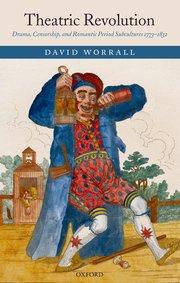
David Worrall, a professor of English at Nottingham Trent University, used Macauley's pamphlet as the title for his 2006 study of Georgian theatre Theatric Revolution: Drama, Censorship, and Romantic Period Subcultures 1773-1832. He argues that the close physical proximity of radical presses and seditious meeting-places to the great theatres in London was no mere coincidence. Both radical politics and its reactionary critique were intertwined with the theatre culture of the day.

In his first chapter, Worrall discusses the regulation of the theatres, examining both the patent system that gave Drury Lane and Covent Garden a monopoly on serious spoken drama, and the censorship system that gave an inordinate amount of power to one man, the Examiner of Plays. Beginning in 1824, the playwright (and son of a playwright) George Colman the Younger was the Examiner, which shows just how incestuous the whole system was. His first year in office, Coleman censored so many passages in Martin Archer Shee's tragedy Alasco that the playwright withdrew the piece from production at Covent Garden. He subsequently published the play with a preface objecting to Coleman's censorship, and by the end of the year Alasco was performed in New York.

Since the two patent theatres had a monopoly on spoken drama, minor theatres like the Royalty Theatre in the East End had to add music to plays, turning them into "melo-dramas" or "burlettas." Worrall's second chapter deals with attempts to suppress the Royalty, which the actor John Palmer built and opened in 1787. The theatre became the subject of a pamphlet war, with the partisans of the patent theatres arguing for its closure. The Royalty was denied a license in 1802, but then licensed again the following year.

Worrall examines the role of the Examiner of Plays in his third chapter. Prior to Geroge Coleman taking over in 1824, the Examiner was John Larpent, and by extension his wife, Anna Margaretta Larpent. According to Anna Larpent's diaries, the couple read aloud all of the plays submitted for performance, and she seems to have given her husband considerable input. In 1795 the Larpents prohibited performance of Lady Mary Eglantine Wallace's play The Whim, a comedy in which an aristocrat, after reading about the Roman custom of Saturnalia, decides that for a day his family will trade places with their servants. Even though the play ends with the confirmation of the social order, this was too much.

Chapter Four deals with the famous scenic designer Philip de Loutherbourg, who was also a Freemason. His 1773 extravaganza A Christmas Tale contained a great deal of Masonic symbolism. Charles Dibdin provided music for the piece, which had a text by David Garrick. After the outbreak of the French Revolution, some critics of Freemasonry linked the Masons to the radical Jacobins, and by the late 1790s the Masonic imagery in A Christmas Tale "had become politically dangerous." The play was not performed for many years, though the Surrey Theatre did stage it in 1817, after anti-Mason (and anti-Jacobin) hysteria had quieted somewhat.

In the fifth chapter, Worrall examines the censorship of The Two Farmers by Thomas Dibdin, Charles Dibdin's son. Though the play was scheduled for performance at Covent Garden in 1800, it ran afoul of the Larpents. Britain had recently experienced grain shortages, and many people blamed farmers for allegedly hoarding their crops. The Two Farmers introduced a villain named Locust who hoarded grain in order to raise prices and justified his actions as being "for the good of the nation." Larpent's blue pencil made quite a number of cuts, and ultimately the censor rejected the play in its entirely.

Chapter Six examines the return of Caroline of Brunswick, the wife of the Prince Regent who returned from self-imposed exile after George III died, making the Prince now King George IV, and Caroline--in theory at least--the queen. However, the king cruelly barred her from the coronation ceremony in 1821, and Caroline died only a few days later. Her return to England featured high-profile attendances at London theatres. At a private party in Montague House, Queen Caroline was even presented to guests as a statue that came to life, a scene consciously reminiscent of the last scene in Shakespeare's The Winter's Tale.

The following chapter looks at theatricalized popular British culture. Worrall notes that drama took place well outside even the "minor" theatres in London and official theatres of the provinces. For instance, the actor Peter Paterson performed a 12-minute version of Matthew G. Lewis's The Castle Spectre at fairgrounds around Birmingham. Audiences could also see spoofs such as W.T. Moncrieff's Frank-in-Steam, or, The Modern Promise to pay, which was performed in 1824, only a year after the English Opera House debuted Richard Brinksley Peake's Presumption; or, The Fate of Frankenstein, the first adaptation of Mary Shelley's novel.

Chapter Eight looks at two plays, the anonymous closet drama Plots and Placemen and James Powell's Drury Lane confection Harlequin Negro. Attributed to on "Zachary Zealoushead," Plots and Placemen satirizes the suppression of radicals during the Regency. The powerful foreign secretary Lord Castlereagh becomes "Callouswretch" and Lord Sidmouth, the widely reviled home secretary, becomes "Proudmouth." This might seem an odd pairing with Harlequin Negro, an 1807 play that Larpent approved without any excisions. However, Powell's play contains what Worrall calls "a vivid moment of empowerment changing the oppressed black Caribbean slave into a gorgeously costumed comic hero." Both plays, then, were furthering the agenda of Britain's radical progressives.

Worrall also includes a chapter on plays inspired by the infamous 1817 murder of 20-year-old Mary Ashford. The young woman went to a dance in Warwickshire one night, and the next day her body was found in a flooded sandpit, probably raped. In 1818, the anonymous three-act plays The Mysterious Murder and The Murdered Maid appeared in print. Two other plays based on the events appeared on the London stage: William Barrymore's Trial by Battle and John Kerr's Presumptive Guilt.

In the final chapter, Worrall looks at the performance of the radical play Swing at the Rotunda, an improvised theatre space where the well-known radical Richard Carlile staged Robert Taylor's five-act tragedy Swing; or, Who Are the Incendiaries? This "People's Tragedy" seems to have been performed with a cast of two, a man named Harrison and Taylor, who at one point appeared as himself under his nickname "Robert the Devil." The shockingly revolutionary play shows the proletarian Swing made king, but he then abdicates so that Britain can become a republic. Carlile hoped to collaborate with Taylor on a second play, but the latter's alcoholism rendered that impossible.

Overall, the picture that emerges of Georgian theatre in Theatric Revolution is one that is far different from the staid Shakespeare revivals people generally associate with that era. Writers like Martin Archer Shee, Eglantine Wallace, Thomas Dibdin, James Powell, and Robert Taylor were constantly pushing the envelope, staging--or attempting to stage--plays that engaged politically with the ever-changing world around them.

Saturday, July 25, 2015

Mr. Cooke Is Goosed

At the beginning of 1789, while France was on the verge of a revolution, the actor George Frederick Cooke found himself being slighted by Elizabeth Whitlock.

Cooke was acting in Newcastle, where he had been almost single-handedly responsible for the success of the Theatre Royal there. When it came time for his benefit performance on March 23rd, it seemed likely that all of his fellow actors would graciously accept invitations to perform with him.

Taking advantage of an actor's prerogative to use his benefit to take on roles that he might not ordinarily play, Cooke decided to play the title role in Joseph Addison's Cato for the first time. He approached Whitlock, the leading actress in the company, and asked her to play Marcia. The role is not particularly large, but it is the leading female part in the play. Whitlock declined.

Undaunted, Cooke engaged another actress for the part. While Whitlock might have lacked a certain amount of tact, there was no reason for the matter to extend beyond the walls of the theatre. Unfortunately for her, it did. A number of ladies, appalled by Whitlock's ingratitude toward the man who had done so much for the theatre in Newcastle, withdrew their support for her benefit.

Faced with declining popularity, Whitlock resigned her own benefit for the season, supposedly to show she had no pecuniary motives, but more likely to avoid playing before a half-empty house. This made matters worse, and with public sentiment turning more and more against her, Whitlock eventually agreed to play the role. That night, she made a public apology from the stage, but then retreated after the audience expressed their hostility. After much ado, she performed the role, skipping a number of her own lines, and ending the whole affair in disgrace.

I recount this little anecdote, because it gives an idea of how rough and tumble the world of theatre could be in Cooke's day. Audiences could be an actor's friend one day, but then turn on him the next. Cooke was a brilliant performer, but he also struggled with alcohol his entire life, and he could be his own worst enemy. Ultimately, the bottle brought him down, and all the talent in the world could not save him.

Cooke was known for playing villains, particularly Richard III, but also Shylock, Iago, and other Shakespearean bad guys, as well as Sir Giles Overreach in Philip Massinger's A New Way to Pay Old Debts. He was drawn to classic plays and did not support the gifted playwrights of his own day. Cooke once wrote of the wonderful Matthew G. Lewis play The Castle Spectre:

I hope posterity, if they read it, will not believe it could repeatedly attract crowded houses, when the most sublime production of the immortal Shakespeare, even for one night, would be played to empty benches, at least to empty boxes:—But it certainly is the best treat for empty skulls.

On Halloween night, 1800, Cooke made his debut at Covent Garden in the role of Richard III. He could have made a home in London long before that, but quarrels with fellow actors kept him out in the provinces. Fortunately, his return to the capital was a success. A letter he received, and kept until the day he died, carried a warning, though:

The public are your friends:—look to them alone; for while you merit their patronage you will ever experience it.

An implied warning here was that if he ever ceased to merit the patronage of the public, Cooke would be lost, just as poor Elizabeth Whitlock was after the Newcastle Cato affair.

Over the next few years, Cooke engaged in an intense rivalry with John Philip Kemble, the leading tragic actor of the day. Cooke saw himself as Kemble's equal, but while he had an intensity Kemble lacked, Cooke did not have as great a range. He also allowed his temper to get the better of him—especially when he was drinking.

In 1802, Cooke saw the Newcastle episode repeat itself, only this time it was in London, and he himself was on the losing end of the audience's wrath. Cooke declined to perform in a benefit performance of another Lewis play, The Harper's Daughter, which is an adaptation of Friedrich Schiller's drama The Robbers. Kemble's nephew Henry Siddons ended up reading the part in the performance while Cooke disappeared for more than two weeks, presumably getting drunk every night.

Cooke returned in time to play the title character in King John, which was being done as a benefit for the remarkably talented actress Harriett Litchfield, who was playing Constance. Cooke on occasion angered Litchfield, but the two remained on good terms throughout their lives. According to a report in the Morning Chronicle, the audience was not as ready to forgive. They hissed Cooke on his first appearance, and—like Whitlock in Newcastle—he had to apologize to them directly.

In that instance, Cooke claimed he had been ill, and the audience allowed him to continue, even giving him hearty applause by the end of the show. As time went on, though, Cooke's "illnesses" became understood as euphemisms for bouts of drunkenness.

Eventually, Cooke left Britain to tour in the United States. In 1810, he performed in America for the first time, making his debut at the Park Theatre in New York, once again in his most famous role of Richard III. The theatre was packed, but by the end of the winter, the novelty had worn off and houses thinned in bad weather. Cooke was living the life of an exile. He was not wanted at home, and did not feel welcome abroad, either.

In 1812, Covent Garden invited Cooke to return. Though his antics had become legendary, management missed the box-office draw he could provide. By that time, however, it was too late. Cooke died on September 26, 1812 at the age of 56. A post-mortem found his liver had almost ceased to function.

Cooke's body was buried in the so-called Stranger's Vault of St. Paul's Chapel in lower Manhattan. According to biographer Arnold Hare, the great actor Edmund Kean (who was an admirer of Cooke) while visiting New York in 1820 arranged for the remains to be moved to the center of the churchyard where a suitable monument could be erected.

Legend says that when they dug up the body, the skull was removed and used as a prop in Hamlet, eventually making its way to a medical museum. Kean also took a bone for himself. (In some versions of the story, it was a toe bone, but Hare asserts it was a finger bone.) Mrs. Kean subsequently threw it away.

The remains of the remains are still there outside St. Paul's Chapel, which narrowly missed being destroyed by the collapse of the World Trade Center on September 11, 2001. I went down there this afternoon. Unfortunately, all of the grass is currently fenced off, so I couldn't get very close to the grave, but I did snap this picture:


The plaque on the monument says it was erected in 1821. Kean was in America from 1820 to 1821, so either year could be correct. I am inclined to doubt Hare's biography, but 19th-century gravestones can be notoriously inaccurate.

Unfortunately, the man at the church gift shop, though very eager to help, was not able to provide any information about the Stranger's Vault. He did give me a number to call to contact the church archives, though, so perhaps I'll be able to get more information next week.

Until then, rest well, Mr. Cooke. I hope you found some peace in death that you rarely had in your lifetime.

Friday, June 26, 2015

The French Revolution and the London Stage

I recently read George Taylor's book The French Revolution and the London Stage, which tracks theatre on both sides of the channel from 1789 to 1805. It tells a fascinating story that makes me want to read more of the plays of that period.

Taylor's first chapter covers England and France in the year 1789. It so happens that on July 14th, when the French were storming the Bastille, audiences at the Haymarket Theatre in London watched Inkle and Yarico, a play by George Colman the Younger that was critical of the slave trade. People in both countries seemed to be calling out for freedom.

Chapter Two discusses the staging of the Revolution, and it is interesting to me how quickly theatres began re-enacting the events of the 14th of July. In August, freedom-loving citizens of London had multiple opportunities to see what had been accomplished by their brethren in France. John Dent produced a spectacle called The Triumph of Liberty; or, the Bastille at the Royal Circus. Astley's Royal Grove Amphitheatre followed that up with Paris in an Uproar; or, the Destruction of the Bastille. By the end of the month, Sadler’s Wells had jumped into the fray with Gallic Freedom; or, Vive la Liberté.

In Paris, historical dramas echoed recent events. Marie-Joseph Chénier's play Charles IX, which he had written in 1787, went into production at the Comédie Français. The story, about how the Cardinal of Lorraine and the Duke of Guise used Marie de Medici to get the king to authorize the St. Bartholomew’s Day Massacre, had clear parallels with the present day. Scheming churchmen and foreign queens certainly didn't look very good in the play. The revolutionary Danton even claimed that "If Figaro killed the aristocracy, Charles IX will kill the royalty."

The following chapter discusses theatre after the Revolution but before the Terror. Chénier’s anti-clerical Henry VIII, banned in 1789, became a hit in Paris in 1791. The next year saw his new play Caius Gracchus, which looked back to Republican Rome for inspiration. The French also turned to Shakespeare, and in 1792 Jean François Ducis premiered his adaptation of Othello (a play later adapted into French by Alfred de Vigny). The French also staged numerous fêtes which celebrated the Revolution in grand public ceremonies.

For the British, however, censorship made it difficult for the theatres to speak openly about a Revolution that was becoming increasingly controversial. Instead, producers turned to gothic dramas that reflected the heightened sense of anxiety. The Haunted Tower premiered in 1789, The Siege of Belgrade in 1791, and The Pirates in 1792. Then, in 1794, John Philip Kemble produced his spectacular Lodoiska, featuring villainous noblemen, imprisoned maidens, and burning castles.

In a chapter on dramatizing the Terror, Taylor discusses the quintessential gothic drama, Matthew G. Lewis's The Castle Spectre. He notes that Dora Jordan played the ingénue, Angela. In the play, men are ineffective, and it is Angela who must stab the villainous Osmond. This event, Taylor says, parallels Charlotte Corday's very real murder of Marat, with the spectre perhaps representing the spirit of the slain Marie Antoinette, looking on and aiding the action.

The following chapter discusses the performers of the era, who seemed to be moving toward a greater naturalism. Taylor also spends a good deal of time on William Betty, the so-called "Infant Roscius" who began his career at age 10, playing adult roles to great acclaim. Apparently, both Kemble and George Frederick Cooke, the leading tragedians of the day, took a brief break from the stage while Bettymania burned itself out, then returned to what they had been doing before the young curiosity came to town.

Taylor argues that the diminutive Master Betty was in some ways a stand-in for Napoleon, the subject of his next chapter. The big play here is Pizarro, Richard Brinsley Sheridan's adaptation of the Incan epic by August von Kotzebue. Jordan again played the ingénue role, Cora, while Sarah Siddons played the weightier role of Pizarro's mistress, Elvira. Apparently, Sheridan expanded this latter role from what Kotzebue had originally written.

The final chapter covers the feeling of alienation many people felt in the wake of the Revolution and how this was reflected on stage. Taylor argues this alienation helped to create the new form of melodrama. Whether or not he is right in this, he certainly gives one food for thought.

Saturday, January 10, 2015

Samuel Taylor Coleridge, Playwright

I've been reading Rosemary Ashton's biography of Samuel Taylor Coleridge, a writer hailed in his lifetime as a great playwright as well as a great poet.

Even from a young age, Coleridge had a dramatic imagination. In 1792, he was spending much time at the home of his friend, Tom Evans, enjoying a sort of adopted family. In a letter to Tom's mother, the 19-year-old Coleridge wrote of his fondness for the family in metaphors of the stage:

You and my Sisters have the very first row in the front box of my Heart's little theatre--and--God knows! you are not crowded. There, my dear Spectators! you shall see what you shall see--Farce, Comedy, & Tragedy--my Laughter, my Chearfulness, and my Melancholy. A thousand figures pass before you, shifting in perpetual succession--these are my Joys and my Sorrows, my Hopes and my Fears, my Good tempers, and my Peevishnesses: you will however observe two, that remain unalterably fixed--and these are Love and Gratitude.

One of the first serious literary attempts Coleridge made was a play about Maximilien de Robespierre he wrote in collaboration with Robert Southey. The two friends undertook the work as a sort of docu-drama, composing The Fall of Robespierre only weeks after the execution of the famed leader of the French Revolution. Robespierre had gone to the guillotine on July 28, 1794, and Coleridge and Southey wrote the play in August, using newspaper accounts of the events leading up to his precipitous fall from power. By the beginning of September they were shopping the play around to publishers, and it was released to the public in October. No grueling developmental workshops here!

Coleridge fell very much under the spell of the German playwright Friedrich Schiller. After having discovered Schiller's The Robbers, he wrote to Southey:

I had read chill and trembling until I came to the part where Moor fires a pistol over the Robbers who are asleep--I could read no more--My God! Southey! Who is this Schiller? This Convulser of the Heart? Did he write his Tragedy amid the yelling Fiends?

Later, in 1795, Coleridge wrote a political pamphlet called The Plot Discovered in which he attacked the government of Prime Minister William Pitt. One of the charges he leveled against the government was that it had suppressed productions of The Robbers.

For most people, Coleridge's name will forever be bound up with that of William Wordsworth. It was the two of them together who ushered in a wave of Romanticism with their joint publication of Lyrical Ballads. However, for their first in-person meeting after a period of admiring correspondence, Coleridge had tucked under his arm not poems but the first two and a half acts of his play Osorio.

Two passages from Osorio actually made their way into Lyrical Ballads as independent poems under the titles "The Foster-Mother's Tale" and "The Dungeon." My favorite of the two is the latter:

And this place our forefathers made for man!

This is the process of our love and wisdom

To each poor brother who offends against us—

Most innocent, perhaps—and what if guilty?

Is this the only cure? Merciful God!

Each pore and natural outlet shrivell'd up

By ignorance and parching poverty,

His energies roll back upon his heart,

And stagnate and corrupt; till changed to poison,

They break out on him, like a loathsome plague spot.

Then we call in our pamper'd mountebanks—

And this is their best cure! uncomforted

And friendless solitude, groaning and tears,

And savage faces, at the clanking hour,

Seen through the steams and vapour of his dungeon,

By the lamp's dismal twilight! So he lies

Circled with evil, till his very soul

Unmoulds its essence, hopelessly deformed

By sights of ever more deformity!

With other ministrations thou, O nature!

Healest thy wandering and distempered child:

Thou pourest on him thy soft influences,

Thy sunny hues, fair forms, and breathing sweets,

Thy melodies of woods, and winds, and waters,

Till he relent, and can no more endure

To be a jarring and a dissonant thing,

Amid this general dance and minstrelsy;

But, bursting into tears, wins back his way,

His angry spirit healed and harmonized

By the benignant touch of love and beauty.

Sadly, the Theatre-Royal at Drury Lane turned down Osorio. Coleridge disliked some of the popular fare that did make it to the boards. He derided Matthew G. Lewis's runaway hit The Castle Spectre as "Schiller Lewisized" with "not one line that marks even a superficial knowledge of human feelings."

In 1798, as Lyrical Ballads was being published, Coleridge set out to Germany, where one of his goals was to gather enough materials to write a biography of the playwright Gotthold Ephraim Lessing. The book on Lessing never materialized, but Coleridge did learn enough German to translate the two main parts of Schiller's dramatic trilogy Wallenstein. These two works, The Piccolomini and The Death of Wallenstein, are now regarded as models of poetic translation.

After his return from Germany, Coleridge joined the circle of the English actress and poet Mary Robinson, nicknamed "Perdita" for the role she played in The Winter's Tale. (It was in this part that she attracted the attention of the Prince of Wales, soon becoming his mistress.) Coleridge read to her from his unfinished and unpublished poem "Kubla Khan." She recalled the scene in her own piece, "Mrs. Robinson to the Poet Coleridge" which she published in October of 1800, not long before her death.

During all this time, Coleridge was yet to have any of his own plays produced, He wouldn't have to wait forever, though. Though Drury Lane had turned down Osorio, Coleridge rewrote the piece as a new tragedy: Remorse. That play was the hit of the season in 1813, and is also the subject of tomorrow's blog post.