Showing posts with label Kotzebue. Show all posts

Monday, January 23, 2023

Animal Magnetism

Elizabeth Inchbald made her playwriting debut with The Mogul Tale in 1784, but her 1788 play Animal Magnetism had a longer-lasting influence on the stage.

There have been multiple stagings of the play in recent years, including one done last year at St. Hugh's College, Oxford and now available to watch on YouTube. I got to see a different staging tonight, which was performed by the Red Bull Theater Company at the Players Club and streamed online.

José Zayas, who directed my adaptation of Charles Dickens's A Christmas Carol in Saratoga Springs directed the staged reading for Red Bull, so I knew it would be well done. I also knew it would feature Carson Elrod, who has shone brilliantly in past Red Bull productions, including The Alchemist.

Like The Mogul Tale, Inchbald's Animal Magnetism is a farce that draws inspiration from the science of the late-eighteenth century. In The Mogul Tale, Inchbald portrays aeronauts who ascend in a balloon in England and (apparently after getting caught in a jet stream) come down in India. Her later farce deals instead with mesmerism, which was called at the time animal magnetism.

Today, we equate mesmerism with hypnosis, but Franz Mesmer—who originated the practice—believed he was manipulating an invisible fluid that penetrates all organisms. In Inchbald's play, the quack Doctor Mystery describes it this way:

This fluid is like a river, that—that—runs—that—goes—that—gently glides—so—so—so—while there is nothing to stop it.—But if it en|counters a mound or any other impediment—boo—boo—boo—it bursts forth—it overflows the country round—throws down villages, hamlets, houses, trees, cows and lambs; but remove obstacles which obstruct its course, and it begins again, softly and sweetly to flow—thus—thus—thus—the fields are again adorned, and every thing goes on, as well as it can go on.

Doctor Mystery, however, is actually La Fleur, the valet of a marquis who loves the play's heroine. He performs fake deeds of mesmerism in order to foil the heroine's guardian. Needless to say, the marquis and the heroine end up together, and La Fleur gains the affections of her maid.

Much of the play's humor comes from the two women pretending to be under the influence of mesmerism. Dickens, who practiced mesmerism himself, found the play hysterical, and it was frequently performed alongside his friend Wilkie Collins's play The Frozen Deep.

Animal Magetism is based on a French play, Le Médecin Malgré tout le monde by Antoine-Jean Bourlin (Dumaniant). It is not Inchbald's only adaptation, though. Perhaps her most famous play, Lovers' Vows, was adapted from a melodrama by August von Kotzebue.

Sunday, May 15, 2022

What Doesn't Go up in Smoke

I have no affection for cigarettes. When I was growing up, both of my parents smoked, and wanting to be like them, I wanted to smoke, too. One day, sitting on my mother's lap, I asked her if I could have a puff of her cigarette. She handed it to me. I took a puff. I have never wanted to smoke anything ever again.

What I do have a fascination for, however, is cigarette cards. These cards were originally added to cigarette packages to stiffen them, and by the 1880s, manufacturers were printing advertisements on them, often including popular images that could be collected by consumers. Those images could be of sports stars, famous Native American leaders, national flags, exotic animals, or sometimes actors and actresses.

These cards can sometimes be found on Internet auction sites, and I've purchased a few in recent years, wanting to have images of performers from the Regency era. The first one I bought was when I saw for sale a cigarette card of the actress Eliza O'Neill identical to one in the collection of the New York Public Library. The card, issued by Chairman Cigarettes, probably dates to the 1920s. The reverse side gives information about O'Neill, including that she excelled in the roles of Belvidera, Juliet, and Mrs. Beverley.

Chairman Cigarettes appears to have been based in England at the beginning of the 20th century, but I've found scant information on them. Recently, I obtained a number of cigarette cards issued by Player's Cigarettes. John Player & Sons was based in Nottingham, but it merged with Imperial Tobacco Group in 1901. Under the ownership of Imperial, Player's issued a number of trading cards, though it had issued its own cards as far back as 1893. Probably around the same time Chairman issued the card showing O'Neill, Player's issued a series of 25 cards showing miniature portraits of great painters. (I've seen 1923 given as the year for this series, but cannot verify it.)

Many (though not all) of those miniature portraits displayed images of actresses. This one shows Sarah Siddons, who according the the reverse side was "one of our greatest tragic actresses." Siddons first appeared on the London stage in 1775, but her first great success did not come until seven years later, when she appeared at Drury Lane as Isabella in an adaptation of Thomas Southerne's The Fatal Marriage. The Player's card calls this performance "a triumph almost unequalled in the history of the English stage."

Siddons introduced her most famous role, Lady Macbeth, in 1785. This portrait by Sir Thomas Lawrence, however, appears to show her in the role of Mrs. Haller from The Stranger, an adaptation Benjamin Thompson did of a melodrama by August von Kotzebue. Siddons was long the reigning tragic actress on the London stage. It was only after the retirement of Siddons that O'Neill came to London from Dublin, taking over many of the elder performer's roles, including Isabella and Mrs. Haller. Neither actress, however, had much of a gift for comedy. The great comedic actress of the period was Dora Jordan.

Here's a Player's trading card showing Jordan. As the card states, the image is based on a painting by George Romney. Jordan's real name was Dorothea Bland, but for obvious reasons, the actress changed it. Like O'Neill, she was born in Ireland and rose to fame in Dublin. Jordan made her London debut at Drury Lane in 1785, the same year Siddons first wowed audiences as Lady Macbeth. Rather than competing with the great tragedienne, Jordan gravitated toward comic roles, making her London debut in the role of Peggy, the protagonist of David Garrick's bowdlerized version of The Country Wife. 

Jordan was just as famous for her personal life off of the stage as she was for the roles she played on stage. In 1790, she became the mistress of the Duke of Clarence, a younger son of the reigning monarch, George III. They had ten children together, but sadly, the Duke could not marry her. After all, she was a humble Irish actress, and he was in line to ascend the throne. In fact, when his elder brother died in 1830, the Duke became King William IV. By that time, poor Jordan was dead. Her body was buried in a cemetery on the outskirts of Paris.

Another Regency actress, Maria Foote, appears on this Player's card, based off of a portrait by George Clint. Foote made her London debut at Covent Garden in 1814, as did O'Neill, but while O'Neill went on to massive fame as an actress, Foote did not. As the reverse side of her trading card puts it, she was "more celebrated for her beauty than for her acting." After her debut in The Child of Nature by fellow actress Elizabeth Inchbald, Foote went on to perform numerous Shakespearean roles, including Miranda in The Tempest, Lady Percy in Henry IV, and Helena in A Midsummer Night's Dream.

Foote also played a key role in Virginius, a new play by James Sheridan Knowles that after a brief run in Glasgow made its London premiere at Covent Garden in 1820. Foote played Virginia, the virtuous daughter of the title character. Virginia falls in love with Icilius, but the tyrant Appius lusts for her, and claims she is secretly the daughter of one of his slaves, sold to Virginius's now conveniently dead wife, since she was allegedly barren. The play made the new British king, George IV, rather nervous, since he was known for treating his wife and numerous mistresses not terribly well.

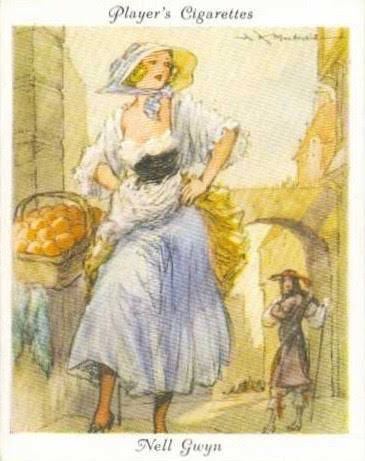
When I bought several Player's cards from a vendor, he kindly sent for free this 1930s card as a thank you. The card shows Nell Gwyn, who according to the reverse side of the card rose from being "a fruit hawker in the precincts of Drury Lane Theatre" to eventually becoming "enrolled a member of the King's Company of Players." This was during the Restoration under Charles II, and the king himself "fell a victim to her charms" as the card says. It was allegedly Gwyn who persuaded the king to complete the construction of Chelsea Hospital to provide a home for discharged soldiers.

The card is one of a series of 25 "Famous Beauties" taken from drawings by A.K. Macdonald. Other "beauties" drawn by Macdonald included Catherine the Great, the Queen of Sheba, and Pocahontas, so including the actress is quite a compliment. Gwyn was a close associate of the playwright Aphra Behn, who dedicated her play The Feigned Courtesans to the actress.

While I certainly am not a fan of the cigarettes that led to the creation of these cards, I'm glad many of the cards are still around today. They give us a fascinating glimpse not just of the world that created them, but also of the way that world looked back upon its own past.

Monday, January 13, 2020

Toy Theatres from the Girard Collection

Last month, I was in New Mexico and happened to visit the Museum of International Folk Art in Santa Fe. They had on display a number of toy theatres collected by Alexander Girard.


This is one of the oldest toy theatres in the collection. It comes from England, perhaps the 1820s. The Orientalist stage costumes are fairly common in British toy theatres, but I can't identify which play this is supposed to be.


This French toy theatre really fascinated me, in part due to what's written on the proscenium. The theatre enshrines the names of four writers popular in the early 19th century: Stéphanie Félicité, comtesse de Genlis (author of numerous moralizing dramas), Maria Edgeworth (most famous for novels like Castle Rackrent, but who also wrote plays for children), August von Kotzebue (a master of German melodrama whose plays are now mainly known for the music they inspired), and Vladislav Ozerov (a Russian dramatist whose tragedies were later overshadowed by the work of Alexander Pushkin).


Another French toy theatre caught by eye because the Théâtre de l’Ambigu-Comique was one of the more popular houses for melodrama in the early 19th century. It was located along the Boulevard du Temple, and helped to give that street the nickname of the Boulevard of Crime. This was not because crimes were committed in the neighborhood. You were quite safe walking on the street. But if you happened to be one of the characters in a melodrama being performed along the Boulevard du Temple, you better look out! All sorts of dastardly villains might be after you.


Here we see a puppet booth portrayed in a toy theatre. The French equivalent of Mr. Punch was Guignol, a puppet who also came out of the commedia dell'arte tradition. At the end of a century, when a non-puppet theatre named itself the Grand Guignol, the name was a bit of a joke, since the tiny character of Guignol was anything but grand.


Toy theatres were also popular in Germany and Denmark. This one comes from Germany. I like the Fairy-Tale aesthetic. Could this be the story of Sleeping Beauty? Hard to tell. I'm glad I got a chance to see it, though!

Tuesday, October 31, 2017

The Rise of Melodrama

The playwright René-Charles Guilbert de Pixérécourt pioneered melodrama in France, with such dramas as The Ruins of Babylon and The Dog of Montargis. These plays gave equal billing to their composers, as they relied just as much on dramatic music and acting dumb shows as on dialogue.

In 1802, the British playwright Thomas Holcroft adapted Pixérécourt's play Coelina, or The Child of Mystery as A Tale of Mystery, calling it "A Mélo-Drame In Two Acts." The melodrama had arrived in England, and was haunting Germany as well, where J.W. Goethe's rival August von Kotzebue had a string of hits, including The Ruins of Athens, Misanthropy and Repentance, and The Spanish in Peru.

These plays were tightly plotted, with succinct, functional dialogue designed to help the audience follow the plot, but the language of melodrama attempts little else and lacks the poetic qualities of Romantic drama. Also, while melodrama can be political, it is usually aimed at leading the audience to simplistic conclusions. Romantic dramas, by contrast, dealt seriously with political and moral issues, often giving equal voice to opposing views. Also, Romantic dramas provided towering characters suited for actors like Edmund Kean. The melodramas that overtook Romantic plays forced actors into roles of virtuous heroes or conniving villains in an effort to get the audience to focus on sensationalistic plot twists instead.

In England, the actress and theatre manager Jane Scott turned the Sans Pareil Theatre into a powerhouse of melodrama. The Sans Pareil was known as a "minor theatre" since it was licensed to perform musical entertainments, but was not allowed to perform purely spoken drama. Scott penned a series of plays that incorporated music and song, getting around the monopoly on spoken drama enjoyed by the patent theatres in London. She wrote more than 50 plays in all, many of them designed to show off her own talents as the leading performer. Her most famous, The Old Oak Chest, was originally a star vehicle for herself, but unlike her other works it was published, which allowed it to continue to be performed long after Scott retired from the stage in 1819.

Melodramas frequently drew inspiration from the Gothic novels of the period. Gothic tales frequently had exotic or medieval settings. They could have supernatural events, like Matthew G. Lewis's hit play The Castle Spectre, or they could portray apparently supernatural occurrences that get explained rationally, as happens in The Old Oak Chest. The most famous Gothic novel, Mary Shelley's Frankenstein, was first adapted as a melodrama by Richard Brinsley Peakes in 1823 as Presumption, or The Fate of Frankenstein. The play initially ran for 37 performances and continued to be revived until the middle of the century.

Meanwhile, the official patent theatres in London saw their audiences dwindle, and they increasingly turned to melodrama themselves. The actor William Charles Macready took over the management of the patent theatre at Drury Lane in 1841 pledging to revive the drama to its former glory. Unable to compete with the minor theatres, however, he asked the owners of the theatre for a decrease in rent, and when they declined he petitioned parliament to end the monopoly held by the patent theatres. In 1843, parliament agreed and passed the Theatres Act, which kept censorship in place, but allowed minor theatres to perform any type of play they wanted. Rather than the minor theatres turning to spoken drama, however, the old patent theatres turned to melodrama, making it the dominant theatrical form of the nineteenth century.


Saturday, April 22, 2017

Manfred at 200

Lord Byron published his drama Manfred in 1817. Now, 200 years later, a number of people are taking advantage of the piece's bicentennial to take a closer look at the work.

Thursday night, Red Bull Theater performed a staged reading of the play with Jason Butler Harner in the title role. And yesterday, New York University held a symposium organized by Omar Miranda to take a more academic look at Manfred.

After I saw the reading, I spoke with Miranda, and he invited me to the symposium. I have to teach on Fridays, so I missed much of it, but I managed to make it over in time to hear Emily Bernhard Jackson from the University of Exeter talk about Manfred, Byron, and incest.

Jackson noted that the character of Manfred expresses guilt, and that incest was a central concern both for Manfred and for his creator, Lord Byron. (Byron likely had a sexual relationship with his half sister, and Manfred loved a woman named Astarte, who also seems to have been related to him.) However, she observed that Manfred's guilt does not necessarily come from incest.

Even if Manfred did commit incest, did that cause his guilt? No, Jackson argued. The source of his guilt was Astarte's death. Manfred does not regret that he loved Astarte. Rather, his real regret lies in her response to that love. Jackson pointed out that Byron's poem Don Juan jokes about sibling incest, and his play Cain portrays incest as natural. Manfred's guilt doesn't come from the incest, she argued, but from the result of that incest, Astarte's mysterious death.

Jackson was followed by Richard Lansdown talking about Manfred and suicide, and Alice Levine comparing the play to the Don Juan legend. Lansdown mentioned that the arrival of modernity can be judged by when the suicide rate surpasses the homicide rate. That occurred around 1680 in London, but only recently in a part of Italy where organized crime has dominated for years. Levine's talk was equally interesting, as she observed that Mozart's Don Giovanni has more in common with Manfred than it does with Byron's Don Juan.

After a break, Jeffrey Cox and Michael Gamer kicked off a new panel on Manfred, performance, and theater. They compared Manfred with melodrama, a genre which Cox called a machine built for speed, and that speedily consumes everything in its way. He noted that in the wake of the French Revolution, there were 30,000 performances of the melodramas by Rene-Charles Guilbert de Pixerecourt. In Germany, the melodramas of August von Kotzebue received more performances than all of the plays by Friedrich Schiller and Johann Wolfgang von Goethe combined!

Gamer filled in some more information on melodrama. Thomas Holcroft, who adapted Pixerecourt to the English staged, was praised by his contemporaries for his ability to capture real life. What made melodrama a genre, however, was not its style but its form, in that it utilized music. Popular melodramas of the early nineteenth century borrowed music from ballet and pantomime to create mood. Similarly, he said, Byron used singing in Manfred, working in music as he tried to revive tragedy.

Jonathan Gross then spoke about the Freemason imagery in Manfred, and Miranda compared Manfred  to Percy Shelley's Prometheus Unbound. The keynote address, however, was given by Jerome McGann. He noted the similarity between Astarte's name and the name of Byron's half sister, Augusta. For all the parallels to Byron's life, through, Manfred remains deeply obscure, deeply ambiguous, and deeply suggestive, he said.

Most exciting for me, however, was at the reception afterward getting to meet Frederick Burwick. I've very much enjoyed reading some of Burwick's books, but I did not know how many Romantic-era plays he had directed! He and Paul Douglass have also made a great number of the songs used in Romantic plays available online.

Do yourself a favor and check out their site, Romantic-Era Songs. It's wonderful!

Monday, July 20, 2015

Private Theatricals

In the eighteenth and nineteenth centuries, fashionable upper-class families often staged plays in their own homes, using amateur, or sometimes a combination of amateur and professional actors.

Catherine Burroughs states in her book Closet Stages: "Private theatricals were often unabashedly elitist projects, not only in the sense that many took place in exclusive domestic environments, but because they required, in addition to time, a great deal of money to arrange."

Jane Austin makes this clear in her novel Mansfield Park. While the conservative Sir Thomas Bertram is away, his household decides to stage a private theatrical in imitation of another great family, the Ravenshaws. The Bertrams and their circle are much more interested in the idea of putting on a play than in any particular play itself, but they ultimately decide on the same play as the Ravenshaws: Elizabeth Inchbald's Lovers' Vows, an adaptation of a play by August von Kotzebue.

Much of the excitement at Mansfield Park is over the mechanics of production, since clearly the play itself is secondary. The young people turn Sir Thomas's billiard room into a theatre, and take great care over hiring carpenters and purchasing green baize for a curtain. Most importantly, however, the play allows unmarried people the opportunity to rehearse love scenes with members of the opposite sex.

The shallow but pretty Mary Crawford plays Inchbald's plucky and quite forward character Amelia. The religious Edmund, though at first resistant to the idea of a theatrical, plays the poor clergyman Anhalt, whom Amelia maneuvers into marrying her, just as Mary is planning to do with Edmund.

Meanwhile, Mary's feckless brother Henry plays Frederick, the Romantic soldier in the play. This casting is suggested by Maria Bertram, who herself wants to play Frederick's mother Agatha, thus giving her a chance to rehearse with Henry. Young Henry, however, has been keeping up flirtations with both Maria and her younger sister Julia, who also makes a bid to play Agatha. Henry makes known his preference for Maria to play the part, which both settles the matter and sows the seeds for disaster later in the novel. Agatha, after all, is a fallen woman, and Maria is destined to play that very role later.

Though the unexpected arrival of Sir Thomas puts an end to the theatricals at Mansfield Park, much of the consternation of the more scrupulous characters centers on how private the play will actually be. Edmund only agrees to accept the part of Anhalt to prevent neighbors from being invited into the production, thus forcing Mary Crawford to act with a stranger and turning a private affair into a more generally public performance, with people from all over the surrounding region invited to participate and watch.

The elitism, then, of private theatricals was not only or even primarily bound by the exclusivity of the venue, since these events could be opened up to the entire neighborhood, as threatens to occur in Mansfield Park. Their elitism came more from the fact that they required leisure time for rehearsals and material wealth to supply a stage, props, and costumes.

Tuesday, June 2, 2015

Helen Faucit

The famed Shakespearian actress Helen Faucit was born in 1814, during the Regency, and died in 1898, at the end of the Victorian era. In many ways, her life reflects the tremendous social changes at work during that period.

I recently finished Carol Jones Carlisle's biography, Helen Faucit: Fire and Ice on the Victorian Stage. She corrects some of the errors made by Faucit's original biographer, her husband, Sir Theodore Martin. Sir Theodore made his wife younger than she really was, claiming she was born in 1817, a year after him. He also glossed over some rather unpleasant business with her family.

Faucit (who was baptized Helena, but always went by Helen) came from a family of actors, a profession not generally known for their chaste sensibilities (especially during a time when the Prince Regent was running around with assorted mistresses, including the actress and poet Mary Robinson). Her mother, Harriet Diddear, eloped with John Faucit when she was only 16, a fact she would use later on when she tried to sue her husband for an annulment.

John Faucit took to theater management while his wife took to the stage, famously playing Gertrude in Hamlet. She could not compete, however, with the brightest star of the Regency stage, Eliza O'Neill. After a couple of years, the talented but impetuous woman took up with a new man, William Farren, who already had a wife of his own. This was the Regency, though, so that mattered very little. The two set up house, undeterred by Mrs. Faucit's unsuccessful attempt in 1821 to terminate her first marriage.

Young Helen stayed with her mother, and Farren became a stepfather to her, in spite of the fact he was still married to another woman. While he might not have been a paragon of family values, he did have a keen business sense, and he helped Helen successfully navigate her early career on the stage. According to legend, the family was at the King's Theatre in Richmond when Helen and her elder sister Harriet decided to act out the balcony scene from Romeo and Juliet upon an empty stage. The new manager, Willis Jones, overheard them, and decided to put the young Juliet in front of a live audience.

On September 30, 1833, Helen Faucit made her debut as Juliet, listed in the program simply as "A Young Lady". She was so nervous that she crushed the glass vial holding Juliet's potion, slicing open her hand and fainting in earnest. Still, she went on with the show, and the audience applauded her heartily. She repeated the performance the next night, this time using a wooden vial. The following month, she went on as Julia in James Sheridan Knowles' play The Hunchback, a part made famous by Fanny Kemble. In November, she appeared as Mrs. Haller in The Stranger, Benjamin Thompson's adaptation of a play by August von Kotzebue.

At the end of 1835, Faucit was given an opportunity to make her London debut on the stage at Covent Garden. Originally, she was supposed to play Juliet, but George Bennett, her prospective Romeo, was deemed too old for her, and Knowles himself was available to play the title role in The Hunchback. At the last minute, the play was switched, and Faucit found herself making her debut as Julia, not Juliet. On January 5, Twelfth Night, Faucit made her London debut. After a rocky start, she was a smash in the role, writing afterward in her diary, "Again and again, thank God it is over!"

Faucit later appeared as Belvidera in Thomas Otway's Venice Preserved, but predictably she suffered in comparisons to Eliza O'Neill, the standard in that role ever since the Regency. A few nights later she appeared on stage as Mrs. Haller in The Stranger, another role played by O'Neill. This time, however, she did something remarkable that set her apart. Instead of allowing the adulterous Mrs. Haller to be reconciled to her estranged husband at the end, she had the unfortunate woman embrace her children, then fall to the feet of her husband, spurned and rejected to the end.

Such a change, just a year before Queen Victoria's ascension to the throne, marks a shift in attitudes toward women, marriage, and sexual morality. During the Regency, Mrs. Haller could do her penance and reunite with her husband. In Victorian England, that would no longer be possible. Faucit, painfully aware of her own family's history, might have had personal reasons for making the change as well. After her mother's scandalous behavior, she herself wanted to be beyond reproach, and that meant no apologies for fallen women.

Faucit appeared as Lady Margaret in Joanna Baillie's The Separation. Then in March, she was at last allowed to go on as Juliet in London. The performance attracted some attention, and Faucit later found herself being invited to act with her hero, William Charles Macready in Thomas Noon Talfourd's tragedy Ion. Faucit worshipped Macready, but he remained cold toward her throughout their professional relationship. Still, she acted opposite him in a number of Shakespeare productions, including Othello, and Macready's landmark King John.

Amazing to me, Faucit originally did not want to play Cordelia in Macready's 1838 production of King Lear. She felt the part had too few lines and not enough opportunities for making a grand effect. Macready's production revolutionized the play, however, getting rid of the silly love story and happy ending introduced during the Restoration, and bringing back the part of the Fool. Critics rewarded Faucit for taking the role, praising her sweetness in the part. They complained, however, that she spoke too softly, perhaps another effect of her Victorian worldview.

Faucit had to play her fair share of unsuitable roles, including Mrs. Oakley in George Coleman the Elder's The Jealous Wife. However, the same year as Macready's Lear, she was given the part that would grant her the most fame, Pauline in Edward Bulwer-Lytton's The Lady of Lyons. The same author who had once begun a novel with the infamous line "It was a dark and stormy night" this time hit pay dirt for Faucit, and she would perform the part of Pauline over and over again for the rest of her career.

Later, Faucit appeared opposite Macready in Bulwer's play Richelieu, but that play was more of a vehicle for her costar. She found more success in Shakespearean roles, playing Rosalind in As You Like It, Miranda in The Tempest, Portia in The Merchant of Venice, as well as a formidable Lady Macbeth opposite Macready. Faucit's Lady Macbeth was not power mad, though, but rather ambitious only for her husband's sake. Victorianism strikes again.

When Macready left to tour America, the 28-year-old Faucit was left to develop her craft on her own. She toured the provinces, becoming a success in Dublin, Birmingham, Bristol, Edinburgh, and Glasgow. In 1844, she reunited with Macready in Paris, playing Desdemona to his Othello. Returning to Dublin, she appeared as Antigone, and was later painted as "The Greek Muse" by Sir Frederick William Burton.

In 1851 Faucit married Theodore Martin, whom Queen Victoria later knighted for completing a grand biography of Prince Albert. They set up house in London, neighbors to the Thackerays, and had a second home in Wales to boot. Still, Faucit didn't give up acting, and she kept her maiden name for billing purposes.

She did not perform as frequently after marriage, but Faucit kept acting until 1879, and even after her retirement from the stage, she took part in numerous fundraisers and public readings, often reading aloud multiple parts in scenes from Shakespeare.

At the instigation of her friend Geraldine Jewsbury, she began a series of published "letters" on characters she had played. These were later collected under the title: On Some of Shakespeare's Female Characters. A typical passage on Desdemona goes like this:

Making so small a part of her father's life, and missing the love, or the display of it, which would have been so precious to her, she finds her happiness in dreams of worth more exalted than any she has known, but which she has heard and read of in the poets and romancers...

So, too, did Helen Faucit, a child of a broken home from an earlier, more permissive era, dream of happiness. Only her happiness was one bound up in the stability and tranquility of wedded life. And fortunately for her, she found it.


Saturday, January 17, 2015

Lovers' Vows

In 1798, the playwright and actress Elizabeth Inchbald adapted August von Kotzebue's 1790 play Das Kind der Liebe as Lovers' Vows. Jane Austen apparently found the play charming enough to work it into her novel Mansfield Park. If you ever see or read the play, you will not wonder why.

The title of Kotzebue's play translates as "The Child of Love" and refers to someone born out of wedlock. That is the situation of the young soldier Frederick. One might find it strange to have a play about a bastard be at the center of an Austen novel, and indeed, the heroine of Mansfield Park objects to the play, but not due to the character of Frederick. Rather, as Austen writes:

Agatha and Amelia appeared to her in their different ways so totally improper for home representation—the situation of one, and the language of the other, so unfit to be expressed by any woman of modesty, that she could hardly suppose her cousins could be aware of what they were engaging in; and longed to have them roused as soon as possible by the remonstrance which Edmund would certainly make.

Agatha Friburg is Frederick's mother, so her situation is understandably objectionable. However, Inchbald paints Agatha in the most sympathetic light possible. Her seducer talked to her of love and promised her marriage, and it is that promise that Inchbald places in the title of the play, rather than a reference to illegitimacy.

Amelia Wildenhaim is the character whose language is shocking. It so happens that she is the daughter of Agatha's former lover, Baron Wildenhaim. He abandoned Agatha to please his family with a marriage to another woman. By the time the play opens, that woman is dead, and as she and the Baron were so clearly incompatible, he has come to regret ever abandoning Agatha, whom he really did love.

Having learned that a love match is far superior to marrying for wealth or station, Amelia spurns the ridiculous Count Cassel and has her heart set on her tutor, Anhalt. She decides to teach her tutor a thing or two about love. When Anhalt protests that there are some things he had rather never know, Amelia responds saucily:

So you may remember I said when you began to teach me mathematics. I said I had rather not know it—But now I have learnt it gives me a great deal of pleasure—and perhaps, who can tell, but that I might teach something as pleasant to you, as resolving a problem is to me.

Only Inchbald could make mathematics sound quite so sexy!

Amelia pins her hopes on Anhalt, but when he is loath to propose to the daughter of his employer, she takes matters into her own hands. Amelia goes to her father to convince him she should marry whomever she wishes. Ultimately, the vows made between Amelia and Anhalt help convince the Baron that he must honor his own vow to Agatha, even though it was made so very long ago.

So even if you don't take it from me, take it from Jane Austen! Lovers' Vows is definitely a worthwhile play.

Thursday, November 13, 2014

Whose Tragedy Is It?

The destruction of the Inca Empire had all of the elements of tragedy: overreaching ambition, a brilliant but flawed leader, and a magnificent downfall. Dramatists have repeatedly turned to the conquest of Peru when seeking inspiration for great tragedy. But whether they recognized it or not, before they ever set pen to paper, they always had to answer a simple question: Whose tragedy is it?

The End of Atau Wallpa, Richard Brinsley Sheridan's Pizarro, and Peter Shaffer's The Royal Hunt of the Sun each come up with a different answer to this question. As a result of the heroes they choose, they end up creating very different plays.

In all likelihood, the first tragic poets to have dealt with the fall of the Inca were Native Americans. Their work does not come to us directly in written form. Still, numerous "Dances of the Conquest" have come down through the oral tradition. These no doubt changed over the years, and by the time they were written down and translated into Western languages, they might have become unrecognizable when compared with early indigenous dramas.

In spite of these questions of authenticity, the Bolivian play The End of Atau Wallpa provides a convenient example of what the first tragedies on the conquest of Peru might have looked like. The Spanish version that we have from Jesús Lara dates to the mid-twentieth century, but it conveys how Native Americans in the sixteenth century likely viewed the fall of the Inca.

The Inca Emperor Atahualpa, or Atau Wallpa, begins the play with a literary device common in tragedy, a prescient dream of ill fortune.

"I saw the Sun, our purifying Father, hidden in thick black smoke," he says, "Maybe death is hovering near."

This typical tragic speech is reminiscent of Cassandra's cry to another sun god in Aeschylus's Agamemnon: "Apollo, Apollo! Leader of Journeys, my destroyer! Where have you led me? Oh! what fearful house is this?"

But while Cassandra is prophesying a tragedy in which she is only a secondary actor, Atau Wallpa remains firmly at the center of his own tragedy. Having deposed his brother, Inca Husácar, he must face a new conqueror. Ultimately, Atau Wallpa must bend before Francisco Pizarro, just as he once made others bend before his will. Like King Lear, who after being stripped of his powers literally strips himself on the heath, Atau Wallpa hands over all the symbols of his authority, including his golden headpiece, mace, and sling.

After a long lament, Atau Wallpa is slain by the base conquistador Pizarro. If it is not already clear that Atau Wallpa is the tragic hero, the King of Spain makes it explicit, lambasting Pizarro and praising his fallen enemy. While the memory of Atau Wallpa lives on, Pizarro dies and his body is cast on a fire. By the king's orders, nothing is to remain of the "infamous soldier."

The End of Atau Wallpa is a simple enough tragedy. The hero is a king, the stakes involve the fate of nations, and the action follows a tremendous reversal of fortune. When the German Romantic dramatist August von Kotzebue tackled the same material, he shifted the focus away from the king and made the noble Inca Rolla his hero. In both Kotzebue's play Die Spanier in Peru, and in Sheridan's English adaptation of it, Pizarro, this shift in heroes accompanies an overall change in aesthetic from a classical notion of tragedy to a more Romantic ideal in which individuals of exalted spirit are more important than kings or empires.

Rolla's entrance in Pizarro quite literally identifies him as a hero, as Alonzo cries out before Rolla comes on stage: "'Tis Rolla comes, the first and best of heroes."

This hero enters accompanied by trumpets, and in the next scene he is embraced by the Emperor. It is Rolla who wins the battle against the Spanish, and Rolla who undertakes the rescue of Alonzo.

The rescue of this single man, rather than the fate of an army or an empire, occupies the heart of the play, another indication that Pizarro is a Romantic rather than classical tragedy.

The machinations of Kotzebue's plot sometimes tip the play into melodrama, yet Rolla remains a dignified tragic hero. Even the ruthless Pizarro is moved by Rolla's nobility of spirit.

In his adaptation, Sheridan grants Rolla the elevated and stoic language of a tragic hero, giving him such poetic lines as, "To triumph o'er ourselves, is the only conquest." As a result, when Rolla dies, the effect is tragic, not merely evoking the pathos of melodrama.

Both Rolla and Pizarro die in the end, but it is Rolla's body that is lamented while Pizarro’s corpse is carried off in infamy. In that respect, the finale is similar to that of The End of Atau Wallpa, but in Atau Wallpa characters lament a king and fallen civilization, whereas in Pizarro they lament one man.

The fate of the Inca Empire is almost irrelevant in Sheridan's play. The Spanish are vanquished for the time being, but history dictates that the Inca will not last long. Sheridan does not invite us to contemplate this fact, however, instead emphasizing the tribute paid to Rolla's memory. Atau Wallpa is a lament for a nation, while Pizarro laments a single individual.

In a post-Romantic era, audiences are less inclined to elevate one person over the fate of a civilization. They are also unlikely to believe in the soaring (sometimes unbelievable) goodness of a character like Rolla, or to be moved by the fall of a dynastic monarchy so remote from modern democracy. To engage a twentieth century audience, Peter Schaffer undertook something very different from either Atau Wallpa or Pizarro: He took the man who had been the villain of the story and made him the tragic hero of The Royal Hunt of the Sun.

Little is known about the historical Francisco Pizarro. All dramatizations of the conquest, however, seem to latch onto one fact about the conquistador — his infamous low birth.

Both Atau Wallpa and Pizarro use the general's humble origins as a way of denigrating him and perhaps explaining why he behaves as such a philistine in the face of the civilized Inca. Writing in a more democratic age, however, Shaffer uses Pizarro's lowborn status as a way to appeal to the audience's sympathies.

Instead of covering up his background, Shaffer has Pizarro revel in it, indulging in the baseness of his past. His first line is, "I was suckled by a sow." Later on he declares, "I learnt my trade as a mercenary, going with who best paid me." He professes himself illiterate and completely lacking in chivalry, but his boastfulness in his lowliness comes, he tells us, from the world constantly saying "No" to him. Now that he is able to, he will take what the world refused to give him.

This is not the language of a villain, but rather of an anti-hero. Shaffer's Pizarro has more in common with the protagonists of Christopher Marlowe than with the evil conquistador he is portrayed as in Atau Wallpa and Pizarro.

What makes The Royal Hunt of the Sun truly extraordinary, however, is the way Shaffer transforms this anti-hero into a legitimate tragic hero, a man who over-reaches, but in the quest for something more than simple self-aggrandizement. Shaffer's Pizarro embarks on a quest for literal gold, but in his encounters with the Inca, he begins to hunger for a spiritual gold. His royal hunt becomes no longer for an earthly sun-like substance, but for the Sun itself, and all the spiritual qualities with which mythology endows the Sun.

As Pizarro and the Inca Emperor Atahuallpa march towards one another in Act I, both claim to be gods, but Atahuallpa actually believes in his godhead, while Pizarro cynically uses the idea of godhood in his game of conquest. Pizarro seems to believe in no god, Inca or Christian, any more than he believes in chivalry or honor. The only thing he does seem to believe in is death, which he views with the cold eyes of realism, draining death of the romantic notions that elevate Rolla's fall in Sheridan's play.

In fact, Pizarro's idea of death seems antithetical to the existence of tragedy at all. "Does anyone ever die for anything?" he asks, adding, "I thought so once. Life was fierce with feeling." In order to become a tragic figure, Pizarro must first get that feeling back. Only then can his death possibly have any meaning.

The feeling Pizarro finally does recapture in Act II comes not from Christianity, but from the Inca religion. In Equus, Shaffer would later probe more fully the appeal of Paganism to the alienated modern world, but in The Royal Hunt of the Sun, he is more interested in Paganism's appeal to one man, a man he will ultimately elevate to being a tragic hero.

The Christians are nominally coming to convert the Inca, but it is Atahuallpa who instead Inca-izes Pizarro. When Atahuallpa gives him an Inca earring, Pizarro, seeing his reflection in a knife, declares, "I have never seemed so distinguished to myself." Atahuallpa teaches Pizarro how to dance and how to laugh. When Pizarro's soldiers demand that he kill Atahuallpa, the man who once believed in nothing but death finds he cannot give the order.

Atahuallpa gives Pizarro a way out. Since he is a god, he cannot die, and if they strike him down, he will only be resurrected. This Pagan belief finally gives Pizarro faith, and even if it is a false faith, it is at least something in which he can believe. At last, Pizarro has something to die for.

After the Spanish execute Atahuallpa, Pizarro waits for his resurrection. When the Inca does not rise, Pizarro feels his faith has been betrayed. Yet for once he has felt faith. For the first time, Pizarro begins to cry, something the villains of Atau Wallpa and Sheridan's drama could never do.

It might seem odd that Kotzebue and Sheridan, living in what we perceive as a less enlightened age, should choose a Native American hero, while Shaffer, in the comparatively progressive 1960s, chose to elevate a conquistador, the very symbol of everything wrong with Western imperialism. However, Rolla manifests a euro-centric myth of the noble savage. He might be Inca in name, but in reality he personifies Western Romantic ideals. Shaffer’s Pizarro, though a Westerner, attempts to grasp a non-Western ideal.

It is easy to criticize Shaffer for falling prey to exoticism and for projecting onto Inca society that which he sees lacking in his own, but in spite of that, The Royal Hunt of the Sun remains a braver play than either Atau Wallpa or Pizarro. By focusing on the least likely tragic hero, Shaffer makes tragedy possible in an age notoriously hostile to tragic sensibilities.

The Royal Hunt of the Sun is neither a classical nor a Romantic tragedy. Instead, it is a modern tragedy which glories in the banality and senselessness of death, but at the same time reaches beyond that to transcend a world that no longer believes in the possibility of transcendence.