Showing posts with label Knowles. Show all posts

Saturday, November 12, 2022

Talfourd's ION

In the latest issue of Theatre Notebook, Christopher Butcher has an excellent article on William Charles Macready bringing Thomas Noon Talfourd's play Ion to the stage.

Though the play shares its title with a tragedy by Euripides, Talfourd's take is quite different, and involves the young prince Ion sacrificing his own life for the good of the state. The author had the piece printed privately and circulated it among a number of notables, including Macready.

The actor was excited about the play, but recognized that audiences might consider him too old to play a young character like Ion. However, impressed by Macready's performance in another tragedy on classical themes, Virginius, Talfourd requested the star actor to appear in the starring role. Macready was only too happy to oblige.

Originally, the play was supposed to be performed for Macready's benefit night at the Theatre Royal, Drury Lane. Unfortunately, Macready had a violent quarrel with the theatre's manager, Alfred Bunn. Macready had to turn to Talfourd for legal advice in the matter. The actor wanted out of his contract at Drury Lane, and so he ended up using Ion as a pretext for gaining his own dismissal. He wrote to Bunn demanding that the play be brought into rehearsal as soon as possible. Bunn fired Macready for his impudence, which is precisely what the actor wanted.

Even before Bunn had fired him, Macready had begun negotiations to appear at the rival Theatre Royal, Covent Garden. Included in his contract was a stipulation that Ion be performed. Eventually, the date of the premiere was set for May 26, 1836, which was also Talfourd's birthday. Macready wanted the painter Clarkson Stanfield to provide the scenery, though he was unfortunately unavailable.

Ellen Tree agreed to play the role of Clemanthe, and the piece was advertised as being for one night only. Joanna Baillie, the most highly regarded dramatist of her day, was in the audience, as were William Wordsworth, Walter Savage Landor, Henry Crabb Robinson, Henry Hart Milman, Robert Browning, Sheridan Knowles, and Charles Dickens.

The play was a success, with the audience calling for the author to take a bow. Talfourd received numerous letters congratulating him, and plans were made for a lengthier run, rather than just the one-night-only event. Macready had introduced cuts that greatly reduced the role of Clemanthe, and when the play later began its official run, Helen Faucit replaced Ellen Tree. At first, Faucit was disappointed by her own performance, but Talfourd wrote her a kind letter that buoyed her spirits.

Ion was performed June 1, 3, 6, 8, 9, 10, and 11 at Covent Garden, and would have run longer, except Macready had engagements elsewhere. It even led to a minor revival in Greek themes on the London stage. Though the play has been largely forgotten, Butcher's article brings new attention to this important moment in theatrical history.

Incidentally, if you want to read more about Macready, you can find plenty of information about him in my new book, Romantic Actors, Romantic Dramas. Though I don't have a full chapter on Macready, his career is discussed at length, as is the work of Baillie, Browning, Faucit, Knowles, Milman, and others.

And though I don't have an article in this issue of Theatre Notebook, my article "War, Pandemic, and Immortality: 1918 and the Drama of Eternal Life" appears in the latest issue of Shaw. Check it out!

Sunday, May 15, 2022

What Doesn't Go up in Smoke

I have no affection for cigarettes. When I was growing up, both of my parents smoked, and wanting to be like them, I wanted to smoke, too. One day, sitting on my mother's lap, I asked her if I could have a puff of her cigarette. She handed it to me. I took a puff. I have never wanted to smoke anything ever again.

What I do have a fascination for, however, is cigarette cards. These cards were originally added to cigarette packages to stiffen them, and by the 1880s, manufacturers were printing advertisements on them, often including popular images that could be collected by consumers. Those images could be of sports stars, famous Native American leaders, national flags, exotic animals, or sometimes actors and actresses.

These cards can sometimes be found on Internet auction sites, and I've purchased a few in recent years, wanting to have images of performers from the Regency era. The first one I bought was when I saw for sale a cigarette card of the actress Eliza O'Neill identical to one in the collection of the New York Public Library. The card, issued by Chairman Cigarettes, probably dates to the 1920s. The reverse side gives information about O'Neill, including that she excelled in the roles of Belvidera, Juliet, and Mrs. Beverley.

Chairman Cigarettes appears to have been based in England at the beginning of the 20th century, but I've found scant information on them. Recently, I obtained a number of cigarette cards issued by Player's Cigarettes. John Player & Sons was based in Nottingham, but it merged with Imperial Tobacco Group in 1901. Under the ownership of Imperial, Player's issued a number of trading cards, though it had issued its own cards as far back as 1893. Probably around the same time Chairman issued the card showing O'Neill, Player's issued a series of 25 cards showing miniature portraits of great painters. (I've seen 1923 given as the year for this series, but cannot verify it.)

Many (though not all) of those miniature portraits displayed images of actresses. This one shows Sarah Siddons, who according the the reverse side was "one of our greatest tragic actresses." Siddons first appeared on the London stage in 1775, but her first great success did not come until seven years later, when she appeared at Drury Lane as Isabella in an adaptation of Thomas Southerne's The Fatal Marriage. The Player's card calls this performance "a triumph almost unequalled in the history of the English stage."

Siddons introduced her most famous role, Lady Macbeth, in 1785. This portrait by Sir Thomas Lawrence, however, appears to show her in the role of Mrs. Haller from The Stranger, an adaptation Benjamin Thompson did of a melodrama by August von Kotzebue. Siddons was long the reigning tragic actress on the London stage. It was only after the retirement of Siddons that O'Neill came to London from Dublin, taking over many of the elder performer's roles, including Isabella and Mrs. Haller. Neither actress, however, had much of a gift for comedy. The great comedic actress of the period was Dora Jordan.

Here's a Player's trading card showing Jordan. As the card states, the image is based on a painting by George Romney. Jordan's real name was Dorothea Bland, but for obvious reasons, the actress changed it. Like O'Neill, she was born in Ireland and rose to fame in Dublin. Jordan made her London debut at Drury Lane in 1785, the same year Siddons first wowed audiences as Lady Macbeth. Rather than competing with the great tragedienne, Jordan gravitated toward comic roles, making her London debut in the role of Peggy, the protagonist of David Garrick's bowdlerized version of The Country Wife

Jordan was just as famous for her personal life off of the stage as she was for the roles she played on stage. In 1790, she became the mistress of the Duke of Clarence, a younger son of the reigning monarch, George III. They had ten children together, but sadly, the Duke could not marry her. After all, she was a humble Irish actress, and he was in line to ascend the throne. In fact, when his elder brother died in 1830, the Duke became King William IV. By that time, poor Jordan was dead. Her body was buried in a cemetery on the outskirts of Paris.

Another Regency actress, Maria Foote, appears on this Player's card, based off of a portrait by George Clint. Foote made her London debut at Covent Garden in 1814, as did O'Neill, but while O'Neill went on to massive fame as an actress, Foote did not. As the reverse side of her trading card puts it, she was "more celebrated for her beauty than for her acting." After her debut in The Child of Nature by fellow actress Elizabeth Inchbald, Foote went on to perform numerous Shakespearean roles, including Miranda in The Tempest, Lady Percy in Henry IV, and Helena in A Midsummer Night's Dream.

Foote also played a key role in Virginius, a new play by James Sheridan Knowles that after a brief run in Glasgow made its London premiere at Covent Garden in 1820. Foote played Virginia, the virtuous daughter of the title character. Virginia falls in love with Icilius, but the tyrant Appius lusts for her, and claims she is secretly the daughter of one of his slaves, sold to Virginius's now conveniently dead wife, since she was allegedly barren. The play made the new British king, George IV, rather nervous, since he was known for treating his wife and numerous mistresses not terribly well.

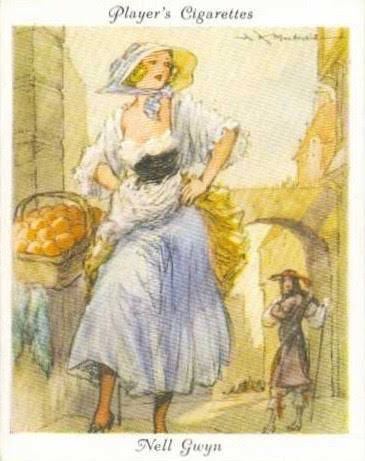
When I bought several Player's cards from a vendor, he kindly sent for free this 1930s card as a thank you. The card shows Nell Gwyn, who according to the reverse side of the card rose from being "a fruit hawker in the precincts of Drury Lane Theatre" to eventually becoming "enrolled a member of the King's Company of Players." This was during the Restoration under Charles II, and the king himself "fell a victim to her charms" as the card says. It was allegedly Gwyn who persuaded the king to complete the construction of Chelsea Hospital to provide a home for discharged soldiers.

The card is one of a series of 25 "Famous Beauties" taken from drawings by A.K. Macdonald. Other "beauties" drawn by Macdonald included Catherine the Great, the Queen of Sheba, and Pocahontas, so including the actress is quite a compliment. Gwyn was a close associate of the playwright Aphra Behn, who dedicated her play The Feigned Courtesans to the actress.

While I certainly am not a fan of the cigarettes that led to the creation of these cards, I'm glad many of the cards are still around today. They give us a fascinating glimpse not just of the world that created them, but also of the way that world looked back upon its own past.

Monday, December 27, 2021

Margaret Somerville Bunn

The actress Margaret Somerville made her debut at the Theatre Royal, Drury Lane playing the female lead in Charles Robert Maturin's play Bertram opposite none other than Edmund Kean.

At the time, she was only 16 years old, at least if we can rely on The Biography of the British Stage, published by Sherwood, Jones, & Co. in 1824. That source gives Somerville's birth as being in Lanark, Scotland, on October 26, 1799.

Young Margaret, at the age of 10, began performing in private theatricals, taking on the role of Marcia in Joseph Addison's Cato in a performance of juveniles. Apparently, she grew into an impressive actress, and in 1815 Douglas Kinnaird, a member of the sub-committee running Drury Lane, managed to get her into rehearsal at the theatre in the starring role of Belvidera in Thomas Otway's Venice Preserved.

Alas, poor Margaret Somerville was dismissed from those rehearsals, being informed she was simply not up to the role. Undeterred, she appealed to John Kemble, then manager of the rival patent theatre at Covent Garden, but he declined to help her. She then returned to Kinnaird and performed some passages from Venice Preserved in an attempt to win a second chance. It so happened that Lord Byron, who was also on the sub-committee, was present, and he and Kinnaird both agreed that the young woman should make her debut immediately.

Bertram opened on May 9, 1816, with Somerville in the role of Imogine. The show was a success, and the actress was offered a three-year contract on "very advantageous terms" according to The Biography of the British Stage. In 1817, she obtained permission to perform in Bath for a engagement of ten weeks, lasting into the new year. It was there that she played the role of Bianca in H.H. Milman's tragedy Fazio. In 1818, she left Drury Lane and defected to Covent Garden, where she played Bianca again. That role had already been made famous in London by Eliza O'Neill, who subsequently appeared with Somerville in Jane Shore by Nicholas Rowe.

Somerville was frustrated with a lack of choice parts for her in London, though, and she left Covent Garden to tour the provinces. It was while performing in Birmingham that she met Alfred Bunn, whom she married in 1819. Bunn became part of the inner circle of Robert William Elliston who then took over Drury Lane, allowing Margaret, now Mrs. Bunn, to appear in London as Bianca again, as well as Hermione in William Shakespeare's The Winter's Tale and Cornelia in Sheridan Knowles's Caius Gracchus.

Perhaps Margaret Bunn's most famous role, however, was Queen Elizabeth in an adaptation of the Walter Scott novel Kenilworth. According to The Biography of the British Stage, she was applauded "to the very echo" in the role.

According to a local newspaper in south-central Minnesota, the Bunns' second daughter Helen immigrated to the United States, and Margaret, then widowed, joined her. She died in 1882 and is buried in Blue Earth, MN.

Sunday, January 24, 2016

Virginius

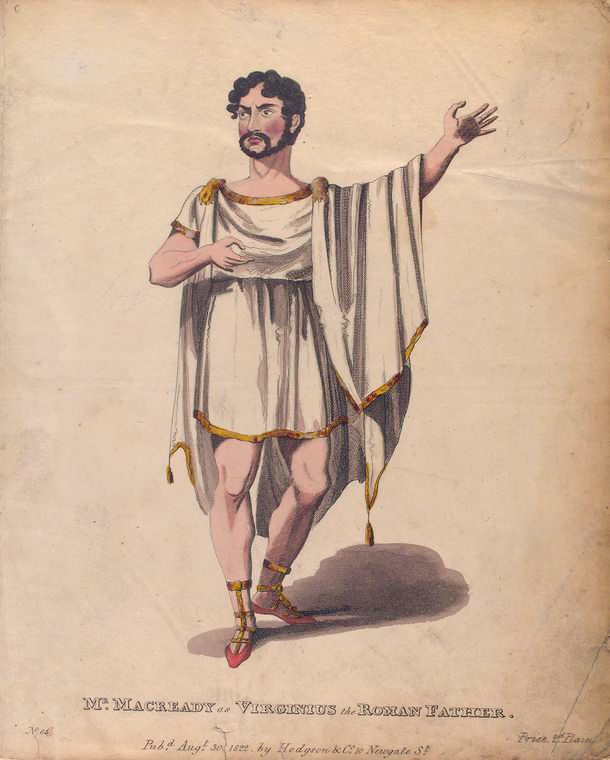
On May 17, 1820, William Charles Macready opened a new play at Covent Garden called Virginius. The play was by James Sheridan Knowles, and according to the author's own preface, he had written it in three months.

Knowles was careful to credit the Glasgow Theatre, which performed his play a month prior to the opening at Covent Garden. It was Macready who made the play's reputation, though, and to Macready that Knowles dedicated the published script.

According to the critic Michael R. Booth, Knowles originally wrote the play at the suggestion of Edmund Kean, but by the time the playwright submitted it to Drury Lane, the theatre had already accepted a play on the same subject by another author. Virginius had a respectable run in Glasgow with John Cooper in the title role, and a friend passed the script on to Macready, who snatched it up for Covent Garden.

A potential crisis arose when King George IV requested to see the manuscript personally. On the eve of the opening, he gave it back with several lines crossed out--lines that referenced tyranny. Not wanting to offend the new monarch, the company dropped the offending passages. Charles Kemble went on as the young lover Icilius, Maria Foote appeared as the virtuous Virginia, but Macready towered over all in the title role of Virginius.

The story deals with the Second Decemvirate of the Roman Republic. The Romans created the First Decemvirate in 451 B.C. to codify their law in the wake of unrest among the lower plebeian class. All of the city's magistrates resigned so that a council of ten men with dictatorial powers could both run the government and draft a new code of laws. The Decemvirs produced ten bronze tables inscribed with the law, but there was a general consensus that an additional two tables would be needed.

Here's where things get tricky. The original Decemvirate included the two men who had just been elected consuls and had to resign: Appius Claudius Crassinus and Titus Genucius Augurinus. When the Romans elected a new Decemvirate, however, only Appius got re-elected from the old Decemvirate, and the other nine Decemvirs were all his close friends. It seems Appius was the one who had counted the votes.

In Knowles's play, Viginius comments on this situation, but by attacking the people who elected Appius rather than accusing Appius of cheating:

Most sapient people! You re-elect Appius into the Decemvirate for his honesty, and you thrust Titus out of the Decemvirate--I suppose for his honesty also! Why, Appius was sick of the Decemvirate!

At least Appius said he was sick of ruling. That, too, was likely a ploy. Virginius, for all his anger, does not hate all the supporters of the Decemvirate, though. He agrees to allow his daughter Virginia to marry Icilius, who apparently had a hand in the election. The two young people are in love, and Virginius cannot bear to refuse his daughter her choice.

Trouble brews in Act II, when Appius sees the beautiful Virginia and falls in lust with her. It isn't just me who says Appius doesn't love her, but Appius himself who recognizes that his feelings are a much less patient emotion than love. He says at the beginning of Act III:

It is not love, if what I've felt before
And call'd by such a name, be love--a thing
That took its turn--that I could entertain,
Put off, or humour--'tis some other thing....

Appius hatches a plot to have his friend Claudius claim Virginia was a child of one of his slaves, illicitly sold to Numitoria (the now deceased wife of Virginius) because she was in fact barren. Then, Appius can have his way with Virginia, in spite of the fact she has rejected all of his smarmy overtures thus far. The plot sounds ridiculous, but Claudius has one of his slaves swear she is Virginia's real mother, and the girl's actual mother isn't around anymore to refute the claim.

Act IV is the heart of the play, and it is here that Macready could really shine. Appearing in the Forum, Virginius mocks the idea that his daughter should be taken from him on the word of one of Claudius's slaves:

Is she not his slave! Will his tongue lie for him--
Or his hand steal--or the finger of his hand 
Beckon, or point, or shut, or open for him?
To ask him if she'll swear! Will she walk or run,
Sing, dance, or wag her head; do any thing
That is most easy done? She'll as soon swear!

When asked to answer the slave woman's oath, Virginius brings forth his daughter as the answer:

Is this the daughter of a slave? I know 
'Tis not with men, as shrubs and trees, that by 
The shoot you know the rank and order of
The stem. Yet who from such a stem would look
For such a shoot? My witnesses are these--
The relatives and friends of Numitoria,
Who saw her, ere Virginia's birth, sustain
The burden which a mother bears, nor feels
The weight with longing for the sight of it.

However, as head of the government, Appius is the judge, and since the Decemivate has dictatorial powers, there is no right to appeal. The crowd supports Virginius, but Appius has troops and lictors (government bodyguards) hold them back. Appius declares he has long known that Virginia was born a slave, and he rules that Claudius must take her home. Seeing through the plot, Virginius appeals to the crowd:

Look not on Claudius--look on your Decemvir!
He is the master claims Virginia!
The tongues that told him she was not my child
Are these--the costly charms he cannot purchase,
Except by making her the slave of Claudius,
His client, his purveyor, that caters for
His pleasures--markets for him--picks and scents
And tastes, that he may banquet--serves him up
His sensual feast, and is not now asham'd,
In the open, common street, before your eyes--
Frighting your daughters and your matrons' cheeks
With blushes they ne'er thought to meet--to help him
To the honour of a Roman maid, my child, 
Who now clings to me, as you see, as if
This second Tarquin had already coil'd
His arms around her. Look upon her, Romans!

Here it perhaps becomes apparent why the king was so concerned about this play. George IV had a reputation for numerous affairs. His separation from his wife and his possession of a string of mistresses (whom he did not always treat well) made him a decidedly unpopular figure. Audiences could very well associate their monarch with the tyrannical villain of the play.

I won't give away the outcome, but let it suffice to say that this scene helped to secure Macready's reputation. Poor Kean missed his chance when Drury Lane passed on the play. Years later, when Kean's career was on the skids, he decided to take on Virginius, in spite of the fact that it had been some time since he had learned a new role. Kean appeared in the play at the end of 1828, but suffered from unfavorable comparisons to Macready. The unfortunate Kean was dead five years later.

Knowles's play, on the other hand, continued in the repertoire for quite some time.