Showing posts with label Theatre Notebook. Show all posts

Sunday, February 15, 2026

The Castle Spectre

Matthew G. Lewis is best known as author of the Gothic novel The Monk, but he also wrote numerous dramas, including The Castle Spectre.

The play premiered in 1797, the year after Lewis published The Monk. While the novel featured numerous supernatural events, ghosts and spirits were frowned upon for the stage at the time. Consequently, most audience members probably didn't expect any spectre to appear, in spite of the play's title.

When the first playbills were issued, they neglected to mention any ghost in the cast. This no doubt encouraged audiences to take a more rationalistic approach to the drama. The play's fool Motley relates that there are numerous stories related to ghosts in the castle, commenting, "Had I minded all the strange things related of this Castle, I should have died of fright in the first half hour."

Toward the beginning of Act IV of the play, the conscious-stricken villain Osmond claims to have seen the ghost of Evelina, the woman he murdered many years ago. Since he is wracked with guilt, this might merely be his own hallucination, much like Lady Macbeth seeing her fair hands covered in blood. Osmond is also reminded of Evelina since her daughter Angela has now grown into a woman who much resembles her deceased mother, and Osmond in fact says he initially mistook the ghost for Angela.

Audiences had every reason to be shocked, then, when the spectre of Evelina did in fact appear on stage at the end of the act. Lewis's stage directions indicate an elaborate effect:

The folding-doors unclose, and the Oratory is seen illuminated. In its center stands a tall female figure, her white and flowing garments spotted with blood; her veil is thrown back, and discovers a pale and melancholy countenance; her eyes are lifted upwards, her arms extended towards heaven, and a large wound appears upon her bosom.

Evelina's ghost comes onstage again in the final act, coming between Osmond and her former husband who is about to be slain by him. It is then that Angela stabs Osmond, preventing the villain from committing any further murders.

Lewis's play was performed over and over again throughout the decades to come, both on real stages and in toy-theatre versions, like the one below, printed by the publisher Dyer. The drama's spooky effects apparently worked on multiple scales.


Incidentally, if you're interested in toy theatres, I recently wrote an article about them that ran in the most recent issue of Theatre Notebook.

Friday, January 19, 2024

Rambling the Streets with Aphra Behn

I recently received the new issue of Theatre Notebook, which includes an article by Kate Aughterson on street scenography in Aphra Behn's play The Rover.

According to Aughterson, when Hellena says in the first scene, "let's ramble," there is an implied sexual connotation for audiences of Restoration drama. Public streets could be places for licentiousness, and women walking the streets publicly might be seen as willing prey for men.

However, Aughterson argues that the play shows female characters using what the philosopher Michel de Certeau referred to as "tactics" that push back against the social standards the general culture imposes on individuals. While streets were often considered male spaces, the women in The Rover sometimes assert themselves there, frequently with the aid of masks or disguises.

Half of the scenes in The Rover, 8 out of 16, take place on the street. This is more than any other Behn play, though her 1681 sequel to the original play comes close with 5 out of 12 scenes taking place on the street. Some scenes even specify a particular type of street scenography, calling for a "long street" which might have used all of the theatre's side shutters, each set of shutters partially open with a different piece of painted scenery, allowing for a sense of perspective.

The famous Molo in Naples, which juts out into the harbor, provides the location of an important scene in Act 4, and reputedly Behn had a special backdrop painted just for this scene. This is the scene with the play's famous duel, which stages a distinctly masculine action, but women are present in the scene as well. At the end Angellica even plots her revenge on Willmore, declaring: "Then since I am not fit to belov’d, / I am resolv’d to think on a revenge / On him that sooth’d me thus to my undoing."

Ultimately, the streets of Naples in The Rover are male-dominated, and they are a risky place for women to be, but Aughterson shows how the women in the play assert their own agency and claim a place in the streets for themselves.

In any case, it's good to see such interesting research being done on Behn. She'd been garnering a lot of attention lately, and there are even plans to erect a statue of her in her hometown of Canterbury, England. That would be nice to see!

Saturday, November 12, 2022

Talfourd's ION

In the latest issue of Theatre Notebook, Christopher Butcher has an excellent article on William Charles Macready bringing Thomas Noon Talfourd's play Ion to the stage.

Though the play shares its title with a tragedy by Euripides, Talfourd's take is quite different, and involves the young prince Ion sacrificing his own life for the good of the state. The author had the piece printed privately and circulated it among a number of notables, including Macready.

The actor was excited about the play, but recognized that audiences might consider him too old to play a young character like Ion. However, impressed by Macready's performance in another tragedy on classical themes, Virginius, Talfourd requested the star actor to appear in the starring role. Macready was only too happy to oblige.

Originally, the play was supposed to be performed for Macready's benefit night at the Theatre Royal, Drury Lane. Unfortunately, Macready had a violent quarrel with the theatre's manager, Alfred Bunn. Macready had to turn to Talfourd for legal advice in the matter. The actor wanted out of his contract at Drury Lane, and so he ended up using Ion as a pretext for gaining his own dismissal. He wrote to Bunn demanding that the play be brought into rehearsal as soon as possible. Bunn fired Macready for his impudence, which is precisely what the actor wanted.

Even before Bunn had fired him, Macready had begun negotiations to appear at the rival Theatre Royal, Covent Garden. Included in his contract was a stipulation that Ion be performed. Eventually, the date of the premiere was set for May 26, 1836, which was also Talfourd's birthday. Macready wanted the painter Clarkson Stanfield to provide the scenery, though he was unfortunately unavailable.

Ellen Tree agreed to play the role of Clemanthe, and the piece was advertised as being for one night only. Joanna Baillie, the most highly regarded dramatist of her day, was in the audience, as were William Wordsworth, Walter Savage Landor, Henry Crabb Robinson, Henry Hart Milman, Robert Browning, Sheridan Knowles, and Charles Dickens.

The play was a success, with the audience calling for the author to take a bow. Talfourd received numerous letters congratulating him, and plans were made for a lengthier run, rather than just the one-night-only event. Macready had introduced cuts that greatly reduced the role of Clemanthe, and when the play later began its official run, Helen Faucit replaced Ellen Tree. At first, Faucit was disappointed by her own performance, but Talfourd wrote her a kind letter that buoyed her spirits.

Ion was performed June 1, 3, 6, 8, 9, 10, and 11 at Covent Garden, and would have run longer, except Macready had engagements elsewhere. It even led to a minor revival in Greek themes on the London stage. Though the play has been largely forgotten, Butcher's article brings new attention to this important moment in theatrical history.

Incidentally, if you want to read more about Macready, you can find plenty of information about him in my new book, Romantic Actors, Romantic Dramas. Though I don't have a full chapter on Macready, his career is discussed at length, as is the work of Baillie, Browning, Faucit, Knowles, Milman, and others.

And though I don't have an article in this issue of Theatre Notebook, my article "War, Pandemic, and Immortality: 1918 and the Drama of Eternal Life" appears in the latest issue of Shaw. Check it out!

Sunday, March 13, 2022

The Unknown Granville Barker

Along with publishing Theatre Notebook, the Society for Theatre Research always sends out one book a year to all of its members.

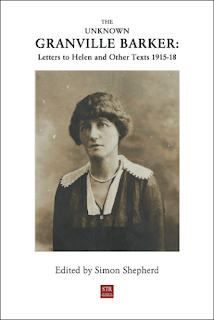
This year, STR sent out The Unknown Granville Barker: Letters to Helen and Other Texts 1915-18. The book compiles a number of writings by Harley Granville Barker, one of the most important actors, directors, playwrights and all-around theatre makers of the early 20th-century British stage.

For years, Barker endured a sexless marriage with the actress Lillah McCarthy, who was a great artistic partner, but did not provide him with the emotional companion he wanted. Then, at the end of 1914, Barker met Helen Huntington. Over the next few years, he fell in love with her and separated from McCarthy, which corresponded with a radical change in his career path.

In The Unknown Granville Barker, the editor Simon Shepherd puts together a number of documents that portray exactly what happened as Barker changed course and ultimately divorced McCarthy, marrying Huntington. In early 1915 Barker was entertaining New York audiences with hits he had already produced in England, including Bernard Shaw's Androcles and the Lion and The Doctor's Dilemma. Already, though, Barker was searching for ways for the theatre to be more than mere entertainment.

Newspapers interviewing Barker in 1915 noted he was now talking about theatre as being a "social force" that was accessible to everyone, not just professionals. "The theatre should come from the community, and not from the experts of the community," he told the New York Columbia Spectator. He looked back to the Middle Ages as an ideal time, when common people came together to put on Mystery Plays as an expression of their faith and beliefs. He longed to create something similar to that for the modern era.

Shepherd also includes an amusing story Barker published in the Manchester Guardian in 1917, in which he described Cain and Abel inventing the first dramas, with a little help from their mother Eve. The heart of the book, though, is a series of letters Barker wrote to Huntington during their courtship. During this period, Barker was also involved in the First World War, taking part in activities by the Red Cross, and later enlisting as a soldier. He also met with numerous literary figures, including J.M. Barrie, John Galsworthy, and Thomas Hardy, making his letters very amusing to read.

Well, it just so happens that I will soon be publishing my own book on the theatre, though not with STR. Instead, Palgrave Macmillan will be publishing my book Romantic Actors, Romantic Dramas about celebrity performers on the Regency stage. Yes, I even have a contract and everything! More information is to come, but needless to say, I am very excited about it.

Thursday, October 7, 2021

Peg Woffington's Lothario

Nicholas Rowe's play The Fair Penitent, based loosely on Philip Massinger and Nathan Field's The Fatal Dowry, contains an excellent role for actors specializing in villains: Lothario!

But what if the actor who played the villain was... an actress! Well, the most recent issue of Theatre Notebook contains an excellent article by Annette Rubery on the 18th-century actress Peg Woffington playing the role.

Woffington had a long and productive artistic partnership with David Garrick, primarily appearing in comic roles, but she also played Lady Randolph in the London premiere of John Home's tragedy Douglas. It was in 1753, however, four years before she excited audiences in Douglas, that Woffington appeared at the Smock Alley Theatre in Dublin as Lothario, the villain of Rowe's tragedy.

Though Woffington's performance as Lothario was not considered a success, it was famous enough to be recorded in paint by the artist John Lewis, whose depiction of her in the role is now owned by the National Portrait Gallery in London. She also was not the first woman to play Lothario, as that distinction belongs to Charlotte Clarke, the eccentric daughter of the actor and dramatist Colley Cibber.

Rubery argues that Woffington played Lothario in an effort to seriously show off her talents as a performer. Women who appeared as men in comedies were not expected to act entirely realistically, and part of the fun for the audience was to see a person they knew to be female in a male role. This could actually reinforce gender binaries rather than fight against them, since a woman playing a man was being held up as something inherently comic.

When a woman played a man in a tragedy, however, which was thought of as more realistic, she was expected to make the audience forget her sex and enter more fully into the illusion of the play. This, Rubery argues, made Woffington's appearance as Lothario a bit scandalous. She quotes a rather interesting poem that commemorated the performance:

     All adroit, each taper Thigh enclos'd
     In manly Vestments, with Parisian step;
     Light as the bounding Doe she tripp'd along,
     The gay LOTHARIO, in his Age of Joy.
     Venus surpriz'd, thus whisper'd 'Let me die,
     If dear ADONIS wore a lovelier Form.'
     Then clasp'd the Youth-dres'd Damsel to her Breast,
     And sighing, murmur'd, O that for my Sake
     Thou wert this Instant what thou represents.

Perhaps the realism of Woffington's Lothario was a bit too much for audiences to take. In the play, Lothario is a heartless seducer of women. How much worse it might have been in the minds of some audience members if that heartless seducer of women was another woman!

Wednesday, June 16, 2021

Lillah McCarthy as Dionysus

Euripides's masterpiece The Bacchae won a posthumous first-place prize for the author when it originally premiered at the City Dionysia in 405 BCE. However, it was not generally performed after the collapse of the classical world. In fact, the play's premiere in English did not occur until 1908, when the role of the great god Dionysus was played by none other than the actress Lillah McCarthy.

David Bullen has an excellent article on this production in the most recent issue of Theatre Notebook. Originally, Dionysus would have been played by a man, of course, given the conventions of Greek drama, and throughout the twentieth century, the part has almost always been cast as male. However, Bullen puts McCarthy's portrayal in the context of nineteenth-century actresses like Elizabeth Vestris who expanded the repertoire of female performers by taking on traditionally male roles.

The 1908 production lasted only two matinees, due to a dispute between translator Gilbert Murray and director William Poel, who was famous for his stagings of Elizabethan classics but appears to have been unsuited for a Greek revival. In spite of the fact that the chorus was supposed to consist of frantic maenads, Poel had the women speaking the chorus's lines stay virtually still for the entire play, while other dancers playing maenads danced in a small space at the center of the stage.

McCarthy herself complained about Poel cutting many of her lines and having her stand like "a statue in Ivory & Gold." This was quite a change for the vigorous actress who had originated the role of Ann Whitefield in Bernard Shaw's Man and Superman. The production was apparently so far away from the Dionysian passion Murray imagined that the translator withdrew his consent. McCarthy asked Murray for permission to re-stage the piece if she could find a new director, but alas, nothing came of those plans.

Bullen argues that the ill-fated production still had an effect on British drama, though, including influencing Shaw's Misalliance. Shaw originally crafted the part of Lina Szczepanowska in that play for McCarthy, though the part ultimately went to another performer. Lina literally descends from the heavens in Misalliance (albeit in an airplane rather than on a cloud of glory) and introduces a new Bacchic energy into the lives of a rather staid English family. As Bullen notes, the play is not an adaptation of The Bacchae, but it is certainly influenced by it.

Even more important to Bullen is the play's engagement with the women's suffrage movement, which was backed by many of the artists involved in the production, McCarthy included. Sometimes simply performing a role can be a political act, and the on-stage maenads in many ways reflected the frenzied protests of suffrage advocates off the stage.

Wednesday, December 18, 2019

Protagonists in Paper

My article "Protagonists in Paper: Toy Theatres and the Cultivation of Celebrity" is out now in Theatre Notebook.

I was able to write the article with help from a research award from the Society for Theatre Research, which publishes Theatre Notebook. They helped subsidize a trip I took to London to examine the toy theatre collection in the British Museum.

The new issue of Theatre Notebook also has Julian Crowe's follow-up article on the actress Mary Ann Canning and an article by Gerald Baker on performance in the late 17th century. The journal always has interesting articles, which have provided fodder for some past blog entries.

I have some other good news to announce as well. PlayMakers Repertory Company has chosen my play Worth as a semifinalist for the International Thomas Wolfe Playwriting Competition. I should find out in February if the play makes it to the finals.

Also in February, New York Theatre Barn will be presenting selections from my new musical Burned, with songs by Joshua H. Cohen. More information on that will come next month, but in the meantime, mark your calendars for February 3rd.

Hopefully, I'll be able to make some other exciting announcements here soon!

Monday, May 29, 2017

Hearing Sarah Siddons

I was excited to learn that the latest issue of Theatre Notebook has an article by Glen McGillivray titled "Rant, Cant and Tone: The Voice of the Eighteenth-Century Actor and Sarah Siddons."

Siddons has interested me for a while now, so after Theatre Notebook arrived in my mailbox this weekend, it didn't take me long to read the article. Frequently, theatre historians compare Siddons with the "natural" acting style of David Garrick who immediately preceded her, or with the Romantic school of actors like Edmund Kean who followed her. McGillivray also makes comparisons, but to show shifting conventions rather than an overall evolution in acting styles.

McGillivray agrees with the conventional wisdom that Siddon's acting "harked back to an earlier era." As he points out, the "new" style pioneered by Siddons and her brother John Phillip Kemble actually "bore strong similarities to the acting techniques of Barton Booth and James Quin, and before them, to those of Elizabeth Barry." This style was described by contemporaries both as being more restrained and as being more stylized than the acting of Garrick and his imitators.

Though Siddons had a strong, deep voice, she frequently made an impression by means of a whisper. This was particularly true of her Lady Macbeth. Rather than exhibiting passionate shrieks of tragic emotion, Siddons made Lady Macbeth at times scarcely audible. McGillivray argues that Siddons, like other actors, was "alert to the rhetorical conventions of the time," but like Garrick, she "could shift an audience's expectations" of those conventions.

Saturday, December 24, 2016

A Christmas Eve Image

When the Society for Theatre Research published my article on Eliza O'Neill in Theatre Notebook I was very grateful to the British Museum for allowing me to use an image from their collection sans royalties.

Their policy made sense. Theatre Notebook is a non-profit journal with a very limited circulation. The image I wanted to reproduce was a cartoon created in the early nineteenth century, so it had long been in the public domain. True, the British Museum had gone to the trouble of photographing it and placing an electronic file in their database, but they are a public institution with taxpayer support.

I was disappointed, however, when I wanted to reproduce some other images from the British Museum in the journal SHAW. It seems the museum's policy has changed. I can't blame them. I'm sure the British Museum has been facing budget cuts from a Tory government intent on a policy of austerity. The museum must be having to look for every crumb of funding they can get now, so they probably had little choice but to monetize their online collection.

As I am not a British taxpayer, I have no right to complain. If the British people want to starve their public institutions, that's their own affair, and as a citizen of a republic that has just elected the least qualified chief magistrate in its history, I certainly should not be throwing stones. Still, it saddens me greatly that the British Museum has been forced into being so parsimonious. We are talking about images in the public domain. The only thing still under copyright is the photograph of the image, not the image itself.

Well, I paid the British Museum (or rather the contractor they hired) for the rights to the images I couldn't get anywhere else. There was one, however, that I was able to secure the rights to permanently. The image in question is of John Singer Sargent's famous painting of Ellen Terry as Lady Macbeth. The opening stage directions of G.B. Shaw's The Philanderer mentions "theatrical engravings and photographs" of various actors, including Terry. This was one of the images I definitely wanted to include in the article.

Since I wanted to illustrate Shaw's stage directions, I needed an engraving of Sargent's painting, not an image of the painting itself (which is owned by the Tate Gallery in London). The British Museum has such an engraving in their collection, but surely many such engravings exist. Couldn't I find one elsewhere? Well, not at the National Portrait Gallery (though they had an image of John Kemble I needed), and not at the New York Public Library (though I've used their images in the past).

After a search online, I discovered a print dealer selling an actual engraving of the painting for less than the British Museum wanted for the rights to reproduce the image in the journal. To be fair, the price was comparable--the same amount in dollars as the museum wanted in pounds, and I also had to pay for shipping. Still, by purchasing the engraving and scanning the image myself, I secured the rights to use it whenever I wanted.

So in the spirit of Christmas Eve, I am offering this image to anyone who wants it, to publish it in any journal, book, newspaper, or magazine they choose. I didn't paint it--that was Sargent. I didn't engrave it--that was C. Carter. The only value I added was making a digital image of the piece. You can have that for free.

If you want a higher quality image, feel free to contact me. You can credit it to the personal collection of James Armstrong. Enjoy!


Sunday, February 14, 2016

Pepper's Ghost

The most recent issue of Theatre Notebook contains an interesting article by Russell Burdekin about the stage illusion known as Pepper's ghost.

Descriptions of this trick go back to the 16th century, when scientist, playwright, and general Renaissance man Giambattista della Porta wrote about it in his book Natural Magic. The effect was not popularized, however, until the 19th century, when Henry Dircks used it for a "Phantasmagoria" performance showing ghosts on stage.

Dircks was never able to sell his illusion technology to mainstream theatres, but his colleague John Pepper improved upon the technique and successfully marketed it to producers. He exhibited the illusion in a performance of Charles Dickens's novella The Haunted Man, in which he read the text and a series of ghosts appeared on the stage. Audiences were hooked, and the effect became known as "Pepper's Ghost" (much to the chagrin of Dircks).

Here's how the effect works:

Beneath the stage and out of view of the audience, an actor stands before a very bright spotlight. Initially, this was an oxy-hydrogen limelight lamp, though later on gas or electric lights could be used. The chamber with the actor would be lined with black cloth, so only the actor could be seen. Sometimes, a tilted mirror could reflect the image of the actor upward, toward the stage.

Projecting at an angle out from the front of the stage would be a large pane of glass. This would be kept as clean as possible so as not to be noticed by the audience. A patent by Dircks and Pepper suggests that the glass could remain below the stage, and only be brought out when it was time for the illusion. Lights on the stage would also have to be angled to illuminate the stage only, and not reflect off of the glass. Fortunately, lights in the theatre were generally dimmed for the ghost scene, anyway.

When the spotlight came on, illuminating the actor beneath the stage, the image of the performer would be reflected by the pane of glass angled out over the audience. To the spectators, a ghostly figure appeared to materialize on the stage itself. The actors on stage, of course, could not see this ghost, but they would react on cue as if they did. The effect was thrilling.

Pepper first licensed the technique in 1863 for a production of Faith, Hope, and Charity at The Britannia Theatre in London. The show ran for a year. The illusion became particularly popular in productions of Faust and A Christmas Carol, as well as John Barnett's opera The Mountain Sylph, where the title character would sometimes wear phosphorescent paint to increase the effect.

Though Pepper's Ghost might not be used much anymore, the illusion excited Victorian audiences for many years. The effect is a reminder that the 19th-century stage could be technologically quite sophisticated at times.

Tuesday, October 20, 2015

Regency Conference Poster Unveiled!

So the "Shaw in New York" conference ended yesterday, but I just received a message about the conference where I'll be presenting my NEXT paper!

From July 29 to July 31, the Society for Theatre Research will be presenting the conference "Theatre in the Regency Era: Plays, Performance, Practice 1795-1843" at Downing College, the University of Cambridge.

The conveners include Barry Sheppard, Marcus Risdell, Michael Burden, Michael Gaunt, Sarah Meer, and Vanessa L. Rogers. Celina Fox will be delivering the keynote address, and historical gesture specialist Jed Wentz will be giving a special lecture and performance.

My paper is entitled "Succeeding the Siddons: Eliza O'Neill and the Triumph of the Romantic Style." It will explore the short but spectacular career of O'Neill, who was the subject of an earlier piece of mine that ran this year in Theatre Notebook. O'Neill embodied a number of early nineteenth-century aesthetic principles that came to be associated with Romanticism, and became the face of the artistic movement both for its practitioners and its detractors.

I've never been to Cambridge before, so I'm looking forward to it!


Saturday, April 4, 2015

The stage is hung with black

It is commonly accepted that in Elizabethan theatres black curtains indicated the playing of tragedies. One line in the anonymous play A Warning for Fair Women famously proclaims:

The stage is hung with black: and I perceive
The auditors prepared for tragedy.

But as Mariko Ichikawa pointed out in a recent article in Theatre Notebook, Elizabethan theatres possessed other curtains as well, sometimes with elaborate pictures on them. An inventory of the Lord Admiral's Men done in 1598 listed "a cloth of Sun & Moon" as well as a "Tasso picture" among the company's possessions. Since Torquato Tasso had introduced pastoral themes to the Italian stage with his 1573 play Aminta, this latter curtain probably depicted a scene of the countryside.

Thomas Kyd's The Spanish Tragedy has the hero Hieronimo hang up a curtain for a play-within-the-play at the end of the piece. This curtain, presumably black since Hieronimo is introducing a tragedy, might have replaced a curtain of a different sort that had been hanging earlier. Ichikawa argues convincingly that non-black curtains could have been hanging in the middle of tragedies, with the black curtains only prominent at the beginning and ending of plays. For tragicomedies, companies might have avoided black curtains at the beginning in order to keep the audience in suspense about the play's finale.

And other colors were certainly available. A lawsuit in the 1530s over the possessions used by a theatrical company listed two curtains of green and yellow. Though the Elizabethan stage could be hung with black, it could be hung in a variety of other hues as well.

Friday, March 27, 2015

Richard III, Villain

As crowds throng to Leicester, England to mark the re-burial of what might be the remains of Richard III, defenders of that monarch often complain bitterly about how Shakespeare maligned the poor man. The murderous king didn't kill nearly as many people as the Bard said he did, they argue, or at least no one can prove it! And besides, usurpation and bloodshed were common in the Middle Ages, sort of like Napster in the early 2000s. Yeah, it might have been wrong, but almost everyone else was doing it, so what's the problem?

In many ways, however, the villainous reputation of Richard III came not so much from Shakespeare's play, but from a later adaptation of that play done by the actor Colley Cibber. In addition to reducing the number of characters and focusing more on Richard himself, Cibber brought offstage acts of violence right before the audience's eyes. While Shakespeare seems to show some sympathy for Richard, particularly toward the end of the play, Cibber never lets us forget he is a villain.

I had always assumed that Cibber wrote the adaptation with himself in mind for Richard, but as Riki Miyoshi points out in a recent article in Theatre Notebook, Cibber originally wrote the part for another actor, Samuel Sandford. Known as the best villain of the Restoration stage, Sandford excelled as the title character in Thomas Porter's 1662 play The Villain. He went on to play more villains in Thomas Otway's Alcibiades and Nathaniel Lee's Caesar Borgia. Sandford became so linked to villainous roles, that when he played an honest man in Aphra Behn's The Widdow Ranter, the audience was furious.

Cibber, by contrast, was known for playing comical fops. Miyoshi notes Cibber scored a great success in 1693 as Fondlewife in William Congreve's The Old Batchelor. Cibber later wrote the fop part of Sir Novelty Fashion for himself in Love's Last Shift. By the time he adapted Richard III, Cibber was firmly ensconced in the minds of audiences as a comedic actor, and one specializing in parts nothing like Richard.

Miyoshi argues that Cibber tailored the role of Richard to suit Sandford's strengths as a stage villain. Unfortunately, by the time Cibber wrote his play, Sandford's health had failed, plus he had signed a contract with a rival company, anyway. Without Sandford available to play the role, Cibber decided to act it himself.

The result was a disaster. Cibber tried to copy Sandford's voice and mannerisms, but the audience hated him in the role. One observer noted that:

...when he was kill'd by Richmond, one might plainly perceive that the good People were not better pleas'd that so execrable an Tyrant was destroy'd, than that so execrable an Actor was silent.

Ouch. Cibber's failure in the role did not prevent the adaptation from being performed throughout the eighteenth century, and in fact even some modern productions make use of a few of Cibber's additions. Those changes to Shakespeare's play seem to have stemmed not just from Cibber himself, though, but from Sandford's reputation as an excellent stage villain.

Sunday, August 31, 2014

From the table of my memory...

Hamlet speaks of "the table of my memory" and famously cries out "My tables, my tables! Meet it is I set it down / That one may smile, and smile, and be a villain...."

Scholars have long known that the "tables" Hamlet speaks of were small wax tablets that Elizabethans frequently used to take down notes. At the end of the day, notes could be copied into a commonplace book and the wax "tables" or "table books" easily erased. These devices were portable, small enough to put in a pouch or pocket, and inscribed with a simple stylus, so pen and ink were not necessary.

In the most recent issue of Theatre Notebook, put out by the Society for Theatre Research, June Schlueter has some interesting speculations about how these tables might have shaped the evidence we have of Elizabethan stage practices. First of all, she notes that in addition to the references in Hamlet, wax tables come up in a number of works from the period, including the plays Love's Labours Lost and Antonio's Revenge. People in Elizabethan England used them all the time. Is it possible someone had used them to take sketches at the theatre?

We have very little visual evidence of what an Elizabethan performance looked like, but we do have two period drawings that come up in nearly every study of Shakespeare's theatre. The first is Henry Peacham's illustration of Titus Andronicus, which appears above a passage from the play, though curiously, that passage does not appear in precisely the same words and spelling in any of the surviving texts of that drama.

What exactly are we looking at here? These figures appear to be the characters in Act I, though Aaron the Moor is looking mighty confident and ready for revenge, something that doesn't occur that early in the play. Most of the lines quoted on the page come from Act I, though the manuscript also quotes Aaron's boast from Act V. So is this a composite illustration of multiple scenes?

More importantly, what does this illustration tell us about how Shakespeare's plays were staged? The characters appear to be dressed in a combination of Elizabethan and mock-Roman outfits. Is that what the actors wore? Or did the actors dress in modern Elizabethan clothes and Peacham is simply imagining what the characters might have looked like in Roman times.

Then there's the matter of Aaron the Moor, who is clearly depicted as black in the drawing. Did Shakespeare's company use a black actor? In fact, there were a number of people of African descent in London during Shakespeare's day, as it was a very cosmopolitan port city even back then. On the other hand, the company could have used something as makeup to darken an actor's skin, or Aaron could have been played by a white actor making no effort to darken his skin, and Peacham might have recorded simply how he imagined the character to appear.

We know for a fact that Peacham did own a table book, so Schlueter brings up a fascinating possibility: What if Peacham had sketched the scene from life, then later copied it onto paper? If so, it would tend to suggest that the depiction might indeed be a fairly accurate portrayal of how the play was staged. Schlueter does not speculate that the text, too, might have been copied down in a table book by someone watching the play, but that certainly would explain the discrepancies between this document and all of the printed versions of the text.

Schlueter makes a similar argument about Johannes de Witt's illustration of the Swan Theatre, which exists unfortunately in only a copy of de Witt's original drawing. The image would appear to tell us a great deal, such as that the theatre had a raised stage surrounded by a circular structure, and that there were multiple entrances and three rows of galleries. But the more we look at the picture, the more questions we have.

Was the stage permanent, or do the leg-like objects propping up the stage in the illustration suggest it could be removed for bear-bating and other entertainments? Was there no trap door beneath the stage? Were there really only two entrances? And were those entrances doors rather than curtains?

What about those people above the stage? Were they actors, musicians, or audience members? Why doesn't de Witt depict audience members anywhere else?

All of these questions have led many scholars to doubt the validity of the Swan drawing. If Schlueter is right, and de Witt sketched the image on a wax tablet first, what we have could be a lot closer to reality than previously thought.

On the other hand, that would mean that the drawing we have is not merely a copy of de Witt's original sketch, but a copy of a copy, since the original would have been drawn into wax, and that evening erased, never to be seen again.

Wednesday, February 26, 2014

The Society for Theatre Research

I am very excited to be joining the Society for Theatre Research, a U.K.-based group for all those interested in the history and technique of the British theatre. After some frustration wrestling with their website, I finally was able to send them my dues through PayPal, so hopefully I'll be on the membership roles soon!

STR is perhaps best known as the publisher of Theatre Notebook, a journal that since 1945 has been publishing essays on British drama by both amateurs and academics. It has recently run articles on the actress Janet Achurch, adaptations of the work of Matthew G. Lewis, and even toilet facilities in early British theatres! This is definitely a publication after my own heart.

The society also publishes books, including biographies of George Frederick Cooke, Helen Faucit, and Charles Mathews. They periodically present lectures in London, as well, though I'm not likely to make it to many of those.

For more information about this great organization, click here:

Society for Theatre Research

http://www.str.org.uk/research/index.html