Showing posts with label Society for Theatre Research. Show all posts

Wednesday, February 21, 2024

Illustrations of Toy Theatres

The Society for Theatre Research sponsored a lecture today by Alan Powers on British toy theatres, and fortunately they also streamed it online, which meant that I was able to watch.

Powers is the Chair of the Pollock’s Toy Theatre Trust, which has issued reprints of classic toy theaters, including one of Oliver Twist. He discussed his long association with the trust and the role of Benjamin Pollock in the revival of toy theatre during the 20th century. 

British toy theatres had their heyday during the Regency period, but they tend not to show up in illustrations until a bit later. One of the earliest depictions of a toy theatre in action comes from The Poetical Present published by William Cole in 1829.

More famous, however, are the illustration's from John Leech's picture book Young Troublesome, or Master Jacky's Holiday, published in 1845. In one double illustration, Leech shows a toy theatre being presented to a boy, and then adults and children alike preparing for a toy production of The Miller and His Men.


A later illustration shows the climactic ending of that performance, which appears to disturb the whole household. The Miller and His Men, which was the most popular play by far for toy theatres, ended with the mill exploding on stage. In the illustration, the proprietors of the toy theatre pull out all of the stops to make the explosion as realistic as possible.


By the 1850s, however, the toy theatre trade had run into difficulties, and the art form declined over the later Victorian era. However, there was renewed interest in the 20th century. Gordon Craig published an article about toy theatres in 1912 in his magazine The Mask. Pollock placed a copy of that magazine in the window of his shop, where he sold toy theatres during their revival prior to the Great Depression and World War II.

Since the war, there have been efforts to bring the art form back, but it's been an uphill battle. Still, it's nice to see people like Powers bringing attention to these wonderful relics of the past.

Friday, July 14, 2023

Theatre Spaces 1920-2020

I recently finished reading Iain Mackintosh's new book Theatre Spaces 1920-2020: Finding the Fun in Functionalism. It's equal parts personal memoir, history of modern drama, and fascinating screed on why the way we configure the audience in a physical space matters so immensely.

You might not have heard of Mackintosh before, but anyone who can get Sir Richard Eyre to write the forward to his new book is not to be trifled with. After helping to run Britain's touring Prospect Theatre Company in the 1960s and '70s, Mackintosh joined Theatre Projects Consultants, using his experience with which spaces worked and which didn't to advise companies looking to build or remodel theatres.

Though the title claims to only cover one century, Mackintosh begins by going back to 1870 and the planning of Richard Wagner's Festspielhaus in Bayreuth. Seating for the theatre was to consist of a giant fan shape surrounding a massive proscenium stage and sunken orchestra pit. Originally, there was no elevated mezzanine or balcony, though an upper level was added later. A fan-shaped auditorium works for Wagner's epics, but Mackintosh argues it can be deadly when applied to lighter operas such as those by Mozart.

The book then takes a detour through an even older theatre, the Festival Theatre Cambridge, which was originally designed by William Wilkins in 1814. I had a chance to visit the theatre (now a Buddhist center) back in 2016 at a conference on Regency-era drama held by the Society for Theatre Research. In the 1920s, Terence Gray acquired the theatre and remodeled it, but left intact some of the original stage machinery. Later, he offered Gordon Craig the chance to take over the theatre, have complete artistic control, and do whatever he wanted, but Craig demurred.

Mackintosh treats the older theatre extensively because it illustrates his point that an old-fashioned horseshoe-shaped wraparound suspended over the orchestra seating provides better intimacy than Wagner's giant fan, which has proved so influential. He argues that the thrust stages pioneered by Tyrone Guthrie provide a better alternative to a fan-shaped auditorium, like that of the Olivier at London's National Theatre. When I saw the brilliant musical Hadestown in the Olivier, I was disappointed, especially since the show had been so enjoyable in the much smaller space of New York Theatre Workshop. According to Macintosh, however, almost nothing works in the massive Olivier, which has a stage far too wide and audiences inevitably stretched out far from the action.

Fan-shaped theatres frequently have poor acoustics, in spite of being modeled on ancient Greek stages that can have excellent acoustics when used properly. Mackintosh argues that the massive theatre at Epidaurus is larger than those used by the great classical dramatists of Athens, and was later more than doubled in size by the Romans, who preferred watching spectacle to listening to poetry. Rather than using the fan layout of the Greeks, Mackintosh prefers theatres like London's Barbican, which uses multiple wrap-around levels to fit the whole audience into a smaller area, making sure no one is positioned too far away from the stage.

The book is also kind to historical reconstructions, such as Shakespeare's Globe and the smaller Wanamaker Playhouse attached to it. When the reconstructed Globe was opened, some purists thought it would just be a tourist trap, but in spite of not receiving the large subsidies enjoyed by the National Theatre, Shakespeare's Globe offers cheaper tickets than the NT, and continues to attract young audiences who prefer its uncomfortable seats (or worse yet--standing room) to the comfortable but pricey seats in the Olivier.

Mackintosh also chronicles efforts to save historic theatres, including the Theatres Royal in Bristol, Bury St. Edmunds, and Richmond Yorkshire. When the theatre in Dunfermline, Scotland couldn't be revitalized, its interior was shipped to Sarasota, Florida, where it graced the home of Asolo Rep. Some other theatre cultures were not so fortunate. In a later chapter, the book discusses the wholesale destruction of traditional theatres in China during the Cultural Revolution.

Perhaps a vindication of Macintosh's preference for wrap-around seating is that the Royal Shakespeare Company modified their main theatre in 2010 to provide a thrust stage. I remember seeing a production of As You Like It in the old theatre there in 1996 and being unimpressed. Overall, I think Mackintosh makes a good case.

Sunday, March 13, 2022

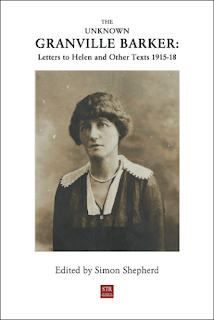
The Unknown Granville Barker

Along with publishing Theatre Notebook, the Society for Theatre Research always sends out one book a year to all of its members.

This year, STR sent out The Unknown Granville Barker: Letters to Helen and Other Texts 1915-18. The book compiles a number of writings by Harley Granville Barker, one of the most important actors, directors, playwrights and all-around theatre makers of the early 20th-century British stage.

For years, Barker endured a sexless marriage with the actress Lillah McCarthy, who was a great artistic partner, but did not provide him with the emotional companion he wanted. Then, at the end of 1914, Barker met Helen Huntington. Over the next few years, he fell in love with her and separated from McCarthy, which corresponded with a radical change in his career path.

In The Unknown Granville Barker, the editor Simon Shepherd puts together a number of documents that portray exactly what happened as Barker changed course and ultimately divorced McCarthy, marrying Huntington. In early 1915 Barker was entertaining New York audiences with hits he had already produced in England, including Bernard Shaw's Androcles and the Lion and The Doctor's Dilemma. Already, though, Barker was searching for ways for the theatre to be more than mere entertainment.

Newspapers interviewing Barker in 1915 noted he was now talking about theatre as being a "social force" that was accessible to everyone, not just professionals. "The theatre should come from the community, and not from the experts of the community," he told the New York Columbia Spectator. He looked back to the Middle Ages as an ideal time, when common people came together to put on Mystery Plays as an expression of their faith and beliefs. He longed to create something similar to that for the modern era.

Shepherd also includes an amusing story Barker published in the Manchester Guardian in 1917, in which he described Cain and Abel inventing the first dramas, with a little help from their mother Eve. The heart of the book, though, is a series of letters Barker wrote to Huntington during their courtship. During this period, Barker was also involved in the First World War, taking part in activities by the Red Cross, and later enlisting as a soldier. He also met with numerous literary figures, including J.M. Barrie, John Galsworthy, and Thomas Hardy, making his letters very amusing to read.

Well, it just so happens that I will soon be publishing my own book on the theatre, though not with STR. Instead, Palgrave Macmillan will be publishing my book Romantic Actors, Romantic Dramas about celebrity performers on the Regency stage. Yes, I even have a contract and everything! More information is to come, but needless to say, I am very excited about it.

Sunday, December 13, 2020

Smike's Happy Ending

Today, the Society for Theatre Research presented a Zoom reading of the the very first stage adaptation of Charles Dickens's novel Nicholas Nickleby.

Playwright Edward Stirling adapted the piece in 1838 while Dickens was still writing the novel, which came out in monthly installments from March of 1838 to October of 1839. Because the novel had only been published through the end of chapter 26 when the play's audience first arrived at the Adelphi Theatre to see it, Stirling had to make up his own ending.

Vincent Crummles had just shown up in the installment next to the last one that had appeared at the play's opening, so he is noticeably absent from Stirling's adaptation. The play instead focuses on Smike, the poor child Nicholas befriends at Dotheboys Hall. This was a trouser role originally played by Mary Anne Keeley, who the following year achieved considerable fame in the title role of Jack Sheppard.

STR's production, which was directed by Sue Solomon, stuck with the tradition of casting a woman as Smike. Rebecca Farrell played the role movingly when she appeared at the beginning of the play's third scene, mourning a child who had recently died from neglect at the aptly named Dotheboys Hall. Mr. Squeers (Mark Fox) arrived with the school's newest teacher, the eponymous hero Nicholas Nickleby, played by Hugh-Guy Lorriman.

The play, like the novel, alternates back and forth between Nicholas's adventures and the trials of his sister Kate back in London. Kate, played by Karen Moss in the STR reading, worked as a milliner in the establishment of Madame Mantalini (Sarah Andrews). The truly great role for the circle of characters around Kate is Madame Mantalini's husband, played hysterically today by Lachlan Wilson. It's clear in the novel that Kate's virtue is going to be threatened due to her precarious position as a young working woman in London without anyone to defend her. Stirling reasonably assumed the menace would come from Mr. Mantalini, who in the novel is mostly harmless, though.

A much larger change in plot comes at the end of the play, when Newman Noggs, played today by John Dobson, reveals that Smike is heir to a fortune, and all is resolved happily. For the most part, however, the adaptation keeps many of the highlights from the first half of the novel, including the hilarious antics of the Squeers family. I particularly enjoyed the performances of Sunita Dugal as Mrs. Squeers and Cheryl Jones as her daughter Fanny.

As is usually the case with Zoom, technical difficulties arose from time to time, but the cast dealt with them admirably. If we have to all stay inside due to COVID, at least organizations like STR are keeping theatre alive in some form.

Wednesday, December 18, 2019

Protagonists in Paper

My article "Protagonists in Paper: Toy Theatres and the Cultivation of Celebrity" is out now in Theatre Notebook.

I was able to write the article with help from a research award from the Society for Theatre Research, which publishes Theatre Notebook. They helped subsidize a trip I took to London to examine the toy theatre collection in the British Museum.

The new issue of Theatre Notebook also has Julian Crowe's follow-up article on the actress Mary Ann Canning and an article by Gerald Baker on performance in the late 17th century. The journal always has interesting articles, which have provided fodder for some past blog entries.

I have some other good news to announce as well. PlayMakers Repertory Company has chosen my play Worth as a semifinalist for the International Thomas Wolfe Playwriting Competition. I should find out in February if the play makes it to the finals.

Also in February, New York Theatre Barn will be presenting selections from my new musical Burned, with songs by Joshua H. Cohen. More information on that will come next month, but in the meantime, mark your calendars for February 3rd.

Hopefully, I'll be able to make some other exciting announcements here soon!

Thursday, February 15, 2018

Succeeding the Siddons

I'm happy to announce that my article "Succeeding the Siddons: Eliza O'Neill and the Triumph of the Romantic Style" has been published in the British journal Theatre Notebook.

The article is based on a paper I gave at the Society for Theatre Research's conference on Theatre in the Regency Era in Cambridge, England. It deals with the effort to find a fitting successor to the great actress Sarah Siddons following her retirement.

If you're ever at the Huntington Library in San Marino, California, they have an excellent portrait of Siddons as the Tragic Muse. The folks at the Huntington were kind enough to allow me to reproduce an image of the painting in the journal.

Eventually, Eliza O'Neill became the new leading tragic actress in England. In order to reproduce an image of her, I requested new photography of an engraving of O'Neill owned by the British Museum. In November I got to spend some time in the prints and drawings collection at the museum, doing research on toy theatres. I hope to turn that research into another article soon.

In the meantime, if you check out the recent issue of Theatre Notebook, you'll also find articles by Leslie Thomson, John H. Astington, Geoff Davidson, and Alan C. Dessen. Enjoy!

Saturday, December 24, 2016

A Christmas Eve Image

When the Society for Theatre Research published my article on Eliza O'Neill in Theatre Notebook I was very grateful to the British Museum for allowing me to use an image from their collection sans royalties.

Their policy made sense. Theatre Notebook is a non-profit journal with a very limited circulation. The image I wanted to reproduce was a cartoon created in the early nineteenth century, so it had long been in the public domain. True, the British Museum had gone to the trouble of photographing it and placing an electronic file in their database, but they are a public institution with taxpayer support.

I was disappointed, however, when I wanted to reproduce some other images from the British Museum in the journal SHAW. It seems the museum's policy has changed. I can't blame them. I'm sure the British Museum has been facing budget cuts from a Tory government intent on a policy of austerity. The museum must be having to look for every crumb of funding they can get now, so they probably had little choice but to monetize their online collection.

As I am not a British taxpayer, I have no right to complain. If the British people want to starve their public institutions, that's their own affair, and as a citizen of a republic that has just elected the least qualified chief magistrate in its history, I certainly should not be throwing stones. Still, it saddens me greatly that the British Museum has been forced into being so parsimonious. We are talking about images in the public domain. The only thing still under copyright is the photograph of the image, not the image itself.

Well, I paid the British Museum (or rather the contractor they hired) for the rights to the images I couldn't get anywhere else. There was one, however, that I was able to secure the rights to permanently. The image in question is of John Singer Sargent's famous painting of Ellen Terry as Lady Macbeth. The opening stage directions of G.B. Shaw's The Philanderer mentions "theatrical engravings and photographs" of various actors, including Terry. This was one of the images I definitely wanted to include in the article.

Since I wanted to illustrate Shaw's stage directions, I needed an engraving of Sargent's painting, not an image of the painting itself (which is owned by the Tate Gallery in London). The British Museum has such an engraving in their collection, but surely many such engravings exist. Couldn't I find one elsewhere? Well, not at the National Portrait Gallery (though they had an image of John Kemble I needed), and not at the New York Public Library (though I've used their images in the past).

After a search online, I discovered a print dealer selling an actual engraving of the painting for less than the British Museum wanted for the rights to reproduce the image in the journal. To be fair, the price was comparable--the same amount in dollars as the museum wanted in pounds, and I also had to pay for shipping. Still, by purchasing the engraving and scanning the image myself, I secured the rights to use it whenever I wanted.

So in the spirit of Christmas Eve, I am offering this image to anyone who wants it, to publish it in any journal, book, newspaper, or magazine they choose. I didn't paint it--that was Sargent. I didn't engrave it--that was C. Carter. The only value I added was making a digital image of the piece. You can have that for free.

If you want a higher quality image, feel free to contact me. You can credit it to the personal collection of James Armstrong. Enjoy!


Saturday, August 6, 2016

Back From Cambridge

I'm back from the U.K. now, and the Society for Theatre Research conference in Cambridge was amazing.

Our final day was jam packed. In the morning, I went to the session on James Winston and the Regency Theatre. Winston was a bit of a jack-of-all-trades in early 19th-century theatre, and is today probably best known for writing The Theatrical Tourist about the provincial theatres in Britain.

Vicky Simon began by giving a great presentation about the proscenium doors at Drury Lane Theatre. After the theatre burned down in 1809, it was rebuilt, and bronze tripods were placed where the proscenium doors had once been. The tripods were criticized, though, and ultimately nixed. During the 1814 remodeling of the theatre, the doors were put back in the proscenium arch.

When Robert William Elliston leased the theatre, he appointed Winston to manage Drury Lane. Winston got Samuel Beazley to remodel the interior of the theatre, contracting it, and removing the proscenium doors. The doors, which had been in and out of fashion for so many years, were now gone for good. But how could people come forward to give curtain speeches? Well, it was Beazley who apparently first designed a way to open up a small part of the front curtain to let people through.

David Wilmore then spoke about the circuits of provincial theatres in the north of England. He mentioned that the town of Richmond in Yorkshire has one of the few remaining Regency-era theatre buildings. (Now I have to visit!) He also showed an interesting map demonstrating how the theatre circuits in Yorkshire tended to follow the turnpikes.

Iain Mackintosh gave a great presentation on the Margravine of Anspach, who built her own private theatre into an old riding school. Born Elizabeth Berkeley, and later Lady Craven, the Margravine had quite a scandalous life. King George III refused to receive her at court, but the Prince of Wales came to her parties and amateur theatricals.

Later that morning, I went to a great session called "Music, Melodrama, and the Survival of the Fittest." I mainly wanted to hear Eva Urban's paper on remorse tragedy, examining both Richard Brinsley Sheridan's Pizarro and Samuel Taylor Coleridge's Remorse. She tied the two plays back to Adam Smith's theory of moral sentiments.

Amy Garnai then gave a great talk on Thomas Holcroft and Joanna Baillie. Holcroft's second melodrama, The Lady of the Rock, premiered at Drury Lane in 1805. Based on a Scottish legend, the piece featured music by Holcroft's daughter Fanny. Though Holcroft's revisions softened the piece, it was still politically radical. The same could not be said of Baillie's treatment of the same story in her rather conservative play The Family Legend.

Christina Fuhrmann gave the last paper in the session, on Carl von Weber's opera Oberon, which had a libretto by James Planche. Though many theatre historians consider the opera to have been a failure, Fuhrmann noted that the opera extended to 32 performances in its first season, and was only disappointing when compared to Weber's runaway hit Der Freischutz.

All in all, it was a great conference, and Downing College was a perfect setting. I look forward to seeing some folks again... perhaps at the next STR conference!


Saturday, July 30, 2016

Regency Theatre Conference

I'm in Cambridge for the Society for Theatre Research's conference on Theatre in the Regency Era. And it's wonderful!

Yesterday, we had a tour of an extant Regency theatre, the Barnwell Theatre, subsequently renamed the Festival Theatre, and now a Buddhist center in Cambridge. Though the space doesn't immediately look like a Regency theatre, a number of original elements remain, and you really can experience what it was like to be in the audience, whether in the pit, in the boxes, or up in the gallery.

Today we had the bulk of the presentations. I first went to the session on dancers and dancing with Moira Goff of the Garrick Club and Michael Burden of New College, Oxford. I am particularly interested in social dancing on stage, and Groff mentioned that minuets were performed in both High Life Below Stairs and in The Belle's Stratagem. The focus of the session was on theatrical dancing, of course, and Burden spoke about Hughes Balls Hughes' scandalous elopement with the ballerina Mercandotti.

The next session I went to was on Shakespeare in the Regency era. Fiona Ritchie gave a great presentation on Dorothy Jordan's response to the Old Price riots. Though she was touring in Birmingham at the time, she heard about the events at Covent Garden and wrote about them. Franklin Hildy then gave a fascinating talk about period-appropriate productions of Shakespeare. He presented the novel idea that it was Regency fashion, in particular the replacement on knee breeches with trousers, but also the simplified fashions more generally, that made Shakespeare for the first time sound odd when performed by actors in modern dress. It was only then that antiquarian productions started to become popular, a fact Hildy linked to the simplified cuts of modern clothes not matching the complexity of poetic language.

Celina Fox gave the keynote address about public entertainments in London functioning as a type of theatre. She mentioned that the last Frost Fair was when the Thames froze over in 1814, which was the occasion for a massive fair out on the ice. Later that year was the Great Jubilee, celebrating the centennial of the Hanover Dynasty, as well as the anniversary of the Battle of the Nile. Fox walked us through a number of other public festivals as well, going up to the coronation of King George IV in 1820.

In the afternoon, there was a great session on Hippodrama, with presentations by Ellen K. Gjervan, David and Cassie Mayer, and Lucy Barnes. They discussed some of the plays of the period that called for horses on stage, including The Blood Red Knight, Timour the Tartar, and Mazeppa. Theatres also used horses to stage recent battles, as when J.H. Amherst wrote plays about Napoleon. In many cases, both the human and equine actors were veterans of actual battles.

My own panel came later in the afternoon, with Terry Robinson speaking about Sarah Siddons and Michael Gaunt speaking about George Frederick Cooke and the mysterious disappearance of his skull. He was able to tell me that the Stranger's Vault, where Cooke was originally buried, no longer exists. (I had looked for it at St. Paul's Chapel, but had not had any luck. No wonder why!) I then gave my one presentation on Eliza O'Neill, which I thought was well received.

We then had a performance of reconstructed period acting, and then the conference gala dinner. Tomorrow, I hope to attend sessions on melodrama and on the theatre architect James Winston. It should be fun!

Saturday, May 28, 2016

The Sands o' Dee

                    'O Mary, go and call the cattle home,
                        And call the cattle home,
                        And call the cattle home,
                        Across the sands of Dee.'
                    The western wind was wild and dark with foam, 
                        And all alone went she.

Thus begins Charles Kingsley's poem "The Sands of Dee." This bit of sentimental Victorian verse is perhaps best known for inspiring D.W. Griffith's 1912 film of the same name. However, it also inspired the only known surviving script from London's famed Hippodrome theatre.

Built in 1900 at the cost of a quarter of a million pounds, the Hippodrome had a massive arena that could sink into the floor and be filled with water. As its name suggests, the Hippodrome was used for equestrian spectacles, but the water feature could also be employed with staging melodramas like The Flood or The Typhoon.

Illustrations of a number of these productions survive, and there is even a film clip of the mill scene from The Bandits, in which horses leap into the water and a coach goes down on a collapsing bridge. In 1909, the Hippodrome was converted into a more traditional music hall with a larger audience capacity, so its last big horse-and-water spectacular was The Sands o' Dee in 1908.

                    The western tide crept up along the sand,
                        And o'er and o'er the sand,
                        And round and round the sand,
                        As far as eye could see.
                    The rolling mist came down and hid the land:
                        And never home came she.

Alicia Ramsay and Rudolph de Cordova, who penned a number of scripts for the Hippodrome, wrote The Sands o' Dee, which only survives because the play was licensed for performance by the Bristol Hippodrome in 1912. Rather than replicating the story of Kingsley's poem, the play exists in the same world of that story, with the ill-fated Mary of the poem remembered by all the characters. Mary's father, now an old man, tells the tale this way:

Mother and Bill and me started running towards her, screaming like mad. Before we got more than a few yards - I heard a sound as made my heart stand still - a roaring muttering sound like the beginning of a storm. I think we must all have gone mad for we stood stock still staring. We knew what that sound meant. It meant that the tide had begun to turn.

This was all 40 years ago, the old man says, adding that "Parson Kingsley made a piece" about the story. To this day, Mary's ghost can sometimes be seen at night, "driving her dead cattle across the sand."

                    'O is it weed, or fish, or floating hair—
                        A tress of golden hair,
                        A drownèd maiden's hair,
                        Above the nets at sea?'
                    Was never salmon yet that shone so fair
                        Among the stakes of Dee.

The play introduces a new Mary (the dead Mary's niece) who is engaged to one John Hooper. The villain (and we know he's a villain because that's how he's described in the characters list) is named Basil Dean, and when he fails to force the young heroine to marry him, he decides to murder her, tying her to a stake on the seashore so that she will drown like her now-famous namesake.

Fortunately, John Hooper arrives in the nick of time. He rescues Mary and carries her away on horseback. Villainous Basil Dean instead drowns, falling into the water while screaming, "Curse you!" The play also features a vision of the dead Mary, which appears on a cloth lowered down while the living Mary is tied to the stake.

                    They row'd her in across the rolling foam,
                        The cruel crawling foam,
                        The cruel hungry foam,
                        To her grave beside the sea.
                    But still the boatmen hear her call the cattle home,
                        Across the sands of Dee.

Before the Hippodrome converted to a music hall, there were a couple of aquatic spectacles staged after The Sands o' Dee, though they did not feature horses. In 1909 The Motor Chase showed an automobile plunging into a lake. That same year, the theatre hosted 70(!) onstage polar bears in the melodrama The Arctic. Take that, chandelier from Phantom!

If you want to find out more about the Hippodrome spectacles, check out Bandits! or The Collapsing Bridge: an early film and a late-Victorian stage by David Mayer and Bryony Dixon, published by the Society for Theatre Research.

Tuesday, October 20, 2015

Regency Conference Poster Unveiled!

So the "Shaw in New York" conference ended yesterday, but I just received a message about the conference where I'll be presenting my NEXT paper!

From July 29 to July 31, the Society for Theatre Research will be presenting the conference "Theatre in the Regency Era: Plays, Performance, Practice 1795-1843" at Downing College, the University of Cambridge.

The conveners include Barry Sheppard, Marcus Risdell, Michael Burden, Michael Gaunt, Sarah Meer, and Vanessa L. Rogers. Celina Fox will be delivering the keynote address, and historical gesture specialist Jed Wentz will be giving a special lecture and performance.

My paper is entitled "Succeeding the Siddons: Eliza O'Neill and the Triumph of the Romantic Style." It will explore the short but spectacular career of O'Neill, who was the subject of an earlier piece of mine that ran this year in Theatre Notebook. O'Neill embodied a number of early nineteenth-century aesthetic principles that came to be associated with Romanticism, and became the face of the artistic movement both for its practitioners and its detractors.

I've never been to Cambridge before, so I'm looking forward to it!


Sunday, August 31, 2014

From the table of my memory...

Hamlet speaks of "the table of my memory" and famously cries out "My tables, my tables! Meet it is I set it down / That one may smile, and smile, and be a villain...."

Scholars have long known that the "tables" Hamlet speaks of were small wax tablets that Elizabethans frequently used to take down notes. At the end of the day, notes could be copied into a commonplace book and the wax "tables" or "table books" easily erased. These devices were portable, small enough to put in a pouch or pocket, and inscribed with a simple stylus, so pen and ink were not necessary.

In the most recent issue of Theatre Notebook, put out by the Society for Theatre Research, June Schlueter has some interesting speculations about how these tables might have shaped the evidence we have of Elizabethan stage practices. First of all, she notes that in addition to the references in Hamlet, wax tables come up in a number of works from the period, including the plays Love's Labours Lost and Antonio's Revenge. People in Elizabethan England used them all the time. Is it possible someone had used them to take sketches at the theatre?

We have very little visual evidence of what an Elizabethan performance looked like, but we do have two period drawings that come up in nearly every study of Shakespeare's theatre. The first is Henry Peacham's illustration of Titus Andronicus, which appears above a passage from the play, though curiously, that passage does not appear in precisely the same words and spelling in any of the surviving texts of that drama.

What exactly are we looking at here? These figures appear to be the characters in Act I, though Aaron the Moor is looking mighty confident and ready for revenge, something that doesn't occur that early in the play. Most of the lines quoted on the page come from Act I, though the manuscript also quotes Aaron's boast from Act V. So is this a composite illustration of multiple scenes?

More importantly, what does this illustration tell us about how Shakespeare's plays were staged? The characters appear to be dressed in a combination of Elizabethan and mock-Roman outfits. Is that what the actors wore? Or did the actors dress in modern Elizabethan clothes and Peacham is simply imagining what the characters might have looked like in Roman times.

Then there's the matter of Aaron the Moor, who is clearly depicted as black in the drawing. Did Shakespeare's company use a black actor? In fact, there were a number of people of African descent in London during Shakespeare's day, as it was a very cosmopolitan port city even back then. On the other hand, the company could have used something as makeup to darken an actor's skin, or Aaron could have been played by a white actor making no effort to darken his skin, and Peacham might have recorded simply how he imagined the character to appear.

We know for a fact that Peacham did own a table book, so Schlueter brings up a fascinating possibility: What if Peacham had sketched the scene from life, then later copied it onto paper? If so, it would tend to suggest that the depiction might indeed be a fairly accurate portrayal of how the play was staged. Schlueter does not speculate that the text, too, might have been copied down in a table book by someone watching the play, but that certainly would explain the discrepancies between this document and all of the printed versions of the text.

Schlueter makes a similar argument about Johannes de Witt's illustration of the Swan Theatre, which exists unfortunately in only a copy of de Witt's original drawing. The image would appear to tell us a great deal, such as that the theatre had a raised stage surrounded by a circular structure, and that there were multiple entrances and three rows of galleries. But the more we look at the picture, the more questions we have.

Was the stage permanent, or do the leg-like objects propping up the stage in the illustration suggest it could be removed for bear-bating and other entertainments? Was there no trap door beneath the stage? Were there really only two entrances? And were those entrances doors rather than curtains?

What about those people above the stage? Were they actors, musicians, or audience members? Why doesn't de Witt depict audience members anywhere else?

All of these questions have led many scholars to doubt the validity of the Swan drawing. If Schlueter is right, and de Witt sketched the image on a wax tablet first, what we have could be a lot closer to reality than previously thought.

On the other hand, that would mean that the drawing we have is not merely a copy of de Witt's original sketch, but a copy of a copy, since the original would have been drawn into wax, and that evening erased, never to be seen again.

Wednesday, February 26, 2014

The Society for Theatre Research

I am very excited to be joining the Society for Theatre Research, a U.K.-based group for all those interested in the history and technique of the British theatre. After some frustration wrestling with their website, I finally was able to send them my dues through PayPal, so hopefully I'll be on the membership roles soon!

STR is perhaps best known as the publisher of Theatre Notebook, a journal that since 1945 has been publishing essays on British drama by both amateurs and academics. It has recently run articles on the actress Janet Achurch, adaptations of the work of Matthew G. Lewis, and even toilet facilities in early British theatres! This is definitely a publication after my own heart.

The society also publishes books, including biographies of George Frederick Cooke, Helen Faucit, and Charles Mathews. They periodically present lectures in London, as well, though I'm not likely to make it to many of those.

For more information about this great organization, click here:

Society for Theatre Research

http://www.str.org.uk/research/index.html