Showing posts with label Mystery Plays. Show all posts

Sunday, March 13, 2022

The Unknown Granville Barker

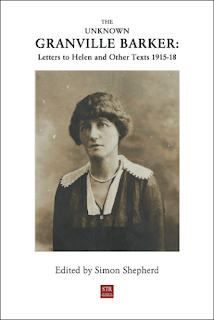
Along with publishing Theatre Notebook, the Society for Theatre Research always sends out one book a year to all of its members.

This year, STR sent out The Unknown Granville Barker: Letters to Helen and Other Texts 1915-18. The book compiles a number of writings by Harley Granville Barker, one of the most important actors, directors, playwrights and all-around theatre makers of the early 20th-century British stage.

For years, Barker endured a sexless marriage with the actress Lillah McCarthy, who was a great artistic partner, but did not provide him with the emotional companion he wanted. Then, at the end of 1914, Barker met Helen Huntington. Over the next few years, he fell in love with her and separated from McCarthy, which corresponded with a radical change in his career path.

In The Unknown Granville Barker, the editor Simon Shepherd puts together a number of documents that portray exactly what happened as Barker changed course and ultimately divorced McCarthy, marrying Huntington. In early 1915 Barker was entertaining New York audiences with hits he had already produced in England, including Bernard Shaw's Androcles and the Lion and The Doctor's Dilemma. Already, though, Barker was searching for ways for the theatre to be more than mere entertainment.

Newspapers interviewing Barker in 1915 noted he was now talking about theatre as being a "social force" that was accessible to everyone, not just professionals. "The theatre should come from the community, and not from the experts of the community," he told the New York Columbia Spectator. He looked back to the Middle Ages as an ideal time, when common people came together to put on Mystery Plays as an expression of their faith and beliefs. He longed to create something similar to that for the modern era.

Shepherd also includes an amusing story Barker published in the Manchester Guardian in 1917, in which he described Cain and Abel inventing the first dramas, with a little help from their mother Eve. The heart of the book, though, is a series of letters Barker wrote to Huntington during their courtship. During this period, Barker was also involved in the First World War, taking part in activities by the Red Cross, and later enlisting as a soldier. He also met with numerous literary figures, including J.M. Barrie, John Galsworthy, and Thomas Hardy, making his letters very amusing to read.

Well, it just so happens that I will soon be publishing my own book on the theatre, though not with STR. Instead, Palgrave Macmillan will be publishing my book Romantic Actors, Romantic Dramas about celebrity performers on the Regency stage. Yes, I even have a contract and everything! More information is to come, but needless to say, I am very excited about it.

Saturday, October 31, 2020

Hellmouths

In medieval drama, Hellmouths frequently appeared on stage. A mouth opening up into Hell appears, for instance, in the illustration of a Passion Play performed at Valenciennes in northern France. Another Hellmouth appears on a diagram of a Passion Play put on in Lucerne, Switzerland.

The entrance to Hell also appears in various plays of the English Mystery Cycles. For instance, The Fall of Lucifer in the N-town Cycle ends with the lines:

Now to helle the way I take,
     In endeles peyn ther to be pyht.
For fere of fyre a fart I crake;
     In helle donjoone myn dene is dyth.

What did these Hellmouths look like? Well, both in the illustrations we have of medieval stages and general depictions of Hell in medieval art we see the mouth of Hell represented as a literal demonic mouth. Yesterday, I was as the Cloisters Museum and snapped this picture of a capital on a medieval pillar:


The souls are being dragged off to Hell by demons and are deposited in the gigantic teeth-filled maw. We see these demons in medieval plays as well. In the York Cycle's version of The Judgment Day, a demon says:

He schall do right to foo and frende,
     For nowe schall all the soth be sought.
All weried wightis with vs schall wende;
     To payne endles thei schall be brought.

In spite of the confidence of the demons, however, they are no match for Christ. In the play of The Harrowing of Hell, we see the gates of Hell opened up by the Messiah, who liberates the dead from Hell, going back all the way to Adam and Eve. In the Chester Cycle, Jesus says:

Open vp Hell gates, yet I say,
     You princes of pine that be present,
And lett the Kinge of Bliss this way,
     That he may fulfill his intent!

You can see an image of Jesus opening the Hellmouth and liberating the dead in this tapestry from the Metropolitan Museum of Art (at the Fifth Avenue location this time, not the Cloisters):


What was it like to see these Hellmouths on stage? I imagine it was pretty thrilling. Contemporary accounts recollect smoke, fire, and explosions coming out of some of the Hellmouths on stage. Quite a spooky effect!

Friday, October 23, 2020

Angels and Demons

There are various ways one can perform theatre in a pandemic. Blessed Unrest was able to perform an outdoor production of Battle of Angels with recorded sound making up for the fact that performers were masked. Other companies have held readings in Zoom. This can be depressing sometimes, but occasionally you come across a real gem, like Gingold Theatrical Group's reading of Arms and the Man.

Folks at the University of South Dakota have found another solution. I just watched their production of Angels and Demons, a show bringing together several pageants from the York and Wakefield cycles of medieval mystery plays. The show was performed live, but made available streaming through the theatre department's website. Though the actors didn't have masks, they did all wear face shields to protect them from one another, and audience members like me watched safely from our homes.

Is it the same as live theatre? Decidedly, the answer is no, but it did give me the chance to see some great medieval drama adapted from the Middle English original by the show's director, Casey Paradies. Unfortunately, we didn't get much of a sense of the poetry of the original, but the adaptation was able to give us a taste of some of the less well known plays from the cycles. We missed the much lauded Second Shepherd's Play, but got to see The Fall of the Angels, The Temptation, and The Harrowing of Hell, among other scenes.

At the beginning of the play, we see God (Chloe Sand) create the world. After she leaves her throne vacant, though, Lucifer (Tyler Peters) declares that he should be master now. In the original play from the York cycle, Lucifer declares:

To ressayve my reverence thorowe righte o renowne.
I sall be lyke unto hym that es hyeste on heghte —
Owe, what I am derworth and defte.
                            Owe, Dewes, all goes downe!
My mighte and my mayne es all marrande.
Helpe, felawes, in faythe I am fallande.

Notice how as soon as Lucifer places himself on the highest height, his pride sends him crashing down to Hell. Paradies' production shows Lucifer and his fellow angels then transformed into demons, with hideous horns and makeup.

With angelkind a disappointment, God decides to create Adam and Eve (Cody Jones and Abby Schwedhelm). In this production, Lucifer emerges from a prison at the side of the set, which seems reminiscent of the Hell Mouths of the medieval stage. Envious of humanity, the arch-fiend appears to Eve with a snake puppet, promising her that if she eats of the forbidden fruit, she will gain wisdom and become like God. She takes the fruit and... well... you should never listen to talking snakes.

After about 4,000 years, though, God comes up with a plan to create righteousness and bring forth a Son named Jesus (Camille Cook). Lucifer finds Jesus, who has wandered out into the wilderness alone, and attempts to tempt Him, but the Son is adamant. Lucifer departs in frustration, and two angels come to comfort Jesus. This is when He declares that His time is at hand. In the original York play, He says:

My blissing have thei with my hande
That with swilke greffe is noght grucchand,
And also that will stiffely stande
Agaynste the fende.
I knawe my tyme is faste command;
Now will I wende.

It's time for the Passion and Crucifixion. The scourging is performed as a dumb show in Paradies' version. Jesus then mounts a scaffold up to the Tree of Life, which we saw in the Adam and Eve sequence, but which lighting designer Dani Roth cleverly transforms into a cross. Jesus has been defeated by death. Or has he...?

The Harrowing of Hell is usually fascinating to modern audiences, in part because it is an event that does not appear in the Bible, other than a brief reference in the Apostle's Creed. Adam and Eve, trapped in Hell, see a great light, which indicates the coming of Christ. This event was prophesied by Isaiah, as well as by John the Baptist and Moses, all three of whom are still in Hell because the Son has yet to redeem humanity. 

Once Jesus enters Hell, it's time for the big fight scene with Lucifer. This is conducted both with words and staves in the USD production. Though Lucifer is defeated, he looks forward to still being able to damn evil souls in the future. He can't enjoy his lordship over Hell, though, as Jesus binds him and sends him to sink into the pit.

We missed The Resurrection and fast forwarded to The Last Judgment, where the online audience got to hear a chant of "Build That Wall!" Are we living in the Endtimes? Perhaps. The good are taken up to heaven, but the demons Beelzebub (Thomas Honeywell) and Ribald (Emmy Hewitt) exult in all the wicked they will be able to now torment eternally, both in body and in soul. 

Jesus then addresses the blessed, reminding them that when He was hungry, they gave Him food, and when thirsty, they gave Him drink. This they did whenever they provided anything for the poor and downtrodden. The damned, however, are reminded of how they never had pity on the unfortunate. When Jesus turns to humanity and reprimands them for their failure to act, it's a moving moment. Here's what it says in the original York play:

In all my woo toke I no wrake,
Mi will itt was for the love of thee.
Man, sore aught thee for to quake,
This dredfull day, this sight to see.
All this I suffered for thi sake.
Say, man, what suffered thou for me?

As we approach an election that seems like as great a reckoning as any our nation has seen, the words of Jesus ring with the force of a powerful accusation. What have we done for the least in our society? And if we have ignored the Face of God in them, what hope can we have for our own salvation?

If you're interested in watching the USD production, it will be livestreamed on Saturday October 24th at 7:30 p.m. Central Time and Sunday, October 25th at 2 p.m. Central. You can watch it here.

Friday, May 31, 2019

Balaam's Ass

It has become fashionable to discount the connections between liturgical dramas of the middle ages and the outdoor mystery plays that developed somewhat later. However, the mystery plays showing Balaam, Balaack, and the prophets retain clear echos of plays performed inside churches during earlier eras.

A 13th-century Latin liturgical drama, Ordo Prophetarum, shows a procession of prophets, including Isaiah, Jeremiah, Daniel, Moses, David, and Habakkuk, all foretelling the coming of Christ. They are followed by the Gospel figures Elizabeth and John the Baptist, as well as pagan authorities thought to have foretold the life of Jesus, including Virgil, Nebuchadnezzar, and the Sibyl of Cumae. After Simeon (another figure from the New Testament) speaks, the play moves to the story of Balaam.

You'll find the story of Balaam and his ass in chapter 22 of The Book of Numbers. He was a pagan prophet who King Balaack hired to curse the Israelites, but God sent an angel to stop him before he could curse the chosen people. Though Balaam couldn't see the angel, his donkey could and refused to go any further. Ordo Prophetarum tells the story this way:

Here let an angel come with a sword. Balaam beats his ass, and when it fails to go forward, he says in anger:

          Why do you stand still, ass?
          Obstinate beast!
          Now the spurs shall tear
          Your ribs and entrails.

A boy underneath the ass answers:

          An angel with a sword
          Whom I see standing in the way
          Keeps me from going on;
          I fear lest I be killed.

Variations of this play appear in manuscripts from Rouen and Limoges, so it appears to have been somewhat popular throughout Europe. A 15th-century mystery play from the Chester Cycle is quite similar. In it, Balaam calls out:

          Goe forth, Burnell! Goe forth, goe!
          What the dyvell! my asse will not goe!
          Served me she never soe.
               What sorrow so her dose nye?

After he beats her, the ass speaks, saying:

          Maister, thou dost evell, witterly,
          So good an ass as me to nye!
          Now hast thou beaten me thry,
               That beare the thus aboute.

In the Chester play, the procession of prophets occurs after the ass scene. Again, it starts with Isaiah, followed this time by Ezekiel, Jeremiah, Jonah, David, Joel, and Micah. It certainly has differences from the older liturgical dramas, but there seems to be a connection, nonetheless.

Sunday, June 3, 2018

Corpus Christi

Today is the Feast of Corpus Christi, which was inspired by a vision by the 13th-century canoness Juliana of Liège. The solemnity, celebrated on the first Thursday after Trinity Sunday in most of the world, but on the following Sunday in the U.S., is quite important to the history of medieval drama.

Juliana of Liège reported having a mystical vision of Christ in which she was told there must be a specific feast to celebrate the Lord’s true presence in the Eucharist. Juliana hesitated before describing the vision to her confessor, and perhaps with good reason. Her confessor spilled the beans to the bishop, who later proclaimed a Feast of Corpus Christi (Latin for "Body of Christ") in his diocese.

The feast remained a local affair until 1261. That’s when a former Archdeacon of Liège became Pope Urban IV. He waited until the last year of his papacy, however, 1264, to formerly institute the feast as part of the official calendar. He asked no less a personage than the great theologian Thomas Aquinas to write texts for a special mass. Still, celebrations of the feast spread slowly. How do you celebrate the theological doctrine that Christ is present in the host?

One idea was to take a consecrated host out of the church and parade it around the the town. This was also a time when plays were being performed outside, not just as liturgical events inside the church. The 12th-century Play of Adam, for instance, seems to have been performed in front of a church, given its stage directions. Why not process plays through the streets as well? Even after the tradition of parading through town with the host began to wane, a tradition continued of performing a procession of plays around the date of the feast.

It should be noted that Corpus Christi occurs in late May or early June, just as weather is getting really good in much of Europe, so it was an opportune time to perform outdoor theatre. The plays focused on how Christ saved humanity through the sacrifice of his body and blood, but Corpus Christi plays told the story of all creation, from the fall of the angels to the last judgement. In England, these plays were performed annually each spring, either on Corpus Christi or close to it, and came to be known as Mystery Plays.

In Christian theology, a religious truth known only through divine revelation is referred to as a Mystery. However, in the middle ages, the term "mystery" had another meaning as well. Each play in a cycle could be associated with a different guild or craft. The term "mysterium" denoted a craft, in part because a guild controlled the secret (or mystery) of how to perform a certain type of labor. Thus, during the middle ages, the term "mystery play" could have called to mind not just religious tenets, but also the practical skills possessed by the craftsmen who performed them.

If you're interested in reading a Mystery Play for Corpus Christi, a few years ago I modernized a portion of the play on the Scourging of Christ that was written by the famed Wakefield Master. The Wakefield Cycle is one of four cycles of English Mystery Plays that remain mostly intact, and many critics consider the plays attributed to the anonymous Wakefield Mast to be some of the best.

Saturday, February 27, 2016

Early Tudor Drama

As the middle ages in England came to a close, the Plantagenet dynasty split into two factions: the House of Lancaster and the House of York. The two sides repeatedly clashed in the long conflict known as the Wars of the Roses, with the young Henry Tudor ultimately triumphing and establishing a new Tudor Dynasty.

Though drama under Henry VII still maintained a medieval sensibility, times were changing. The printing press had already been introduced, and Renaissance ideas that had flourished in Italy were finally reaching England. Under the reign of the king's son, Henry VIII, secular drama gained considerable ground, with the gifted English playwright John Heywood providing such interludes as The Play of the Weather and The Four P's.

Another important playwright from Henry's reign was John Bale. His play King Johan tells the story (from a decidedly Protestant standpoint) of a notorious medieval monarch's conflict with the Pope. King Johan is notable both for its unique verse structure and its mixing together of historical and allegorical figures. The play exists in multiple versions, and a reference in one to "our late kynge Henrye" could indicate it was performed during the reign of Edward VI as well. Bale was highly regarded under Edward, and the young king appointed him as a bishop.

Sometime around the end of Edward's reign, the schoolmaster Nicholas Udall wrote the comedy Ralph Roister Doister. The play focuses on the dramatic descendant of the Miles Gloriosus character in Plautus, depicting a braggart who tries to woo a virtuous widow but ends up running away from her maids. The play appears to have been intended for performance by Udall's students, though it may have been performed before Mary I as well. By the time Elizabeth I took the throne, there was already a healthy tradition of secular plays in England.

That proved to be fortunate, as Elizabeth set about banning all religious drama. The mystery, miracle, and morality plays of the middle ages advocated a Catholic theology, and Elizabeth's legitimacy depended on Henry VIII's ability as head of the church to obtain an annulment without the consent of the Pope. As Elizabeth began the long, slow process of repressing religious plays, more and more writers turned to secular themes. Two men, Thomas Norton and Thomas Sackville, collaborated on a play in 1561 called Gorboduc. The tragedy is the first drama in English written in unrhymed iambic pentameter, or blank verse, which subsequently became the standard verse form for Elizabethan plays.

Elizabethan drama did not truly come into its own, however, until the 1580s. One of the first plays to capture the imaginations of mass audiences was The Spanish Tragedy by Thomas Kyd. The play, about a father who must avenge the murder of his son, established the popularity of revenge tragedy. Kyd provided ghosts, mad scenes, a play-within-a-play, and a final bloody slaughter. All of these became staples of later Elizabethan revenge tragedies, and Kyd might even have written an early version of the most popular of revenge tragedies: William Shakespeare's Hamlet.

Kyd was overshadowed in 1587, though, with the appearance of a young playwright from Cambridge University named Christopher Marlowe. That is a post, however, for another day.

Wednesday, February 10, 2016

Adam

On this Ash Wednesday, I want to write about the medieval drama The Play of Adam. Scholars often cite this anonymous play as a half-way point between liturgical dramas performed inside the church (like the Quem Quaeritis Trope) and Mystery Plays performed in secular spaces throughout the city.

Why would they say that? Well, because Adam appears to have been performed just outside the church. While the text of the play is written mainly in Norman French, Latin stage directions refer to a church. One stage direction reads:

Then let the Figure go to the church, and let Adam and Eve walk about, innocently delighting themselves in Paradise. In the mean time, let the demons run to and fro through the square, making fitting gestures; and let them come, one after another, alongside of Paradise, showing Eve the forbidden fruit, as if entreating her to eat thereof.

After the Figure of God judges Adam, Eve, and the Serpent, another stage direction states:

And when this is ended, the Figure shall go back unto the church.

The story continues, with the Expulsion from the Garden and Cain's murder of Abel. After that, there is a procession of prophets foretelling the coming of Christ. The stage directions call for Habakkuk to "lift up his hands toward the church, manifesting wonder and fear."

Unfortunately, the manuscript breaks off after a speech by King Nebuchadnezzar, but the piece looks forward not just to the coming of the Messiah, but to the coming of a new type of drama.

Monday, January 6, 2014

The Cornish Rounds

In R.S. Hawker's short story "The Botathen Ghost," there is a comment that a Cornish clergyman "must needs have been artist and poet in his way, for he had to enliven his people three or four times a-year, by mastering the arrangements of a 'guary', or religious mystery, which was duly performed in the topmost hollow of a green barrow or hill, of which many survive, scooped out into vast amphitheatres and surrounded by benches of turf which held two thousand spectators."

This is a reference to the famous Cornish Rounds, huge earthworks which medieval actors used to stage religious plays. In the Cornish tongue, such an outdoor theatre was known as a "plen-an-gwary" or playing place. There are traces of as many as 18 of these rounds, though only a couple are still visible. The famous Perran Round, however, shows evidence of seven tiers of seating and could have accommodated an impressive audience for medieval plays.

In "The Botathen Ghost," Hawker notes that some of those plays included "'The Creation' and 'Noe's Flood', which still exist in the original Celtic as well as the English text." There is in fact an extensive cycle of Cornish mystery plays known as the Ordinalia. The first section of the Ordinalia tells the stories of the Creation, the Fall of Man, Cain and Abel, Noah, and Abraham.

Hawker's story goes on to grant a parson who organized such plays the power to "govern any ghost or evil spirit." I'm not sure about that, but the plays must have required a steady hand to organize them all. The cycles performed in Cornwall seem to have lasted several days. They told the story of the world from the Creation to the Ascension, though unlike the extant mystery cycles in Middle English, the Ordinalia leaves out the Last Judgment.

By the way, Hawker seems to imply that the Rounds were built to be theatres. Most scholars today believe they were constructed for other purposes, but they were no doubt utilized by medieval players. As to whether or not they are haunted... I defer to Mr. Hawker on that one!

Sunday, December 29, 2013

Liturgical Drama in Till Eulenspiegel

The adventures of Till Eulenspiegel first appeared in German in 1515. They tell the life story of a trickster who is constantly mocking everyone he meets. In one tale, he tricks two thieves into fighting each other and leaving behind a beehive they are trying to steal. In another story, he eats one of two chickens being cooked by a priest's poor one-eyed maid. When she asks him what happened to the second chicken, he tells her to open her second eye in order to see it.

While not a nice guy, Eulenspiegel can be truly hilarious. What is more, he can teach us something about theatre history.

Chapter 13 of the original Till Eulenspiegel book tells the story of how a priest put the trickster in charge of staging an Easter play. The play is precisely the type of liturgical drama with which all students of medieval theatre should be familiar. The three Marys come to the sepulcher, and an angel appears to them, saying "Quem queritis?" or "Whom do you seek?"

The appropriate response is always something along the lines of: "Jesus of Nazareth, the crucified, O Heavenly Beings." Then the angel says he isn't here because he was raised from the dead, and everyone rejoices.

In the Eulenspiegel story, the play is performed in Latin, which fits with what we know about how these dramas were presented in the church. Since the priest's one-eyed maid can both read and write in Latin, she plays the angel in the play. This is interesting, because we generally think of medieval drama being performed only by men, but that appears not to have always been the case. In at least one part of Germany, by the early 16th century it was not unimaginable that a woman might appear onstage, and as an angel no less. According to the story, the maid had already been in "many" of these plays.

The maid gets very excited about her role and straps wings onto her back as the angel. In addition to having costumes, the play also has a sepulcher set. The priest playing Jesus waits underneath the sepulcher, ready to pop out at the appropriate moment. Eulenspiegel gets three illiterate farmers to play the three Marys. The priest and the maid know their lines, but Eulenspiegel has to coach the farmers in exactly what to say, since none of them knows Latin.

When it comes time for the play, the maid comes out at the angel and asks, "Quem queritis?" or "Whom do you seek?"

One of the farmers responds in Latin, "'We're looking for a priest's old one-eyed whore.'"

The maid springs out of the tomb, loses her angel wings, and ends up in a brawl with the farmers. The priest, who in the story is also wearing wings, runs to the defense of the maid, and everyone soundly thrashes everyone else. Except for Eulenspiegel, who calmly walks away from the whole thing, leaving the village, never to return. 


By 1515, these types of plays might have seemed old fashioned to some, but clearly they were alive and well in the popular imagination.

Tuesday, August 13, 2013

Notes on Spain's Golden Age

Early Spanish Drama

During the 16th and 17th centuries, Spain asserted its power across the globe. It dominated Europe, conquered much of the Americas, and established footholds in Africa and Asia. Spanish literature and the arts flourished, and the theatre in Spain came into its own. Religious dramas grew into elaborate pageants called autos sacramentales that celebrated the sacraments of the Church. Secular drama, influenced by French farces and Italian commedia dell'arte, spread across the peninsula. These plays were frequently performed by traveling troupes that could consist of anything from a single actor reciting stock pieces to refined companies with as many as sixteen actors.

Both men and women acted, though there were fewer actresses on stage, and boys frequently played the lesser female roles. The most famous of these early strolling players was Lope de Rueda, the son of a goldsmith who rose to fame as an actor in the middle of the sixteenth century. He was famous for playing comic characters and also wrote many of his own plays. These works ranged from full-length sweeping dramas to short farces called pasos, for which he was most famous. Popular folk humor was the basis for many of these pasos, including The Olives, a play about a husband and wife arguing over how much to charge for olives that will grow from a newly planted shoot.

One of the many people to see Rueda was Miguel de Cervantes, who later recalled that when he was a boy he had witnessed the great actor perform a play on a simple stage made up of four or five boards on benches with a blanket used as a backdrop. Cervantes later became famous for his novel Don Quixote, but before that, he wrote numerous plays, including the four-act historical drama The Siege of Numantia. The play uses allegorical figures such as War, Hunger, Pestilence, and Fame, as well as historical figures like the Roman general Scipio. There are plenty of opportunities for pageantry, such as a woman representing Spain entering crowned with towers and bearing a castle in her hand. Stage directions also call for complicated special effects, including shooting off rockets to represent lightning and rolling a tub full of stones to create the sound of thunder.

In between the acts of such serious plays, performers often staged interludes called entermeses. Later on in his career, Cervantes published eight of these entermeses. One of the more famous of these, The Vigilant Sentinel, shows the author's ironic stance toward soldiers and chivalric values. In the play, a soldier courts a kitchen maid, chasing away any men who might even possibly be rivals. In spite of his efforts (or perhaps because of them) she rejects his suit and marries instead a sacristan who knows nothing of the arts of war.

The Spanish Stage 

The improvised stages of traveling players continued throughout the Golden Age of Spanish drama. However, the larger cities in Spain established permanent playhouses. In 1574, the Italian architect Giovanni Bellini built Spain's first permanent theatre of the period in Seville. Others followed in Cordoba, Valencia, Madrid, and elsewhere. Spanish theatres tended to be built in preexisting courtyards, earning them the name corrales. In the town of Almagro, one of these corrales still exists and is used for theatre even today.

On one side of the corrale was the stage, which had a balcony or balconies for entrances from above. The Siege of Numantia calls for a character to leap from a tower, an effect likely achieved using one of these balconies. Like public theaters in England, these stages had few scenic elements, which allowed actors to travel across miles or years in the space of a few lines. Audience members wishing to be seen could sit on stage for an additional fee, occupying areas to the side of the stage referred to as mountains. At the back of the stage was frequently a discovery space where a curtain could open to reveal additional characters or a new scene.

Directly in front of the stage was an open courtyard known as the patio. Originally men stood in this area, though gradually theatres added benches. Only men were allowed in the patio, and these were the rowdy, lower-class playgoers known as mosqueteros. Frequently, it was the mosqueteros who decided the success or failure of a play, and writers were obliged to please them. If the mosqueteros did not like a play, they hissed and whistled until it could not be heard.

Facing the stage was an elevated gallery for women, who were kept separate from the rough men in the patio. This area, known as the cazuela, or "stew pot," had benches that were frequently fought over by the female playgoers. To sit in the front, where a woman could be easily seen by men, was considered brazen, but it was hard to see from the back rows, so women came early to the theatre to get one of the middle seats. Sometimes, there was another level above the cazuela reserved for dignitaries. Below the cazuela was typically the refreshment stand, or alojeria, which also sent sellers up to the cazuela to hawk snacks.

On either side of the patio were rows of seats rising up at an incline. These were known as the gradas, and an extra charge was required for these seats. Unfortunately, many playgoers felt they were entitled to such seats--and indeed to admission period--without paying. It was a constant struggle to keep order in the gradas as well as the patio. Also, actors did not own the corrales. They were either paid a flat fee or kept only a portion of the admission charge, so freeloaders could cut painfully into the income of performers.

Above the gradas were boxes known as aposentos. These originally connected to the houses on either side of the courtyard in which the corrale was built. They sometimes had private entrances through the houses, which led to complex arrangements with the homeowners, who typically took a cut of the admission for these seats. The aposentos were the only places where women and men could sit together, but a respectable woman would only go to the theatre in the company of family members. The top levels of aposentos were sometimes called attics, or desvanes.

Originally, theatres only performed plays on Sundays and during religious festivals, but beginning in 1579 authorities began making exceptions. Performances were not allowed at all during Lent, however, or during periods of national mourning. The corrales had to shut down for the hottest part of the summer, and they were closed as a matter of course during plagues or wars. This meant they could remain open fewer than 200 days out of the year. Since the corrales were open to the sky, rain could also spoil a performance.

Lope de Vega

The one man who shaped Spanish Golden Age drama more than anyone else was the playwright Lope de Vega. Born in Madrid in 1562, he came to write literally hundreds of plays and became so famous that most critics are now on a first-name basis with him, referring to him simply as Lope. Lope studied at the University of Alcala, but never completed his degree. He became a soldier and fought in numerous military expeditions, including the ill-fated Spanish Armada that launched in 1588 to invade England. Lope's ship was one of the few to make it back to Spain, an example of his prodigious good luck, which got him out of numerous scrapes and close calls throughout his life.

Before Lope's time, Spanish plays had any number of acts. Lope, however, found that three acts worked best for him. Once he established three acts as the standard for himself, both his tremendous skill and incredible output led other Spanish writers to adopt the three-act form as well. He specialized is so-called cape and sword dramas, which valued swashbuckling action and ingenious plot twists over complex characterizations or overly decorous poetry. This led many critics to attack his plays, frequently citing his failure to follow neoclassical rules.

In response, Lope published The New Art of Writing Plays for Our Time in 1609. Written in verse, this defense of free and inventive playwriting imitates the informal style of Horace's Ars Poetica. Though Lope apologizes for breaking neoclassical rules, he slyly counters that had he followed those rules his plays would not have been nearly so popular. While abasing himself before classical scholars, he also throws in jabs about how he actually has experience writing plays, and very successful ones at that. Anyone who does not like his plays need not come see them, he notes.

The New Art also gives a great deal of practical advice about playwriting. It recommends writing each act on no more than four sheets of paper, as any more would test the patience of the audience. Rather than condemning the entire play to take place in a single day, the poem recommends confining each act to a single day. The first act should set out the matter of the play, and the second act should weave together events, but only in such a manner that the audience will not be able to guess the outcome. Only in the final scene should the play's ending become apparent.

Unlike English drama, which settled upon blank verse as the standard poetic form for writing plays, Spanish Golden Age drama was written in a variety of styles. In fact, the verse form typically changed throughout a single play. The New Art suggests fitting the verse form to the mood of each scene. For instance, complaining characters should use ten-line stanzas called decimas. A character waiting in anticipation might speak in a sonnet, while grave matter might be related in three-line tercets.

One of Lope's most famous plays is Fuenteovejuna. The play is inspired by actual events in the town of Fuenteovejuna, whose name roughly translates to "The Sheep's Well." A sadistic commander torments the town, raping and torturing villagers with impunity. Eventually, a group of villagers kill the commander, and the king orders that the murderers be punished. Even under torture, however, the villagers refuse to name names, calling out only, "Fuenteovejuna did it!" Lope depicted an even more famous event from Spanish history in The New World Discovered by Christopher Columbus.

Another play, The Dog in the Manger (or The Gardener's Dog), plays off of an old fable about a dog who will not eat hay but refuses to let others eat it, either. In the play, a noble woman falls in love with her secretary. While she does not want to marry him, she prevents him from marrying anyone else until a wily servant tricks everyone into thinking the secretary is the long-lost son of a noble. Lope created a darker outcome for The Knight of Olmedo, the story of a virtuous gentlemen who beats all of his rivals to win the heart of a lady in Medina. Out of revenge, the spurned lovers shoot and kill him as he is riding back to Olmedo.

Lope's reputation was beginning to fade when at the age of 68 he wrote the play Justice Without Revenge (sometimes titled in English Lost in a Mirror). At the time he wrote it, his daughter Marcela had already gone mad and was in the process of slowly dying. Though honor prevails in the play, it is at a great price, and the dark, passionate drama won new respect for Lope. Justice Without Revenge has many parallels with Jacobean revenge tragedy, and in fact Lope wrote his own version of the events depicted in Webster's The Duchess of Malfi. In Lope's The Duchess of Amalfi's Steward, however, the mood tends to be pastoral until the play's bloody final act.

Lope's Contemporaries

Though Lope dominated the stage during his lifetime, Spain's Golden Age produced a number of other important plays and playwrights. The author Guillen de Castro transformed the epic Spanish poem The Cid into the play The Youthful Deeds of the Cid, which came in turn to inspire the French playwright Pierre Corneille. Castro also wrote plays based on classical mythology as well as some inspired by the prose of Cervantes. Lope dedicated one of his plays to him, and he dedicated the first volume of his plays to Lope's daughter. Unfortunately, Castro was not as successful as his friend, and he died in poverty.

The friar Gabriel Tellez, better known by his pseudonym Tirso de Molina, wrote a number of popular plays around the same time as Lope. His most famous work, The Trickster of Seville, introduced to literature the character of Don Juan, a charismatic womanizer who devotes his life to seducing women. In the play, Don Juan kills the father of a young woman he has seduced and later invites the dead man to supper. When the father does show up, Don Juan is dragged off to hell without the chance of repenting of his sins. Playwrights from Moliere to George Bernard Shaw to David Ives have retold the classic story, though often lending it very different interpretations.

The Mexican-born Juan Ruis de Alarcon churned out about 25 of plays, including The Suspicious Truth, about a compulsive liar. Like Castro, Alarcon later influenced Corneille. He was a friend of Cervantes, but won the enmity of Lope, who lampooned him. A short, hunchbacked redhead, Alarcon stood out in Spanish society. Eventually, however, he was appointed to the Royal Council of the Indies and achieved relative stability through his position in government.

By far the most important of Lope's contemporaries was Pedro Calderon de la Barca. By the time Calderon was born in 1600, Lope had already established himself as a playwright, so while the two were contemporaries, Calderon came from a very different generation. While Lope developed Spanish drama from its rough-and-tumble origins to the form it would take throughout the Golden Age, it was Calderon who refined it and brought out its poetry. Lope was the more influential writer, but most critics today consider Calderon to be the better dramatists. In fact, when Lope died in 1635, the young Calderon had already surpassed him in reputation.

Calderon

Like Lope, Calderon was born in Madrid. He was fortunate enough to receive a Jesuit education, but after his father died, Calderon was orphaned at the age of 15. He later studied law at the University of Salamanca. In 1622, he entered a poetry competition in honor of Saint Isidore, who was in the process of being canonized. Not only did Calderon's poetry win first place, it was specifically praised by Lope, who was one of the judges in the competition.

Shortly after that, Calderon's plays began appearing in the corrales. One early play, The Constant Prince, tells the story of the historical Prince Ferdinand of Portugal, who died imprisoned in Morocco due to Portugal's decision not to hand over the city of Ceuta to Muslim forces. The play is notable for its sympathetic portrayal of many Muslim characters, even though Christian forces are ultimately victorious. The role of Ferdinand is demanding, both emotionally and physically, as the young prince is systematically (and willingly) tortured to death. In the twentieth century, the Polish director Jerzy Grotowski used the play to create one of his most famous productions.

In 1635, Calderon wrote his most famous play Life Is a Dream. The play follows the fictional Segismundo, the heir to the throne of Poland. Sigismundo's father, King Basilio, imprisoned the prince due to a prophesy he would bring disaster to the country. Having a change of heart, the king tests Segismundo, bringing him to the palace, but when the prince behaves abominably, King Basilio has him drugged and brought back to his cell where he is told the whole experience was a dream. In the third act, Calderon introduces new plot twists that leave a reformed Segismundo wondering whether all life might indeed be but a dream.

Though most critics consider Life Is a Dream to be Calderon's masterpiece, he continued to produce exceptional works for years afterward. His play The Mighty Magician influenced Goethe's Faust. In such dark plays as The Doctor of His Own Honor Calderon drew out traditions of honor in Spanish society to fantastic and chilling extremes. In 1651, Calderon became a priest. That same year, he wrote The Mayor of Zalamea, one of his last great secular plays.

After taking Holy Orders, Calderon focused on writing explicitly religious plays, the autos sacramentales for Corpus Christi and other religious feasts. However, the king asked him to write entertainments for the court, and Calderon could scarcely refuse. Teaming up with the composer Juan Hidalgo de Polanco, Calderon helped to create a new operatic form for the king, the zarzuela. These pieces are partially spoken and partially sung. Today, the zarzuela remains a popular dramatic form in Spain and many Spanish-speaking countries.

Autos Sacramentales

Autos sacramentales during the Golden Age of Spain could take many forms. Some told biblical stories, like mystery plays. Others recounted miracles or the lives of saints, like miracle plays. Most frequently, however, they contained allegorical figures similar to those found in morality plays. In any case, the finest dramatists available, including both Lope and Calderon, were chosen to write the plays.

Though older plays were sometimes revived, from 1647 to 1681 all of the autos sacramentales performed in Madrid were new works commissioned especially from Calderon. In fact, when Calderon died in 1681, he was writing one of the auto sacramentales for that year's Corpus Christi celebration. Of Calderon's many plays of this type, the most famous is The Great Theatre of the World. The play portrays God as a theatre director who casts individuals as King, Female Beauty, Rich Man, Poor Man, Worker, Discretion, and Unborn Child. God asks each to act his or her part as well as possible then sends them each to a final judgment.

The actors for these plays processed through the streets on two-story wagons called carros. There were usually two carros for each play, and actors would descend onto an acting area for the performance. The acting areas were originally also on wagons, though they were later replaced by fixed stages in various parts of the city. In addition to performing the autos sacramentales, actors danced and sometimes put on short farces, much to the dismay of religious conservatives. In 1765, the government officially banned the plays.

New World Performance

As Spain's culture spread throughout its empire, Spanish theatre spread as well. In the Americas, Spanish theatre blended together with indigenous theatrical practices. In Guatemala, the theatrical dance known as the Rabinal Achi became associated with the Feast of Saint Paul on January 25. Also known as The Dance of the Trumpets, it is still performed annually in the town of Rabinal on that day. The dialogue of the play is in Mayan, and the story recounts events prior to the conquest by Spain. Still, the fact that it came to be associated with a Christian religious holiday shows that there were attempts to bring together Spanish and indigenous cultures.

Given that indigenous Americans often already had theatrical traditions, many Christian missionaries found theatre to be an effective tool for evangelization. Beginning in the 1530s, the Spanish began performing their own plays in the Americas. These performances were usually religious in nature and frequently occurred on feasts such as Corpus Christi, as they did in Spain. The first great Spanish playwright to be born in the Americas was Juana Ines de la Cruz, a highly educated nun generally known as Sor Juana. Born in present-day Mexico, Sor Juana wrote both secular and religious plays and is considered the founder of Latin American drama.

The illegitimate daughter of a Spanish captain and a Mexican woman of Spanish descent, Sor Juana learned to read and write Spanish at an early age. By the time she was a teenager, she knew Latin and Greek as well. She joined the court of the viceroy of New Spain, but in spite of receiving numerous marriage proposals there, she chose instead to enter a convent. Finding the rules in that convent did not agree with her, Sor Juana left after a few months, but in 1669 she entered another convent run by the Order of St. Jerome, where she remained until her death. It was there that she composed her best-known works, including most of her plays.

Sor Juana wrote (or at least collaborated on) some secular plays, but more critics have been drawn to her autos sacramentales. The most famous of her religious plays is The Divine Narcissus, a complex allegory of faith. The play contains a short introductory piece called a loa. In her loa to The Divine Narcissus, Sor Juana portrays the conquest of the New World in allegorical terms. Occident and America are shown worshipping the God of Seeds, but are overcome by Religion and Zeal. Though Zeal wishes to slay America, Religion promises to convert the pagans by means of the play that follows.

The loa to The Divine Narcissus shows just how ambitious a writer Sor Juana was. Unfortunately, her plays were mostly forgotten before the twentieth-century poet Octavio Paz brought renewed attention to Sor Juana's work. Today, however, historians credit Sor Juana with laying the foundations of all Latin American drama that was to come. The roots of drama in the Americas extend back much further than the nineteenth-century, as past historians might have us believe. Instead, the Golden Age of Spain quite clearly extended to the Western Hemisphere, having a lasting impact on the other side of the globe.
Tuesday, August 6, 2013

Notes on Medieval Drama

Liturgical Drama

Though early Christians opposed the theatre, their rituals were themselves dramatic. At the heart of Christian religious services was in fact a re-enactment of the Last Supper, the final meal of Jesus Christ before his crucifixion and death. This sacred meal would later become very important to the history of Western drama, but it was actually the celebration of Easter--the feast commemorating Christ's resurrection--that gave rise to the first recorded Christian liturgical dramas.

The earliest liturgical dramas trace their ancestry at least to the early tenth century, when the monks in the Swiss monastery of St. Gall sang a trope beginning with the line "Quem quaeritis?" or "Whom do you seek?" It is clear that the so-called Quem Quaeritis Trope soon had a distinctly theatrical staging. Instructions from a tenth-century bishop, Ethelwold of Winchester, called for one singer impersonating an angel to ask, "Whom do you seek in the sepulcher, O Christian woman?" Then, three singers representing the three women at the tomb were to respond, "Jesus of Nazareth, the crucified, O heavenly one." The angel was then to sing, "He is not here; He is arisen, as He foretold. Go and announce that he is risen from the dead."

From these humble beginnings arose elaborate plays performed inside churches. For these performances, we have records of costumes, sets, and impressive special effects, including an Ascension play in which an actor playing Christ was hoisted up into wool clouds inside the church. Other plays portrayed processions of prophets, shepherds coming to see the infant Christ, and the visitation of the three magi. The action of the plays frequently began on raised platforms called mansions erected inside the church. Stage directions sometimes called for actors to come down from the mansions and perform on a common playing area known as the platea, which was on the same level as the audience.

These early plays were in Latin, but in the twelfth century plays in the local vernacular began to appear. One, The Play of Adam, which was performed in northern France, was written mostly in Norman French, though it has substantial passages in Latin. From the stage directions, it seems clear the play was performed in front of a church, with characters occasionally exiting into the church. In later centuries, many plays took place away from churches entirely and were performed not by churchmen but by lay actors speaking (and only occasionally singing) in the vernacular.

Corpus Christi Plays

In 1208, a canoness named Juliana of Liege (in present-day Belgium) reported having a mystical vision of Christ urging her to work for a new feast for the church. The vision told her there must be a specific feast to celebrate Christ's bodily presence in the Eucharist, the sacrament served during the ritual re-enactment of the Last Supper. Juliana claimed to have had the vision over and over again for years before she finally related it to her confessor. The confessor told the bishop, who proclaimed in Liege a Feast of Corpus Christi, Latin for "Body of Christ." After a former Archdeacon of Liege became Pope Urban IV in 1264, the feast spread across Europe.

Traditionally, people celebrated Corpus Christi by taking a consecrated wafer, believed to be the Body of Christ, out of the church and parading it through the streets of the town. In some places, the Feast of Corpus Christi came to be associated with a procession of plays through the streets. These plays told the history of the entire world, as Christians understood it, from the Fall of Lucifer, to the Last Judgment. They focused, however, on how through Christ humanity came to be saved. Each play could be associated with a different guild or craft, known as a mystery, hence the plays are often called mystery plays.

Cycles of mystery plays were performed throughout Europe, but they were particularly popular in England. Each guild generally sponsored a different play and produced it every year or few years. A guild might take charge of a particular play for practical reasons, for instance the shipwrights' guild performing the play of Noah's Ark. There was generally a symbolic reason for the guild to perform a play as well. In York, the Pinners' Guild, which made nails, performed the Crucifixion.

The guilds built elaborate carts that paraded through the streets, stopping periodically to perform the plays. In some cases, the performance sites were close enough together that the audience would be able to vaguely hear the previous play at the next site and the next play at the previous site. This could have emphasized the idea that each scene was a part of a larger narrative involving the cosmic history of humanity's redemption. Because there were so many plays, performances of an entire cycle lasted from one to three days, and sometimes even longer. Performances began at dawn and ended at sundown.

After the Protestant Reformation, the government in England banned the performance of these plays, though some cities managed to hold onto the tradition well into the reign of Elizabeth I. Scripts for four nearly complete cycles survive in English. They are the cycles for York, Wakefield, Chester, and a city designated in the script as "N-town." There are many theories about where "N-town" might have been, or whether that name was just a placeholder, and the name of any city could have been used in the script depending on where the plays were performed.

Eight of the plays in the York cycle are written in an alliterative verse identified with an anonymous playwright scholars have dubbed the York Realist. These plays all deal with the Passion of Christ, from the conspiracy to arrest Jesus to his body's burial. Written sometime in the fifteenth century, the plays of the York Realist achieve an emotional intensity rarely exceeded in medieval drama. The characters in these plays maintain a believable psychology even as they sometimes address the audience directly.

Even more famous is a playwright known as the Wakefield Master, who wrote in an equally distinctive verse form. The Wakefield Master wrote the better part of at least six plays, including not one but two plays about shepherds visiting the infant Christ. The First Shepherd's Play shows three petty shepherds who are so foolish they argue with each other over imaginary sheep. After an angel appears to them, however, they become humbled. They travel to Bethlehem while singing a song and then offer simple gifts to the newborn child.

The Second Shepherd's Play is an even more famous depiction of the same events. The shepherds have the same names as in the former play, but it is unclear if the plays were performed together or alternated on different years. The Second Shepherd's Play is notable for a folk-tale plot that precedes the main action. In the folk-tale plot, a thief named Mak steals a sheep and takes it home to his wife. The wife pretends the sheep is a newborn child to whom she has just given birth, but the shepherds see through the ruse and punish Mak, tossing him in a blanket. An angel then appears, and the shepherds visit a real infant who in Christian theology is known as "the Lamb of God."

As can be seen, mystery plays went beyond the depiction of events as described in the Bible. While they sometimes adhered closely to biblical narratives, they also added in accounts from other sources, such as folk traditions, Apocryphal Gospels, and medieval poems. Often they contained songs, the most famous of these coming from The Shearmen and Tailors' Play. This piece comes from a cycle of mystery plays (only two of which have survived) that were performed in Coventry in the fifteenth century. It ends with three songs, one of which is still frequently sung at Christmastime. The song, generally known as "The Coventry Carol," laments the innocent children slaughtered by King Herod.

Herod was in fact one of the great characters of the medieval stage. A famous stage direction in The Shearmen and Tailors' Play reads: "Here Erode ragis in the pagond and in the strete also." This seems to indicate that upon occasion the action of plays spilled over from the pageant wagons and into the audience. The passions of Herod, who would call out things like, "I stampe! I stare! I loke all abowtt!" were remembered well beyond the middle ages. Shakespeare's Hamlet recalls such antics when he remarks that overacting "out-herods Herod."

European Passion Plays


Biblical cycle plays telling multiple stories but focusing on the life and death of Christ were performed on the European continent as well as in England. Since these plays usually focused on the "Passion" of Christ (Christ's betrayal, trial, and execution) they are often referred to as passion plays. The earliest surviving play depicting the crucifixion of Christ is a twelve-scene play from Montecassino, Italy that dates from the middle of the twelfth century. The thirteenth-century manuscript known as the Carmina Burana, which was discovered in the monastery of Benediktbeuern in German, also contains two passion plays. Though the first passion plays appear to have been performed inside churches, later plays were staged outside in public places.

Rather than having guilds stage cycle plays, many places in Europe formed special associations to produce their annual or semi-annual passion plays. For instance, in the town of Lucerne in Switzerland the Confederation of the Crown of Thorns staged a passion play that took place over two twelve-hour performances. That play took place in the town square. On one side of the square was a mansion representing Paradise, and at its base was the Garden of Eden. In a corner on the other side of the square was a mansion representing the mouth of Hell.

Such Hell Mouths were typical of medieval plays. They were literal demonic mouths through which demons would emerge to drag characters into Hell. Smoke billowed out of the mouth, and medieval technicians staged small explosions there, which unfortunately went wrong upon occasion, causing injuries. Opposite the Hell Mouth was typically Paradise, which contemporary reports considered the grandest of all the mansions. One representation of Paradise in Florence had ten rotating wheels bedecked with copper lanterns to represent stars.

In France, the town of Valenciennes staged a passion play with more than 100 roles, though the production did utilize some doubling. Actors in the Valenciennes passion play had to take an oath that they would follow through with their duties and appear in the performance. Actors were fined for breaking rules or missing performances. In Valenciennes, final rehearsals took place in the morning, and scenes from the play were performed in the afternoon. The play took a full 25 days to perform the entire cycle.

Gradually, these massive performances faded, but fortunately for us, some of them were recorded for us visually. In 1577, the painter Hubert Cailleau created a color illustration of the Valenciennes passion play, which he had designed thirty years earlier. The illustration shows only a few of the mansions, which might have numbered as many as 70. However, it is likely some mansions were refitted for multiple uses. In Lucerne, for instance, 32 mansions provided about 70 locales. For all of the limitations of Cailleau's illustration, it is one of the best depictions we have of medieval passion plays.

Miracle Plays

Not all medieval plays focused on the life of Christ. Also popular were miracle plays, which told the stories of miraculous events and often focused on the life of a saint. One of the best depictions of a miracle play is an illustration done by the 15th-century artist Jean Fouquet of a play depicting the martyrdom of St. Appollonia. The illustration shows a series of mansions, including a Hell Mouth. Overseeing the proceedings is a man with a book and a staff, who appears to be directing the action.

Many of these plays focused on the life of the Virgin Mary or on St. Nicholas. Miracle plays were particularly popular in England, but Henry VIII banned them in the 16th century, and few of them survive. One of these, The Conversion of St. Paul is a relatively short piece probably performed in conjunction with the feast day commemorating the apostle's conversion. Another English miracle play, The Play of the Sacrament, does not tell the story of any particular saint, but rather relates an anti-Semitic folktale about a host miraculously surviving torture from non-believers.

The longest and most famous of the English miracle plays is Mary Magdalene. This two-part play begins with Biblical accounts of Mary Magdalene, as they were interpreted during the middle ages, conflating several different women into a single character. The second half of the play continues the story of Mary, using legends about her converting the King and Queen of Marculle. The play also utilizes characters such as "World," "Flesh," "Devil," and allegorical figures of the Seven Deadly Sins. Because of this, Mary Magdalene also crosses over into another genre of medieval theatre, the morality play.

Morality Plays

Morality plays were particularly popular in the later middle ages. They portrayed individuals dealing with the temptations of life and relied heavily on allegorical figures. The most famous morality play is the anonymous Everyman, which also exists in a Dutch version called Elckerlijc, though it is unclear which version came first. In the play, God sends Death to the titular character. Everyman must account for his life, but all of his boon companions, such as Fellowship, Kindred, and Worldly Goods, abandon him. Ultimately, only a character known as Good Deeds will accompany him as he comes before God.

Another morality play, Mankind, also uses a generalized protagonist and allegorical figures. Unlike the somber Everyman, however, it uses outrageous scatological humor to keep the audience interested. During the play, actors portraying various vices ask the audience to give money if they want to see the devil Titivillus, a demon they promise will be highly entertaining. After the audience pays up, Titivillus makes Mankind's life miserable and convinces him to engage in a life of sin. Though Mankind ultimately accepts Mercy and is saved, the play reminds the audience that they were complicit in bringing about Mankind's sufferings.

While there is little evidence about how these plays were performed, the manuscript for the morality play The Castle of Perseverance contains numerous stage directions and even a drawing of the setup for the stage. From the drawing, it appears that the play took place in the round with five mansions around the perimeter. In the center of the action was a castle in which the character of Mankind took refuge from enemies including World, Flesh, and the Devil. When Mankind died, a character named Soul emerged from under his bed. Like other morality plays, The Castle of Perseverance ends with the judgment of the protagonist and a warning for the audience.

Farces and Interludes

Not all medieval plays in Europe were religious in nature. There was also a strong secular tradition of theatre at markets and fairs as well as before the courts of nobles and royalty. The anonymous 13th-century play The Boy and the Blind Man is the oldest surviving farce from the middle ages. It uses only two characters and could be performed practically anywhere. The play's depiction of a boy robbing and beating an old blind man might not sound very funny to us, but it seems to have entertained crowds well enough to convince them to give donations to the performers.

French farce seems to have directly influenced the English playwright John Heywood. Heywood wrote numerous court performances for Henry VIII. His most famous farce is Johan Johan the Husband, Tyb his Wife, and Sir Johan, the Priest, which also supplies the cast list in its title. The play makes fun of all of the characters, but especially the cuckolded husband whose wife is having an affair with the local priest. Such anti-clericism was typical of medieval humor, though the Protestant Reformation no doubt made it more politically desirable.

Entertainments like Heywood's were sometimes performed between courses of a feast, which might be the reason they came to be called interludes. Other interludes could be entirely mimed. They might be allegorical, like morality plays, but instead deal with secular topics. One Heywood interlude, The Play of the Weather, portrays several people asking Jupiter for different types of weather. Another play, The Four P's, depicts individuals of different professions. Interludes appear to have been common in courts throughout Europe during the medieval period.

Outside in the town square regular people were more likely to see quick farces like The Boy and the Blindman or folk plays depicting popular heroes like St. George or Robin Hood. The texts of these plays tend to be quite short, but they likely contained music, dancing, and mimed action. Some entertainments, such as those performed by costumed mummers were entirely mimed. Mummers disguised themselves as animals, wild men, or fantastic beasts. In addition to dancing, they sometimes played gambling games with the host of a feast, usually letting the host win.

Similar mimed performances were also given during triumphal processions. Performers dressed as allegorical figures, for instance, might greet a monarch entering a city. These performers sometimes created a living picture known as a tableau vivant.

The Medieval Inheritance

Many medieval traditions, including mummers, folk plays, and tableau vivants, continue until this day. Others, such as the English mystery cycles, have been revived in later centuries as an expression of historical interest and civic pride. Medieval plays influenced the Renaissance dramas of the golden age of theatre that was to come. Later playwrights, including Strindberg, have also looked to medieval drama for inspiration. While the middle ages seem remote in many respects, in other ways they are still with us.

One example of the dual nature of the medieval inheritance is the passion play performed in the German town of Oberammergau. Passion plays were already an old-fashioned throwback when from 1632 to 1633 the bubonic plague struck the town of Oberammergau. Residents vowed that if God spared them, they would for the rest of time produce a play depicting the life and death of Christ. In 1634, the town produced the play for the first time. Though originally Oberammergau put on the play every year, the town later shifted to producing the play once every 10 years.

Today, the people of Oberammergau still produce a passion play once every decade. The huge undertaking now involves more than 2,000 performers, musicians, and stagehands. About half a million people come from all over the world to witness the event. The play is now performed in a specially built outdoor theatre from May to October in years ending with zero. Each performance lasts about seven hours and includes a meal break.

While Oberammergau has the longest tradition of performing a passion play, many other communities have revived this medieval form for the modern era. Frequently, they have adapted it drastically for modern tastes and sensibilities. The New Jerusalem Theatre in Brejo da Madre de Deus in Brazil hosts an annual passion play in what is probably the largest outdoor theatrical space in the world. Since 1968, Eureka Springs, Arkansas has played host to one of the largest annual passion plays in the United States, which takes place in a 4,000-seat amphitheatre. The Mormon Miracle Pageant in Manti, Utah includes a non-biblical episode about Christ appearing to Native Americans that appears in The Book of Mormon.

The popularity of biblical movie epics from the films of Cecil B. DeMille to Mel Gibson's The Passion of the Christ also owe a great deal to the medieval inheritance. Critics have attacked all of these productions for perpetuating negative traditions of the middle ages, including anti-Semitism. Supporters of these plays argue they are inspired by genuine religious conviction, that they teach important lessons, that they build civic pride, and that they help generate money for the local economy. All of these motivations are shared with the original guilds, confraternities, and professional acting troupes that performed drama in the middle ages. Also, some medieval critics leveled similar charges that passion plays created mischief and perpetuated erroneous doctrines. In more ways than one, the middle ages are closer to us than we might think.

Sunday, March 31, 2013

The Scourging

On Good Friday, I decided to read the scourging play from the Wakefield cycle of medieval mystery plays. The heart of the play is written in the verse style of the so-called Wakefield Master. This section can also stand by itself. Was it perhaps performed on its own, and then at other times with the additional dialogue at the beginning and end (which are written in a different verse style)? Who knows? But it inspired me to write a modernization of the Wakefield Master's verse. I didn't finish it in time to post on Good Friday, but at least I can post it for Easter.


First Torturer:
I have run that I sweat             from sir Herod our king
With this man that will not let             our laws to down bring;
He has done so much yet            of care may he sing;
Through realm of sir Pilate he gets      an ill ending
And sore;
The great works he has wrought
Shall serve him for naught,
And but they be dear bought,
Heed me no more.
But make room and make peace,                 I bid you belief,
And of your noise that you cease,               both man and wife;
To sir Pilate at feast                 this man will we drive,
His deed for to beat,                 and rob him his life
This day;
Do draw him forward!
Why stand ye so backward?
Come on, sir, hitherward,
As fast as you may!

Second Torturer:
Do pull him apace,               whiles we be going;
I shall spit in his face                        though it be far shining;
Of us three get you no grace,               your deeds are so harming,
But more sorrow you waste               our mirth is increasing,
No lack.
Fellows, all cast,
With this band that will last
Let us bind fast
Both his hands on his back.

Third Torturer:
I shall lead you a dance               unto sir Pilate's hall;
You betide an ill chance            to come among us all.
Sir Pilate, with your chieftains,            to you we cry and call
That ye make some ordinance                     with this wretch thrall,
By skill;
This man that we led
On a cross you'll make dead.

Pilate:
What! With no more said?
That is not my will;
But you, wisest of law,               help me understand:
This man without awe                 which you led in a band,
Neither in deed nor in saw                    can I find wrong to stand
Wherefore you should him draw    or bear falsely on hand
With ill.
You say he turns our people,
You call him false and fickle;
World's shame is on you full
His blood if you spill.
Of all these causes known              which you put on him,
Herod, truly as stone,               could find nothing again
Nothing hereupon                     that stuck to any sin;
Why should I then so soon                to death here deem him?
Therefore
This is my counsel:
I will not wish him ill;
Let him go where he will
For now and evermore.

First Counselor:
Sir, I tell you one thing                     without any miss,
He calls himself king                when he none is;
Thus he would down bring                  our laws, our bliss,
With his false teaching            and cunning wits
This tide.

Pilate:
Hark, fellow, come near!
You know I have power
To excuse or to damn here,
In bale to abide.

Jesus:
Such power have you naught             to work your will thus with me,
But from my Father that is brought                        one-fold God in persons three.

Pilate:
Certain, it is fallen well in my thought            at this time, as well know ye,
A thief that any felony has wrought                       to let him 'scape or go free
Away;
Therefore ye let him pass.

First Torturer:
Nay, nay, but Barabas!
And Jesus in this case
To death ye damn this day.

Pilate:
Sirs, look ye take good heed:                his clothes I from him throw.
You make his body bleed                   and beat him black with blows.

Second Torturer:
This man, as might I speed,              that has wrought us this woe,
How judicious comes in creed             shall we teach, or we go,
All soon.
Bind him to this pillar.

Third Torturer:
Why stand you so far?

First Torturer:
To beat his body bare
I haste, to make room.

Second Torturer:
Now fall I the first                  to flap on his hide.

Third Torturer:
My heart would all burst,                        but I might strike his side.

First Torturer:
A stroke fain, if I durst,                      would I teach him this tide.

Second Torturer:
Let me give him the worst               that the blood may down glide
And swift.

Third Torturer:
Have at!

First Torturer:
Take thou that!

Second torturer:
I shall teach thee a flap.
My strength for a gift.

Third Torturer:
How serves your prophecy             you tell us in this case,
And all your works of great mastery                        you showed in diverse place?
Your apostles full readily                   are run from the race;
You are here heavily             without any grace
Of 'scape.

Second Torturer:
Do rug him.

Third Torturer:
Do, ding him.

First Torturer:
Nay, I myself should kill him
But for sir Pilate.
Sirs, at the feast held at Cana,                           this prophet he was;
There turned he water into wine                 that day he had such grace;
His apostles to him can incline                   and another time there was;
The sea he passed, but few years since;                  it let him walk thereon apace
At will.
The elements had been,
And winds that were so keen,
The firmament, as I ween,
By him became still.

Second Torturer:
A leper came full fast                        to this man that here stands,
And prayed him, in all haste,               of bale to loose his bands;
His travail was not waste                     though he came from far lands;
This prophet by him passed             and healed him with his hands.
Full whole.
The son of a centurion,
For whom his father made great moan,
Of the palsy he healed anon;
They loved his very soul.

Third Torturer:
Sirs, as he came from Jericho             a blind man sat by the way;
To him he walked with many mo'                     and cried to him, to say,
"Thou son of David, before thou go                        of blindness heal thou me this day,"
There was he healed of all his woe;                       such wonders can he work all way
At will.
He raises men from death to life;
And casts out devils like a knife,
Sick men came to him full rife;
He heals them of all ill.

First Torturer:
For all these deeds of great loving              three things I have found certainly,
For which he is worthy to hang:               One is our king that he would be;
Our Sabbath day in his working                       he cannot heal the sick truly;
He says our temple he shall down bring                  and in three days build it highly
All whole again;
Sir Pilate, as you sit,
Look wisely in your wit;
Damn Jesu or you're fit
On cross to suffer his pain.

Pilate:
You man that suffers all this ill,                    why will you us no mercy cry?
Slake your heart and your great will                      whiles on you we have mastery;
Of your great works show us some skill;                   men call you king, now tell us why;
Wherefore they seek your blood to spill               the cause I would know wittingly,
Tell me;
Say what is your name,
You blush not for shame;
They put on you great blame,
Else might you 'scape from me.

SECOND COUNSELOR:
Sir Pilate, prince peerless,                        this is my dread,
That he 'scape not harmless                but damn him to dead:
He calls him a king in every place,               thus has he many led
Our people in his trace                       and our laws down tread
By skill;
Sir, your knights of good choice,
And the people, with one voice,
To hang him high on a cross
They cry and call you still.

PILATE:
Now, certain, this is a wondrous thing;               that you would bring to naught
Him that is your liege lording,                        in faith this was far sought;
But say, why make you no obeying                       to him that all has wrought?

THIRD TORTURER:
Sir, he is our chief lording                sir Cesar so worthily wrought
On mold.
Pilate, do after us,
And damn to death Jesus,
Or to sir Cesar we'll trust,
And count your friendship cold.

PILATE:
Now, that I am blameless                     of this blood shall you see;
Both my hands in express                    washed shall be;
This blood was dear bought, I guess,              that you spill so freely.

FIRST TORTURER:
We pray it fall endless                        on us and on our many,
His blood we take.

PILATE:
Now your desire fulfill I shall;
Take him among you all;
On cross you put that thrall,
His ending there to make.

FIRST TORTURER:
Come on! Trip on your toes                without any feigning;
You have made many woes                  with your false talking.

SECOND TORTURER:
We have won a great rose                     that thus have brought a king
From sir Pilate and other foes                          thus into our ring,
Where he is doomed.
Sirs, a king he him calls,
Therefore a crown him befalls.

THIRD TORTURER:
I swear by all mine elder laws,
I shall it ordain soon.

FIRST TORTURER:
Lo, here's a crown of thorn             to perch his brain within,
Put on his head with scorn               and go through the skin.

SECOND TORTURER:
Hail king! Where were you born,             such worship for to win?
We kneel all you before                   and you to grieve will we not sin,
That be you bold;
Now by Mahowne's blood
There will no meat do me good
Til he be hanged on a rood,
And his bones be cold.

FIRST TORTURER:
Sirs, we may be fain             for I have found a tree,
I tell you for certain              it is of great beauty,
On the which he shall suffer pain,                 bound fast with nails three
There shall nothing him gain                 there until he dead be,
I insure it:
Do bring him hence.

SECOND TORTURER:
Take up our gear and defense.

THIRD TORTURER:
I would spend all my pence
To see him endure it.

FIRST TORTURER
This cross up you take                                   and make you ready now;
Without grudging you rake                               and bear it through the town;
Mary, your mother, I know, will make                great mourning and moan,
But for your false deeds' sake                 shortly you shall be slain,
No nay;
The people of Bedlem,
And gentles of Jerusalem,
All the commoners of this realm,
Shall wonder on you this day.