Showing posts with label Regency. Show all posts

Sunday, February 23, 2025

William West and the Toy Theatre

Printmaker William West pioneered the creation of the Regency toy theatre, helping to preserve the theatrical legacy of Britain in the early nineteenth century.

West's work was the subject of an exhibition at Sir John Soane's Museum in 2004 and later an accompanying book. His endeavor began with a print showing characters from the pantomime Mother Goose which were derived from the contemporary theatre.

Initially, West worked together with an engraver's apprentice named John Green, who later set up his own toy theatre business. Their first prints were just sheets of characters that children could color, cut out, and mount on stiffened backings to enact on a miniature stage.

Later, West printed stage fronts that could be attached to miniature prosceniums, and eventually scenery that could be used as backdrops or wings. Many toy theatre makers also printed abridged texts of popular plays to be used in at-home amateur performances.

Black-and-white prints were traditionally sold for a penny, with pre-colored prints offered for two pence. West employed some serious artists, including George Cruikshank, who seems to have designed characters from the pantomime Harlequin Whittington. Cruikshank's brother Robert also created numerous toy theatre prints.

The artist Charles Tomkins began making theatrical prints for West and later became a scene painter for real theatres, first at the Royal Coburg and later at the Surrey and the Adelphi. West himself had numerous connections with the theatre, and by his own account even talked his way into getting a sketch of the new proscenium at the Theatre Royal, Drury Lane before the rebuilt theatre had been opened to the public.

Popular plays West offered in toy theatre form included Charles Robert Maturin's Bertram, Richard Brinsley Peake's The Bottle Imp, and Isaac Pocock's The Miller and His Men, which according to West sold better than any other play he offered in a toy version.

Friday, April 5, 2024

Austen and Byron

I recently finished reading Christine Kenyon Jones's excellent book Jane Austen & Lord Byron: Regency Relations. It's a must-read for anyone interested in theatre of the Regency period in Britain.

Austen, of course, is known as a novelist rather than a playwright, though some very funny plays are included in her juvenilia. Her work makes frequent allusions to the theatre, particularly Mansfield Park, in which the young people try to put on a production of the play Lovers' Vows.

Byron took part in private theatricals much like those described in Austen's novel. In 1806, he played the role of Roderick Penruddock in a production of Richard Cumberland's The Wheel of Fortune. This was in Southwell, Nottinghamshire, where for many years Byron lived with his mother in Burgage Manor.

Kenyon Jones quotes an amusing letter from Mary Ann Bristoe describing the poet's antics. "Lord Byron requested to rehearse with me alone, for what reason I never knew," Bristoe wrote. "I had cause to rejoice at his having made this request, as it prepared me for what I might expect on the stage."

Byron went on to author numerous plays, including Manfred, Marino Faliero, and Sardanapaulus, the last of which is scheduled to have a staged reading in New York this fall. Both Byron and Austen admired some of the same actors, including Robert William Elliston.

Pick up a copy of the book if you can. I recommend it!

Wednesday, February 21, 2024

Illustrations of Toy Theatres

The Society for Theatre Research sponsored a lecture today by Alan Powers on British toy theatres, and fortunately they also streamed it online, which meant that I was able to watch.

Powers is the Chair of the Pollock’s Toy Theatre Trust, which has issued reprints of classic toy theaters, including one of Oliver Twist. He discussed his long association with the trust and the role of Benjamin Pollock in the revival of toy theatre during the 20th century. 

British toy theatres had their heyday during the Regency period, but they tend not to show up in illustrations until a bit later. One of the earliest depictions of a toy theatre in action comes from The Poetical Present published by William Cole in 1829.

More famous, however, are the illustration's from John Leech's picture book Young Troublesome, or Master Jacky's Holiday, published in 1845. In one double illustration, Leech shows a toy theatre being presented to a boy, and then adults and children alike preparing for a toy production of The Miller and His Men.


A later illustration shows the climactic ending of that performance, which appears to disturb the whole household. The Miller and His Men, which was the most popular play by far for toy theatres, ended with the mill exploding on stage. In the illustration, the proprietors of the toy theatre pull out all of the stops to make the explosion as realistic as possible.


By the 1850s, however, the toy theatre trade had run into difficulties, and the art form declined over the later Victorian era. However, there was renewed interest in the 20th century. Gordon Craig published an article about toy theatres in 1912 in his magazine The Mask. Pollock placed a copy of that magazine in the window of his shop, where he sold toy theatres during their revival prior to the Great Depression and World War II.

Since the war, there have been efforts to bring the art form back, but it's been an uphill battle. Still, it's nice to see people like Powers bringing attention to these wonderful relics of the past.

Tuesday, August 29, 2023

Robert Dighton's Caricatues

The author Dion Clayton Calthrop said in an article about the Regency-era artist Robert Dighton, “The essence of caricature is polite laughter and polished attack.” That description seems to fit Dighton’s theatrical portraits, which are well worth a look.

Dighton was born in 1752 and lived until 1814. He first exhibited his work at the Free Society of Artists when he was only seventeen, and he continued to exhibit from 1769 to 1773. In 1775 he exhibited some drawings at the prestigious Royal Academy, but his fame came from more popular works.

In December of 1806, Dighton published a portrait of Angelica Catalani, the famed opera singer who caused much controversy on the London stage. Rumored to be mistress to the brutal politician Lord Castlereagh, Catalani became a target of numerous xenophobic attacks. Dighton's hand-colored caricature of her is sympathetic, though, showing her in the opera Semiramide by Rossini.


Another famous caricature Dighton did was of the actor Stephen Kemble, who was famous for playing Falstaff without needing any extra padding for the role. Kemble allegedly weighed 18 stone, about 250 pounds. Sadly, Dighton's depiction of Kemble playing Hamlet is less than sympathetic.


By the way, Kemble was brother to both John Kemble and the enormously popular Sarah Siddons. Here's his vision of Siddons as Elvira in Richard Brinsley Sheridan's play, Pizarro:


Dighton's son Richard followed him into the print-making business. Richard Dighton later engraved a portrait of William Farren, an actor known as "The Cock Salmon" (don't ask) who famously appeared as Sir Peter Teazle in The School for Scandal, also by Sheridan.


Farren, by the way, essentially acted as stepfather to the Victorian actress Helen Faucit. Much to Faucit's embarrassment, Farren had carried on an illicit affair with her mother. The actor did eventually marry his live-in mistress, but only after Faucit's father died.

And you thought your parents were embarrassing....

Friday, July 14, 2023

Theatre Spaces 1920-2020

I recently finished reading Iain Mackintosh's new book Theatre Spaces 1920-2020: Finding the Fun in Functionalism. It's equal parts personal memoir, history of modern drama, and fascinating screed on why the way we configure the audience in a physical space matters so immensely.

You might not have heard of Mackintosh before, but anyone who can get Sir Richard Eyre to write the forward to his new book is not to be trifled with. After helping to run Britain's touring Prospect Theatre Company in the 1960s and '70s, Mackintosh joined Theatre Projects Consultants, using his experience with which spaces worked and which didn't to advise companies looking to build or remodel theatres.

Though the title claims to only cover one century, Mackintosh begins by going back to 1870 and the planning of Richard Wagner's Festspielhaus in Bayreuth. Seating for the theatre was to consist of a giant fan shape surrounding a massive proscenium stage and sunken orchestra pit. Originally, there was no elevated mezzanine or balcony, though an upper level was added later. A fan-shaped auditorium works for Wagner's epics, but Mackintosh argues it can be deadly when applied to lighter operas such as those by Mozart.

The book then takes a detour through an even older theatre, the Festival Theatre Cambridge, which was originally designed by William Wilkins in 1814. I had a chance to visit the theatre (now a Buddhist center) back in 2016 at a conference on Regency-era drama held by the Society for Theatre Research. In the 1920s, Terence Gray acquired the theatre and remodeled it, but left intact some of the original stage machinery. Later, he offered Gordon Craig the chance to take over the theatre, have complete artistic control, and do whatever he wanted, but Craig demurred.

Mackintosh treats the older theatre extensively because it illustrates his point that an old-fashioned horseshoe-shaped wraparound suspended over the orchestra seating provides better intimacy than Wagner's giant fan, which has proved so influential. He argues that the thrust stages pioneered by Tyrone Guthrie provide a better alternative to a fan-shaped auditorium, like that of the Olivier at London's National Theatre. When I saw the brilliant musical Hadestown in the Olivier, I was disappointed, especially since the show had been so enjoyable in the much smaller space of New York Theatre Workshop. According to Macintosh, however, almost nothing works in the massive Olivier, which has a stage far too wide and audiences inevitably stretched out far from the action.

Fan-shaped theatres frequently have poor acoustics, in spite of being modeled on ancient Greek stages that can have excellent acoustics when used properly. Mackintosh argues that the massive theatre at Epidaurus is larger than those used by the great classical dramatists of Athens, and was later more than doubled in size by the Romans, who preferred watching spectacle to listening to poetry. Rather than using the fan layout of the Greeks, Mackintosh prefers theatres like London's Barbican, which uses multiple wrap-around levels to fit the whole audience into a smaller area, making sure no one is positioned too far away from the stage.

The book is also kind to historical reconstructions, such as Shakespeare's Globe and the smaller Wanamaker Playhouse attached to it. When the reconstructed Globe was opened, some purists thought it would just be a tourist trap, but in spite of not receiving the large subsidies enjoyed by the National Theatre, Shakespeare's Globe offers cheaper tickets than the NT, and continues to attract young audiences who prefer its uncomfortable seats (or worse yet--standing room) to the comfortable but pricey seats in the Olivier.

Mackintosh also chronicles efforts to save historic theatres, including the Theatres Royal in Bristol, Bury St. Edmunds, and Richmond Yorkshire. When the theatre in Dunfermline, Scotland couldn't be revitalized, its interior was shipped to Sarasota, Florida, where it graced the home of Asolo Rep. Some other theatre cultures were not so fortunate. In a later chapter, the book discusses the wholesale destruction of traditional theatres in China during the Cultural Revolution.

Perhaps a vindication of Macintosh's preference for wrap-around seating is that the Royal Shakespeare Company modified their main theatre in 2010 to provide a thrust stage. I remember seeing a production of As You Like It in the old theatre there in 1996 and being unimpressed. Overall, I think Mackintosh makes a good case.

Friday, March 31, 2023

Romantic Dramas at NASSR

Today, I presented my paper on Olympe de Gouges and Ira Aldridge online as a part of the annual conference of the North American Society for the Study of Romanticism, better known as NASSR.

I was a part of a panel on Theaters of Violence and Justice moderated by Sophie Thomas. The panel was led off by Marjean D. Purinton of Texas Tech University who spoke on "Justice on Trial in Romantic Period Drama and Novels."

Purinton is incredibly knowledgable about British Romantic drama, which is also the subject of a recent book of mine. She began by discussing one of my favorite playwrights of the period, Joanna Baillie, but instead of talking about one of her more well-known dramas, she delved into The Stripling, a prose tragedy based on a real-life case in Scotland.

In most of the plays Purinton discussed, legal trials are suggested but not directly portrayed on stage. In The Iron Chest, for instance, George Colman the Younger's adaptation of the novel Caleb Williams by William Godwin, a trial is central to the plot, but occurs offstage, as the accused title character comes to have less and less faith in a legal system that seems to just protect the rich and powerful.

Next, Purinton discussed The Cenci, a drama by Percy Shelley which I have written about frequently. She argued that the play really criticizes the justice system in Britain during the Regency, not the courts of Renaissance Rome that are nominally depicted in the tragedy. In addition she discussed James Boaden's The Secret Tribunal and a play by Elizabeth Inchbald, though I didn't catch the title of that one.

Young-ok An from the University of St. Thomas rounded out the panel, discussing Percy Shelley's The Cenci and Mary Shelley's novel Valperga. Thanks to everyone who showed up to listen to us!

Monday, December 12, 2022

Year-End Sale!

Yesterday, my sister and I drove down to Trenton to see the closing performance of my adaptation of A Christmas Carol at Passage Theatre Company. It was great to see some fellow Dickens enthusiasts there, and the audience seemed to enjoy themselves.

Now there's a special holiday gift from Palgrave Macmillan, the publisher of my book Romantic Actors, Romantic Dramas. Until December 31st, you can get 70 percent off Palgrave hardcover books. That means my definitive study of British tragedy on the Regency stage is only $42.

Go to the Springer website to order the book online and use the code PALHC at check-out to receive your discount. At this price, it's considerably cheaper to order the hardcover book than to buy the volume as an ebook.

So if you want to read about Romanticism in both acting and English verse drama, here's your chance!

Friday, July 15, 2022

Gothic Toy Theatres

This week, I was supposed to have arrived back from London just in time to see the opening of my new play, My Fellow Americans.

Well, I got back in time, alright, but then tested positive for a pesky virus. Fortunately, I haven't been near cast and crew since my return. That means the show will go on, and hopefully I'll be testing negative soon and will be able to see it for myself!

Where did I catch the bug? Well, I can't be sure, but the United Kingdom seems to be following the example of their outgoing Prime Minister in taking infections with as little seriousness as possible. I tried to mask whenever I could, but you have to take a mask off to eat and drink, which means that eventually you'll be vulnerable.

While there, however, I did get a chance to go back to Horace Walpole's estate at Strawberry Hill, where there is an exhibition on gothic toy theatres. The exhibition is titled "Cardboard Gothic: Damsels, Demons, and Heroes" and it contains miniature theatres from Pollock's Toy Museum. I was thrilled to be able to see so many toy theatres in such an amazing setting. For instance, take a look at this one:


This modern toy theatre was made in collaboration with the Museum of Witchcraft and Magic in Cornwall. (Who knew there was such a place?) Though the design is modern, it was created using the same techniques used to print toy theatres all the way back in the Regency era. At Strawberry Hill, it is displayed at the foot of the grand staircase, leading up into Walpole's outlandish summer retreat.

During the early nineteenth century when toy theatres were popular, melodramas frequently dominated the stage, so it is no coincidence that many of these miniature stages enact melodramas. One example is the toy theatre version of The Mistletoe Bough by Charles A. Somerset. The play premiered at the Garrick Theatre on Leman Street in 1834. You can see here a toy version based on designs John Reddington executed sometime around 1859:


One of my favorite melodramas is Raymond and Agnes, also known as The Travelers Benighted, which retold the subplot of the Bleeding Nun from Matthew G. Lewis's novel The Monk. Here's a closeup of a toy theatre showing the key moment where the ghostly nun entreats the hero to protect the innocent heroine:


Horace Walpole's novel The Castle of Otranto has been adapted for the stage many times (including by me). On the toy theatre stage, however, it was generally seen in a spoofed version, Harlequin and the Giant Helmet, written by J.R. Planche. This toy theatre version issued by J.K. Green is currently on display in Walpole's library:


By far, the most popular toy theatre adaptations were of Isaac Pocock's melodrama The Miller and His Men. This 1813 play ended with a spectacular onstage explosion, which young theatre fans could re-enact in paper, looking something like this:


If you happen to find yourself in London between now and September 14th, when the exhibition closes, you'll definitely want to go to Strawberry Hill to see it. Just make sure you wear a mask! We need to try to keep the drama onstage...

Sunday, May 15, 2022

What Doesn't Go up in Smoke

I have no affection for cigarettes. When I was growing up, both of my parents smoked, and wanting to be like them, I wanted to smoke, too. One day, sitting on my mother's lap, I asked her if I could have a puff of her cigarette. She handed it to me. I took a puff. I have never wanted to smoke anything ever again.

What I do have a fascination for, however, is cigarette cards. These cards were originally added to cigarette packages to stiffen them, and by the 1880s, manufacturers were printing advertisements on them, often including popular images that could be collected by consumers. Those images could be of sports stars, famous Native American leaders, national flags, exotic animals, or sometimes actors and actresses.

These cards can sometimes be found on Internet auction sites, and I've purchased a few in recent years, wanting to have images of performers from the Regency era. The first one I bought was when I saw for sale a cigarette card of the actress Eliza O'Neill identical to one in the collection of the New York Public Library. The card, issued by Chairman Cigarettes, probably dates to the 1920s. The reverse side gives information about O'Neill, including that she excelled in the roles of Belvidera, Juliet, and Mrs. Beverley.

Chairman Cigarettes appears to have been based in England at the beginning of the 20th century, but I've found scant information on them. Recently, I obtained a number of cigarette cards issued by Player's Cigarettes. John Player & Sons was based in Nottingham, but it merged with Imperial Tobacco Group in 1901. Under the ownership of Imperial, Player's issued a number of trading cards, though it had issued its own cards as far back as 1893. Probably around the same time Chairman issued the card showing O'Neill, Player's issued a series of 25 cards showing miniature portraits of great painters. (I've seen 1923 given as the year for this series, but cannot verify it.)

Many (though not all) of those miniature portraits displayed images of actresses. This one shows Sarah Siddons, who according the the reverse side was "one of our greatest tragic actresses." Siddons first appeared on the London stage in 1775, but her first great success did not come until seven years later, when she appeared at Drury Lane as Isabella in an adaptation of Thomas Southerne's The Fatal Marriage. The Player's card calls this performance "a triumph almost unequalled in the history of the English stage."

Siddons introduced her most famous role, Lady Macbeth, in 1785. This portrait by Sir Thomas Lawrence, however, appears to show her in the role of Mrs. Haller from The Stranger, an adaptation Benjamin Thompson did of a melodrama by August von Kotzebue. Siddons was long the reigning tragic actress on the London stage. It was only after the retirement of Siddons that O'Neill came to London from Dublin, taking over many of the elder performer's roles, including Isabella and Mrs. Haller. Neither actress, however, had much of a gift for comedy. The great comedic actress of the period was Dora Jordan.

Here's a Player's trading card showing Jordan. As the card states, the image is based on a painting by George Romney. Jordan's real name was Dorothea Bland, but for obvious reasons, the actress changed it. Like O'Neill, she was born in Ireland and rose to fame in Dublin. Jordan made her London debut at Drury Lane in 1785, the same year Siddons first wowed audiences as Lady Macbeth. Rather than competing with the great tragedienne, Jordan gravitated toward comic roles, making her London debut in the role of Peggy, the protagonist of David Garrick's bowdlerized version of The Country Wife

Jordan was just as famous for her personal life off of the stage as she was for the roles she played on stage. In 1790, she became the mistress of the Duke of Clarence, a younger son of the reigning monarch, George III. They had ten children together, but sadly, the Duke could not marry her. After all, she was a humble Irish actress, and he was in line to ascend the throne. In fact, when his elder brother died in 1830, the Duke became King William IV. By that time, poor Jordan was dead. Her body was buried in a cemetery on the outskirts of Paris.

Another Regency actress, Maria Foote, appears on this Player's card, based off of a portrait by George Clint. Foote made her London debut at Covent Garden in 1814, as did O'Neill, but while O'Neill went on to massive fame as an actress, Foote did not. As the reverse side of her trading card puts it, she was "more celebrated for her beauty than for her acting." After her debut in The Child of Nature by fellow actress Elizabeth Inchbald, Foote went on to perform numerous Shakespearean roles, including Miranda in The Tempest, Lady Percy in Henry IV, and Helena in A Midsummer Night's Dream.

Foote also played a key role in Virginius, a new play by James Sheridan Knowles that after a brief run in Glasgow made its London premiere at Covent Garden in 1820. Foote played Virginia, the virtuous daughter of the title character. Virginia falls in love with Icilius, but the tyrant Appius lusts for her, and claims she is secretly the daughter of one of his slaves, sold to Virginius's now conveniently dead wife, since she was allegedly barren. The play made the new British king, George IV, rather nervous, since he was known for treating his wife and numerous mistresses not terribly well.

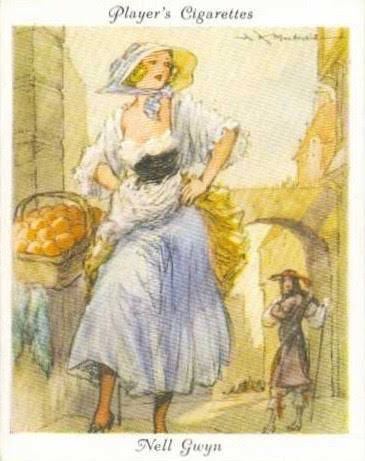
When I bought several Player's cards from a vendor, he kindly sent for free this 1930s card as a thank you. The card shows Nell Gwyn, who according to the reverse side of the card rose from being "a fruit hawker in the precincts of Drury Lane Theatre" to eventually becoming "enrolled a member of the King's Company of Players." This was during the Restoration under Charles II, and the king himself "fell a victim to her charms" as the card says. It was allegedly Gwyn who persuaded the king to complete the construction of Chelsea Hospital to provide a home for discharged soldiers.

The card is one of a series of 25 "Famous Beauties" taken from drawings by A.K. Macdonald. Other "beauties" drawn by Macdonald included Catherine the Great, the Queen of Sheba, and Pocahontas, so including the actress is quite a compliment. Gwyn was a close associate of the playwright Aphra Behn, who dedicated her play The Feigned Courtesans to the actress.

While I certainly am not a fan of the cigarettes that led to the creation of these cards, I'm glad many of the cards are still around today. They give us a fascinating glimpse not just of the world that created them, but also of the way that world looked back upon its own past.

Sunday, March 13, 2022

The Unknown Granville Barker

Along with publishing Theatre Notebook, the Society for Theatre Research always sends out one book a year to all of its members.

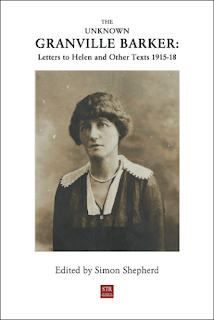
This year, STR sent out The Unknown Granville Barker: Letters to Helen and Other Texts 1915-18. The book compiles a number of writings by Harley Granville Barker, one of the most important actors, directors, playwrights and all-around theatre makers of the early 20th-century British stage.

For years, Barker endured a sexless marriage with the actress Lillah McCarthy, who was a great artistic partner, but did not provide him with the emotional companion he wanted. Then, at the end of 1914, Barker met Helen Huntington. Over the next few years, he fell in love with her and separated from McCarthy, which corresponded with a radical change in his career path.

In The Unknown Granville Barker, the editor Simon Shepherd puts together a number of documents that portray exactly what happened as Barker changed course and ultimately divorced McCarthy, marrying Huntington. In early 1915 Barker was entertaining New York audiences with hits he had already produced in England, including Bernard Shaw's Androcles and the Lion and The Doctor's Dilemma. Already, though, Barker was searching for ways for the theatre to be more than mere entertainment.

Newspapers interviewing Barker in 1915 noted he was now talking about theatre as being a "social force" that was accessible to everyone, not just professionals. "The theatre should come from the community, and not from the experts of the community," he told the New York Columbia Spectator. He looked back to the Middle Ages as an ideal time, when common people came together to put on Mystery Plays as an expression of their faith and beliefs. He longed to create something similar to that for the modern era.

Shepherd also includes an amusing story Barker published in the Manchester Guardian in 1917, in which he described Cain and Abel inventing the first dramas, with a little help from their mother Eve. The heart of the book, though, is a series of letters Barker wrote to Huntington during their courtship. During this period, Barker was also involved in the First World War, taking part in activities by the Red Cross, and later enlisting as a soldier. He also met with numerous literary figures, including J.M. Barrie, John Galsworthy, and Thomas Hardy, making his letters very amusing to read.

Well, it just so happens that I will soon be publishing my own book on the theatre, though not with STR. Instead, Palgrave Macmillan will be publishing my book Romantic Actors, Romantic Dramas about celebrity performers on the Regency stage. Yes, I even have a contract and everything! More information is to come, but needless to say, I am very excited about it.

Saturday, July 28, 2018

Father and Son


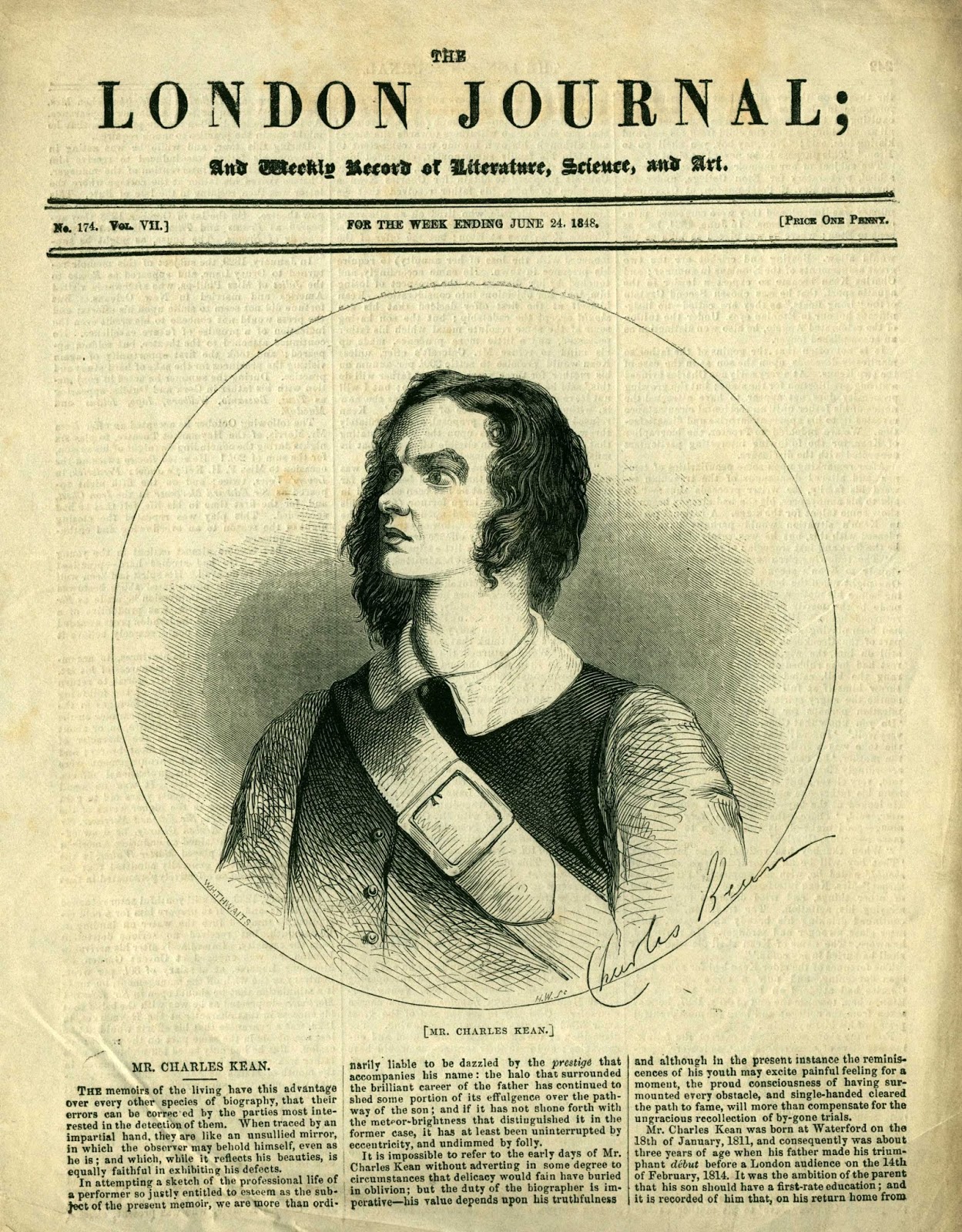
The actor Charles Kean, in spite of all his accomplishments in the theatre, was always known--and probably always will be known--as the son of Edmund Kean, one of the greatest actors of the Regency period.

In a memoir of Charles Kean published in 1848 in The London Journal, the paper noted that "the halo that surrounded the brilliant career of the father has continued to shed some portion of its effulgence over the pathway of the son," adding, "if it has not shone forth with the meteor-brightness that distinguished it in the former case, it has at least been uninterrupted by eccentricity, and undimmed by folly."

Edmund Kean was, quite frankly, a lecher and a drunk. His son was only three years old when the father rocketed to fame playing Shylock in Shakespeare's The Merchant of Venice at Drury Lane. Edmund didn't want the boy to have to stoop to acting, so he made sure Charles had (in the words of The London Journal) "a first-rate education." When Edmund came home from his triumphant debut as Shylock, he reportedly kissed his son and said: "Now, my boy, you shall go to Eton."

Indeed, Charles did attend the prestigious preparatory school in Eton, and supposedly "was placed as high as the rules of the institution, having reference to age, would allow." There he excelled at boating as well as academics, and distinguished himself in fencing (a skill that would come in handy during his later career as an actor). Unfortunately, the elder Kean's star dimmed in in the 1820s, and in 1827 he was forced to take his son out of school. Edmund still under no circumstances wanted his son to become an actor, though.

Charles Kean was offered a cadetship in India, but he was reluctant to go, given that his parents by that point were estranged, and he wanted to make sure someone could provide for his mother. When Edmund declined to increase his wife's allowance, Charles refused the position in India. His father was furious, and told Charles he would have to fend for himself. At only 16 years of age, with only an incomplete education and few skills other than his natural talent for acting, the son had little choice other than to pursue a career on the stage.

He first appeared at Drury Lane on 1 October 1827 as Young Norval in John Home's tragedy Douglas. Audiences were curious to see the son of the most celebrated actor alive try his hand at the family business. Reviewers were harsh, but Charles appeared a few more times at Drury Lane before touring the provincial circuit. According to The London Journal, he even appeared with his father on stage in Glasgow in Howard Payne's tragedy Brutus. In 1829, Charles returned to Drury Lane after improving his acting on the road. In the fall, he appeared at the Haymarket for the tail end of that theatre's season, finally finding success in The Iron Chest by George Colman the Younger.

Charles toured the provinces again, and then America. Returning to London in 1833, he was engaged not by Drury Lane, but by the rival patent theatre at Covent Garden. Soon thereafter, his father was hired by Covent Garden as well. Edmund Kean appeared first as Shylock, and then it was announced he would play one of his most powerful and well-known roles: Othello. The plan was for Ellen Tree to play Desdemona and for Charles to take the role of Iago.

There were no rehearsals, as all of the actors knew their parts already, but Edmund called his son into his dressing room for a private conference. The elder Kean was dreadfully ill and did not think he would be able to perform that night. Charles tried to cheer him up, and on the Ides of March 1833, father and son shared the same stage once again.

It was to be their last time, as well. In the middle of Act III, Edmund collapsed, crying out: "O God, I am dying. Speak to them, Charles." He died a few days later. Charles went on to become a great theatre manager, but his acting always remained in the shadow of his father.


Tuesday, October 25, 2016

Emma Rice's Departure

When Shakespeare's Globe in London first announced that Emma Rice would be the company's new artistic director, I had mixed feelings.

On the one hand, I LOVE Emma Rice's directing. Her work at Kneehigh has been amazing, and her Tristan and Yseult was one of the best plays I saw in 2014.

On the other hand, I wondered if she would be a good fit for the Globe. While the Globe does not limit itself to Renaissance-period productions, it utilizes period staging techniques, forcing actors to project instead of using microphones, and using a general light wash rather than allowing directors to rely on lighting tricks to covey scene changes or shifts in mood.

Rice is known for her innovative use of recorded sound and stylized lighting, and even more so for her aerial work. True, the original Globe lowered actors down from the "heavens" above the stage, but that was a far cry from the bungee chords Rice likes to use in her productions. Was this really going to be a good fit? Just because you love Spider-man and you love musicals, it doesn't necessarily mean you want to see the two together.

This summer, I was going to be in the U.K. for a Regency Theatre Conference, so I figured while I was in the area I would see Rice's inaugural production as the new artistic director of the Globe. She was doing A Midsummer Night's Dream. If aerial work is appropriate for any Shakespeare play, it would be for that one, and Rice's innate sense of romance and theatricalization of the sense of falling in love seemed to go perfectly with the play. This should have been the ideal piece for her to do at the Globe.

Alas, I was greatly disappointed, and apparently I was not the only one. The Globe recently released a statement regarding the company's future artistic direction. Rice will be stepping down as artistic director after the 2017-2018 winter season. According to the company's statement:

Following much deliberation and discussion, the Globe Board has concluded that from April 2018, the theatre programming should be structured around ‘shared light’ productions without designed sound and light rigging, which characterised a large body of The Globe’s work prior to Emma’s appointment.

Yes, Rice introduced high-tech lighting and sound to the Globe, and no, it did not work. The Globe is round, and lighting instruments were installed on each tier of seating, and when lights turned on opposite the seat where I was, I was blinded. Instead of adding to the performance, the lights became a nuisance. Perhaps that wasn't the case with all seats, because it was obvious Rice had directed the play out to the front, and had not spent time to the side of the stage, where I was. Directing for a thrust stage can be a challenge, but it can be done, and the blocking for the show was quite frankly insulting to anyone in the cheaper seats on the side.

I wasn't the only one to think so, either. All of us in my row kept inching further and further toward the center, because it was obvious that the further to the side you were, the more of the action you would miss. I've sat on the side before at the Globe, and previous productions have always been blocked with the theatre's seating arrangement in mind. This one certainly was not. Even worse, while the production contained lots of sight gags and ad-libbed lines that garnered laughs, the actual lines by Shakespeare just weren't funny. A Midsummer Night's Dream is a hysterical play, and the fact that Rice added humor to the piece rather than finding the comedy within it seems to imply that maybe she's best off directing things other than Shakespeare.

Seeing Rice's A Midsummer Night's Dream made me doubly sad. I was sad to see the wonderful space of the Globe poorly used, and I was sad to see Rice's equally wonderful talents also poorly used. Not only was the Globe wasted on Rice, but Rice was wasted on the Globe. The space did not match her amazing and unique talents as a director, and for that, we should blame neither her nor the theatre. On the company's website, Rice recently made this statement:

I have had a wonderful time creatively here at the Globe, but I respect the Board’s decision for its future direction. I look forward to continuing to explore the possibilities of this extraordinary space over the next 18 months, excited to see even more astonishing work unfolding in the glorious wooden 'O' as well as the exquisite Sam Wanamaker Playhouse.

The Sam Wanamaker Playhouse is designed to resemble an indoor Jacobean playhouse such as Shakespeare frequently used in the latter part of his career. This winter, Rice will be directing an adaptation of the works of Hans Christian Andersen there, which could be delightful. In the summer, she'll be bringing Tristan and Yseult to the Globe, as well as directing a production of Twelfth Night.

After that and after the following winter, I'm not sure where she'll be going or what she'll be doing, but I'm sure whatever she does will be better than her Midsummer. Rice's parting ways with the Globe should be better for her, better for the theatre, and better for audiences.