Showing posts with label Douglas. Show all posts

Saturday, July 28, 2018

Father and Son


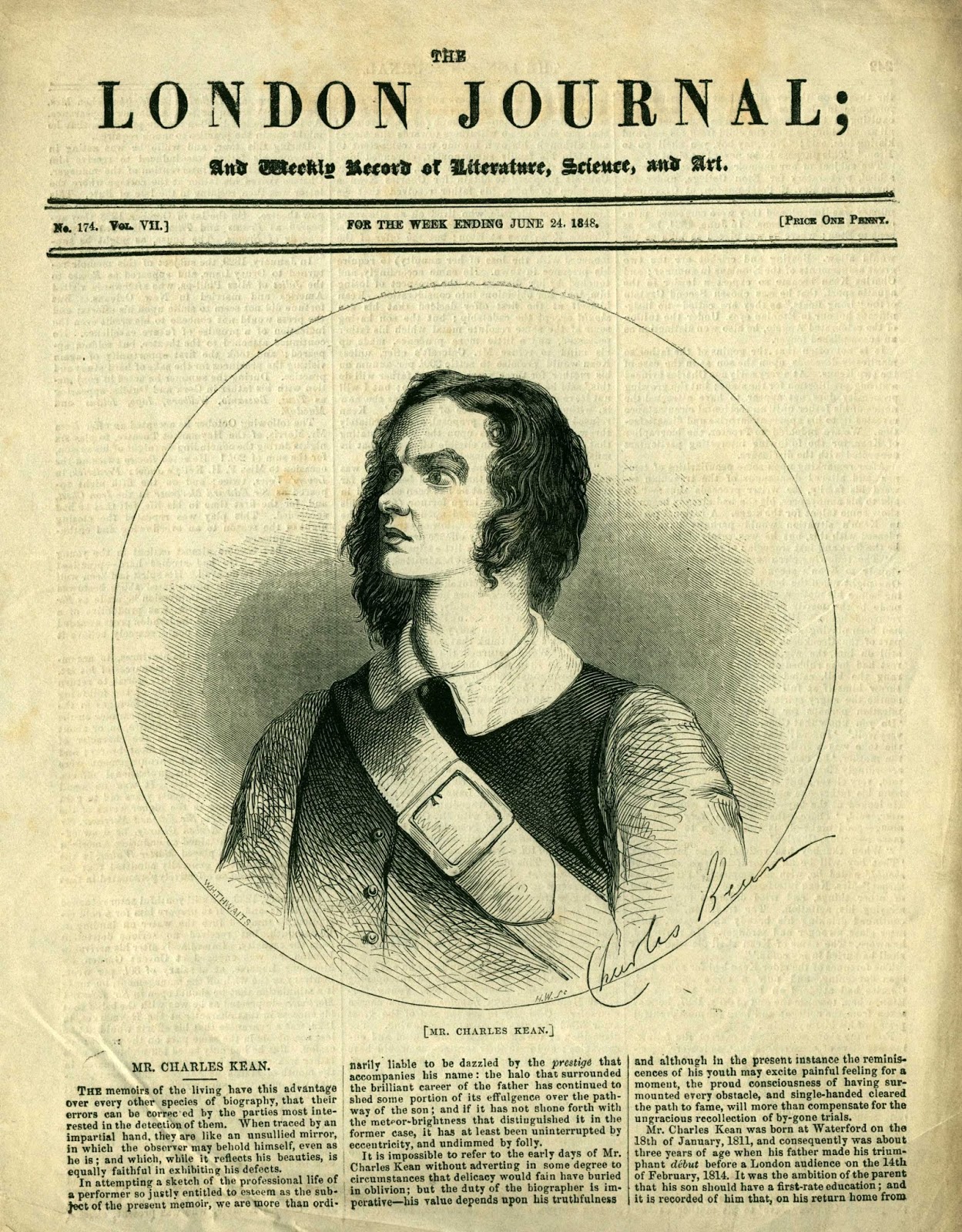
The actor Charles Kean, in spite of all his accomplishments in the theatre, was always known--and probably always will be known--as the son of Edmund Kean, one of the greatest actors of the Regency period.

In a memoir of Charles Kean published in 1848 in The London Journal, the paper noted that "the halo that surrounded the brilliant career of the father has continued to shed some portion of its effulgence over the pathway of the son," adding, "if it has not shone forth with the meteor-brightness that distinguished it in the former case, it has at least been uninterrupted by eccentricity, and undimmed by folly."

Edmund Kean was, quite frankly, a lecher and a drunk. His son was only three years old when the father rocketed to fame playing Shylock in Shakespeare's The Merchant of Venice at Drury Lane. Edmund didn't want the boy to have to stoop to acting, so he made sure Charles had (in the words of The London Journal) "a first-rate education." When Edmund came home from his triumphant debut as Shylock, he reportedly kissed his son and said: "Now, my boy, you shall go to Eton."

Indeed, Charles did attend the prestigious preparatory school in Eton, and supposedly "was placed as high as the rules of the institution, having reference to age, would allow." There he excelled at boating as well as academics, and distinguished himself in fencing (a skill that would come in handy during his later career as an actor). Unfortunately, the elder Kean's star dimmed in in the 1820s, and in 1827 he was forced to take his son out of school. Edmund still under no circumstances wanted his son to become an actor, though.

Charles Kean was offered a cadetship in India, but he was reluctant to go, given that his parents by that point were estranged, and he wanted to make sure someone could provide for his mother. When Edmund declined to increase his wife's allowance, Charles refused the position in India. His father was furious, and told Charles he would have to fend for himself. At only 16 years of age, with only an incomplete education and few skills other than his natural talent for acting, the son had little choice other than to pursue a career on the stage.

He first appeared at Drury Lane on 1 October 1827 as Young Norval in John Home's tragedy Douglas. Audiences were curious to see the son of the most celebrated actor alive try his hand at the family business. Reviewers were harsh, but Charles appeared a few more times at Drury Lane before touring the provincial circuit. According to The London Journal, he even appeared with his father on stage in Glasgow in Howard Payne's tragedy Brutus. In 1829, Charles returned to Drury Lane after improving his acting on the road. In the fall, he appeared at the Haymarket for the tail end of that theatre's season, finally finding success in The Iron Chest by George Colman the Younger.

Charles toured the provinces again, and then America. Returning to London in 1833, he was engaged not by Drury Lane, but by the rival patent theatre at Covent Garden. Soon thereafter, his father was hired by Covent Garden as well. Edmund Kean appeared first as Shylock, and then it was announced he would play one of his most powerful and well-known roles: Othello. The plan was for Ellen Tree to play Desdemona and for Charles to take the role of Iago.

There were no rehearsals, as all of the actors knew their parts already, but Edmund called his son into his dressing room for a private conference. The elder Kean was dreadfully ill and did not think he would be able to perform that night. Charles tried to cheer him up, and on the Ides of March 1833, father and son shared the same stage once again.

It was to be their last time, as well. In the middle of Act III, Edmund collapsed, crying out: "O God, I am dying. Speak to them, Charles." He died a few days later. Charles went on to become a great theatre manager, but his acting always remained in the shadow of his father.


Friday, August 4, 2017

The Licensing Act

During the beginning of the eighteenth century, many playwrights in Britain tried to imitate the great comedies of the Restoration period, but they eliminated much of the bawdry that made those comedies funny. The laugh-free plays they produced earned the label "sentimental comedies" since they continued to appeal to an audience's sentiments even as they erased what had been a source of great humor. The Irish dramatist Richard Steele scored a hit in 1722 with his sentimental comedy The Conscious Lovers. Based very loosely on Terence's Roman play The Girl from Andros, the play featured heroes who controlled and overcame their passions rather than giving in to them. The play emphasized patience over emotions and peaceful resolutions over violent action.

The small success Steele had was dwarfed, however, by the runaway hit by John Gay called The Beggar's Opera. Premiering at the Lincoln's Inn Fields Theatre in London in 1728, the play ran for 62 consecutive performances, the longest run of any play in British history up to that time. It was periodically revived throughout the century, becoming one of the most performed plays ever (though in the twentieth century it was largely eclipsed by its German-language adaptation The Threepenny Opera). Gay used the melodies of popular songs but rewrote their lyrics to make pointed comments about public figures, including the powerful Sir Robert Walpole, the first Prime Minister in British history. This new form, called ballad opera, was imitated throughout the century, including by Gay himself in a sequel to the play, Polly, which Walpole had banned.

Traditional tragedies of kings and queens seemed out of place in a world that was increasingly being run by the middle classes. The playwright Henry Fielding exploited this disconnect by mocking high drama in his play The Tragedy of Tragedies, which opened in 1731. Also known as The Life and Death of Tom Thumb the Great, Fielding's play featured a protagonist diminutive in stature in love with a princess named Huncamunca. To add to the comedy, Fielding had a giantess fall in love with Tom Thumb. Nearly everyone in the play dies in grand fashion, and audiences laughed hysterically at the deaths of kings, queens, and nobles.

Just as Gay had run afoul of Walpole, Fielding, too, provoked the wrath of the powerful prime minister. In The Historical Register for the Year 1736 (which actually debuted in 1737), Fielding made fun of all of the events of the previous year, particularly excoriating Walpole. This time, however, Walpole was ready. He took advantage of a particularly outrageous satire of the king called The Golden Rump and introduced to parliament the Licensing Act of 1737. The act provided for extreme censorship of the British stage, ensuring that playhouses be licensed by the Lord Chamberlain, and stating that anyone who offered a play without a license be fined the exorbitant amount of fifty pounds for each offense.

The two patent theatres in London now had a virtual monopoly throughout the entire country. What was more, all new plays had to be submitted to the Lord Chamberlain at least 14 days before they were performed, and if he deemed them unfit for performance, there was no appeal. A theatre manager who performed a banned play could lose his license immediately, and strolling players who performed without a license were treated as vagabonds. The artist William Hogarth created a famous engraving called "Strolling Actresses Dressing in a Barn" which depicted a copy of the Licensing Act lying on a bed in the corner. As viewers well knew, the act was the death-knell for small companies like the one depicted in the engraving.

Fielding gave up the theatre to write novels, and most serious authors in England followed his lead. Almost two decades passed before Britain produced another play that would capture the public's imagination and work its way into the standard repertoire. That drama was John Home's tragedy Douglas, which perhaps not coincidentally opened in Scotland, debuting in Edinburgh and only later transferring to London. The Licensing Act worked all too well, banishing serious topics from the stage and intimidating authors for years to come. While the eighteenth century became an era of tremendous growth for the English novel, English-language drama languished until the 1770s.

As it happens, I recently purchased a 19th-century copy of the Hogarth engraving. The details aren't as fine as Hogarth's original, but I'm offering the image for free to anyone who wants to publish it in a journal, book, website, whatever. If you need a higher quality image, feel free to contact me. You can credit it to the personal collection of James Armstrong.


Monday, October 6, 2014

Burke on Tragedy

In his 1757 book A Philosophical Enquiry into the Origin of our Ideas of the Sublime and Beautiful, Edmund Burke wrote not only about painting, poetry, and our direct response to nature, but also about an audience's response to tragedy. This is hardly surprising, given the high regard with which the eighteenth century regarded tragic drama. Much of Burke's analysis is derivative of Aristotle, who wrote of a catharsis "through pity and fear" in a manner similar to that which Burke would use to describe the sublime. Burke's observations on tragedy are interesting, however, since they show how someone in mid-eighteenth-century Britain viewed the production of new tragedies for the stage.

Burke's modifications of Aristotle, including his theories with regard to astonishment, are stated in absolute terms, but they particularly apply to British tragedies written during his own lifetime. In fact, John Home's tragedy Douglas, which first played at Covent Garden the very same year Burke published his philosophical speculations, embodies the tragic ideals described in Burke's landmark work.

One stumbling block for interpreters of Aristotle has always been explaining how watching an incestuous patricidal tyrant decide to tear his eyes out is something that should be enjoyable. As Burke states the problem, "objects which in reality would shock, are in tragical, and such like representations, the source of a very high species of pleasure." He deftly navigates these waters by observing: "terror is a passion which always produces delight when it does not press too close." Provided we are able to watch from a safe distance, there is no horror too great or fantastical for our rapt observation. In fact, Burke postulates that, "there is no spectacle we so eagerly pursue, as that of some uncommon and grievous calamity."

While Aristotle sees value in the purgation of terrifying emotions, Burke views our safe observation of terrors as good in and of itself. That which excites "the ideas of pain, and danger" is what Burke calls "the sublime" and "is productive of the strongest emotion which the mind is capable of feeling." Even if tragedy does not make us feel precisely good, it makes us feel more fully human. In order to feel the strongest emotion possible, we must experience the sublime, a quality Burke associates closely with nature. According to Burke, the highest passion aroused by the sublime is astonishment, which he calls "that state of the soul in which all its motions are suspended with some degree of horror."

This discussion of astonishment brings us to Douglas, a play on the cutting edge of public taste in tragedy during Burke's time. Rejected by David Garrick for Drury Lane, Douglas received a trial run in Edinburgh in 1756, leading to the play's London debut the following year.

The presence of nature is felt from the very first scene, which according to the stage directions takes place in "The court of a castle surrounded with woods." Even if those woods are not immediately visible onstage, the natural world is constantly encroaching on the court in the person of Norval, the peasant-raised hero. Norval's famous speech in Act II celebrates the natural environment, citing the "Grampian hills," "frugal swain," and "flocks and herds" that once surrounded the hero.  To complete the play's movement in the direction of the natural world, the final act takes place in the woods themselves.

Home uses this last act to create the feeling of astonishment Burke describes in his treatise. Burke's description of how "motions are suspended with some degree of horror" finds an almost literal manifestation in the play's description of Lady Randolph perched on the edge of a precipice. Suspended between life and death, Home's heroine gazes with horror down into the abyss. The scene recalls Burke's chapter on vastness in Part II, in which he claims "height is less grand than depth; and that we are more struck at looking down from a precipice, than at looking up at an object of equal height." Contemplating both the depth of the natural landscape and the depth of her own despair, Lady Randolph no doubt feels a sensation of astonishment--and is the cause of astonishment in the audience.

Home describes Lady Randolph as standing "Upon the brink," looking "Down on the deep," and then gazing up with "her white hands to heaven." Before her plunge, she is literally suspended between the heavens and the abyss. Though this bodily manifestation of astonishment occurs offstage, it appears in the audience's imagination. The sublime image of the precipice could not be realized onstage with the technologies available in the 1750s (though later eras would attempt such feats with spectacular scenic designs). Still, Home successfully painted a portrait of astonishment, and in a way that closely paralleled the graphic description of this feeling as Burke had penned it at nearly the identical time.

Wednesday, May 21, 2014

'Terror and Pity reign in every Breast'

No, that isn't a rejected motto for Chick-fil-A. It's the title of a really great book by Paul Ranger about gothic drama in England from 1750 to 1820. Ranger takes the title from a review in the London Chronicle in 1757:

Our expectation is well worked up and Terror and Pity reign in every Breast, till by due degrees the Discovery is made, when a Tide of Joy breaks in upon us...

In his first chapter, "The Gothic Spirit," Ranger tries to define what he means by the term "gothic drama" as neither 18th-century playwrights not their audiences used the term. Incidentally, while "gothic" was not in vogue, variations on the term "Romantic" were. Matthew G. Lewis's 1797 play The Castle Spectre for instance introduces in the Prologue a "fair enchantress" named "Romance." Ranger also points out that Samuel Johnson included in his dictionary the word "Romantick" which could mean "fanciful; full of wild scenery." He also cites a 1773 reference in Richard Graves's The Spiritual Quixote to a garden "laid out in a romantic taste" that mixed "the cheerful and the gloomy."

Wild scenery was certainly important to the gothic, as was a gloomy atmosphere, but so were other qualities. Gothic plays tended to have stock characters, including a conventional hero, heroine, and villain. They had a few recurring devices, including mistaken identity, and a slew of horrors unleashed in the last act. These plays displayed the distinct influence of German playwrights such as Friedrich von Schiller and August von Kotzebue. Sometimes, there were direct adaptations, such as Joseph Holman's 1799 play The Red Cross Knights, which took Schiller's bandits in The Robbers and turned them into Knights Templars. Similarly, Richard Brinsley Sheridan adapted Kotzebue's The Spanish in Peru as the tragedy Pizarro. For Ranger, what is particularly important, though, is that in these dramas a dark and wild side of human nature was reflected by the characters' surroundings.

The second chapter, "A World Untamed," explores those settings that served as a metaphor for the characters. In Joanna Baillie's 1800 play De Montfort, the title character finds himself instinctively drawn to scenes of horror. In the 1816 play Bertram, Charles Robert Maturin placed a tempest at the opening, employing not just visuals but also gripping sound effects to move the audience and inspire them with thoughts of the characters' inner lives. Ranger observes that this unity of scene and character gradually led to the integration of the performer into the scenic background. Actors began to appear as diminutive beings, pitted against the untamed grandeur of a sublime yet savage world. This eventually led to melodrama, a genre that appeared in part in John Philip Kemble's 1794 play Lodoiska, but more fully in 1802 with Thomas Holcroft's A Tale of Mystery.

Chapter Three tackles the two most popular gothic settings, the castle and the cloister. Lodoiska included three scenes of a castle, the first outside, the second in a tower, and the third with a hall and gallery, which went up in flames at the end of the play. Anna Maria Crouch, who played the title role, was supposed to stand imperiled in a tower, but one night, she became imperiled for real. Michael Kelly, the actor playing her love interest, Florenski, tried to come to her assistance. He later wrote:

I ran up the bridge which was a great height from the ground, towards the tower, in order to rescue her; just as I was quitting the platform a carpenter prematurely took out one of its supports; down I fell and at the same moment the fiery tower, in which was Mrs. Crouch, sank down in a blaze with a violent crash; she uttered a scream of terror. Providentially, I was not hurt by the fall and, catching her in my arms, scarcely knowing what I was doing, I carried her to the front of the stage.

Once the actors reached the front, the audience erupted with applause, thinking the entire disaster had been planned. According to Crouch, many members of the audience were convinced it was some of the best acting they had ever seen.

The other great gothic building was the cloister. Of course, most monasteries and convents in England had been long closed by the 18th century, but the advent of the French Revolution meant that some monks and nuns expelled from France ended up taking refuge in Britain. Of even more importance were the trips abroad that had become standard for young people as a way of finishing their educations. Returning to England, these travelers rarely had positive images of what went on behind cloistered walls.

One of the most spectacular stage buildings of the period was the convent chapel in Baillie's De Montfort. The scenery was designed and built by William Capon, the senior designer at Drury Lane. The chapel had a reasonable degree of historical accuracy, which was rather unusual for the time. Capon loved medieval architecture, and he built the chapel to represent a 14th-century church. The set went back a full 52 feet. In spite of her reputation for writing closet drama, Baillie didn't miss an opportunity for spectacular stage technique. She called for a procession of nuns bearing torches to walk around a freshly dug grave while singing a funeral dirge. Reaction to the play was mixed, but the set was a hit, and Drury Lane ended up reusing it several times in different plays.

The importance of stage spectacle increased in the ensuing years, which is the subject of Ranger's fourth chapter. Capon designed an impressive Hall of Armoury for Samuel Taylor Coleridge's 1813 play Remorse, which had been strongly influenced by Baillie's work. That same year saw far more impressive scenery on stage at Covent Garden in Isaac Pocock's The Miller and His Men. The titular miller led a group of bandits by night and by day stayed holed up in a windmill. At the climax of the play, the mill spectacularly exploded on stage, an event that rendered the elevated poetry of plays like Remorse irrelevant in a new world of spectacular special effects.

Ranger's fifth chapter covers the attitude and speech of actors in gothic dramas. He focuses on two roles, Euphrasia in The Grecian Daughter and the title character in De Montfort. Drury Lane first produced Arthur Murphy's tragedy The Grecian Daughter in 1772, but the play was performed frequently throughout the later 18th century. Beginning in 1782, Sarah Siddons took over the role of Euphrasia, who had to kill a tyrant in order to save her own father. Ann Barry, who originated the role, portrayed the killing without reticence, but Siddons made Euphrasia conflicted about taking the tyrant's life, a choice that earned her great acclaim as an actress.

Baillie wrote the part of De Montfort hoping that Kemble would play it, which he did. Though Baillie avoided giving stage directions instructing the actor how to handle emotion, Ranger argues that she clearly wanted his facial expressions to be seen. The proof? Her play called for some monks' lanterns to light De Montfort's face at a key moment, an intriguing use of lighting design by a playwright. Later on, Edmund Kean revived the play at Drury Lane, and Baillie revised the part to better suit his particular talents.

In chapter six, Ranger goes into three case studies of gothic plays: Douglas, The Castle Spectre, and Pizarro. John Home's 1756 tragedy Douglas is one of the earliest plays still considered a gothic drama. Originally the play was performed in Edinburgh, which suited its Scottish setting, but after achieving critical acclaim there, it opened the next year in Covent Garden. Peg Woffington played the leading role of Lady Randolph, while the not-so-young Spranger Barry played Young Norval. Later, Sarah Siddons would take on the role of Lady Randolph, famously beginning with a quiet intensity and working herself up into a frenzy.

Thomas Greenwood designed the original set for The Castle Spectre, which depicted Conway Castle in northern Wales. The play is notable for the role of Angela, a young, virtuous heroine originally played by Dorothy Jordan. The lengthy role apparently exhausted Jordan so much she was unable to sing the song in the fourth act, and it had to be cut. Also grueling is the role of the villain, Osmond, who in the fourth act must recount his bone-chilling encounter with the titular ghost. It was while reciting this speech that an actor named (I'm not making this up) Graves Aickin collapsed and died from a burst blood vessel.

Pizarro, Richard Brinsley Sheridan's take on Kotzebue's The Spanish in Peru, helped revive the finances of Drury Lane, largely due to Kemble's triumphant portrayal of the hero Rolla. Of course, he had a great supporting cast, with Siddons as Elvira and Jordan playing the innocent Cora, but it was Kemble who made the largest impact on audiences. Sir Thomas Lawrence later painted a famous portrait of Kemble as Rolla holding Cora's infant aloft and defending the child with a drawn dagger. The fact that he looked absolutely nothing like the Incan warrior he was playing was irrelevant. At the time the play premiered, Britain feared an invasion by Napoleon, and Kemble's portrayal of an incorruptible warrior defying an invading army won the day.

Ranger's final chapter examines the response to gothic drama. He traces its influence on Sir Walter Scott, Mary Shelley, Iris Murdoch, and of course modern horror films. Ranger, it should be noted, has also directed some of these plays, notably The Castle Spectre and Pizarro, both of which strike me as quite performable today.
Monday, September 2, 2013

The (Briefly) Most Famous Speech in English Drama (Shakespeare Excluded)

I was recently reading Douglas by John Home. The first act is mostly unremarkable. We see Lady Randolph in a loveless marriage. She tells her confidant, Anna, that she previously had been wed to the son of the great Lord Douglas, who married her under an assumed name. After her husband died in battle, she gave birth to a son, but the boy disappeared with his nurse, and both were assumed dead. Lady Randolph breaks off the story with the entrance of the villain, Glenalvon. This much is all typical of 18th-century melodrama.

In the second act, however, the young Norval appears. More astute audience members can probably guess that this shepherd boy is actually Lady Randolph's long-lost son, and the heir of Douglas. What struck me most about this act was a footnote proclaiming that Norval's first big speech "was once perhaps, Shakespeare excluded, the most famous speech in English drama." I'll give some selections:

My name is Norval; on the Grampian hills
My father feeds his flocks, a frugal swain,
Whose constant cares were to increase his store,
And keep his only son, myself, at home,
For I had heard of battles, and I longed
To follow to the field some warlike lord;
And heaven soon granted what my sire denied.
The moon which rose last night, round as my shield,
Had not yet filled her horns, when, by her light,
A band of fierce barbarians, from the hills,
Rushed like a torrent down upon the vale,
Sweeping our flocks and herds....

The other shepherds flee, but Norval pursues the bandits and kills their chief. He continues:

Returning home in triumph, I disdained
The shepherd's slothful life; and having heard
That our good king had summoned his bold peers
To lead their warriors on the Carron side,
I left my father's house, and took with me
A chosen servant to conduct my steps....

You get the idea. It isn't brilliant writing, but it was good enough to excite audiences in the pre-Romantic era. The play premiered in Edinburgh in 1756, and opened at Covent Garden in London the following year. This is well before the publication of Lyrical Ballads and the launch of Romanticism in England, so this exciting and exotic Scottish tragedy no doubt moved London audiences who were more used to the dull poetry of The London Merchant.

Glenalvon, being a villain, of course plots to bring down this brave Norval, who appears seemingly out of nowhere. In the third act, Lady Randolph discovers the truth that the young stranger is her son, a fact she relates to him in the fourth act. All that remains is for Glenalvon to engineer a fight in which he stabs Norval (in actuality young Douglas) in the back. Lady Randolph's grief drives her over "the precipice of death," and all ends unhappily.

How did a set piece in this play become, even briefly, the most famous speech in English drama, Shakespeare excluded? My guess is by anticipating the powerful Romantic dramas that were to come. The plays of Lewis, Coleridge, and Byron were later able to capture similar sentiments, but with far more skill. Still, Douglas is interesting as an important precursor to Romanticism.