Showing posts with label Elizabeth Inchbald. Show all posts

Saturday, February 7, 2026

The Plays of Charles Dickens

Today is the 214th birthday of Charles Dickens, which is as good a time as any to mention that my review of The Plays of Charles Dickens ran in the most recent issue of Dickens Quarterly.

Joanna Hofer-Robinson and Pete Orford edited this wonderful collection that includes both plays Dickens authored solo and collaborations he did with friends like Wilkie Collins, as well as prologues he wrote for plays including The Lighthouse and The Patrician's Daughter, and a closing scene he wrote for Elizabeth Inchbald's farce Animal Magnetism.

Dickens himself didn't always have a high opinion of his plays, and he came to regret writing the libretto to the operetta The Village Coquettes, which had music by John Pyke Hullah. His comic burletta The Strange Gentleman has some fun moments, but it is essentially the same as his prose sketch "The Great Winglebury Duel." Is She His Wife? is perhaps Dickens's most unlucky play, since it was after seeing it that his sister-in-law Mary Hogarth collapsed and later died. (Probably not from the play, though.)

Having all of Dickens's plays together with the in-depth notes provided by the editors is quite useful. In the early part of his career, Dickens went back and forth between the stage and the page. His play The Lamplighter, for instance, was originally penned for William Charles Macready, but after the actor rejected it, Dickens turned it into a short story for Sketches by Boz. Dickens also wrote with his friend Mark Lemon a farce called Mr. Nightingale's Diary, which included characters suspiciously similar to ones in Pickwick Papers and Martin Chuzzlewit.

Perhaps Dickens's most famous play today is The Frozen Deep, a melodrama officially authored by Collins, but very much a collaboration between the two authors. Dickens supplied the subject for the play, Collins wrote the first draft, and then Dickens substantially reworked it, tailoring the part of Richard Wardour for himself. He indeed played the role in an amateur performance, and then for a charity production, where he met his future love, Ellen Ternan. (You can read about the two of them in my own play, Capital.)

More successful in his own lifetime was another melodrama he wrote with Collins, No Thoroughfare, which was based on a tale the two had written together and published in the journal All the Year Round. The editors of The Plays of Charles Dickens note that Dickens even wrote an alternate ending to the play for a French production, though sadly it is not included in the book.

Tuesday, June 20, 2023

Elizabeth Farren

Elizabeth Farren began her career as an actress, and ended up Countess of Derby. Along the way, her life was a pretty wild ride.

She was born in 1759 to an Irish father from Cork and an English mother from Liverpool. Her father was an apothecary, but he gave up medicine for the stage. As a girl, Farren was said to have beat a drum for his troupe of traveling players as they went from town to town.

After her father died, the family tried to support themselves with Elizabeth and her sister Peggy taking small roles on the stage. By the time she was 15, Elizabeth Farren was playing the role of Rosetta in Love in a Village, a ballad opera by Isaac Bickerstaffe and Thomas Arne.

In 1777, Farren appeared at the Haymarket Theatre in London as Kate Hardcastle in Oliver Goldsmith's She Stoops to Conquer. She lodged near the theatre with her mother. George Colman the Elder, who managed the Haymarket, allegedly gave her mother the nickname "Tin Pocket" after she gave her daughter a pocket lined with tin to hold hot boiled beef.

According to C.J. Hamilton, the turning point in Farren's career came when she was invited to perform at some private theatricals held by the Duke of Richmond. She acted together with the Earl of Derby, who was married at the time. Though the Earl was struck with Farren, she made a point of never being in his company unless in the presence of a third person for respectability's sake.

When Frances Abington retired in 1782, Farren took her place as the most prominent actress in London for depicting ladies of fashion. She played Mrs. Euston in Elizabeth Inchbald's comedy I'll Tell You What, and took on numerous Shakespearean roles, including Portia in The Merchant of Venice and Hermione in The Winter's Tale. All the while, Lord Derby followed her, now unhappily separated from his wife.

Lady Derby died in 1797, and the Earl proposed to Farren. She gave her farewell performance as Lady Teazle in Richard Brinsley Sheridan's A School for Scandal. She and Lord Derby had three children together, though only one daughter survived to adulthood.

Perhaps Farren's most famous legacy, though, was a portrait painted of her by Thomas Lawrence, now in the Metropolitan Museum of Art.

Friday, March 31, 2023

Romantic Dramas at NASSR

Today, I presented my paper on Olympe de Gouges and Ira Aldridge online as a part of the annual conference of the North American Society for the Study of Romanticism, better known as NASSR.

I was a part of a panel on Theaters of Violence and Justice moderated by Sophie Thomas. The panel was led off by Marjean D. Purinton of Texas Tech University who spoke on "Justice on Trial in Romantic Period Drama and Novels."

Purinton is incredibly knowledgable about British Romantic drama, which is also the subject of a recent book of mine. She began by discussing one of my favorite playwrights of the period, Joanna Baillie, but instead of talking about one of her more well-known dramas, she delved into The Stripling, a prose tragedy based on a real-life case in Scotland.

In most of the plays Purinton discussed, legal trials are suggested but not directly portrayed on stage. In The Iron Chest, for instance, George Colman the Younger's adaptation of the novel Caleb Williams by William Godwin, a trial is central to the plot, but occurs offstage, as the accused title character comes to have less and less faith in a legal system that seems to just protect the rich and powerful.

Next, Purinton discussed The Cenci, a drama by Percy Shelley which I have written about frequently. She argued that the play really criticizes the justice system in Britain during the Regency, not the courts of Renaissance Rome that are nominally depicted in the tragedy. In addition she discussed James Boaden's The Secret Tribunal and a play by Elizabeth Inchbald, though I didn't catch the title of that one.

Young-ok An from the University of St. Thomas rounded out the panel, discussing Percy Shelley's The Cenci and Mary Shelley's novel Valperga. Thanks to everyone who showed up to listen to us!

Monday, January 23, 2023

Animal Magnetism

Elizabeth Inchbald made her playwriting debut with The Mogul Tale in 1784, but her 1788 play Animal Magnetism had a longer-lasting influence on the stage.

There have been multiple stagings of the play in recent years, including one done last year at St. Hugh's College, Oxford and now available to watch on YouTube. I got to see a different staging tonight, which was performed by the Red Bull Theater Company at the Players Club and streamed online.

José Zayas, who directed my adaptation of Charles Dickens's A Christmas Carol in Saratoga Springs directed the staged reading for Red Bull, so I knew it would be well done. I also knew it would feature Carson Elrod, who has shone brilliantly in past Red Bull productions, including The Alchemist.

Like The Mogul Tale, Inchbald's Animal Magnetism is a farce that draws inspiration from the science of the late-eighteenth century. In The Mogul Tale, Inchbald portrays aeronauts who ascend in a balloon in England and (apparently after getting caught in a jet stream) come down in India. Her later farce deals instead with mesmerism, which was called at the time animal magnetism.

Today, we equate mesmerism with hypnosis, but Franz Mesmer—who originated the practice—believed he was manipulating an invisible fluid that penetrates all organisms. In Inchbald's play, the quack Doctor Mystery describes it this way:

This fluid is like a river, that—that—runs—that—goes—that—gently glides—so—so—so—while there is nothing to stop it.—But if it en|counters a mound or any other impediment—boo—boo—boo—it bursts forth—it overflows the country round—throws down villages, hamlets, houses, trees, cows and lambs; but remove obstacles which obstruct its course, and it begins again, softly and sweetly to flow—thus—thus—thus—the fields are again adorned, and every thing goes on, as well as it can go on.

Doctor Mystery, however, is actually La Fleur, the valet of a marquis who loves the play's heroine. He performs fake deeds of mesmerism in order to foil the heroine's guardian. Needless to say, the marquis and the heroine end up together, and La Fleur gains the affections of her maid.

Much of the play's humor comes from the two women pretending to be under the influence of mesmerism. Dickens, who practiced mesmerism himself, found the play hysterical, and it was frequently performed alongside his friend Wilkie Collins's play The Frozen Deep.

Animal Magetism is based on a French play, Le Médecin Malgré tout le monde by Antoine-Jean Bourlin (Dumaniant). It is not Inchbald's only adaptation, though. Perhaps her most famous play, Lovers' Vows, was adapted from a melodrama by August von Kotzebue.

Sunday, May 15, 2022

What Doesn't Go up in Smoke

I have no affection for cigarettes. When I was growing up, both of my parents smoked, and wanting to be like them, I wanted to smoke, too. One day, sitting on my mother's lap, I asked her if I could have a puff of her cigarette. She handed it to me. I took a puff. I have never wanted to smoke anything ever again.

What I do have a fascination for, however, is cigarette cards. These cards were originally added to cigarette packages to stiffen them, and by the 1880s, manufacturers were printing advertisements on them, often including popular images that could be collected by consumers. Those images could be of sports stars, famous Native American leaders, national flags, exotic animals, or sometimes actors and actresses.

These cards can sometimes be found on Internet auction sites, and I've purchased a few in recent years, wanting to have images of performers from the Regency era. The first one I bought was when I saw for sale a cigarette card of the actress Eliza O'Neill identical to one in the collection of the New York Public Library. The card, issued by Chairman Cigarettes, probably dates to the 1920s. The reverse side gives information about O'Neill, including that she excelled in the roles of Belvidera, Juliet, and Mrs. Beverley.

Chairman Cigarettes appears to have been based in England at the beginning of the 20th century, but I've found scant information on them. Recently, I obtained a number of cigarette cards issued by Player's Cigarettes. John Player & Sons was based in Nottingham, but it merged with Imperial Tobacco Group in 1901. Under the ownership of Imperial, Player's issued a number of trading cards, though it had issued its own cards as far back as 1893. Probably around the same time Chairman issued the card showing O'Neill, Player's issued a series of 25 cards showing miniature portraits of great painters. (I've seen 1923 given as the year for this series, but cannot verify it.)

Many (though not all) of those miniature portraits displayed images of actresses. This one shows Sarah Siddons, who according the the reverse side was "one of our greatest tragic actresses." Siddons first appeared on the London stage in 1775, but her first great success did not come until seven years later, when she appeared at Drury Lane as Isabella in an adaptation of Thomas Southerne's The Fatal Marriage. The Player's card calls this performance "a triumph almost unequalled in the history of the English stage."

Siddons introduced her most famous role, Lady Macbeth, in 1785. This portrait by Sir Thomas Lawrence, however, appears to show her in the role of Mrs. Haller from The Stranger, an adaptation Benjamin Thompson did of a melodrama by August von Kotzebue. Siddons was long the reigning tragic actress on the London stage. It was only after the retirement of Siddons that O'Neill came to London from Dublin, taking over many of the elder performer's roles, including Isabella and Mrs. Haller. Neither actress, however, had much of a gift for comedy. The great comedic actress of the period was Dora Jordan.

Here's a Player's trading card showing Jordan. As the card states, the image is based on a painting by George Romney. Jordan's real name was Dorothea Bland, but for obvious reasons, the actress changed it. Like O'Neill, she was born in Ireland and rose to fame in Dublin. Jordan made her London debut at Drury Lane in 1785, the same year Siddons first wowed audiences as Lady Macbeth. Rather than competing with the great tragedienne, Jordan gravitated toward comic roles, making her London debut in the role of Peggy, the protagonist of David Garrick's bowdlerized version of The Country Wife

Jordan was just as famous for her personal life off of the stage as she was for the roles she played on stage. In 1790, she became the mistress of the Duke of Clarence, a younger son of the reigning monarch, George III. They had ten children together, but sadly, the Duke could not marry her. After all, she was a humble Irish actress, and he was in line to ascend the throne. In fact, when his elder brother died in 1830, the Duke became King William IV. By that time, poor Jordan was dead. Her body was buried in a cemetery on the outskirts of Paris.

Another Regency actress, Maria Foote, appears on this Player's card, based off of a portrait by George Clint. Foote made her London debut at Covent Garden in 1814, as did O'Neill, but while O'Neill went on to massive fame as an actress, Foote did not. As the reverse side of her trading card puts it, she was "more celebrated for her beauty than for her acting." After her debut in The Child of Nature by fellow actress Elizabeth Inchbald, Foote went on to perform numerous Shakespearean roles, including Miranda in The Tempest, Lady Percy in Henry IV, and Helena in A Midsummer Night's Dream.

Foote also played a key role in Virginius, a new play by James Sheridan Knowles that after a brief run in Glasgow made its London premiere at Covent Garden in 1820. Foote played Virginia, the virtuous daughter of the title character. Virginia falls in love with Icilius, but the tyrant Appius lusts for her, and claims she is secretly the daughter of one of his slaves, sold to Virginius's now conveniently dead wife, since she was allegedly barren. The play made the new British king, George IV, rather nervous, since he was known for treating his wife and numerous mistresses not terribly well.

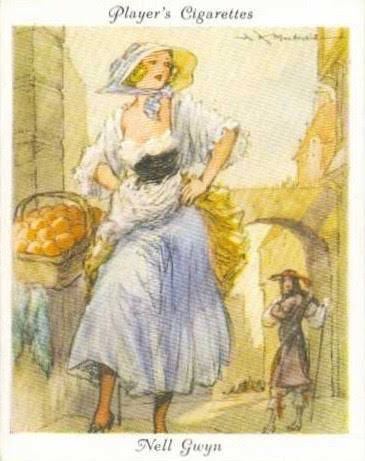
When I bought several Player's cards from a vendor, he kindly sent for free this 1930s card as a thank you. The card shows Nell Gwyn, who according to the reverse side of the card rose from being "a fruit hawker in the precincts of Drury Lane Theatre" to eventually becoming "enrolled a member of the King's Company of Players." This was during the Restoration under Charles II, and the king himself "fell a victim to her charms" as the card says. It was allegedly Gwyn who persuaded the king to complete the construction of Chelsea Hospital to provide a home for discharged soldiers.

The card is one of a series of 25 "Famous Beauties" taken from drawings by A.K. Macdonald. Other "beauties" drawn by Macdonald included Catherine the Great, the Queen of Sheba, and Pocahontas, so including the actress is quite a compliment. Gwyn was a close associate of the playwright Aphra Behn, who dedicated her play The Feigned Courtesans to the actress.

While I certainly am not a fan of the cigarettes that led to the creation of these cards, I'm glad many of the cards are still around today. They give us a fascinating glimpse not just of the world that created them, but also of the way that world looked back upon its own past.

Wednesday, February 27, 2019

The Siddons of Bath


The Irish actress Sarah Smith was supposed to be the next big thing in the early nineteenth century. Unfortunately, the most promising bright new stars sometimes disappoint.

Not a lot is known about Smith's early years. She was probably born in Liverpool around 1783. As a child, she appeared onstage in Elizabeth Inchbald's comedy Every One has his Fault at a theatre in Salisbury.

At 16, Smith played Joanna in a regional production of The Deserted Daughter by Thomas Holcroft. After that, she went to Edinburgh, where she worked for Stephen Kemble. Smith apparently tried to leave the stage, but ended up working the circuit in the North of England for a while, before moving on to Birmingham and then Bath.

It was in Bath that Sarah Siddons had found an audience, and with that great tragedienne in mind, some people started referring to Smith at the "Siddons of Bath" given her star turns in tragedies. Thomas Harris saw her there and invited her to come perform at his theatre in Covent Garden in London. On October 2, 1805, she made her London debut in John Vanbrugh's play The Provoked Husband. As was the case with Siddons's first debut in London, though, it seemed the city was not quite ready for her yet.

In 1808, Smith went to Ireland, where audiences embraced her acting. London audiences began to warm to her eventually, and in 1811 she joined the rival company to Covent Garden at Drury Lane. The theatre at Drury Lane had burned down in 1809, so for a while the company had to perform elsewhere, but in 1812 their new theatre opened with a production of Hamlet. This is the same theatre there today, so if you go to London you can see the very building in which Smith performed. After a successful reopening, the company turned to a new play by an established writer, and at the beginning of 1813 they premiered Remorse by Samuel Taylor Coleridge.

I've blogged about Remorse before, so I'll just say that everyone was expecting Smith to be the star, but she sadly did not shine. The following year she married the actor George Bartley, and her marriage seems to have been a happy one. The couple travelled to America in 1818 and made quite a bit of money touring.

Here's a picture of Smith playing Imogen in Cymbeline. It was never her most famous role, but I still would like to have seen her in it.

Tuesday, February 26, 2019

The Mogul Tale

Elizabeth Inchbald's first play was a light farce called The Mogul Tale. One might be tempted to call is a lighter-than-air farce, since its plot revolves around a hot-air balloon.

When the play premiered in 1784, ballooning was the latest fad in Europe. The Montgolfier brothers had succeeded in the first manned balloon flight the previous year, and British balloonists were trying to repeat their success.

The first balloon flight across the English Channel did not occur until the following year, but Inchbald imagined a far longer trip--all the way to India! Though India at the time was nominally ruled by the Mogul Emperor, the British had set up a Governor General in 1773 who held significant (and largely unchecked) powers.

British colonial authorities in India made such a mess of things in the eighteenth century that parliament tried to impeach the Governor General in 1788. Inchbald, who travelled in radical circles, seems to have seen this coming, as she uses The Mogul Tale not to gape at the "exotic East" so much as to make fun of the British characters in the play.

The piece depicts an unscrupulous doctor who sets down in a balloon in India together with a cobbler and his wife, both of whom the doctor paid to come up in the aircraft as an experiment. At first, the British characters don't know where they are, but they then discover they're in the Seraglio of the Great Mogul, whose entire court conveniently speaks English. Also, the Mogul has already heard about the ballooning craze, so he's not too surprised when people fall from the sky. Deciding to have a little fun with his visitors, the Mogul tells his chief eunuch:

Aggravate their fears, as much as possible, tell them, I am the abstract of cruelty, the essence of tyranny; tell them the Divan shall open with all its terrors. For tho' I mean to save their lives, I want to see the effect of their fears, for in the hour of reflection I love to contemplate that greatest work of heaven, the mind of man.

In order to avoid execution, the doctor pretends to be the English Ambassador and the cobbler pretends to be the Pope. The cobbler's wife gets dressed up in local clothes, only to be hit on by the "Pope" her husband. Inevitably, the impostors are unmasked and threatened with execution. Then the Mogul reveals he will pardon them, because Christians have taught him the virtues of mercy and compassion, but not the way one might think. As the Mogul puts it:

For your countrymen's cruelty to the poor Gentoos has shewn me tyranny in so foul a light, that I was determined henceforth to be only mild, just and merciful.

The term "Gentoos" was used by the English at the time to refer to the native inhabitants of India. Ironically, the English have taught the Mogul Emperor through their bad example! Though light-hearted, Inchbald's little farce is also a scathing critique of British colonialism.