Showing posts with label Lolita Chakrabarti. Show all posts

Monday, August 3, 2020

The Black Doctor

Ira Aldridge is one of those remarkable people we've known about for a long time, but who has been in recent years increasingly getting the attention he deserves.

Aldridge was born in 1807 in New York, though he later claimed to be from Africa, probably in a bid to appeal to European audiences who wanted to view him as a more "exotic" foreigner than just another American ex-patriot.

His father sold straw for a living, but also was a lay preacher. Later scholars have speculated that young Ira might have gotten his first vocal training from his father, who not only had to have a strong voice to preach, but who also hawked his straw from a cart he took around New York City, which meant he must have needed a strong voice to attract customers.

Aldridge's real theatrical training came from the African Grove Theatre, though. William Alexander Brown founded the theatre in 1821 to perform amateur productions of plays by Shakespeare and others, including Brown himself, whose play King Shotaway was sadly lost. The actors were of African ancestry, including William Hewlett, the star of the company, who was particularly famous for playing Richard III.

At the African Grove Theatre, Aldridge played such parts as the Inca warrior Rolla in Richard Brinsley Sheridan's Pizarro, but the company did not last long. The year the African Grove Theatre began offering their performances in downtown Manhattan, the Park Theatre was rebuilt in the same neighborhood.

The Park Theatre offered professional performances by white actors for a predominately white audience, though African Americans like Aldridge did watch shows from the upper balcony. When white audience members saw how good the productions at the African Grove were, though, they started patronizing the amateur company, and this was too much for the managers of the Park Theatre to take. They began to harass Brown's company, and the African Grove Theatre was eventually burned down, likely at the instigation of the management of the Park Theatre.

Aldridge probably saw that if he was going to have any success as an actor, it wasn't going to be in his home country. He emigrated to Britain, and had some success playing roles including Othello. That's when the most famous portrayer of Othello on the British stage, Edmund Kean, collapsed during a performance playing opposite his son Charles and died a couple months later. The theatre needed a new Othello, and Aldridge was chosen for the part.

What happened next is recounted in Lolita Chakrabarti's wonderful play Red Velvet. Reviews of Aldridge's Othello were mixed, and some were openly hostile and explicitly racist. Aldridge ended up leaving London, instead touring provincial theatres in Britain as well as larger venues on the European continent. There, he won great renown not just in Othello, but also Richard III, The Merchant of Venice, and King Lear, as well as dramas by Matthew G. Lewis, Charles Robert Maturin, and others.

In 1846, the hack dramatist Auguste Anicét-Bourgeois wrote a play called Le Docteur Noir. Anicét-Bourgeois seems to have written the play together with Philippe François Pinel Dumanoir, a melodramatist who would go on to adapt Uncle Tom's Cabin for the Théâtre de l'Ambigu-Comique in Paris. Le Docteur Noir might not have been great literature, but it did provide moments for great acting, and it appeared on the London stage in a translation by John Vilon Bridgeman and further adapted by Thomas Hailes Lacy.

In Bath, Bristol, and Dublin, Aldridge began performing another adaptation of the play by Thomas Archer. Aldridge's adaptation of The Black Doctor gives particular emphasis to race and class, according to theatre scholar Keith Byerman, who did a thorough analysis of different texts.

The play begins on the Isle of Bourbon, now known as Réunion, in the Indian Ocean near Madagascar. In the first scene, we hear of Pauline de la Reynerie, a French noblewoman whose life was saved by Fabian, the titular black doctor played by Aldridge. Pauline's mother was on a ship that is assumed to be wrecked, but it was her mother's wish that Pauline marry the Chevalier St. Luce. Meanwhile, Fabian has mysteriously disappeared, though some say "he has been observed wandering on the cliffs, but always avoiding anyone who appeared to seek him."

Scene Two takes place in Fabian's hut, where Pauline tracks him down and gives him a purse full of gold to distribute to the poor since he has refused payment for his services. She also tells him that a mysterious man has been sighted near her house, and we understand that the stranger is Fabian himself, who is in love with her. Pauline's mixed-race foster sister Lia is in love with a white clerk, and when Pauline says she will help her to marry the man in spite of racial prejudice, Fabian begins to have hope for his own prospects.

The brief third scene concerns some minor characters, and prepares the audience for the thrilling climax of the act, illustrated on the first page of the published play. Fabian, hearing that Pauline has been betrothed to St. Luce, takes her to a grotto down by the sea, hoping the ocean will kill them both when the tide comes in and floods the grotto.

Wait... the doctor who saved her is now going to murder her? Well, it isn't much different from Othello killing Desdemona, is it? Unlike Othello, though, Fabian takes pity on his victim. Pauline, thinking she will die, confesses, "I have long, long loved you!" Hearing this, Fabian carries her to a rock where they are saved by a passing ship.

Act Two takes place at the house of Pauline's family in Paris. It turns out that her mother the Marchioness is not dead after all. Fabian and Pauline have been secretly married, but he is officially employed by her family as a servant, and the Marchioness clearly thinks very little of him. Instead, she wants Pauline to marry St. Luce so she can become a lady of honor to the Queen. (This is presumably Marie Antoinette, as the next act takes place at the outset of the French Revolution.) Pauline, distraught, tries to take poison rather than abandon her husband, but Fabian grabs the poison from her and flees from the room, promising the Marchioness he will restore her daughter to her since that is the only way to save his beloved Pauline.

The dramatic curtain at the end of the second act is exceeded in drama by a third act that takes place in the Bastille on the historic day of its storming in 1789. Both St. Luce and Fabian have been imprisoned in different cells in the Bastille. St. Luce is portrayed as a stuck-up fop, enraged that he can't get luxuries while in prison. Fabian, on the other hand, has been living in misery and trying to communicate with his friend Andre to get news of what is happening outside the prison. Revolutionaries storm the Bastille, freeing the prisoners, but it is too late for Fabian. Thinking Pauline is dead, he falls into an insanity, and the act ends with the cannons of the revolution sounding.

In the fourth and final act, we are transported forward to the year 1793, during the Reign of Terror. Pauline is considered an enemy of the people, since it was her family who was responsible for crimes against Fabian, the good black doctor who is now revered. Andre has been taking care of Fabian, who is still insane. When the mad doctor sees Pauline, it looks like she will be saved from the mob, but then Fabian sees St. Luce beside her, as well as a portrait of the Marchioness. Still thinking the Marchioness is alive and will kill Pauline if they are together, Fabian denies being her husband. A man in the mob fires a gun at Pauline, but Fabian throws himself in front of her, taking the bullet. With his dying strength, Fabian produces the proof of their marriage, saving Pauline at the cost of his own life.

If the play sounds melodramatic, well, it is in fact a melodrama, even including a musical chord at the moment Pauline sees her husband in the final act. Aldridge might not have been a great playwright, but he was a great actor, and the play he adapted no doubt provided a suitable vehicle to display his own talents.

Tuesday, December 30, 2014

Best Plays of 2014

It's that time of year again, and I'm compiling a list of the best new shows I saw in New York in 2014.

Last year the big hits included Saint Joan, Unlock'd, Tamar of the River, and Dialogues des Carmelites.

This year, the same rules apply. This list is only shows that opened in New York City in 2014. (Sorry, Matilda!) However, given my recent post on the top 12 plays of the late 18th century, I'm increasing my picks to a round dozen. Here they are in reverse order:

12. El Año en que nací  This documentary theater piece played at La Mama in January as part of the Under the Radar Festival. Performed in Spanish, with English supertitles, it featured young people imagining what life had been like in Chile for their parents around the years when they had been born. Playwright and director Lola Arias beautifully wove together narratives by each of the cast members, creating a haunting portrait of Chile under Pinochet.

11. Billy & Ray  This production at the Vineyard Theatre could hardly have been more different from the avant-garde style of Lola Arias, yet it also attempted to recreate true events. In this case, the action surrounded the writing of the screenplay for Double Indemnity, one of the most influential noir films of all time. Billy Wilder and Raymond Chandler, both brilliant writers in very different ways, collaborated to pen the screenplay, and the experience knocked poor Chandler off the wagon. Comic playwright Mike Bencivenga turned that story into a delightful, frequently farcical play that provided a platform for actors Vincent Kartheiser (Wilder) and Larry Pine (Chandler) to show their stuff. The result was an evening of pure magic.

10. Tamburlaine the Great  Christopher Marlowe might have been basing his megalomaniacal hero-villain on a real person, but facts in this play scarcely matter, and Theatre for a New Audience's production directed by Michael Boyd deftly set the production in a timeless era with geographical differences only hinted at from time to time. War, bloodshed, and pointless slaughter remain constant, no matter where or when they might occur. It's still playing until January 4, so get your tickets here.

9. pool (no water)  Mark Ravenhill's play received an excellent production at the Barrow Street Theatre in November, thanks to the One Year Lease Theater Company. Director Ianthe Demos broke up the famous in-your-face playwright's block text into five voices, performed by a superb cast of actors. The ingenious set consisted of only a handful of long, white benches, which the cast rearranged in astonishing ways. The story, which follows a group of artists invited out to visit the California home of one of their former associates, might not seem terribly moving (in part because the characters themselves are such terrible people), but innovative staging and exceptional acting made this piece a pleasure to watch, even as increasingly horrible things began to happen.

8. Lady Day at Emerson's Bar & Grill  This play by Lanie Robertson is sensational even without a star like Audra McDonald. However, with McDonald giving the performance of a lifetime, how could you not love it? James Noone provided a set design that transformed the Circle in the Square into a jazz club for legends fallen upon hard times. Instead of just a single piano player accompanying Billie Holiday, the audience was treated to a three-piece band that created a haunting and memorable sound. If you missed it, fortunately there's a cast album available.

7. Tristan & Yseult  Esteemed British company Kneehigh brought this fresh take on an old legend to St. Ann's Warehouse. Though the production contained less dance than I anticipated, I was not disappointed. Writers Anna Maria Murphy and Carl Grose kept a contemporary feel for the piece, with occasional nods to the medieval source material and the famous opera by Wagner. Most moving for me me was the portrayal of Whitehands, played by Kristy Woodward, who commented on the action with the aid of the Lovespotters, a chorus of crooners who observe love at arm's length but never engage in passion themselves. The audience, however, has no choice but to engage emotionally, whether flying with elated lovers or burning with despair in this production so skillfully directed by Emma Rice.

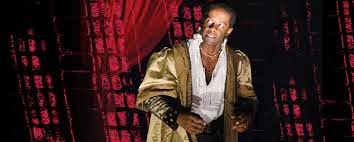
6. Red Velvet  Kudos to St. Ann's Warehouse for making the list twice with a second British import. Tricycle Theatre brought the 19th-century Shakespearean actor Ira Aldridge to life in this wonderful new play by Lolita Chakrabarti. Adrian Lester, known for his own Shakespearean acting, played Aldridge with both easy grace and simmering anger. As a bonus for theatre history nerds, both Charles Kean and Ellen Tree made appearances in the play.

5. Machinal  In January, Roundabout officially opened this stunning revival of Sophie Treadwell's classic play. I saw it in previews and was quite moved by Rebecca Hall's magnificent performance as a doomed murderess. Treadwell's expressionist drama gives the audience nine scenes of descent into an increasingly mechanized life. This production also featured transitional scenes, as Es Devlin's set rotated to reveal new rooms, like fresh cages for urban rats. Director Lyndsey Turner skillfully helmed the play, steering us toward the inevitable conclusion, where the true horror of the machine, literal as well as metaphorical, becomes apparent. This was the kind of production that makes me regret not getting a chance to see more of Roundabout's plays.

4. That Poor Dream  The Assembly's modern-day adaptation of Great Expectations had me on two fronts, adapting a work by my favorite novelist and setting it aboard a familiar Metro North train headed from Grand Central to Connecticut. Though the piece skillfully uses much of the dialogue by Dickens, it branches out to explore how the issues in the novel apply to the United States in the 21st century. I'm writing in the present tense now because while That Poor Dream closed in October, it is reopening in January for six performances at The Tank. It's playing only from the 9th through the 11th, so get our tickets here.

3. King Lear  The Public Theater doesn't always do Shakespeare to my liking, but they nailed it this year with this magnificent outdoor production starring John Lithgow. Though excessively long (combining Shakespeare's two texts of Lear to create an extended version lasting well over three hours), this production gave a moving portrayal of a once-great man slipping into madness and struggling to regain his senses (and his dignity) again. Chuckwudi Iwuji, who also played Bajazeth in Tamburlaine, was a memorable Edgar, feigning madness with compelling vigor. His father Gloucester, played by Clarke Peters, was also quite effective. Though the set (designed by John Lee Beatty) might not have been as creative as the one for That Poor Dream, it worked incredibly well in Central Park's Delacorte, especially with lighting designed by Jeff Croiter and projections by Tal Yarden. Thankfully, director Daniel Sullivan brought it all together this time.

2. All the Way  Amazingly, I never blogged about this show, but perhaps I just wanted to keep the memory of it pure in my mind. The last time playwright Robert Schenkkan had a play on Broadway was The Kentucky Cycle in 1993. I saw that play as a freshman in college, and it left quite an impression on me. Now, more than two decades later, Schenkkan was back again with another play exploring America's history. This one focused on L.B.J.'s efforts to get the Civil Rights Act passed and then win re-election so the Republicans wouldn't smash it all to pieces. Bryan Cranston played President Johnson impeccably, virtually disappearing into his character. The rest of the cast was exceptional as well

1. Macbeth  Hands down, this was the theatrical event of the year. Kenneth Branagh starred in and co-directed this production at the Park Avenue Armory. Doctor Who's Alex Kingston played Lady Macbeth, and Jimmy Yuill (Captain Jamy from Branagh's Henry V) was Banquo. Though originally performed in a deconsecrated church, this production re-imagined itself for its new home in the Armory. It used the historic building for great effect, and when the doors opened into the massive drill hall, it was impossible not to be in awe of the Scottish heath that had been built inside the building. Open flames, clanging broadswords, and blood, blood, blood abounded. Even better, however, was watching Branagh illuminate Shakespeare's words in ways only he can do. The "Tomorrow and tomorrow and tomorrow" speech seemed fresh and new, as if we were hearing it for the first time, even though many of us had been forced to memorize it in high school. Thank you, Mr. Branagh! And please come back to New York soon!

Honorable mentions include Red-Eye to Havre de Grace, Row After Row, and Hellman v. McCarthy. Here's to an even better theatre year in 2015!

Wednesday, April 16, 2014

Red Velvet

Last night I saw Tricycle Theatre's wonderful production of Red Velvet at St. Ann's Warehouse. This new play by Lolita Chakrabarti tells the story of the great nineteenth-century actor Ira Aldridge. It's definitely worth seeing, especially for the performance of Adrian Lester, who plays Aldridge.

The play begins in Poland, where Aldridge died, and where his grave is still honored and revered. A  female Polish journalist sneaks backstage and proceeds to try to get an interview, but the aging and cantankerous Aldridge will have none of it. Why, she wonders, did Aldridge, one of the greatest Shakespearean actors alive, play Covent Gardens only twice? He doesn't want to tell her, but the play flashes back to 1833, showing the audience just what Aldridge has against London.

Chakrabarti takes some liberties with history, but always to heighten dramatic effect. What is true is that Aldridge--an African-American actor who could not get recognized in his home country and had been touring the provinces in Great Britain--was asked to take over the role of Othello at Covent Garden following the collapse of the great Edmund Kean. Poor Kean had been playing Othello when he collapsed on stage, calling for his son Charles, who was playing Iago at the time.

In the play, Charles Kean refuses to go on as Iago opposite Aldridge due to the American actor's race. In reality, he probably didn't play Iago due to the shock of his father's terrifying collapse less the two weeks previously. In fact, Charles Kean had already played Iago to Aldridge's Othello in Belfast in 1829. The play gets around this by claiming Kean was engaged for the performance, but had to cancel due to illness.

It might not be fair to tar poor Charles Kean as a racist, but in Chakrabarti's hands, he makes a wonderful antagonist, especially as his fiancé, Ellen Tree, is performing the part of Desdemona opposite Aldridge. Kean becomes intensely jealous (hints of Othello). Tree, though hesitant at first, comes to appreciate the passionate and more naturalistic acting style of Aldridge, and the play gives us a wonderful glimpse into some of the acting debates of the 1830s.

For whatever reason, Aldridge only performed the role of Othello twice at Covent Garden, and a few days later the theatre went dark for less than a week. The play builds off of these facts to weave a brilliant back-stage drama in which Aldridge descends into his own personal tragedy. Even if Chakrabarti has to conjure up some of the details, however, it is certain than Aldridge left London with a bitter taste in his mouth and preferred acting on the Continent in the future, where his performances were much better received.

Some historical information I picked up at the performance quoted one of my own heroes, Eliza O'Neill, greatly complimenting Aldridge. "During my professional and private life," the retired actress wrote, "I never saw so correct a portraiture of Othello amidst the principal luminaries of my age."

Aldridge was one of the greatest Shakespearean actors of the Victorian era, and it's wonderful to see that he now has a play of his own!