Showing posts with label de Loutherbourg. Show all posts

Tuesday, October 3, 2017

The Age of Garrick

Though the Licensing Act of 1737 kept politics off the stage in Britain for much of the eighteenth century, British theatre continued to make tremendous artistic strides, particularly in acting.

The provincial actor David Garrick moved to London the very year the Licensing Act was passed, and had the good fortune to be coached by Charles Macklin, an actor renowned for his performances as Shylock in William Shakespeare's The Merchant of Venice. At first, Garrick performed at a theatre of dubious legality known as Goodman's Fields, but in 1742 he made his debut at Drury Lane, one of the two patent theatres with a near monopoly on drama in London.  He soon began a long and productive artistic partnership with Peg Woffington, the leading actress with the Drury Lane company. Such was his success, that in 1747 Garrick took over the management of Drury Lane and instituted a number of reforms.

The most important of these reforms came in 1762, when Garrick banned spectators from the stage. Wealthy patrons had traditionally paid extra to sit on the stage itself and be seen as well as watch the actors. The practice was common before the English Civil War, and while it abated during the Restoration period when expensive new scenery was being introduced, theatres at the beginning of the 18th century placed benches onstage for the audience. Garrick abhorred the practice and eliminated the onstage benches. This allowed for greater realism, both in scenery and in acting. He also raised ticket prices to pay for the fancy new sets he was commissioning.

In 1771, Garrick hired the French-born artist Philippe de Loutherbourg to design sets at Drury Lane. De Loutherbourg also made numerous innovations in lighting, which made his sets even more impressive. His sets moved as well, so clouds could drift across the sky, and miniature ships could appear to sail through the water in the distance. Eventually, de Loutherbourg created a miniature stage he called the Eidophusikon, which controlled the lighting and scenery to an extreme degree, but had no room for actors. People paid money simply to watch the brilliant moving pictures, and the Eidophusikon attempted to compete with the theatre itself. Fortunately, the Eidophusikon never put Drury Lane out of business.


Garrick wasn't satisfied with the new plays being written, however, so he began writing his own. He collaborated with the playwright George Coleman the Elder (best known for his hilarious but misogynistic comedy The Jealous Wife) to write The Clandestine Marriage, which was based loosely on a series of satirical pictures by William Hogarth. Garrick's plays might not have been terribly original, but they were entertaining and remained popular well after his retirement. In 1769, Garrick held a massive celebration of William Shakespeare in the Bard's hometown of Stratford-upon-Avon. Though it was a little late for the bicentennial of Shakespeare's birth five years earlier, Garrick spared no expense in arranging a Jubilee celebration, which featured a pageant of Shakespeare's most popular characters. Unfortunately, heavy rains flooded a special tent for the occasion, and all Stratford was covered with mud. Not to be put out, Garrick wrote a play about the event, called it The Jubilee, and performed it at Drury Lane along with the procession of characters.

Garrick's most important contribution, however, came in raising the standards of acting in the eighteenth century, not just in England, but on the European continent as well. The French philosopher Denis Diderot after seeing Garrick wrote a famous essay called "The Paradox of the Actor" in which he tried to determine what made a great actor's performances so engaging. According to Diderot, great actors like Garrick display the illusion of feeling without feeling strong emotions themselves. The paradox is that the more emotional an actor becomes, the less able he is to convey emotions consistently on stage, while the more rational he is, the better he is to show different emotions night after night. Intelligence was what a great performer needed, not feeling.

Though Drury Lane dominated London's theatre scene under Garrick, the rival theatre at Covent Garden scored a palpable hit in 1773 with a play by Oliver Goldsmith called She Stoops to Conquer. Goldsmith loathed the sentimental comedies that had become popular in the eighteenth century and considered his play a "laughing comedy" since the crazy antics of the characters provoked outright guffaws rather than the knowing smiles of earlier works.

Though not as bawdy as Restoration comedy, She Stoops to Conquer captures much of the energy of earlier comic works, and it helped to pave the way for another playwright, Richard Brinsley Sheridan. In 1775, Covent Garden produced Sheridan's play The Rivals, about a man who creates an alter-ego for himself to be his own rival for the love of the woman he wants to marry. The play features a duel, which had special interest for the audience, since Sheridan himself had fought two widely publicized duels over the honor of his fiancée and later wife, the singer Elizabeth Ann Linley.

In 1776, Garrick retired from the stage, and the newly successful Sheridan bought his stake in Drury Lane. He soon took over the theatre, and tailored his next play, The School for Scandal, to perfectly suit the strengths of the actors in the Drury Lane company. The play was a massive hit, and Sheridan later used his fame to launch a successful bid for parliament. From 1780 onward, he enjoyed a dual career as both a theatre manager and a politician. The mild-mannered Age of Garrick was over, and increasingly the theatre was becoming politically charged.

Wednesday, January 6, 2016

The Age of Wonder

Richard Holmes' book The Age of Wonder examines the fascinating links between science and art during the Romantic era. Did you know that the chemist Humphrey Davy wrote poetry? Or that the poet Samuel Taylor Coleridge participated in Davy's experiments?) While Holmes is primarily interested in links between science and poetry, he also points out some links between science and drama.

The book begins with an account of Joseph Banks' trip around the world with Captain Cook. Banks first landed in Tahiti in 1769. Though officially he was a botanist, Banks' encounter with the Tahitians caused him to reflect on the "natural" state of human beings. After returning from the voyage, Banks gradually rose to become president of the Royal Society, the oldest scientific academy in continuous existence.

In addition to jump-starting his scientific career,  Banks' adventures in Tahiti also became fodder for stage. Omai, the Tahitian interpreter Banks used, lent his name to a pantomime at Drury Lane in 1785, called Omai, or a Trip Round the World. Landscape painter Phillipe de Loutherbourg designed the elaborate sets and costumes. Holmes adds dryly that a certain Madame Charlotte Hayes produced a decidedly more low-brow "Tahitian Review" in which "a dozen beautiful Nymphs... performed the celebrated rites of Venus, as practiced at Tahiti." Madame Hayes was a notorious brothel-keeper, so the show was probably more an advertisement for other services than an entertainment in itself.

Holmes also deals extensively with the history of early ballooning. Bothers Joseph and Etienne Montgolfier helped launch the balloon craze by sending up a hot air balloon at Versailles on September 11, 1783. In November, the Montgolfiers launched their first manned balloon, which rose to a height of 900 feet. Days later, Dr. Alexandre Charles made the first ascent in a hydrogen balloon. Some 400,000 people are estimated to have watched as the ballon lifted off from the Tuileries Gardens, with Joseph Montgolfier handling the release chord.

By the next year, the balloon craze had reached Britain, where the Italian aeronaut Vincent Lunardi charged admission to crowds wanting to watch launches. In 1785, he sent the actress Letitia Anne Sage up in a balloon, billing her as the "First Aerial female." (That honor actually belonged to Elisabeth Thible, who had flown in a balloon in France the previous year.) By the time of Sage's ascent, however, another actress (and budding playwright) named Elizabeth Inchbald had managed to get her first play produced. And what was it about? Ballooning, of course! Inchbald's play A Mogul Tale, or the Descent of the Balloon opened on July 6, 1784 at the Haymarket Theatre and continued to be a part of the theatre's repertoire for years to come.

In Inchbald's play, a group of ladies in the seraglio of the Great Mogul of India watch as a trio of English balloonists (including a cobbler's wife named Fanny) descend into their midst. The aeronauts have no idea where they are. (At first, one of them suspects Greenland.) When they learn the truth, they are terrified of the Mogul, but he turns out to be good-humored about the whole affair. Unlike the Europeans who are obsessed with the skies, the Mogul loves "to contemplate the greatest work of heaven, the mind of man." After testing the visitors and giving them a good scare, he pardons them and sends them home.

Perhaps the best known piece of Romantic literature in dialogue with science is Mary Shelley's novel Frankenstein. As I've written about previously, Frankenstein's first stage adaptation was done by Richard Brinsley Peakes in 1823. Holmes notes that the play, Presumption, or The Fate of Frankenstein, made a star out of T.P. Cooke, who played the monster. The original program left a blank for the part of "The Creature," but audiences knew who he was, and Shelley herself praised his performance. After seeing the play, Shelley wrote in a letter:

Mr. Cooke played the "blank's" part extremely well--his trying to grasp at the sounds he heard--all he does was well imagined and executed... it appears to excite a breathless eagerness in the audience... in the early performances all the ladies fainted and hubub ensued!

Holmes remarks on the irony that Shelley's incredibly articulate monster was reduced to grunts and moans in the play, but that tradition later carried over into other adaptations and became the monster we all remember. The image of Frankenstein's monster continues to symbolize a hostility toward science, but as Holmes observes, such hostility was not necessarily felt by all artists of the Romantic era.

Friday, August 14, 2015

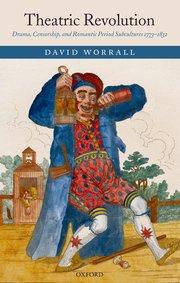
Theatric Revolution

In 1819, the former actress Elizabeth Macauley wrote a pamphlet called Theatric Revolution, or Plain Truth Addressed to Common Sense. The pamphlet addressed the mistreatment of actors by the two patent theatres at Drury Lane and Covent Garden. Macauley argued that actors must band together for their common good, and for the common good of society.

David Worrall, a professor of English at Nottingham Trent University, used Macauley's pamphlet as the title for his 2006 study of Georgian theatre Theatric Revolution: Drama, Censorship, and Romantic Period Subcultures 1773-1832. He argues that the close physical proximity of radical presses and seditious meeting-places to the great theatres in London was no mere coincidence. Both radical politics and its reactionary critique were intertwined with the theatre culture of the day.

In his first chapter, Worrall discusses the regulation of the theatres, examining both the patent system that gave Drury Lane and Covent Garden a monopoly on serious spoken drama, and the censorship system that gave an inordinate amount of power to one man, the Examiner of Plays. Beginning in 1824, the playwright (and son of a playwright) George Colman the Younger was the Examiner, which shows just how incestuous the whole system was. His first year in office, Coleman censored so many passages in Martin Archer Shee's tragedy Alasco that the playwright withdrew the piece from production at Covent Garden. He subsequently published the play with a preface objecting to Coleman's censorship, and by the end of the year Alasco was performed in New York.

Since the two patent theatres had a monopoly on spoken drama, minor theatres like the Royalty Theatre in the East End had to add music to plays, turning them into "melo-dramas" or "burlettas." Worrall's second chapter deals with attempts to suppress the Royalty, which the actor John Palmer built and opened in 1787. The theatre became the subject of a pamphlet war, with the partisans of the patent theatres arguing for its closure. The Royalty was denied a license in 1802, but then licensed again the following year.

Worrall examines the role of the Examiner of Plays in his third chapter. Prior to Geroge Coleman taking over in 1824, the Examiner was John Larpent, and by extension his wife, Anna Margaretta Larpent. According to Anna Larpent's diaries, the couple read aloud all of the plays submitted for performance, and she seems to have given her husband considerable input. In 1795 the Larpents prohibited performance of Lady Mary Eglantine Wallace's play The Whim, a comedy in which an aristocrat, after reading about the Roman custom of Saturnalia, decides that for a day his family will trade places with their servants. Even though the play ends with the confirmation of the social order, this was too much.

Chapter Four deals with the famous scenic designer Philip de Loutherbourg, who was also a Freemason. His 1773 extravaganza A Christmas Tale contained a great deal of Masonic symbolism. Charles Dibdin provided music for the piece, which had a text by David Garrick. After the outbreak of the French Revolution, some critics of Freemasonry linked the Masons to the radical Jacobins, and by the late 1790s the Masonic imagery in A Christmas Tale "had become politically dangerous." The play was not performed for many years, though the Surrey Theatre did stage it in 1817, after anti-Mason (and anti-Jacobin) hysteria had quieted somewhat.

In the fifth chapter, Worrall examines the censorship of The Two Farmers by Thomas Dibdin, Charles Dibdin's son. Though the play was scheduled for performance at Covent Garden in 1800, it ran afoul of the Larpents. Britain had recently experienced grain shortages, and many people blamed farmers for allegedly hoarding their crops. The Two Farmers introduced a villain named Locust who hoarded grain in order to raise prices and justified his actions as being "for the good of the nation." Larpent's blue pencil made quite a number of cuts, and ultimately the censor rejected the play in its entirely.

Chapter Six examines the return of Caroline of Brunswick, the wife of the Prince Regent who returned from self-imposed exile after George III died, making the Prince now King George IV, and Caroline--in theory at least--the queen. However, the king cruelly barred her from the coronation ceremony in 1821, and Caroline died only a few days later. Her return to England featured high-profile attendances at London theatres. At a private party in Montague House, Queen Caroline was even presented to guests as a statue that came to life, a scene consciously reminiscent of the last scene in Shakespeare's The Winter's Tale.

The following chapter looks at theatricalized popular British culture. Worrall notes that drama took place well outside even the "minor" theatres in London and official theatres of the provinces. For instance, the actor Peter Paterson performed a 12-minute version of Matthew G. Lewis's The Castle Spectre at fairgrounds around Birmingham. Audiences could also see spoofs such as W.T. Moncrieff's Frank-in-Steam, or, The Modern Promise to pay, which was performed in 1824, only a year after the English Opera House debuted Richard Brinksley Peake's Presumption; or, The Fate of Frankenstein, the first adaptation of Mary Shelley's novel.

Chapter Eight looks at two plays, the anonymous closet drama Plots and Placemen and James Powell's Drury Lane confection Harlequin Negro. Attributed to on "Zachary Zealoushead," Plots and Placemen satirizes the suppression of radicals during the Regency. The powerful foreign secretary Lord Castlereagh becomes "Callouswretch" and Lord Sidmouth, the widely reviled home secretary, becomes "Proudmouth." This might seem an odd pairing with Harlequin Negro, an 1807 play that Larpent approved without any excisions. However, Powell's play contains what Worrall calls "a vivid moment of empowerment changing the oppressed black Caribbean slave into a gorgeously costumed comic hero." Both plays, then, were furthering the agenda of Britain's radical progressives.

Worrall also includes a chapter on plays inspired by the infamous 1817 murder of 20-year-old Mary Ashford. The young woman went to a dance in Warwickshire one night, and the next day her body was found in a flooded sandpit, probably raped. In 1818, the anonymous three-act plays The Mysterious Murder and The Murdered Maid appeared in print. Two other plays based on the events appeared on the London stage: William Barrymore's Trial by Battle and John Kerr's Presumptive Guilt.

In the final chapter, Worrall looks at the performance of the radical play Swing at the Rotunda, an improvised theatre space where the well-known radical Richard Carlile staged Robert Taylor's five-act tragedy Swing; or, Who Are the Incendiaries? This "People's Tragedy" seems to have been performed with a cast of two, a man named Harrison and Taylor, who at one point appeared as himself under his nickname "Robert the Devil." The shockingly revolutionary play shows the proletarian Swing made king, but he then abdicates so that Britain can become a republic. Carlile hoped to collaborate with Taylor on a second play, but the latter's alcoholism rendered that impossible.

Overall, the picture that emerges of Georgian theatre in Theatric Revolution is one that is far different from the staid Shakespeare revivals people generally associate with that era. Writers like Martin Archer Shee, Eglantine Wallace, Thomas Dibdin, James Powell, and Robert Taylor were constantly pushing the envelope, staging--or attempting to stage--plays that engaged politically with the ever-changing world around them.

Tuesday, February 18, 2014

Painting the Scene

I've been reading James Laver's book Drama - Its Costume and Décor. Though the book was originally published back in 1951, it still contains a lot of wonderful insights.

One of the more interesting figures Laver profiles is Phillipe Jacques de Loutherbourg, a painter from Alsace who came to London and designed sets for Drury Lane. It was de Loutherbourg who moved the candle lights behind the proscenium, finally forcing British actors, who preferred acting on the apron of the stage, behind the proscenium as well. He also used transparent and semi-transparent scenery pieces that could be lit from behind, so in a de Loutherbourg set you might have a night sky with a moon that actually glowed.

His scenic designs tended to use bright colors, so much so that the painter Thomas Gainsborough objected to his work, and asked David Garrick, who ran Drury Lane, to return to more "mild" backdrops. After Richard Brinsley Sheridan took over the theatre, he kept de Loutherbourg, having the skilled painter design a number of the sets for his own plays. Sheridan, however, was not an easy man to work for, and the painter found an alternative outlet for his skills.

That outlet was the Eidophusikon, a small stage with perfect lighting and brilliant sound effects, and best of all, no actors! Audiences could enjoy all the brilliance of theatrical design without having to sit through a boring old play. The fad lasted a couple of years, before de Loutherbourg moved into landscape painting, which had probably been his true calling anyway.

His masterful depictions of the outdoors ushered in a new era, in which scenic designers would no longer be architects but landscape painters. The backcloth came to dominate the entire stage, with side-wings all but disappearing.

The early nineteenth century ushered in a whole new generation of scenic designers who followed the lead set by de Loutherbourg. These included William Clarkson Stanfield, Inigo Richards, William Grieve, and William Telbin.

Stanfield is best known as a marine painter, and he created a number of nautical sets for London theatres. Even after he officially abandoned painting for the theatre in 1834, he continued to design scenery for William Macready as a personal favor. He also designed scenery for some of the amateur theatricals Charles Dickens staged at Tavistock House. The sets for acts two and three of The Frozen Deep were Stanfield's handiwork.

Richards mainly worked at Covent Gardens, where he was known for his sets depicting medieval ruins. Incidentally, his brother-in-law was the actor Thomas Wignell, who left Britain for the U.S. and became one of our important early actors. Richards might even have supplied the design for the Chestnut Street Theatre in Philadelphia.

Grieve is probably best known for his set for Robert le Diable. After the opera was performed in London, the audience reportedly demanded that Grieve himself take a curtain call for the set design.

Telbin frequently worked on the (mostly) historically accurate productions of Charles Kean, but like de Loutherbourg he also dreamed of a "pure" scenic design, and experimented with dioramas.

I wish I could get some images of their work to share on my blog. Maybe I'll find some soon!