Showing posts with label Hannah More. Show all posts

Thursday, November 21, 2019

Waxworks as Theatre

Ever since Madame Tussaud began exhibiting wax figures in the eighteenth century, the display of waxworks has had a theatrical flair. Charles Dickens picked up on this in his novel The Old Curiosity Shop, which depicts its heroine, Nell, getting a job with a traveling waxworks exhibit.

The proprietress of the waxworks, Mrs. Jarley, first spied Nell when she was traveling in the company of two Punch and Judy men, Codlin and Short. To Mrs. Jarley, however, her refined waxworks show is infinitely superior to the pair's puppets. "Never go into the company of a filthy Punch any more," she instructs Nell.

While Punch and Judy shows emphasized their comedy, waxworks stressed their refined and educational value. Mrs. Jarley puts it this way:

It's calm and--what's that word again--critical?--no--classical, that's it--it's calm and classical. No low beatings and knockings about, no jokings and squeakings like your precious Punches, but always the same, with a constantly unchanging air of coldness and gentility; and so like life, that if wax-work only spoke and walked about, you'd hardly know the difference. I won't go so far as to say, that, as it is, I've seen wax-work quite like life, but I've certainly seen some life that was exactly like wax-work.

In spite of Mrs. Jarley's pride in the refinement of her craft, she is embarrassed by the fact that she cannot read. When she uncovers that Nell can read and write, she seizes upon this fact as evidence that the girl will be a valuable addition to her team. Mrs. Jarley then goes about teaching Nell the stories of all the people depicted in wax, including "an unfortunate Maid of Honour in the Time of Queen Elizabeth, who died from pricking her finger in consequence of working upon a Sunday" and "Jasper Packlemerton of atrocious memory, who courted and married fourteen wives, and destroyed them all by tickling the soles of their feet."

What's interesting about the waxworks segment of the novel is that Nell herself as exhibitor becomes of greater interest to the crowds than any of the waxworks themselves. Mrs. Jarley at first sends Nell out through the streets in a light cart with a wax figure of a notorious brigand. This attempt to drum up interest in the show works so well that the proprietress later keeps Nell in the exhibition room and sends the brigand out alone, not wanting to cheapen the value of her live exhibit.

Comically, the waxworks figures turn out to be interchangeable. A wax figure of the famed clown Joseph Grimaldi is altered to resemble the grammarian Lindley Murray, and a figure of a murderess is transformed into the imminently respectable dramatist Hannah More, author of the moralistic tragedy Percy. A nightcap and gown are added to a waxwork of William Pitt to turn it into the likeness of the poet William Cowper, and Mary Queen of Scots is dressed in male attire to become Lord Byron!

Not everyone was a fan of the waxworks, however. Miss Monflathers, who runs a school for young ladies, tells Nell that working for a waxworks is "very naughty and unfeminine, and a perversion of the properties wisely and benignantly transmitted to us." As hard as Mrs. Jarley works trying to induce visitors to patronize her establishment, the public increasingly just comes to the entryway to peek inside at the figures there rather than pay their sixpence admission to see the whole show.

Dickens acknowledges the difficulty of art forms that position themselves as middle-brow culture. Punch and Judy, which has no pretensions to being great art, remains popular with the working class, and the temples of culture at Drury Lane and Covent Garden continue in operation. Mrs. Jarley's exhibition, while it has pretensions of appealing to the gentry, earns the scorn of uppity people like Miss Monflathers and fails to draw in the sixpences of working class folks who find the cost of admission to be prohibitive.

The continued presence of Madame Tussaud's wax museum in Times Square proves that waxworks today can still be economically viable, but many other middlebrow arts continue to struggle. One need look no further than the Broadway shows nearby Tussaud's waxworks. They are frequently forced to exhibit star actors as their main attraction, rather than the plays themselves, which can sometimes seem as interchangeable as Lord Byron and a Scottish queen.


Saturday, December 30, 2017

Kelton House Commedia

I recently got back from celebrating Christmas in Ohio, and while I didn't see any theatre in Columbus, I managed to stumble across some theatrical memorabilia.

While visiting the historic Kelton House, I was surprised to see in a bookcase the complete works of Hannah More. Today, More is rarely remembered, but her 1777 drama Percy (which opened the same year as The School for Scandal by Richard Brinsley Sheridan) was the most successful English verse tragedy of its era.


Even more exciting was a glass case filled with ceramic figurines of commedia dell'arte characters. Such porcelain miniatures of stage actors were popular during the nineteenth century. How they got to the house and whether or not they were collected by the Kelton family (which incidentally also ran a stop on the underground railroad) I don't know.


Next to the case of miniatures was a series of prints of commedia actors modeled off of the illustrations done by Jacques Callot. In the 1620s, Callot did a series of etchings he called Balli di Sfessania. These etchings give us an idea of how commedia performers dressed in the seventeenth century.


Here we see Captain Zerbino and Scapino. Zerbino is one of many braggart soldier figures popular in commedia, but Scapino is particularly famous for inspiring the character of Scapin that Moliere frequently played. To see these treasures and other curiosities of the past, take a tour of Kelton House Museum in Columbus. It's worth a visit!


Thursday, June 8, 2017

Almeyda, Queen of Granada

Sophia Lee's tragedy Almeyda, Queen of Granada ran for five nights at Drury Lane in 1796. That might not seem like a long time, but plenty of tragedies had shorter runs in the preceding decades, and the London stage hadn't seen a truly remarkable tragedy since Hannah More's Percy in 1777.

The success of Almeyda (such as it was) came largely from its leading lady, Sarah Siddons, who played the titular queen. Lee dedicated the printed version of the play to Siddons, and said she never would have written a second play (after her 1780 foray into comedy The Chapter of Accidents) if it hadn't been for the great actress.

"Not all the various charms you dignify the Drama with, can equal those of your sympathizing mind, and unassuming manners," Lee wrote in her dedication to Siddons. In a special advertisement to the reader, Lee went on to say that one "must have wanted taste and feeling, not to have been animated, by the exquisite talents of Mrs. Siddons" and that she was proud to have been "the means of displaying, in a new point of view, her various powers."

Though Lee created an original story for Almeyda, she acknowledged a debt to the Caroline playwright James Shirley. The play's prologue, written by Lee's sister Harriet, plays homage to other tragic writers as well, including William Shakespeare, Nicholas Rowe, and Thomas Otway. It urges the audience to cherish the "spark divine" of tragedy which had been all but extinguished in recent years:

                    Ah! gently fan the flame! lest fashion's breath
                    O'er the pale promise send the blast of death;
                    Nor let the wreath Thalia only wear,
                    Her sister muse deserves so well to share.

Thalia is the muse of comedy, and the comic works of Richard Brinsley Sheridan, Oliver Goldsmith, and John Gay continued to hold the stage even as tragedy had languished. However, according to Harriet Lee, tragedy "mends the morals while it fills the heart." Using strikingly gendered terms, the prologue urges the audience to not just enjoy making fun of folly and vice in comedy, but to "own the manly privilege to feel."

The title character in Almeyda is a Moorish princess who was raised in the court of Castile after the Spanish conquest of Granada. She converts to Christianity and falls in love with Alonzo, son of the King of Castile. However, at the start of the play, international politics call for Granada to be returned to the Moors, and for Almeyda to be installed as queen there. She remains devoted to Alonzo, but wonders if he will continue to love her, or if his patriotic duty to Castile will triumph:

                    Ah, no! For nature here makes distinction;
                    Forms man's large heart for many a various duty,
                    And blends his passions into a republic--
                    While woman, born for love and softness only,
                    Delights to feel love's absolute dominion!

This may sound sexist, and indeed it is, but perhaps not in the way it first appears. Remember, this was first performed in 1796, when the British monarchy was at war with Republican France. Patriotic audiences in London might well have cheered on the "absolute dominion" of woman while scorning the "republic" that represents the fickle heart of man.

Almeyda's uncle Abdallah seeks to control the throne of Granada by marrying her to his son, Orasmyn. Though Orasmyn is in love with his cousin Almeyda, he is too honorable to accept a forced marriage and hopes to truly win her heart. She, however, does not trust the policy of men. She recognizes that her honesty is not prudent, but she gains strength from the seeming foolishness of straight-forward sincerity:

                    --I would like you be guarded, prudent, selfish;
                    Preserve a silence might ensure my safety,
                    And rest upon the future.--But my soul
                    Disdains the mean, the temporising wisdom,
                    Nor knows to tremble in the cause of truth.

In Act III, we meet Alonzo, who was originally played by John Philip Kemble, the younger brother of Siddons. Like Almeyda, he is more passionate than judicious, and sneaks into the enemy palace at Granada in order to see his love. As he explains:

                    In vain would time, or distance, wrest her from me,
                    She, she alone, can shield me in the war,
                    Or nerve my arm at the fierce battle's onset.

Abdallah catches him though, and secure in the knowledge that no one knows Alonzo snuck into Grenada, imprisons him in a dungeon without fearing retribution from the Castilians. Orasmyn, out of both his own sense of honor and the love he has for Almeyda, rescues his rival Alonzo. Unfortunately, when Almeyda descends into the dungeon with her own rescue plan, she finds it empty and concludes that Alonzo has been cast into a gaping chasm. Her uncle appears, and she again uses honesty as her weapon against him, claiming:

                    I will have such revenge!--From thy black heart,
                    At once I'll pluck away its worldly veil,
                    And punish thee in mere sincerity.

In the final act, Abdallah realizes he will never get Almeyda to marry his son. He tries to get her to abdicate, and when that fails, he poisons her and then himself. As she is dying, Almeyda reconciles Alonzo and Orasmyn:

                    Orasmyn's gen'rous heart is virtue's temple!
                    Alonzo, dear Alonzo! honour--love him...
                    --And now, indeed, farewel!--A hand for each.
                    This gives away my crown; and this, oh! this,
                    The faithful heart that's in it!--I am cold;
                    And these dim eyes seek vainly for Alonzo!

Though Almeyda did not make its way into the permanent repertoire of Drury Lane, the performance of Siddons drew positive reviews. Lee's tragedy, even if it never became famous, added to the fame of Siddons by giving her acting a chance to shine.

Sunday, July 3, 2016

Hannah More's PERCY

Hannah More's tragedy Percy, which premiered at Covent Garden in 1777, was probably the most successful English verse tragedy of its era. Incidentally, the play opened the same year Richard Brinsley Sheridan's The School for Scandal premiered at Drury Lane. Why has that play been remembered and More's drama largely forgotten?

The tragedy concerns Elwina, a noblewoman who in childhood was promised by her father to Lord Percy of Northumberland. After perceiving a slight from the lord, he instead married Elwina off to Percy's enemy, the Scottish nobleman Lord Douglas. The play begins in a "Gothic Hall" where Elwina pledges obedience to her husband. Unfortunately, obedience is not enough for Douglas. He cruelly upbraids her, saying:

               Heart-rending word!—obedience? what's obedience?
               'Tis fear, 'tis hate, 'tis terror, 'tis aversion,
               'Tis the cold debt of ostentatious duty,
               Paid with insulting caution, to remind me
               How much you tremble to offend a tyrant
               So terrible as Douglas.—O, Elwina——
               While duty measures the regard it owes
               With scrupulous precision and nice justice,
               Love never reasons, but profusely gives,
               Gives, like a thoughtless prodigal, its all,
               And trembles then, lest it has done too little.

The king returns from the Holy Lands, and with him returns Percy, who participated in the latest crusade. (Anachronistically, the medieval lady Elwina disapproves of the crusades, criticizing them in distinctly Protestant terms, even though Martin Luther hasn't been born yet.) Douglas is jealous of Percy, and he condemns Elwina as an adulteress, saying she has betrayed him even if she never committed the deed in the flesh. As he puts it:

               Will it content me that her person's pure?
               No, if her alien heart dotes on another,
               She is unchaste, were not that other Percy.
               Let vulgar spirits basely wait for proof,
               She loves another—'tis enough for Douglas.

News comes of Percy's death, but this doesn't comfort Douglas. When his wife weeps for Percy, he says that "If she laments him, he's my rival still."

The third act opens with Percy very much alive, and apparently unaware that Elwina has wed his enemy. More could have explained the marriage as one forced through strength of arms, but instead she explores the subtler forms of emotional intimidation parents can use against their children. Though her father did not raise his hand against Elwina, he forced the marriage nonetheless. As she explains it:

               I could withstand his fury; but his tears,
               Ah, they undid me! Percy, dost thou know
               The cruel tyranny of tenderness?
               Hast thou e'er felt a father's warm embrace?
               Hast thou e'er seen a father's flowing tears,
               And known that thou could'st wipe those tears away?

Though Elwina has been robbed of her peace of mind, her one consolation is that she has retained her fame, which she describes as "a rich jewel" she must keep "spotless, and unsoil'd."

Douglas discovers his rival has returned alive and stabs Percy's friend Harcourt, who was carrying a message to Elwina. In Percy's intercepted letter, he declines to return a scarf Elwina once gave him. For Douglas, this is proof positive of adultery. What he doesn't know is that Elwina gave him the scarf years earlier when they were young, and before she had even met Douglas.

Percy and Elwina meet in a garden, but she shuns his passion, explaining that emotions can be the enemies of virtue. Chastising desire, she tells him:

               Heaven, when it gives such high-wrought souls as thine,
               Still gives as great occasions to exert them.
               If thou wast form'd so noble, great, and gen'rous,
               'Twas to surmount the passions which enslave
               The gross of human-kind.—Then think, O think,
               She, whom thou once didst love, is now another's.

Douglas enters and tries to kill Percy, but the two instead resolve on fighting a proper duel.

In the next act, Elwina hears of the duel while waiting in her own chamber. Douglas returns, having slain his rival and sent a cup of poison for Elwina to drink. Dutifully, she drinks the poison, but when her husband finds out that she never gave Percy leave to see her since her marriage, Douglas begins to feel remorse. It is too late, of course, and Elwina has a magnificent death speech:

               Soft, soft—no violence—he's dead already;—
               I did it—Yes—I drown'd him with my tears;
               But hide the cruel deed! I'll scratch him out
               A shallow grave, and lay the green sod on it;
               Ay—and I'll bind the wild briar o'er the turf,
               And plant a willow there, a weeping willow—

Though More provides some striking poetry, her sentiments do not align well with modern concerns. It's interesting to see a man who is jealous even if adultery has not been consummated, but Douglas's change of heart at the end seems to work against this idea. Elwina's father is interesting at times, but he remains a minor character, and his motives are never fully explored.

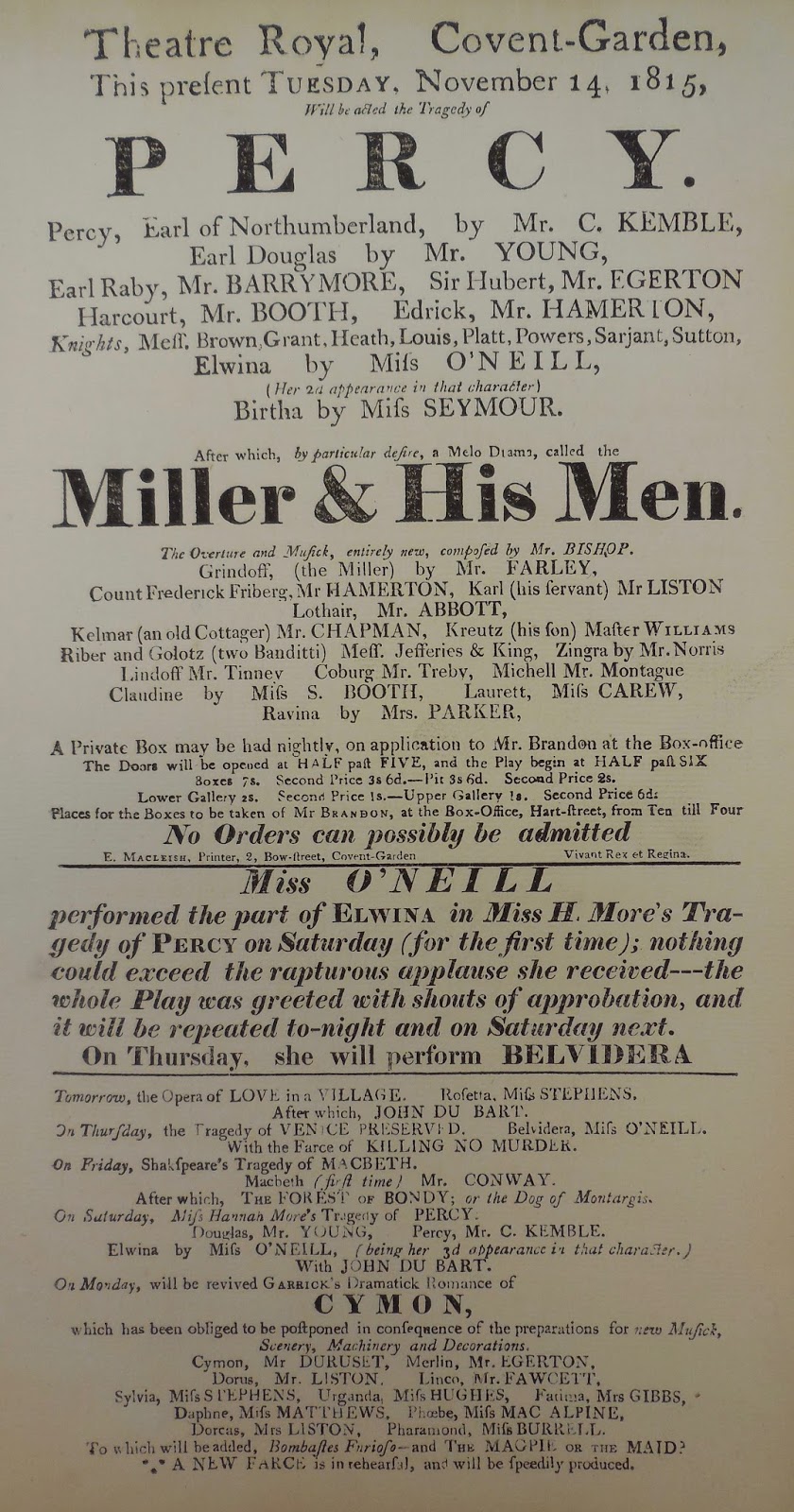
The one character who really does stand out is Elwina, and that part continued to attract star actresses for years to come. Sarah Siddons played the role at Drury Lane in the 1780s, and Eliza O'Neill later excelled in the part, receiving "rapturous applause" when she first performed it in 1815. For all of the play's flaws, it still offers an opportunity for a talented tragedienne.


Tuesday, July 21, 2015

Powerful Conservative Women

"To put it bluntly," writes the critic Jeffrey Cox, "powerful conservative women pose a particular problem to both traditional and revisionist literary histories."

In his essay "Baillie, Siddons, Larpent: gender, power, and politics," Cox argues that traditional literary histories have ignored women like Hannah More, whose 1777 play Percy was the most popular new tragedy by anyone--male or female--in England of the late 18th century. At the same time, feminists espousing a progress narrative in which heroic (liberal) women fight valiantly against patriarchy don't quite know what to do with an adamant conservative like More whom the male powers-that-be actively embraced.

As the title suggests, Cox's essay focuses on three powerful conservative women, playwright Joanna Baillie, actress Sarah Siddons, and Anna Larpent. (The last woman was the second wife of John Larpent, the Lord Chamberlain's Examiner of Plays from 1778 to 1824. Thus, she was married to the official censor of British drama.) All three, Cox argues, exercised agency and power, just not in the ways that we in the 21st century might have liked.

Cox says of Baillie, "while in her works she may not have been trapped by gendered roles, she was certainly an ally of ugly reactionary social and political forces." Baillie seems to have never interacted with the radical playwright and critic Leigh Hunt, in spite of the fact the two were practically neighbors. Yet she was quite close to the arch-Tory Sir Walter Scott, and even once gave him a ring containing hairs of Charles I, an act Cox argues was an expression of intense Royalism.

I find feminist critics quick to applaud Baillie's play The Trial, in spite of the intense traditionalism of the comedy's fifth act. After testing the love of her suitor Mr. Harwood, the character of Agnes resolves to put him through one final trail. Agnes claims that if Harwood will "prove that his love for me is stronger than his love of virtue" she will "give him up for ever."

Agnes writes a letter on the back of a love note sent to her by Harwood and arranges for it to fall into his hands. The false letter supposedly begs a certain lady not to "expose" Agnes, presumably for the loss of her virginity. Like a Desdemona conniving to get her handkerchief into the hands of a jealous lover, Agnes tries to supply proof of her own sexual misconduct. The use of Harwood's letter is not employed to show a betrayal of his confidence, but rather to supply proof that the confession could not have been forged. In essence, Agnes is ensuring that she would not marry any man who would agree to marry her were she not "pure."

Baillie's conservatism was perhaps matched by that of her favorite actress, Sarah Siddons. Naturally enough, Siddons sided with her little brother, John Philip Kemble, during the "Old Price Riots" of 1809 that followed the rebuilding of the theatre at Covent Gardens. When the previous theatre burned down, Siddons had claimed that her greatest loss in the flames had been a "piece of lace which had been a toilette of the poor Queen of France" Marie Antoinette. These are hardly the sentiments of a revolutionary.

Though often overlooked, perhaps the most powerful woman in late 18th- and early 19th-century British theatre was Anna Larpent. Cox probes Larpent's daily journals for evidence that she had tremendous influence over her husband's decisions to censor plays, and that she used it primarily to keep any serious discussion of politics off the stage. Mrs. Larpent read Baillie and admired Siddons. What she could not abide was any reference to the French Revolution.

As George Taylor pointed out in his book The French Revolution and the London Stage, the British were eager to represent the storming of the Bastille and other momentous events in France. However, these stagings had to take place in smaller "illegitimate" theatres, because the Larpents banned all political plays from the patent theatres at Covent Garden and Drury Lane. Anna Larpent's notes specifically condemn Edmund John Eyre's Death of the Queen of France, even though it was sympathetic to Marie Antoinette. She also damned Richard Cumberland's Richard the Second which dealt with Wat Tyler's rebellion, refusing to allow talk of civil unrest even when historicized hundreds of years into the past.

Cox acknowledges that plenty of women on the left also wielded power in the theatre of the Romantic Era (citing Mary Shelley, Elizabeth Inchbald, and Jane Scott), but he reminds us not to overlook extraordinary conservative women simply because their values don't line up with those of 21st-century liberal democracy.