Showing posts with label Joanna Baillie. Show all posts

Friday, February 28, 2025

The Tryal

During the 18th century, British plays sometimes revolved around a plot in which a woman pretended to be lesser than she is to determine if a potential matrimonial partner truly loves her.

Oliver Goldsmith set the standard with his comedy She Stoops to Conquer, which premiered at Covent Garden in 1773. Hannah Cowley developed the idea further in her play The Belle's Stratagem.

While I've seen both of those plays on stage, I've never seen a live production of Joanna Baillie's The Tryal. That play, first published in 1798, shows an heiress named Agnes Witherington pretending to be penniless during a visit to Bath so that she can avoid fortune hunters.

The play recently had a staged reading at the Theatre Royal in Bury St Edmunds which fortunately was recorded and can now be viewed online. Helen Dallas plays Agnes and Ed Whatley-Smith plays Mr. Harwood, who falls in love with her while other suitors bestow their affections on Agnes's poor cousin Mariane, played by Ailun Zhou. Added comedy is provided by the loquacious Miss Eston, played by Lesley Peterson.

Robert Price is quite sympathetic as Agnes's uncle Mr. Witherington, who suggests that Harwood's love for Agnes might be perverse. If he can remain affectionate even for a woman who is truly vile, Agnes will never be able to be happy with him. To ensure this is not the case, Agnes resolves upon a second trial. She will allow Harwood to read a letter that implies she has a dark secret. If he still loves her after that, she will refuse to marry him, but resolves never to be married at all if that is the case.

What is the secret? While it's not explicit in the text, Baillie implies the black mark is that Agnes has lost her virginity. The conservative Baillie appears to be engaging in a bit of 18th-century slut shaming. In the recent production, the author was brought on stage, in the person of Sarah Burdett who commented on the action and mimed writing.

Price, Burdett, and Peterson adapted the script, which was directed by Robert Price and produced by Chris Bundock. If you want to check it out, you can view it here.

Friday, September 13, 2024

Joanna Baillie's Circle

A recent issue of The Coleridge Bulletin published some new letters from Sara Coleridge, daughter of poet and dramatist Samuel Taylor Coleridge. I was surprised to learn that she was acquainted with the playwright Joanna Baillie, and the two had a number of friends in common.

I had known that Baillie frequently corresponded with the painter Thomas Lawrence and the writer Walter Scott, but the letters reveal that her circle also included not just Sara Coleridge, but other notables including the poet Maria Jane Jewsbury and the playwright William Sotheby.

Writing to Jewsbury on November 3rd, 1830, Sara Coleridge noted "Mrs. Baillie we often see and are more & more delighted with her" and that Baillie had "been staying a few days with Mr. Sotheby." Sotheby's play Julian and Agnes had been performed at Drury Lane in 1801, the year after Baillie's De Monfort premiered there. Both plays featured the same leads, the brother-sister duo of John Kemble and Sarah Siddons.

Two years later, Sara Coleridge wrote that "Mrs. J. Baillie has been at the point of death with a low fever, but is happily recovered." Baillie ended up living well into her 80s, and didn't die until 1851. She rose to fame after the first volume of her Plays on the Passions was published in 1798.

That volume included her comedy The Tryal, which will be getting a staged reading next month at the Theatre Royal in Bury St Edmunds. You can find more information about it here.

Saturday, July 27, 2024

BARS 2024

I’ve been in the United Kingdom for the 2024 conference of the British Association for Romantic Studies in Glasgow.
 
The conference kicked off on Tuesday with a talk by Michelle Levy on women writers and publishing. Though we often think of authors in the 18th and 19th centuries as selling their copyrights outright, Levy noted that this often was not the case. She gave particular attention to the poet Phillis Wheatley, who appears to have received half of the print run of her poems to sell herself for her own profit.
 
Next, I chaired a panel on Faustian Romanticism. Three speakers addressed how the Faust dramas of Christopher Marlowe and Johann Wolfgang von Goethe influenced British Romantic writers. Martin Potter discussed Faustian elements in Mary Shelley’s Frankenstein, while also addressing the E.T.A. Hoffmann short story “The Sandman.” Liz Wan talked about how William Godwin’s novel St. Leon could be read as a Faust story, and Maddy Potter addressed Faustian elements in both John Polidori’s The Vampyre and Charles Robert Maturin’s Melmoth the Wanderer.
 
Later in the afternoon, I went to a panel on P.B. Shelley, since multiple speakers were scheduled to address Shelley’s play The Cenci, with which I have a particular interest. Anna Mercer compared the play to Mary Shelley’s novel Valperga, which also features a Beatrice who suffers a horrible fate. She mentioned that Mary Shelley even quoted from her husband’s play in her journal long after he had died. Nora Crook later went into detail about the various manuscripts that the Shelleys might have had access to that discussed the story of Beatrice Cenci. She also drew parallels between the play and G.E. Lessing’s Emilia Galotti.
 
The final panel I attended on Tuesday was on remediating the supernatural. Natalie Tal Harries mentioned that Walter Scott collected books on witchcraft and demonology and justified his use of superstition in a note on his poem The Lady of the Lake. Orianne Smith also discussed Scott, focusing on his novel Guy Mannering, a book from which Sarah Siddons often performed readings after her retirement from the stage. The character of Meg Merrilies in the book became a favorite in stage adaptations of the novel. Haya Alwehaib spoke last, comparing Mary Shelley’s Frankenstein with The Arabian Nights. We then headed over to Glasgow City Chambers for a drinks reception in a beautiful setting.
 
Wednesday there was a plenary roundtable with Elizabeth Edwards, Craig Lamont, and Tim Fulford. My big activity for the day, though was chairing a session on Romanticism’s legacies in fantasy literature. Will Sherwood talked about William Blake’s influence on J.R.R. Tolkien, noting that while most people focus on how Tolkien’s work as a medievalist influenced his fiction, he was greatly influenced by Romantic writers as well. Annise Rogers discussed the Romantic legacy in Ben Aaronovitch’s fantasy series The Rivers of London. Jason Whittaker then spoke on the influence William Blake had on Glasgow’s own Alasdair Gray, who like Blake was both a writer and a visual artists. That evening, the conference banquet was held at Òran Mór, a restaurant in a former church that is graced by murals designed by Gray.
 
My own paper was scheduled for Thursday. I began the day at a panel on the Gothic. Samiha Begum discussed Ann Radcliffe, a writer who appears as a character in my own play The Mysteries of the Castle of the Monk of Falconara. Radcliffe, who was influenced by the paintings of Claude Lorrain and Salvator Rosa, was propelled to fame with her novel The Romance of the Forest and received 500 pounds for her next book, The Mysteries of Udolpho at a time at which the average royalty payment for a novel was only 80 pounds. Interestingly enough, gossip recorded by Anna Seward held that Radcliffe had written Joanna Baillie’s anonymously published Plays on the Passions. I was also interested to hear Jakob Lipski speak on the 1803 historical novel Thaddeus of Warsaw and Laura Eastlake discuss links between vampires and volcanos.
 
In my completely neutral, unbiased, unprejudiced opinion, however, my panel was the best. It began with Bethan Elliott discussing the plays of Baillie (not Radcliffe). She quoted from an 1804 letter Baillie wrote to fellow dramatist William Sotheby. Though Sotheby (who had not had the success on stage that Baillie achieved) urged her to focus on “reading” plays rather than “acting” plays, Baillie held that the qualities that make a play good for acting also make it good for reading. Baillie was not snobbish about how her plays were performed, either, and in 1810 wrote to Walter Scott about being pleased that one of her plays had been performed at a fair. The one play Baillie wrote that she did not think was fit for performance was The Martyr, but that was because of its religious subject matter, not because she didn’t deem it an “actable” piece.
 
My paper was on J.H. Amherst’s play The Death of Christophe King of Hayti. Its depiction of armed women was naturally interesting to the third panelist, Sarah Burdett, who has written extensively on that subject. Her paper was on stage adaptations actresses had written of the poems of Walter Scott. Sarah Smith, who was a favorite of Scott’s, wrote adaptations of both The Lay of the Last Minstrel and The Lady of the Lake performed at the Crow Street Theatre in Dublin. Eliza Macauley, an actress who had a difficult relationship with the Crow Street Theatre, wrote an adaptation of Scott’s Marmion that took a character who only appears in a single Canto of the poem and made her the center of the adapted drama.
 
On Friday, conference delegates could opt for a trip to New Lanark and the Falls of Clyde, which provided some very dramatic landscapes. All in all, it was a wonderful conference!

Thursday, January 25, 2024

Iguana Night

"I don't judge people, I draw them," says Hannah Jelkes in Tennessee Williams's play The Night of the Iguana. The dramatist might well have been speaking about himself. Williams rarely judged his characters, but he did exquisitely draw them for his audience.

That's what we see on stage in the Off-Broadway revival of the play at the Pershing Square Signature Center. Directed by Emily Mann, the production brings together top-quality actors who embrace the characters they play in all their problematic excess.

I saw the show last night, when the cast was led by Christopher Innvar as the Reverend T. Lawrence Shannon, a former Episcopal priest now leading tourists through some of the seedier locales in Mexico. Innvar would seem to be perfect casting for the role. He played Albany opposite John Lithgow in King Lear, and has performed the title character in Joanna Baillie's De Monfort, as well as more recently being Kurt, the odd man out in Dance of Death by August Strindberg. Is it any wonder Mann cast such a magnificent performer in the lead of this anticipated revival?

Oh, wait. Innvar was the understudy! No matter. He nailed the character, and was particularly good in Shannon's scenes together with Judith Fellowes, the annoying matronly woman on the tour who has it out for Shannon, and with very good reason. Fellowes is unbearable, even though we know she's essentially in the right, and is played with priceless humor by Dee Pelletier, best known for her Broadway turns in the Tracy Letts dark comedies The Minutes and August: Osage County.

Hold on, Pelletier was an understudy, too! Her performance was still wonderful, though, and she and Innvar held their own with the show's headliner who did make last night's performance, Daphne Rubin-Vega. Best known as the original Mimi in Rent, Rubin-Vega, can still display her posterior in tight pants without any complaints from the audience. That's good, since she plays Maxine Faulk, the recently widowed proprietor of the hotel where the tour group is staying. Maxine rolls out her sexual charm to welcome Shannon, and the biggest wonder of the play is how he can resist her.

The answer would appear to be Hannah, the Nantucket spinster played by Jean Lichty, who seems to understand the kind of spiritual turmoil Shannon is going through in a way that Faulk cannot. Hannah is traveling with her grandfather (played by the legendary Austin Pendleton), barely scraping by through a combination of selling her artwork and showing off her grandfather as "the oldest living and practicing poet on earth."

This motley assortment of oddballs is displayed with humanity, reminding us of the importance to not judge others for their weaknesses. That's a lesson that should be learned by the German couple staying at the hotel, who represent the dark cloud of fascism that was rolling in during the summer of 1940, when the play is set.

This splendid revival is only playing until February 25, so see it while you still can.

Thursday, April 6, 2023

My Book on Sale!

If you've been wanting to order a copy of my new book, Romantic Actors, Romantic Dramas, but were putting it off because copies were too expensive, now is the time to get one, as the book is currently on sale for $24.99!

That's only if you get the hardcover edition, of course. If you want the e-book, you still have to pay $89. Yes, the illustrations are in color in the electronic version, but not only is there no substitute for paper, but the hard copy is currently cheaper, so why not get it?

Click here to order the book. I'm not sure how long the sale will last, so you might want to order it soon. The publisher, Palgrave Macmillan, is also advertising free shipping on select orders. Oh, and if you're in Europe, they're advertising books for €24.99 as well. (That's slightly more expensive at current exchange rates, but might be cheaper than paying conversion fees.)

The full title of the book is Romantic Actors Romantic Dramas: British Tragedy on the Regency Stage. It reinterprets British dramas of the Romantic era through the lens of the star actors for whom they were written. In addition to providing an overview of the period, the book provides four in-depth case studies of actors and the playwrights they influenced: Sarah Siddons and Joanna Baillie, Julia Glover and S.T. Coleridge, Edmund Kean and Lord Byron, and Eliza O'Neill and P.B. Shelley.

Hopefully, you'll find it insightful and filled with interesting surprises!

Friday, March 31, 2023

Romantic Dramas at NASSR

Today, I presented my paper on Olympe de Gouges and Ira Aldridge online as a part of the annual conference of the North American Society for the Study of Romanticism, better known as NASSR.

I was a part of a panel on Theaters of Violence and Justice moderated by Sophie Thomas. The panel was led off by Marjean D. Purinton of Texas Tech University who spoke on "Justice on Trial in Romantic Period Drama and Novels."

Purinton is incredibly knowledgable about British Romantic drama, which is also the subject of a recent book of mine. She began by discussing one of my favorite playwrights of the period, Joanna Baillie, but instead of talking about one of her more well-known dramas, she delved into The Stripling, a prose tragedy based on a real-life case in Scotland.

In most of the plays Purinton discussed, legal trials are suggested but not directly portrayed on stage. In The Iron Chest, for instance, George Colman the Younger's adaptation of the novel Caleb Williams by William Godwin, a trial is central to the plot, but occurs offstage, as the accused title character comes to have less and less faith in a legal system that seems to just protect the rich and powerful.

Next, Purinton discussed The Cenci, a drama by Percy Shelley which I have written about frequently. She argued that the play really criticizes the justice system in Britain during the Regency, not the courts of Renaissance Rome that are nominally depicted in the tragedy. In addition she discussed James Boaden's The Secret Tribunal and a play by Elizabeth Inchbald, though I didn't catch the title of that one.

Young-ok An from the University of St. Thomas rounded out the panel, discussing Percy Shelley's The Cenci and Mary Shelley's novel Valperga. Thanks to everyone who showed up to listen to us!

Saturday, November 12, 2022

Talfourd's ION

In the latest issue of Theatre Notebook, Christopher Butcher has an excellent article on William Charles Macready bringing Thomas Noon Talfourd's play Ion to the stage.

Though the play shares its title with a tragedy by Euripides, Talfourd's take is quite different, and involves the young prince Ion sacrificing his own life for the good of the state. The author had the piece printed privately and circulated it among a number of notables, including Macready.

The actor was excited about the play, but recognized that audiences might consider him too old to play a young character like Ion. However, impressed by Macready's performance in another tragedy on classical themes, Virginius, Talfourd requested the star actor to appear in the starring role. Macready was only too happy to oblige.

Originally, the play was supposed to be performed for Macready's benefit night at the Theatre Royal, Drury Lane. Unfortunately, Macready had a violent quarrel with the theatre's manager, Alfred Bunn. Macready had to turn to Talfourd for legal advice in the matter. The actor wanted out of his contract at Drury Lane, and so he ended up using Ion as a pretext for gaining his own dismissal. He wrote to Bunn demanding that the play be brought into rehearsal as soon as possible. Bunn fired Macready for his impudence, which is precisely what the actor wanted.

Even before Bunn had fired him, Macready had begun negotiations to appear at the rival Theatre Royal, Covent Garden. Included in his contract was a stipulation that Ion be performed. Eventually, the date of the premiere was set for May 26, 1836, which was also Talfourd's birthday. Macready wanted the painter Clarkson Stanfield to provide the scenery, though he was unfortunately unavailable.

Ellen Tree agreed to play the role of Clemanthe, and the piece was advertised as being for one night only. Joanna Baillie, the most highly regarded dramatist of her day, was in the audience, as were William Wordsworth, Walter Savage Landor, Henry Crabb Robinson, Henry Hart Milman, Robert Browning, Sheridan Knowles, and Charles Dickens.

The play was a success, with the audience calling for the author to take a bow. Talfourd received numerous letters congratulating him, and plans were made for a lengthier run, rather than just the one-night-only event. Macready had introduced cuts that greatly reduced the role of Clemanthe, and when the play later began its official run, Helen Faucit replaced Ellen Tree. At first, Faucit was disappointed by her own performance, but Talfourd wrote her a kind letter that buoyed her spirits.

Ion was performed June 1, 3, 6, 8, 9, 10, and 11 at Covent Garden, and would have run longer, except Macready had engagements elsewhere. It even led to a minor revival in Greek themes on the London stage. Though the play has been largely forgotten, Butcher's article brings new attention to this important moment in theatrical history.

Incidentally, if you want to read more about Macready, you can find plenty of information about him in my new book, Romantic Actors, Romantic Dramas. Though I don't have a full chapter on Macready, his career is discussed at length, as is the work of Baillie, Browning, Faucit, Knowles, Milman, and others.

And though I don't have an article in this issue of Theatre Notebook, my article "War, Pandemic, and Immortality: 1918 and the Drama of Eternal Life" appears in the latest issue of Shaw. Check it out!

Thursday, November 10, 2022

The Book Is Finally Out!

After a long wait, my new book Romantic Actors, Romantic Dramas: British Tragedy on the Regency Stage is now available from publisher Palgrave Macmillan.

The book reinterprets British dramas of the Romantic era through the lens of the star actors for whom they were written. It is the first book-length study to examine the interplay of early 19th century actors and the dramatists writing for them.

I've tried to answer questions about how and why actors from the Romantic period influenced major writers. The work focuses on four pairs of actors and playwrights: Sarah Siddons and Joanna Baillie, Julia Glover and S.T. Coleridge, Edmund Kean and Lord Byron, and Eliza O'Neill and P.B. Shelley.

If you're interested in any of those people, you'll want a copy of this book. Unfortunately, both the e-book and the hardcover version are rather pricey at the moment, but Palgrave Macmillan does frequently have sales, so keep your eyes open for possible discounts to come.

In the meantime, ask your local library to order a copy. The hardcover is still not officially released, but you will be able to pre-order the physical book soon. Electronic versions are available already.

The cover image features Eliza O'Neill. Interior images include a mezzotint of Siddons, a toy theatre version of Coleridge's play Remorse, a close-up photograph of a screen owned by Lord Byron, and a cartoon comparing Siddons and O'Neill.

Monday, April 25, 2022

Rhetorical Gesture and Action

In 1807, the actor Henry Siddons, son of the famous tragedienne Sarah Siddons, published a treatise on acting--freely adapted from a German book--called Practical Illustrations of Rhetorical Gesture and Action.

In the "Advertisement" at the beginning of the book, Siddons defends his free adaptation of a work by Johann Jakob Engel. While a straight-forward translation of Engel's work might have proved "sufficient" Siddons argues that "as the application of his principles, in the original work, was adapted to the business of the German Stage, and as his references and examples were chiefly taken from the German drama, it became an essential duty of the Editor to Anglicise the matter, as well as translate the language of his author."

Siddons makes sure to give examples from English plays that were well known at the beginning of the 19th century, including Joanna Baillie's De Monfort, Matthew G. Lewis's The Castle Spectre, and William Congreve's Love for Love, as well as popular works by Shakespeare, such as Macbeth, Romeo and Juliet, and Hamlet. He also makes explicit reference to his mother. At one point,  he writes: "If the first actress now on our stage had never been present at the bed of a dying person, her acting, under such circumstances, might probably have lost one of its most natural and affecting traits." This was Siddons's trick of having her fingers twitch, but nothing else, as she had once seen in a person near death.

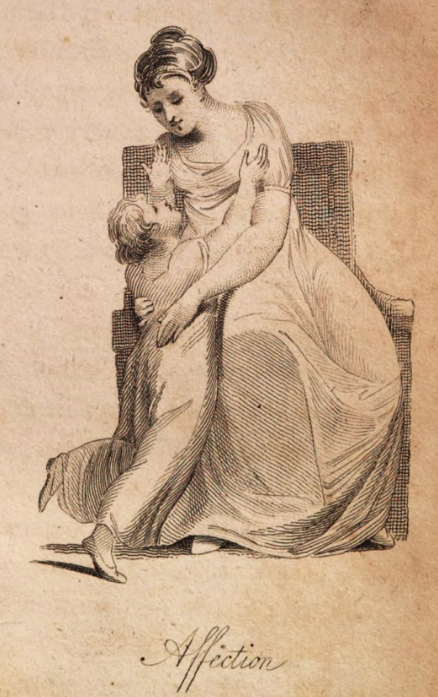
The book also includes illustrations, one of which is reminiscent of a painting of Sarah Siddons together with a very young Henry. That painting, Mrs. Siddons and Her Son in the Tragedy of Isabella by William Hamilton, shows a tall, stately mother with a small child to the left. Similarly, the illustration for "Affection" shows a mother and son, and the book draws attention to the fact that (as in the painting) the two figures are on different planes. Siddons writes: "First of all, my friend, let us suppose an object of desire placed more high than the person desirous of obtaining it; or what comes to the same point, that the personages are not of an equal height."

How much was Siddons's guide used as a practical tool for actors? It's difficult to tell, but in addition to being raised by the most famous actress of the era (not to mention being nephew to the actor John Philip Kemble), Henry Siddons was a famous performer himself. He was the leading man at the Theatre Royal in Edinburgh, where he originated the role of the Lord of Lorne in Baillie's The Family Legend.

Actors today might not want to follow the advice in the book, which as its title suggests is aimed at a rather rhetorical approach to performance, but it is a fascinating glimpse into the past.

Tuesday, August 17, 2021

British Romantic Theatre Salon

Covid-19 has cancelled a number of conferences, or at least driven them online. Last week, the British Association for Romantic Studies began its International Digital Conference, which runs until this Friday.

I've already Zoomed in for a panel on "Poetic Reckonings" that discussed Joanna Baillie, a panel on "Communicative Powers" that covered letters between Fanny Brawne and Fanny Keats, a panel on "Appropriations and Reworkings" that examined how German heroines were adapted for the London stage, and a panel on "Weaving the Gothic" that addressed the gothic tales of Percy Shelley.

Today's virtual salon on Romantic Theatre was the best, though. Sarah Burdett, from St. Mary's University in Twickenham, did an excellent job hosting the event. I was happy to find that she has a great interest in Samuel Taylor Coleridge's play Remorse and the actress Julia Glover who helped to make it such a success. I was also pleased to hear of other people who have taught Baillie's play De Monfort.

Though opportunities to see live theatre are still relatively few and far between, there are performances available online right now, and I discovered at the salon that Yale University's staged reading of the Horace Walpole play The Mysterious Mother is currently available on YouTube. Francesca Saggini, who teaches at Università degli Studi della Tuscia in Italy, is planning on doing some virtual readings of plays by Fanny Burney, which could be a lot of fun.

On Thursday and Friday, there will be more panels, including one on scandals around Lord Byron, and one on "Visuality and Self" that will cover Mary Robinson as well as other figures. Though it hasn't been as fun as attending the BARS Conference in Nottingham in 2019, I'm glad I've at least had some contact with other scholars of Romantic drama this summer.

Saturday, January 9, 2021

The Family Legend

Joanna Baillie is probably best known for her tragedy De Monfort, but she also enjoyed considerable success with a later drama, The Family Legend.

Baillie rose to fame after publishing the first volume of her Plays on the Passions in 1798. After De Monfort, the strongest piece in that volume, was performed at the Theatre Royal, Drury Lane in 1800, Baillie issued a second volume of Plays on the Passions in 1802. She published a volume of miscellaneous plays in 1804, but still held back The Family Legend from being published, in hopes of having it produced first.

A production at Drury Lane was not forthcoming, but Baillie's friend Walter Scott helped to secure a production in Edinburgh. Scott himself wrote the prologue to the play, which as the title suggests, is based on a legend about a feud between the Maclean and Campbell clans. The actor Daniel Terry played the Earl of Argyll, leader of the Campbell clan, and also recited Scott's prologue.

When the play opens, Argyll's daughter Helen has been married to the chief of the Maclean clan in order to resolve a feud between the two families. They have a baby son together, but many of the Macleans are furious that a half-Campbell is set to one day rule over them all. The vengeful Benlora, who was once imprisoned in a Campbell dungeon, calls Helen "a bosom worm, / Nursed in that viper's nest, to infuse its venom / Through all our after race."

In reality, Helen is not only virtuous, showing kindness to the misfortunate, but also fiercely loyal to the Maclean clan that she now regards as her new family. When her brother, the Lord of Lorne, comes in disguise to see her, she tells him:

                              here my place I'll hold
As dame and mistress of the warlike clan
Who yield obedience to their chief, my lord ;
And whatsoe'er their will to me may bear,
Of good or ill, so will I hold me ever.

The Lord of Lorne, it so happens, was played by Henry Siddons, son of the famous Sarah Siddons who had originated the role of Jane De Monfort in Baillie's earlier stage success. Lorne's sister Helen was played by Henry's wife Harriet. Though she had not been born in Scotland, Harriet (the daughter of the famed Scottish actor Charles Murray) was considered Scottish by Edinburgh theatre fans, who referred to her as "Our Mrs. Siddons" to distinguish her from her mother-in-law.

Harriet got to really show off her acting in the third act of the play, as the Macleans abandon her character on a tidal island to drown when the sea rises. Putting her trust in God, Helen raises her eyes to heaven and says:

Thou art i' the blue coped sky—th' expanse immeasurable;
I' the dark roll'd clouds, the thunder's awful home:
Thou art i' the wide-shored earth,—the pathless desert;
And in the dread immensity of waters,—
I' the fathomless deep thou art.
Awful but excellent! beneath thy hand,
With trembling confidence, I bow me low,
And wait thy will in peace.

Fortunately, Helen does not drown. Fisherman rescue her and return her to Lorne and his friend, Sir Hubert de Grey. In Act IV, they bring her back to her father's castle. Lorne wants revenge, but his father cautions him that they must be careful. Then, a messenger arrives with false news from the Maclean clan that Helen died tragically in an unforeseen illness and was bitterly mourned. This sets the stage for Act V, when Helen's deceitful husband and the other members of the Maclean clan arrive at Argyll's castle wearing black and bewailing the innocent woman they tried to murder.

How does the play end? No spoilers here, but it should be sufficed to say that medieval Scottish clans were not generally known for their tendency to forgive and forget. The play was a hit in Edinburgh, and in 1815 it was produced at Drury Lane as well. I'd love to see a modern production of the piece!

Friday, August 3, 2018

ATHE, Day Three

Today, I went to the Theatre and Religion Focus Group meeting at the annual conference of the Association for Theatre in Higher Education. It was the start of a day dominated by those two topics: theatre and religion.

In the afternoon, there was a roundtable discussion of the Museum of the Bible in Washington, D.C. Though the museum does have a theatre, the panelists were discussing museums as theatre. Though initially the museum aimed to evangelize, by the time it opened, its mission changed to simply informing people about the Bible. The general consensus of the panelists who had visited the museum was that the museum (while it could have been worse) celebrated the Bible's history without engaging with that history in a meaningful critical way,

After the roundtable, I presented my own paper, "Assassination Discovered: Revolutionary Implications of Revelation Scenes in Baillie's De Monfort and Coleridge's Remorse." The paper was part of a panel entitled "Catastrophe: Performance That Revolutionizes." I was happy to share the stage with Alley Edlebi, who spoke about Samuel Beckett, and Joy Palacios, who discussed the priest Jacques-Andre Emery. Joy's paper and mine were very much in conversation, since they were both about responses to the French Revolution.

Following my own panel, I went to hear a paper by Shiraz Biggie on poetry as performance among Irish immigrants. Also on her panel were Tova Markenson, who spoke about objections to Yiddish theatre in Argentina because of its alleged ties to prostitution, and Alicia Hernandez Grande, who delivered her paper via Skype on street protests of the Catalan independence movement. Rounding out the panel was Gina di Salvo, who spoke about court cases in Jacobean Britain over performances that were part of May Day and Twelfth Night celebrations.

The conference continues on Saturday and Sunday, but my papers are over, so I'm looking forward to attending the Theatre History Focus Group meeting and relaxing a bit!

Monday, July 30, 2018

ATHE Conference This Week!

Why am I up so late packing? Because this week is the annual conference of the Association for Theatre in Higher Education.

This year, the conference is in Boston, and I'll be delivering two different papers. The first one, "Byron's Dramatic Revolt," is a part of a session called "Unconventional Resistance on the European Stage." It's sponsored by the Theatre History Focus Group, and I'll be discussing Lord Byron's play Manfred. That will be at 4:00 on Thursday.

On Friday at 5:00, I'll be part of a session sponsored by the Religion and Theatre Focus Group called "Catastrophe: Performance That Revolutionizes." I'll be delivering a paper entitled "Assassination Discovered: Revolutionary Implications of Revelation Scenes in Baillie's De Monfort and Coleridge's Remorse." Our moderator will be Jill Stevenson, a colleague of mine at Marymount Manhattan College.

On Saturday, I'm going to try to see Cry Innocent, a play about the Salem Witch Trials presented by the Salem-based company History Alive. This is my first ATHE conference. We'll see how it goes!

Friday, February 24, 2017

The Rise of the English Actress

I just finished reading Sandra Richards's book The Rise of the English Actress. By its nature, the book is a rather general study, but it gives a wonderful history of women on the British stage.

Women appeared on stage during the middle ages, but by the Renaissance they were official banned from taking part in the public performances of plays in England. There were some exceptions, such as the infamous "Moll Cutpurse" who acted illegally, and the French actresses who were hissed at the Blackfriars Theatre in 1629.

It wasn't until the Restoration that actresses became the norm in England, and they quickly became an attractive novelty. Richards points out that in 1664 Thomas Killigrew staged an all-female performance of his play The Parson's Wedding. All-female casts were still being used a decade later when John Dryden's Secret Love was revived with only women on the stage.

By the early eighteenth century actresses were using playwrights to pen works especially for them. Richards cites Henry Fielding's Deborah and The Intriguing Chambermaid, written for Kitty Clive, and Colley Cibber's The Careless Husband and The Provok'd Husband, both vehicles for Anne Oldfield. Such collaborations did not always go well, though. Samuel Jonson blamed the failure of his play Irene on a sub-standard performance by Hannah Pritchard.

Perhaps the most celebrated eighteenth-century role created for a specific actress was Lady Teazle in Richard Brinsley Sheridan's The School for Scandal. According to Richards, Sheridan wrote the part especially for Frances Abington. It was Abington who made the mob cap fashionable after she wore it on stage in James Townley's two-act farce High Life Below Stairs. The role she played, Kitty, was originally played by Kitty Clive, but Abington used it to create a fashion sensation that came to be known as the Abington Cap.

Women were instrumental in the creation of the benefit performance, and their earnings could top those of male actors. Richards notes that in 1792 the top-grossing benefit night belonged to Dora Jordan. That year, Jordan earned 540 pounds, while the tragic actress Sarah Siddons earned 490 pounds, and the leading male actor, John Philip Kemble, earned only 480 pounds. The Jordan-Siddons rivalry mirrored a debate over whether comedy or tragedy was the superior genre. The Dramatic Magazine in 1788 sided with Jordan, declaring she "fairly beat Melpomene out of the field."

The late eighteenth century also saw the remarkable career of Mary Robinson, the actress who in 1775 began publishing her poems under the patronage of the Duchess of Devonshire. Unfortunately, her 1794 play Nobody struck a nerve, and was hissed off the stage when it exposed the gambling habits of a number of prominent society ladies. Robinson allegedly dictated her poem "The Maniac" while under the influence of opium. As one might expect, Samuel Taylor Coleridge saw a kindred spirit in her and in 1800 declared Robinson "a woman of undoubted genius."

Robinson was famously painted by the major artists of the day, and as Richards puts it, it was in the eighteenth century that actresses "now became a means of establishing a painter's reputation when they allowed themselves to be portrayed." Portraits of actresses "were offered to the market by painters satisfying a public demand, and reflected how audiences saw female players." Richards specifically cites Thomas Lawrence, whose 1790 portrait of Elizabeth Farren catapulted the painter into fame and royal favor.

The great tragic actress of the late eighteenth century was of course Sarah Siddons, and Richards devotes an entire chapter to her. Drawing on Siddons's biography by Thomas Campbell, Richards points out that Siddons strove to be "natural" but by "natural" she meant credible for the character, rather than what we today might consider naturalistic. Siddons famously studied Egyptian and Greek sculpture, using it to help her achieve the exact poise and muscle tension she wanted to have.

In spite of her generally acknowledged superiority over her brother, John Philip Kemble, Siddons could not always enjoy her stardom. While Kemble was given a public dinner at the occasion of his farewell performance, Siddons received no such honor. She remarked to Samuel Rogers, "Well, perhaps in the next world women will be more valued than they are in this." Still, she left her mark on plays, and Richards notes that "Siddons's personality and bearing unquestionably informed and determined the role" of Jane de Monfort in Joanna Baillie's play De Monfort, which premiered in 1800.

Eliza O'Neill succeeded Siddons as the great British tragedienne of the early nineteenth century. O'Neill retired from the stage in 1819, though, and in the early Victorian period actresses like Helen Faucit and Siddons's niece Fanny Kemble took the reins. In 1837, Fanny Kemble wrote An English Tragedy, but William Charles Macready refused to stage the play, in spite of recognizing that it was "full of power, poetry and pathos."

The most famous Victorian actress was Ellen Terry, and Richards gives Terry her own chapter. Terry was most renowned for playing Lady Macbeth, wearing "a gown of soft green silk and blue tinsel edged with rubies and diamonds, draped by a heather velvet cape and decorated with flaming griffins and real beetle wings of green to achieve a metallic dazzle.” John Singer Sargent painted a portrait of Terry wearing the dress, helping it to become, in Richards's words, "the most famous costume in stage history."

Sybil Thorndike was one of the great British actresses of the early twentieth century. Richards considers her production of Percy Shelley's The Cenci in 1922 to be one of the most important of the actress's career. According to Richards, "Sybil's Beatrice established her firmly as a great tragic actress and Shelley as a great dramatist." At the time, George Bernard Shaw was trying to determine who should play the title character in his new play Saint Joan. After seeing Thorndike as Beatrice Cenci, Shaw informed his wife, "I have found my Joan." Thorndike later became closely associated with the role of Joan of Arc, which she did indeed originate in Shaw's play.

Richards continues the story of the English actress past Thorndike, writing for instance about Peggy Ashcroft, who played Desdemona opposite Paul Robeson in Othello. She goes right up to the present, discussing Harriet Walter, who I just saw play Prospero in an all-female production of The Tempest. All in all, this is a wonderful book for anyone interested in the history of British acting.

Sunday, September 11, 2016

Happy Birthday, Joanna Baillie!

"Nothing has been so much an object of man's curiosity as man himself." Thus wrote Joanna Baillie in the preface to her first volume of the Plays on the Passions published in 1798.

It's that remarkable woman's birthday today. She came into the world on September 11, 1762, one of two premature twins, the other of whom soon died. Her older siblings, Agnes and Matthew, seemed the remarkable ones. Matthew in particular excelled at his studies, while young Joanna was more interested in horses than her books.

When her father died, the family moved into the home of her uncle, William Hunter, a London doctor who kept an estate in Scotland but rarely visited it. Matthew went to college in Glasgow and then Oxford while the girls stayed at home with their mother. When Uncle William died, however, the Scottish estate passed to his younger brother, and the family moved to London, staying with Matthew, who was now a promising young physician.

The girls never lost touch with their Scottish roots, though. As one of Baillie's biographers puts it: "Agnes and Joanna never attempted to sophisticate their vowels or compromise with their r's." They were hardly social outcasts in London, and one of Joanna's acquaintances was Mary Berry, a writer and close friend of Horace Walpole. In 1798, the now married Matthew bought a new house in a more fashionable part of town, and his mother and sisters moved out to Hampstead, then a "country" area just outside of London.

It was in that year that Baillie's first plays were published. As she wrote in her preface, she wanted to satisfy the "universal desire in the human mind to behold man in every situation, putting forth his strength against the current of adversity." The idea was to show people in the thrall of intense passions--passions so violent no one would wish to feel them in themselves--but these passions could be instructive when seen in others. As Baillie put it, no one wants to see a ghost, but we love watching those who believe in ghosts struck by the terror of their imaginations.

"There is, perhaps, no employment which the human mind will with so much avidity pursue, as the discovery of concealed passion," Baillie wrote. Thus, she proposed writing two plays, a tragedy and a comedy, on each of the major passions. She belittled the Gothic style then in vogue, but admitted that it did sometimes strike upon moments of truth, and she wanted to convey those natural truths about emotion in a more refined manner. Her plays, she said, would be studies in human nature, and would instruct the audience on how they might behave when moved by similar passions.

Most people assumed the author of the Plays on the Passions was a man, but the literary patron Hester Piozzi could not be fooled. She saw that Baillie was writing parts for older women who had psychological sophistication, whereas most male authors didn't seem to care for heroines once they passed the first bloom of youth. In 1800, Baillie's identity was revealed, and that same year her play De Monfort premiered at the Theatre Royal Drury Lane with John Kemble and Sarah Siddons in the leading roles.

Though the production was not as successful as the theatre had hoped, Baillie continued to enjoy a reputation as being the finest British dramatist alive. She met Walter Scott, who had written some of his own plays, but said that after reading Baillie's works he had decided to abandon the drama, feeling himself incapable of ever writing a tragedy as fine as one of hers. Scott wrote to her in 1808: "I may say this with confidence, because it is the simple truth, that there breathes not a person whose opinion I hold in equal reverence."

Baillie's plays have fallen out of fashion, though the Red Bull Theatre did recently perform a staged reading of De Monfort. Scholars are beginning to rediscover her work, and perhaps one day audiences will, too.

Saturday, August 6, 2016

Back From Cambridge

I'm back from the U.K. now, and the Society for Theatre Research conference in Cambridge was amazing.

Our final day was jam packed. In the morning, I went to the session on James Winston and the Regency Theatre. Winston was a bit of a jack-of-all-trades in early 19th-century theatre, and is today probably best known for writing The Theatrical Tourist about the provincial theatres in Britain.

Vicky Simon began by giving a great presentation about the proscenium doors at Drury Lane Theatre. After the theatre burned down in 1809, it was rebuilt, and bronze tripods were placed where the proscenium doors had once been. The tripods were criticized, though, and ultimately nixed. During the 1814 remodeling of the theatre, the doors were put back in the proscenium arch.

When Robert William Elliston leased the theatre, he appointed Winston to manage Drury Lane. Winston got Samuel Beazley to remodel the interior of the theatre, contracting it, and removing the proscenium doors. The doors, which had been in and out of fashion for so many years, were now gone for good. But how could people come forward to give curtain speeches? Well, it was Beazley who apparently first designed a way to open up a small part of the front curtain to let people through.

David Wilmore then spoke about the circuits of provincial theatres in the north of England. He mentioned that the town of Richmond in Yorkshire has one of the few remaining Regency-era theatre buildings. (Now I have to visit!) He also showed an interesting map demonstrating how the theatre circuits in Yorkshire tended to follow the turnpikes.

Iain Mackintosh gave a great presentation on the Margravine of Anspach, who built her own private theatre into an old riding school. Born Elizabeth Berkeley, and later Lady Craven, the Margravine had quite a scandalous life. King George III refused to receive her at court, but the Prince of Wales came to her parties and amateur theatricals.

Later that morning, I went to a great session called "Music, Melodrama, and the Survival of the Fittest." I mainly wanted to hear Eva Urban's paper on remorse tragedy, examining both Richard Brinsley Sheridan's Pizarro and Samuel Taylor Coleridge's Remorse. She tied the two plays back to Adam Smith's theory of moral sentiments.

Amy Garnai then gave a great talk on Thomas Holcroft and Joanna Baillie. Holcroft's second melodrama, The Lady of the Rock, premiered at Drury Lane in 1805. Based on a Scottish legend, the piece featured music by Holcroft's daughter Fanny. Though Holcroft's revisions softened the piece, it was still politically radical. The same could not be said of Baillie's treatment of the same story in her rather conservative play The Family Legend.

Christina Fuhrmann gave the last paper in the session, on Carl von Weber's opera Oberon, which had a libretto by James Planche. Though many theatre historians consider the opera to have been a failure, Fuhrmann noted that the opera extended to 32 performances in its first season, and was only disappointing when compared to Weber's runaway hit Der Freischutz.

All in all, it was a great conference, and Downing College was a perfect setting. I look forward to seeing some folks again... perhaps at the next STR conference!


Sunday, March 13, 2016

L'Amant Anonyme

This afternoon I had the pleasure of hearing an abridged version of the Chevalier de Saint-Georges' opera L'Amant Anonyme at 59 E 59 Theaters. This rare gem presented by Little Opera with the New Vintage Baroque ensemble is playing until March 20th, so see it while you still can!

I have a long-standing interest in Joseph Boulogne, the 18th-century composer who was knighted Le Chevalier de Saint-Georges for his fencing skill as well as his accomplishments as a violinist. Together with Lorraine Goodman, a former opera singer, I collaborated on a play about him, God of Arms, which received a couple of staged readings but has yet to be produced.

Saint-Georges was born on the island of Guadeloupe, the son of a wealthy French planter and an African slave. His father acknowledged him as his son and raised him as befitted a French gentleman, ensuring he had lessons in fencing and music. When he arrived in France, however, his dark skin provoked a great deal of prejudice, which would dog him all his life.

L'Amant Anonyme (The Anonymous Lover) is the only opera by Saint-Georges to survive in its entirety. Madame de Montesson, who was the secret wife of the Duke of Orleans and a patron of Saint-Georges, premiered the opera at her private theater in 1780. It tells the story of Valcour, a man secretly in love with his friend Leontine, but unable to tell her of his affections.

The opera is based on a play by Stephanie Felicite, a niece of Madame de Montesson who at 16 married the Comte de Genlis, becoming known thereafter as Madame de Genlis. Like Joanna Baillie, the Scottish playwright who followed her, Madame de Genlis saw drama as an opportunity to educate people, and wrote her plays as teaching devices.

Fortunately, L'Amant Anonyme feels delightful rather than didactic. If you want to go, check out the theater's website here:

59 E 59 Theaters

Wednesday, July 29, 2015

Sir Walter Scott, Playwright


In 1799, the Scottish writer Walter Scott published a translation of Goethe's Götz von Berlichingen. It was the first publication to which Scott—who was later made a baronet in 1820—put his name.

Scott is better known as a novelist, but when he published his first novel, Waverly, in 1814, he made sure to leave the work anonymous. It was poetry and poetic drama that Scott considered his serious literature.

The eighteenth century was an age of reason, but as Scott's biographer John Buchan has pointed out, the public's desire for romance had never died out. The more fantastic elements of literature survived in the ballads Scott collected, and in the legends that formed the basis for his epic poems and for his plays.

In 1817, Scott began work on what eventually became his play The Doom of Devorgoil. Not published until 1830, the melodrama was derided by the Dublin Literary Gazette as "shallow" in comparison to the author's other works. However, it has some striking lyric passages, including this song found in Act I, scene i:

            Admire not that I gain'd the prize
                        From all the village crew;
            How could I fail with hand and eyes,
                        When heart and faith were true?

            And when the floods of rosy wine
                        My comrades drown'd their cares,
            I thought but that thy heart was mine,
                        My own leapt light as theirs.

            My brief delay then do not blame,
                        Nor deem your swain untrue;
            My form but linger'd at the game,
                        My soul was still with you.

The second scene switches to a Gothic setting, inside Devorgoil Castle, "in which there is much appearance of present poverty, mixed with some relics of former grandeur." Scott shows his familiarity with the conventions of Gothic drama, as well as a desire to utilize the stage effects available at the time to advance his story and achieve dramatic effects. For instance, in Act II, scene ii, he includes a footnote explaining how to portray lightening striking a suit of armor on the wall:

I should think this may be contrived by having a transparent zig-zag in the flat scene, immediately above the armour, suddenly and very strongly illuminated.

In Act III, scene iii, a ghost appears, first as an indistinct shape, then gradually materializing. Again, Scott demonstrates his intense interest in stage devices when he writes:

As they advance towards the Figure, it is more plainly distinguished, which might, I think, be contrived by raising successive screens of crape. The Figure is wrapped in a long robe, like the mantle of a Hermit, or Palmer.

The addition of "I think" seems to indicate Scott was unsure of how practical his solution might be. Still, he plainly was interested in how the play might be performed on stage. In the final scene, Scott wanted the entire castle to be flooding with water, but unsure how this could be managed, he added the footnote:

If it could be managed to render the rising of the lake visible, it would answer well for a Coup de théâtre.

Not all of Scott's plays were Gothic melodramas. He dedicated his poetic one-act drama MacDuff's Cross to the very serious playwright Joanna Baillie. Scott greatly admired Baillie, and wrote in the prelude of the play:

                                                —But, to thee,
            Joanna, why to thee speak of such visions?
            Thine own wild wand can raise them.

The story takes place at the ancient monument of MacDuff's Cross. The monk Ninian explains the rules surrounding the landmark:

            Know then, when fell Macbeth beneath the arm
            Of the predestined knight, unborn of woman,
Three boons the victor ask'd, and thrice did Malcom,
Stooping the scepter by the Thane restored,
Assent to his request. And hence the rule,
That first when Scotland's king assumes the crown,
MacDuff's descendant rings his brow with it;
And hence, when Scotland's King calls forth his host,
MacDuff's descendant leads the van in battle:
And last, in guerdon of the crown restored,
Red with the blood of the usurping tyrant,
The right be granted in succeeding time,
That if a kinsman of the Thane of Fife
Commit a slaughter on a sudden impulse,
And fly for refuge to this Cross McDuff,
For the Thane's sake he shall find sanctuary;
For here must the avenger’s step be staid,
And here the panting homicide find safety.

References to the same history immortalized by Shakespeare indicate that Scott's literary aims are much higher in this short play that in The Doom of Devorgoil. The same is true of the plot, which both idealizes clannish blood feuds and shows them melting into a more civilized Christian forgiveness.

Though Scott's plays have never proven popular, many of his novels, including Rob Roy, were successfully adapted into plays, which is also true of some of his longer poems, such as The Lady of the Lake, now probably best known in its incarnation as an opera—La donna del lago—with music by Rossini. Despite Scott's ambitions as a playwright, he was much more successful with providing other dramatists with source material than with writing plays of his own.