Showing posts with label Charles Robert Maturin. Show all posts

Saturday, July 27, 2024

BARS 2024

I’ve been in the United Kingdom for the 2024 conference of the British Association for Romantic Studies in Glasgow.
 
The conference kicked off on Tuesday with a talk by Michelle Levy on women writers and publishing. Though we often think of authors in the 18th and 19th centuries as selling their copyrights outright, Levy noted that this often was not the case. She gave particular attention to the poet Phillis Wheatley, who appears to have received half of the print run of her poems to sell herself for her own profit.
 
Next, I chaired a panel on Faustian Romanticism. Three speakers addressed how the Faust dramas of Christopher Marlowe and Johann Wolfgang von Goethe influenced British Romantic writers. Martin Potter discussed Faustian elements in Mary Shelley’s Frankenstein, while also addressing the E.T.A. Hoffmann short story “The Sandman.” Liz Wan talked about how William Godwin’s novel St. Leon could be read as a Faust story, and Maddy Potter addressed Faustian elements in both John Polidori’s The Vampyre and Charles Robert Maturin’s Melmoth the Wanderer.
 
Later in the afternoon, I went to a panel on P.B. Shelley, since multiple speakers were scheduled to address Shelley’s play The Cenci, with which I have a particular interest. Anna Mercer compared the play to Mary Shelley’s novel Valperga, which also features a Beatrice who suffers a horrible fate. She mentioned that Mary Shelley even quoted from her husband’s play in her journal long after he had died. Nora Crook later went into detail about the various manuscripts that the Shelleys might have had access to that discussed the story of Beatrice Cenci. She also drew parallels between the play and G.E. Lessing’s Emilia Galotti.
 
The final panel I attended on Tuesday was on remediating the supernatural. Natalie Tal Harries mentioned that Walter Scott collected books on witchcraft and demonology and justified his use of superstition in a note on his poem The Lady of the Lake. Orianne Smith also discussed Scott, focusing on his novel Guy Mannering, a book from which Sarah Siddons often performed readings after her retirement from the stage. The character of Meg Merrilies in the book became a favorite in stage adaptations of the novel. Haya Alwehaib spoke last, comparing Mary Shelley’s Frankenstein with The Arabian Nights. We then headed over to Glasgow City Chambers for a drinks reception in a beautiful setting.
 
Wednesday there was a plenary roundtable with Elizabeth Edwards, Craig Lamont, and Tim Fulford. My big activity for the day, though was chairing a session on Romanticism’s legacies in fantasy literature. Will Sherwood talked about William Blake’s influence on J.R.R. Tolkien, noting that while most people focus on how Tolkien’s work as a medievalist influenced his fiction, he was greatly influenced by Romantic writers as well. Annise Rogers discussed the Romantic legacy in Ben Aaronovitch’s fantasy series The Rivers of London. Jason Whittaker then spoke on the influence William Blake had on Glasgow’s own Alasdair Gray, who like Blake was both a writer and a visual artists. That evening, the conference banquet was held at Òran Mór, a restaurant in a former church that is graced by murals designed by Gray.
 
My own paper was scheduled for Thursday. I began the day at a panel on the Gothic. Samiha Begum discussed Ann Radcliffe, a writer who appears as a character in my own play The Mysteries of the Castle of the Monk of Falconara. Radcliffe, who was influenced by the paintings of Claude Lorrain and Salvator Rosa, was propelled to fame with her novel The Romance of the Forest and received 500 pounds for her next book, The Mysteries of Udolpho at a time at which the average royalty payment for a novel was only 80 pounds. Interestingly enough, gossip recorded by Anna Seward held that Radcliffe had written Joanna Baillie’s anonymously published Plays on the Passions. I was also interested to hear Jakob Lipski speak on the 1803 historical novel Thaddeus of Warsaw and Laura Eastlake discuss links between vampires and volcanos.
 
In my completely neutral, unbiased, unprejudiced opinion, however, my panel was the best. It began with Bethan Elliott discussing the plays of Baillie (not Radcliffe). She quoted from an 1804 letter Baillie wrote to fellow dramatist William Sotheby. Though Sotheby (who had not had the success on stage that Baillie achieved) urged her to focus on “reading” plays rather than “acting” plays, Baillie held that the qualities that make a play good for acting also make it good for reading. Baillie was not snobbish about how her plays were performed, either, and in 1810 wrote to Walter Scott about being pleased that one of her plays had been performed at a fair. The one play Baillie wrote that she did not think was fit for performance was The Martyr, but that was because of its religious subject matter, not because she didn’t deem it an “actable” piece.
 
My paper was on J.H. Amherst’s play The Death of Christophe King of Hayti. Its depiction of armed women was naturally interesting to the third panelist, Sarah Burdett, who has written extensively on that subject. Her paper was on stage adaptations actresses had written of the poems of Walter Scott. Sarah Smith, who was a favorite of Scott’s, wrote adaptations of both The Lay of the Last Minstrel and The Lady of the Lake performed at the Crow Street Theatre in Dublin. Eliza Macauley, an actress who had a difficult relationship with the Crow Street Theatre, wrote an adaptation of Scott’s Marmion that took a character who only appears in a single Canto of the poem and made her the center of the adapted drama.
 
On Friday, conference delegates could opt for a trip to New Lanark and the Falls of Clyde, which provided some very dramatic landscapes. All in all, it was a wonderful conference!

Monday, December 27, 2021

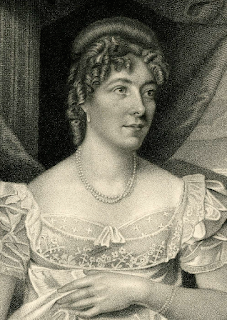
Margaret Somerville Bunn

The actress Margaret Somerville made her debut at the Theatre Royal, Drury Lane playing the female lead in Charles Robert Maturin's play Bertram opposite none other than Edmund Kean.

At the time, she was only 16 years old, at least if we can rely on The Biography of the British Stage, published by Sherwood, Jones, & Co. in 1824. That source gives Somerville's birth as being in Lanark, Scotland, on October 26, 1799.

Young Margaret, at the age of 10, began performing in private theatricals, taking on the role of Marcia in Joseph Addison's Cato in a performance of juveniles. Apparently, she grew into an impressive actress, and in 1815 Douglas Kinnaird, a member of the sub-committee running Drury Lane, managed to get her into rehearsal at the theatre in the starring role of Belvidera in Thomas Otway's Venice Preserved.

Alas, poor Margaret Somerville was dismissed from those rehearsals, being informed she was simply not up to the role. Undeterred, she appealed to John Kemble, then manager of the rival patent theatre at Covent Garden, but he declined to help her. She then returned to Kinnaird and performed some passages from Venice Preserved in an attempt to win a second chance. It so happened that Lord Byron, who was also on the sub-committee, was present, and he and Kinnaird both agreed that the young woman should make her debut immediately.

Bertram opened on May 9, 1816, with Somerville in the role of Imogine. The show was a success, and the actress was offered a three-year contract on "very advantageous terms" according to The Biography of the British Stage. In 1817, she obtained permission to perform in Bath for a engagement of ten weeks, lasting into the new year. It was there that she played the role of Bianca in H.H. Milman's tragedy Fazio. In 1818, she left Drury Lane and defected to Covent Garden, where she played Bianca again. That role had already been made famous in London by Eliza O'Neill, who subsequently appeared with Somerville in Jane Shore by Nicholas Rowe.

Somerville was frustrated with a lack of choice parts for her in London, though, and she left Covent Garden to tour the provinces. It was while performing in Birmingham that she met Alfred Bunn, whom she married in 1819. Bunn became part of the inner circle of Robert William Elliston who then took over Drury Lane, allowing Margaret, now Mrs. Bunn, to appear in London as Bianca again, as well as Hermione in William Shakespeare's The Winter's Tale and Cornelia in Sheridan Knowles's Caius Gracchus.

Perhaps Margaret Bunn's most famous role, however, was Queen Elizabeth in an adaptation of the Walter Scott novel Kenilworth. According to The Biography of the British Stage, she was applauded "to the very echo" in the role.

According to a local newspaper in south-central Minnesota, the Bunns' second daughter Helen immigrated to the United States, and Margaret, then widowed, joined her. She died in 1882 and is buried in Blue Earth, MN.

Monday, June 10, 2019

Nicolas Levasseur

I frequently write about nineteenth-century British actors on this blog, but today I'm going to write about a bygone performer from France, instead.

His name was Nicolas Levasseur, and for a while now, I've kept a postcard of him on my bookshelf. You can see him below in the role of Bertram in Giacomo Meyerbeer's 1831 opera Robert le Diable.


The postcard comes from the Victoria and Albert Museum in London and was given to me on the basis of a bit of a misunderstanding, since I am quite interested in the play Bertram by Charles Robert Maturin. Whoops! Wrong Bertram.

No matter. He's still a striking figure. But if I'm going to display his postcard on by bookshelf, I probably should know a bit about him. I mean, other than his living from 1791 to 1871 and making his debut at the Paris Opera in 1813 and that sort of a thing, since anyone can find that out from Wikipedia. Like I did.

No. What's really interesting to me is his performance in Robert le Diable. The Meyerbeer opera had a libretto by Eugène Scribe and Germain Delavigne. It told the story of Robert, Duke of Normandy, a notorious party boy who drank, gambled, and womanized to his heat's delight. In the first act, however, his foster sister Alice warns him against a mysterious companion. That companion was Bertram, originally played by Levasseur.

And who is Bertram? Well the title of the opera should give you a clue. He's Robert's long-lost father who is in league with demonic forces. His plan is to get Robert to sign away his soul to the devil so he can be with his son forever. (See? Family values!) Alice overhears the plot, though, and ends up saving the day.

Levasseur played plenty of other roles, too. The V&A has images of him in the role of Marcel in Meyerbeer's Les Huguenots and Bazu in Fromental Halévy's Le Drapier. Neither role is quite as diabolical as Bertram, though.

Tuesday, August 16, 2016

The Tragic Mr. Rae

In my last blog post, I wrote about the mysterious Mrs. Gibbs. Today, I'll be covering an actor about whom considerably more is known: Alexander Rae.

Rae is probably best known for playing Ordonio in Remorse, a tragedy by Samuel Taylor Coleridge. According to his memoir in the 1826 Dramatic Biography, Rae "had the good-fortune to receive a classical education.” His training in recitations of classical texts prepared him for a lifetime on the stage.

Born sometime in May of 1782 (no exact date is given), Rae lost his father at a young age and worked for a while in the office of an army agent. Passing up a chance to go to India, Rae appeared as Hamlet in 1810 at a theatre in Huntington. He later acted in Hamlet at both Bath and Bristol and was favorably received.

Still, Rae was praised for "the elegance of his style, rather than his capabilities as an actor.” He attracted the notice of George Coleman the Younger at the Haymarket Theatre, where he subsequently appeared as Sir Edward Mortimer in Coleman's The Iron Chest. At the close of the Haymarket's season, he proceeded to Liverpool, where he took on the management of a local theatre.

On the circuit, Rae played with both Sarah Siddons and John Philip Kemble. After the Theatre Royal at Drury Lane reopened in 1812 following a disastrous fire, Rae took to the stage there, appearing both in Hamlet and Coleridge's Remorse. The Dramatic Biography calls Rae's Ordonio "a first-rate effort" adding that he "was a picture of horror we shall never forget.” Rae did not entirely capture the tragic spotlight, however, but had to share it with Robert William Elliston, who played Alvar in the play.

Elliston, as it turned out, probably had more of an aptitude for comedy, but at that point in his career he still frequently played tragic roles. It seemed that Elliston would be Rae's rival for the tragic leads, but that was not to be. The next year, Edmund Kean made his Drury Lane debut as Shylock, and the theatrical world would never be the same. Rae acted with Kean in Richard III, but the two reportedly did not get along, and Rae turned to comedic roles. The one part in which he successfully competed with Kean was as De Zelos in Charles Robert Maturin's tragedy Manuel.

Rae eventually rose to become stage manager of Drury Lane, but his tenure did not go well. He was said to have been overly lavish in his expenditures, and his attempts at reviving some classic comedies failed with the public. Leaving Drury Lane, Rae went to the Royalty Theatre. Money troubles followed him though, and soon even greater difficulties. Rae was married, but a certain woman who had fallen in love with him threatened to commit suicide if he would not abandon his wife and move in with her. He obliged her, much to his wife's dismay.

While living with his new mistress, the Dramatic Biography tells us, Rae developed a painful "stone" which caused him physical as well as mental distress. His wronged wife came to his bedside, and the remorseful Rae died under the surgeon's knife. After Rae's death, his fellow actors staged a benefit performance of The Rivals at Drury Lane for his widow and family.

One of Rae's daughters followed him into the theatre, but I have been unable to trace the rest of his family. The general feeling is that Rae's case was one of missed opportunity. As the Dramatic Biography lamented: "He studied little, was frequently imperfect, and may therefore be said to have never given himself a fair chance in the field."

Thursday, June 23, 2016

British Romanticism

British Romantic writers were frequently inspired by what their colleagues were doing in Germany, but they also created their own version of Romanticism.

The watershed moment for the Romantic movement in Britain was William Wordsworth and Samuel Taylor Coleridge publishing their joint poetry collection Lyrical Ballads in 1798. Before publishing Lyrical Ballads, however, both Wordsworth and Coleridge read German writers of the Storm and Stress movement, and incidentally enough, both wrote their own plays, hoping to have them produced in London.

After being rejected by Covent Garden, Wordsworth seems to have ceased to have ambitions for the stage, not publishing his drama The Borderers until 1842. Coleridge, on the other hand, clung to his play Osorio, recycling two passages from it to provide the poems "The Foster-Mother's Tale" and "The Dungeon" in Lyrical Ballads. Later, he rewrote the play as Remorse, getting it finally staged at Drury Lane in 1813.

For both Englishmen and observers on the European continent, the soul of British Romanticism was expressed in one extraordinary person, George Gordon, known as Lord Byron. Byron was instrumental in getting Remorse staged at Drury Lane, and he undoubtedly influenced Charles Robert Maturin's tragedy Bertram, which features a dark, brooding hero-villain, perhaps modeled after Byron himself.

A month before Bertram's premiere in 1816, however, Byron had left England, never to return. After the break-up of his marriage (which unfortunately occurred not long after the wedding) Byron was dogged by scandals about his sex life, including his probable incest with his half-sister Augusta Leigh. To avoid the scandal, Byron fled to Switzerland, where he proposed the famous ghost story contest that led to the creation of both Frankenstein and the first literary vampire tale in English, The Vampyre.

In Byron's drama Manfred, published in 1817 but not performed until after the author's death, the title character exclaims: "My Spirit walked not with the souls of men, / Nor looked upon the earth with human eyes." This super-human attitude came to be ascribed to Byron himself. Byron, in turn, admired the acting of the English tragedian Edmund Kean, and likely had him in mind when he wrote the role of Manfred.

Indeed Byron was the most theatrical of all the British Romantics. Though only one play of his (a rather minor work called Marino Faliero) was performed during Byron's brief lifetime, his entire life was a piece of theatre, watched breathlessly by all of British and European society.

After leaving Switzerland, Byron traveled south to Italy, where in addition to writing Marino Faliero, he composed a trio of important dramas published in 1821, Sardanapalus, The Two Foscari, and Cain. The young English poet Percy Bysshe Shelley followed Byron from Switzerland to Italy, where he composed his own drama The Cenci, about the fall of a powerful Roman family during the Renaissance. Though the play was not performed until the end of the nineteenth century, The Cenci influenced later theatre and came to be considered the greatest Romantic tragedy in English.

Sadly, the most talented playwrights of the era did not feel comfortable remaining in England, largely due to crackdowns on political dissent in the wake of the French Revolution and Napoleon. Shelley drowned while sailing off the coast of Italy, and Byron went to help the Greeks obtain independence from the Ottoman Empire. Instead, he died of disease in Missolonghi in western Greece on April 19, 1824.

Thomas Lovell Beddoes represents the final stage of Romanticism in Britain. While still a precocious teenager at Pembroke College, Oxford, Beddoes published The Bride's Tragedy, a verse drama that garnered favorable reviews, but no productions. Beddoes left England for Germany in 1825 in order to study anatomy, and it was there that he wrote his masterpiece Death's Jest-Book.

The play pays homage to Jacobean revenge tragedies, but with absurd twists and morbid devices that go beyond anything in the work of Cyril Tourneur, Thomas Middleton, or John Webster. However, Beddoes's uncompromising portrayal of characters descending into death and madness has led some critics to consider it one of the first major responses to English Romanticism, anticipating the modernist movements to come. Sadly, Beddoes committed suicide in 1849, and the play was not published until after his death.

Friday, August 1, 2014

Maturin's Byronic Hero

On May 9, 1816, Charles Robert Maturin's play Bertram premiered at Drury Lane. Maturin had written some minor novels, but he had not yet penned Melmoth the Wanderer, the 1820 novel that would secure his reputation. Both Sir Walter Scott and Lord Byron supposedly helped to get the play staged at Drury Lane, where no one less than the great Edmund Kean played the title role.

Though Maturin was an ordained Protestant minister, I find Bertram fascinating for its moral ambiguity. The title character appears--at least at first--not so much immoral as amoral. At the beginning of the play, he survives a fierce storm. A monk reports that: "No hand did aid him, and he aided none." Bertram is entirely alone, completely self-sufficient, but also unwilling or unable to reach out to others. He preserves his own life not because he wishes to live, but because he does not wish to have the crime of suicide upon his soul. He sees poison in the touch of any other man.

At the end of the first act, the audience hears Imogine, Bertram's lost love, recount how he came to be this way. Though Bertram was once noble and enjoying his sovereign's favor, his enemies had him sent into exile, where he came to deal with "desperate men." Imogine was of low birth. Maturin does not write that she and Bertram married, but he does imply that the child she bore might well be his. Her lover gone, and herself thrust into poverty, Imogine had little choice but to marry Bertram's mortal enemy, Aldobrand.

As the second act begins, Bertram learns that he has washed up near the castle of Aldobrand. Fired by revenge, he gleefully reflects on the fact that his enemy's wife, and possibly his enemy's child, could be alone and defenseless. Of course, Bertram does not know the true identities of this wife and child, but he will soon discover them.

When Bertram and Imogine are alone together, Bertram recognizes her, but heartbreakingly, she does not recognize him until he calls out her name. Imogine must reveal that she married Aldobrand in order to save her father's life. As Imogine explains it, her wedding was not a sacred ritual, but a kind of anti-marriage:

For broken-hearted, in despairing hour
With every omen dark and dire I wedded --
Some ministering demon mocked the robed priest,
With some dark spell, not holy vow they bound me,
Full were the rites of horror and despair.
They wanted but -- the seal of Bertram's curse.

Bertram responds feelingly, claiming he will not curse her, then launching into what is pretty much one long curse. The two are somewhat reconciled at the end of the scene when Imogine's child comes on, bringing the old lovers together. For me, this moment is reminiscent of the end of Benjamin Thompson's famous 1798 Kotzebue adaptation The Stranger. In spite of everything, a child's embrace seems to soothe all ills.

Maturin's play doesn't end there, however, nor does Bertram's vengeance. The third act begins with Aldobrand approaching his castle, where he hopes to find "My dame and child." What Bertrand claims outside of wedlock, Aldobrand claims according to the rules of the world. Meanwhile, Bertrand cries out in rebellion against all the ways of this world. Railing against the monks who took him in after his rescue, he cries:

Yea -- thus they live, if this may life be called
Where moving shadows mock the parts of men.
Prayer follows study, study yields to prayer --
Bell echoes bell, till wearied with the summons
The ear doth ache for that last welcome peal 
That tolls an end to listless vacancy --

Bertram resolves to go to the forest where he will lead team of bandits, but first, he has an encounter with Imogine. She agrees to meet with Bertram one final time, but her child comes in and embraces her. This time, the effect is the reverse of the embrace at the end of the last act. The child claims that his "father" is returned and has kissed and blessed him. He means not Bertram, but Aldobrand, and the mention of her lawful husband makes Imogine waiver. Bertram leaves her in contempt.

For a moment in the next act, Bertram considers forgiving Aldobrand, recognizing that they both have wronged one another. Then news arrives that Aldobrand has a royal commission to kill Bertram. All pity melts away. When asked if he will flee, Bertram responds:

Never -- on this spot I stand
The champion of despair -- this arm my brand --
This breast my panoply -- and for my gage --
(Oh thou hast reft from me all knightly pledge)
Take these black hairs torn from a head that hates thee --

Aldobrand has a different version of Bertram's history. He claims that Bertram in his ambition had struggled against the king himself, and his removal was but a public service. He also claims to have wooed Imogine "with a weeping tenderness." Whom are we to believe? Bertram, who leads a band of ruffians? Or Aldobrand, who goes to feast with the holy Knights of St. Anselm?

Though the opening acts paint Bertram in a somewhat sympathetic light, Maturin portrays his protagonist more and more like a villain as the play continues. When Aldobrand returns to his castle, Bertram slays him mercilessly, as the old rival cries out pitifully for the child he has raised. (Given Maturin's ambiguity about the child's paternity, Aldobrand might very well be the boy's biological father as well.)

The final act presents Bertram with a certain "majesty of guilt." A holy Prior claims that the murderer is able to "blend our wonder with our curses." Instead of running from his guilt, Bertram embraces it, saying to the knights who surround him:

One prayer, my executioners, not conquerors --
Be most ingenious in your cruelty --
Let rack and pincer do their full work on me --
'Twill rouse me from that dread unnatural sleep,
In which my soul hath dreamt its dreams of agony --
This is my prayer, ye'll not refuse me --

Ultimately, Bertram dies by his own hand, perishing boldly and tragically, to the wonderment of all those around him.

Though this Romantic tragedy might seem like an obscure historical curiosity, I suspect that it influenced quite a number of other works, including the dramas of Lord Byron. Byron missed the premiere of Bertram, as he had left Britain the month before it, in part to get away from scandal. (When did Byron not have scandal? This one centered on his separation from his wife Annabella and his probable incest with his half-sister Augusta.) It was while living abroad that Byron produced his drama Manfred, which was published in 1817.

Like Bertram, Manfred's sufferings come from a woman, in his case the beautiful Astarte, whom he loved, but who died without forgiving him. Similarly, the hero of Bertram is in agony when Imogine dies without granting him forgiveness. Manfred even sounds a bit like Bertram, crying out as his death approaches:

I have not been thy dupe nor am thy prey,
But was my own destroyer, and will be
My own hereafter. -- Back, ye baffled fiends!
The hand of death is on me -- but not yours!

Manfred dies his "own destroyer" and like Bertram leaves those around him mystified. These details could be seen as common tragic tropes, but given Byron's championing of Maturin's play, it's also possible that Bertram had a certain effect upon Byron as a dramatist.

Wednesday, May 21, 2014

'Terror and Pity reign in every Breast'

No, that isn't a rejected motto for Chick-fil-A. It's the title of a really great book by Paul Ranger about gothic drama in England from 1750 to 1820. Ranger takes the title from a review in the London Chronicle in 1757:

Our expectation is well worked up and Terror and Pity reign in every Breast, till by due degrees the Discovery is made, when a Tide of Joy breaks in upon us...

In his first chapter, "The Gothic Spirit," Ranger tries to define what he means by the term "gothic drama" as neither 18th-century playwrights not their audiences used the term. Incidentally, while "gothic" was not in vogue, variations on the term "Romantic" were. Matthew G. Lewis's 1797 play The Castle Spectre for instance introduces in the Prologue a "fair enchantress" named "Romance." Ranger also points out that Samuel Johnson included in his dictionary the word "Romantick" which could mean "fanciful; full of wild scenery." He also cites a 1773 reference in Richard Graves's The Spiritual Quixote to a garden "laid out in a romantic taste" that mixed "the cheerful and the gloomy."

Wild scenery was certainly important to the gothic, as was a gloomy atmosphere, but so were other qualities. Gothic plays tended to have stock characters, including a conventional hero, heroine, and villain. They had a few recurring devices, including mistaken identity, and a slew of horrors unleashed in the last act. These plays displayed the distinct influence of German playwrights such as Friedrich von Schiller and August von Kotzebue. Sometimes, there were direct adaptations, such as Joseph Holman's 1799 play The Red Cross Knights, which took Schiller's bandits in The Robbers and turned them into Knights Templars. Similarly, Richard Brinsley Sheridan adapted Kotzebue's The Spanish in Peru as the tragedy Pizarro. For Ranger, what is particularly important, though, is that in these dramas a dark and wild side of human nature was reflected by the characters' surroundings.

The second chapter, "A World Untamed," explores those settings that served as a metaphor for the characters. In Joanna Baillie's 1800 play De Montfort, the title character finds himself instinctively drawn to scenes of horror. In the 1816 play Bertram, Charles Robert Maturin placed a tempest at the opening, employing not just visuals but also gripping sound effects to move the audience and inspire them with thoughts of the characters' inner lives. Ranger observes that this unity of scene and character gradually led to the integration of the performer into the scenic background. Actors began to appear as diminutive beings, pitted against the untamed grandeur of a sublime yet savage world. This eventually led to melodrama, a genre that appeared in part in John Philip Kemble's 1794 play Lodoiska, but more fully in 1802 with Thomas Holcroft's A Tale of Mystery.

Chapter Three tackles the two most popular gothic settings, the castle and the cloister. Lodoiska included three scenes of a castle, the first outside, the second in a tower, and the third with a hall and gallery, which went up in flames at the end of the play. Anna Maria Crouch, who played the title role, was supposed to stand imperiled in a tower, but one night, she became imperiled for real. Michael Kelly, the actor playing her love interest, Florenski, tried to come to her assistance. He later wrote:

I ran up the bridge which was a great height from the ground, towards the tower, in order to rescue her; just as I was quitting the platform a carpenter prematurely took out one of its supports; down I fell and at the same moment the fiery tower, in which was Mrs. Crouch, sank down in a blaze with a violent crash; she uttered a scream of terror. Providentially, I was not hurt by the fall and, catching her in my arms, scarcely knowing what I was doing, I carried her to the front of the stage.

Once the actors reached the front, the audience erupted with applause, thinking the entire disaster had been planned. According to Crouch, many members of the audience were convinced it was some of the best acting they had ever seen.

The other great gothic building was the cloister. Of course, most monasteries and convents in England had been long closed by the 18th century, but the advent of the French Revolution meant that some monks and nuns expelled from France ended up taking refuge in Britain. Of even more importance were the trips abroad that had become standard for young people as a way of finishing their educations. Returning to England, these travelers rarely had positive images of what went on behind cloistered walls.

One of the most spectacular stage buildings of the period was the convent chapel in Baillie's De Montfort. The scenery was designed and built by William Capon, the senior designer at Drury Lane. The chapel had a reasonable degree of historical accuracy, which was rather unusual for the time. Capon loved medieval architecture, and he built the chapel to represent a 14th-century church. The set went back a full 52 feet. In spite of her reputation for writing closet drama, Baillie didn't miss an opportunity for spectacular stage technique. She called for a procession of nuns bearing torches to walk around a freshly dug grave while singing a funeral dirge. Reaction to the play was mixed, but the set was a hit, and Drury Lane ended up reusing it several times in different plays.

The importance of stage spectacle increased in the ensuing years, which is the subject of Ranger's fourth chapter. Capon designed an impressive Hall of Armoury for Samuel Taylor Coleridge's 1813 play Remorse, which had been strongly influenced by Baillie's work. That same year saw far more impressive scenery on stage at Covent Garden in Isaac Pocock's The Miller and His Men. The titular miller led a group of bandits by night and by day stayed holed up in a windmill. At the climax of the play, the mill spectacularly exploded on stage, an event that rendered the elevated poetry of plays like Remorse irrelevant in a new world of spectacular special effects.

Ranger's fifth chapter covers the attitude and speech of actors in gothic dramas. He focuses on two roles, Euphrasia in The Grecian Daughter and the title character in De Montfort. Drury Lane first produced Arthur Murphy's tragedy The Grecian Daughter in 1772, but the play was performed frequently throughout the later 18th century. Beginning in 1782, Sarah Siddons took over the role of Euphrasia, who had to kill a tyrant in order to save her own father. Ann Barry, who originated the role, portrayed the killing without reticence, but Siddons made Euphrasia conflicted about taking the tyrant's life, a choice that earned her great acclaim as an actress.

Baillie wrote the part of De Montfort hoping that Kemble would play it, which he did. Though Baillie avoided giving stage directions instructing the actor how to handle emotion, Ranger argues that she clearly wanted his facial expressions to be seen. The proof? Her play called for some monks' lanterns to light De Montfort's face at a key moment, an intriguing use of lighting design by a playwright. Later on, Edmund Kean revived the play at Drury Lane, and Baillie revised the part to better suit his particular talents.

In chapter six, Ranger goes into three case studies of gothic plays: Douglas, The Castle Spectre, and Pizarro. John Home's 1756 tragedy Douglas is one of the earliest plays still considered a gothic drama. Originally the play was performed in Edinburgh, which suited its Scottish setting, but after achieving critical acclaim there, it opened the next year in Covent Garden. Peg Woffington played the leading role of Lady Randolph, while the not-so-young Spranger Barry played Young Norval. Later, Sarah Siddons would take on the role of Lady Randolph, famously beginning with a quiet intensity and working herself up into a frenzy.

Thomas Greenwood designed the original set for The Castle Spectre, which depicted Conway Castle in northern Wales. The play is notable for the role of Angela, a young, virtuous heroine originally played by Dorothy Jordan. The lengthy role apparently exhausted Jordan so much she was unable to sing the song in the fourth act, and it had to be cut. Also grueling is the role of the villain, Osmond, who in the fourth act must recount his bone-chilling encounter with the titular ghost. It was while reciting this speech that an actor named (I'm not making this up) Graves Aickin collapsed and died from a burst blood vessel.

Pizarro, Richard Brinsley Sheridan's take on Kotzebue's The Spanish in Peru, helped revive the finances of Drury Lane, largely due to Kemble's triumphant portrayal of the hero Rolla. Of course, he had a great supporting cast, with Siddons as Elvira and Jordan playing the innocent Cora, but it was Kemble who made the largest impact on audiences. Sir Thomas Lawrence later painted a famous portrait of Kemble as Rolla holding Cora's infant aloft and defending the child with a drawn dagger. The fact that he looked absolutely nothing like the Incan warrior he was playing was irrelevant. At the time the play premiered, Britain feared an invasion by Napoleon, and Kemble's portrayal of an incorruptible warrior defying an invading army won the day.

Ranger's final chapter examines the response to gothic drama. He traces its influence on Sir Walter Scott, Mary Shelley, Iris Murdoch, and of course modern horror films. Ranger, it should be noted, has also directed some of these plays, notably The Castle Spectre and Pizarro, both of which strike me as quite performable today.

Friday, November 29, 2013

It's Good to Be the King

Today I went to John K. King bookstore in downtown Detroit. Wow. I will definitely be coming back. They have an amazing collection of plays, and I literally had to be dragged away from the drama section.

In addition to buying an 1892 edition of the plays of Sheridan, I picked up a great anthology of nineteenth-century British plays. The anthology has Charles Robert Maturin's play Bertram, as well as Dion Boucicault's London Assurance and Robert Browning's Pippa Passes.

The bookstore is located in an old glove factory. It is somewhat heated, very dusty, and packed to the gills with treasures. Detroit might be going bankrupt, but it's still an amazing city, and John K. King is proof.