Showing posts with label Edmund Kean. Show all posts

Thursday, July 9, 2026

A Man of the People

I've written before about the actor Edmund Kean's working-class associations, including his membership in the notorious Wolves Club.

William Hazlitt, a theatre critic who admired Kean, frequently linked him with the common man. "Mr. Kean's acting is not of the patrician order," he wrote in the London Magazine in 1820, "he is one of the people, and what might be termed a radical performer."

Seeing Kean as the title character in William Shakespeare's Coriolanus, Hazlitt deemed him a failure. Since "the prevailing characteristics of the part are inordinate self-opinion, and haughty elevation of soul," Kean simply lacked the aristocratic grace to play the role, Hazlitt thought. Instead, Kean "descended into the common arena of man," which might have been good for other characters, but not Coriolanus.

Similarly, Hazlitt was disappointed at seeing Kean in the regal title role of Shakespeare's King Lear. Of course, Kean wasn't exactly acting Shakespeare's Lear, as he was performing Nahum Tate's adaptation of the play with a happy ending. Still, Hazlitt found Kean's performance "altogether inferior to his Othello."

The parts of Kean's Lear that Hazlitt found most affecting were the ones where he was least royal and most human. He singled out this speech Lear has when reunited with Cordelia:

Pray, do not mock me;
I am a very foolish, fond old man,
Fourscore and upward, not an hour more nor less;
And, to deal plainly,
I fear I am not in my perfect mind.
Methinks, I should know you, and know this man;
Yet I am doubtful; for I'm mainly ignorant
What place this is; and all the skill I have
Remembers not these garments; nay, I know not
Where I did lodge last night. Do not laugh at me,
For, as I am a man, I think this lady
To be my child Cordelia.

Hazlitt wrote that on speaking the last words, the great actor "staggered faintly into Cordelia's arms, and his sobs of tenderness, and his ecstasy of joy commingled, drew streaming tears from the brightest eyes."

That was the Kean that Hazlitt wanted to see, and it appears to have been the Kean most of his other fans wanted as well.

Friday, September 12, 2025

The Tragedy of Ina

After Samuel Taylor Coleridge’s verse tragedy Remorse became a hit in 1813, many writers with literary ambitions turned to the stage, hoping to repeat the poet's success.

One of them, Barbarina Wilmot, had her play Ina premiered at the Theatre Royal, Drury Lane in 1815. In the first scene, the Mercian princess Edelfleda’s maid Bertha even cries out, “Oh heaven! thou speak’st as tho’ remorse / Had stung thy bosom.”

Edelfleda counters that remorse more rightfully belongs to the man who has wronged her, Prince Egbert of Wessex, who was engaged to Edelfleda by his father in order to secure peace with Mercia. However, he is actually in love with Ina, Edelfleda’s beloved friend.

For his part, Egbert thinks of Edelfleda as a sister, while he is passionately in love with Ina, the orphan daughter of a warrior who died saving the king. That king, Egbert’s father Cenulph, decides to resolve the quandary by sending his son off to war defending the kingdom’s border, but Egbert instead flees with Ina.

Act II begins with Egbert brought back to his father, who reprimands him for placing himself above the good of his people. The problem is that Egbert and Ina have not only been secretly married already, but they even have a child together. Edelfleda leaves in a passion, declaring she will have vengeance. When the Mercian forces invade, Cenulph has little choice but to allow his son to lead an army against them.

In the following act, Edelfleda goes to Ina and tells her that Egbert has been imprisoned and placed in chains. This was briefly true, but is no longer, as becomes apparent when Egbert himself arrives. Thwarted, Edelfleda leaves, quietly vowing Ina’s death. Alwyn, the king’s faithful retainer, arrives and offers to take Ina and her child to safety as Egbert goes off to war. All of them are aware of the dangers present at court, not just from Edelfleda but also from the monk Baldred, who was once himself in love with Ina. 

Indeed, Baldred captures Ina and in the next act brings her to trial for treason. The trial scene allows Ina, who was originally played by Sarah Smith Bartley, to shine in her own defense, but it is in vain, and she is sentenced to death. In the final act, she appeals to the king and escapes her execution, but Egbert, returning to her home, finds her gone and expects the worst. Just before he kills himself, Ina returns, and the play has a happy ending, depriving the actor who plays Egbert of a death scene.

Who was that actor originally? It was none other than Edmund Kean, an otherwise brilliant performer who ended up giving such a weak portrayal of Egbert that the play was only presented at Drury Lane for a single night. Reviewers praised Julia Glover as Edelfleda, but she was unable to carry the show.

Is there a lesson here? Perhaps it's to always give your leading actor a juicy death scene, at least if your leading actor happens to be Edmund Kean.

Wednesday, September 10, 2025

Kean, Dumas, Sartre

Edmund Kean has been called the greatest actor of the Romantic era, perhaps even the greatest actor of all time. (Kean wouldn't disagree with that.) However, his genius also attracted other geniuses, and he became the subject of a play by Alexandre Dumas that was later adapted for the 20th-century stage by Jean-Paul Sartre.

Dumas's play Kean is a comedy, while the actual Kean's life was more of a tragedy. (Like Molière, he collapsed onstage and subsequently died.) The play premiered in 1836--just three years after Kean's death--at the Théâtre des Variétés in Paris. No mention of the actor's famous death is made in the piece, as Dumas's play ends happily. It originally starred Frédérick Lemaître in the title role. Lemaître was a highly respected performer, and would go on to originate another title role in Victor Hugo's play Ruy Blas.
The play opens at a society soirée attended by the Danish ambassador and his wife, Elena, who is rumored to be in love with Edmund Kean. The fact is Kean had many lovers, but I'm not familiar with his ever being linked with the wife of a Danish ambassador. It hardly matters, since the scene is an excuse for Kean to at first decline an invitation to the party, and then show up and make a brilliant speech, entreating Elena to read aloud a letter. He then quietly asks her to flip the letter over and read the other side, which is an invitation to a private assignation with him.

Act II takes place in Kean's chambers. (In Sartre's adaptation, it's explicitly his dressing room at the theatre.) Dumas's stage directions state: "Au lever du rideau, le théâtre présente toutes les traces d’une orgie." (As the curtain rises, the theatre presents all the signs of an orgy.) A woman arrives in disguise, but it's not Elena, rather another woman, Anna, who wants to learn acting from Kean.

The third act takes place at the tavern of Peter Patt, which is called the Black Horse in Sartre's adaptation. This might be based on the Coal Hole, a pub Kean frequented with the members of his infamous Wolves Club. Kean agrees to act the role of Romeo at a benefit for a performer down on his luck. Kean was considered weak in that part, so Sartre changed it to Othello.

The performance is a disaster and causes a scandal which Kean is only extricated from by Anna. The French versions of Kean's life--both Dumas's and Sartre's--are historically inaccurate and leave out his wife Mary and son Charles. Still, they are a great deal of fun.

Saturday, August 30, 2025

Byron's Dramas

Today is the birthday of novelist Mary Shelley, but I want to write about the plays of one of her associates, George Gordon Byron, who remained a close friend and colleague of hers until his death in 1824.

While Byron is today known mainly as a poet, the latest issue of The Byron Journal has a couple of articles addressing his dramas Cain and Manfred. Both plays are verse dramas that Byron protested (perhaps too much, methinks) were not intended for the stage, but then they got performed over and over again anyway.

In "Byron in Space" Anthony Howe of Birmingham City University takes a look at cosmology in Cain as well as Byron's mock-epic poem Don Juan. While earlier poets like John Milton could invoke the Ptolemaic universe at least somewhat seriously, that was not the case for Byron in the 19th century. Act II of Cain shows Lucifer taking the title character to "The Abyss of Space" and asking him to point out the Earth. Cain responds:

                                                        As we move
    Like sunbeams onward, it grows small and smaller,
    And as it waxes little, and then less,
    Gathers a halo round it, like the light
    Which shone the roundest of the stars, when I
    Beheld them from the skirts of Paradise...

Howe notes how Cain becomes lost in the vastness of space. He seems to suffer from the pain of the Copernican revolution, no longer able to count on the Earth being a fixed point. Interestingly, though, the cosmos he sees still has elements of the Ptolemaic model of the universe, including not just "ether" also a heaven that is a "blue wilderness" postulated by earlier astronomers who thought the sky only grew dark when the Earth's shadow passed over it.

Flora Lisica of Northeastern University London speculates in "Byron's Manfred and Tragedy in the 'Mental Theatre'" that the tragedies of Byron achieve their greatest intimacy when read. Curiously, she does not include Heaven and Earth with the tragic plays Byron had published. (The play is a sort of sequel to his earlier drama Cain.) However, she does remind readers of the advice--traced back to Roman drama--that Byron gives in his poem Hints from Horace:

    Yet many deeds preserved in history's page
    Are better told than acted on the stage;
    The ear sustains what shocks the timid eye,
    And horror thus subsides to sympathy...

Later in the article, Lisica quotes from one of Byron's letters he wrote after seeing Barbarina Wilmot's tragedy Ina, which failed at Drury Lane, probably due to the half-hearted acting of Edmund Kean. Byron lamented Kean's poor performance, and the fact that the epilogue recited by Sarah Bartley could hardly be heard. Alas, the play bombed, in spite of fine performances by Alexander Rae as the villainous monk Baldred and Julia Glover as Princess Edelfleda.

Perhaps it was the fear of failing with a play like Ina that made Byron turn inward when writing Manfred, creating a deeply introspective work. In any case, I enjoyed reading both articles and look forward to the next issue of The Byron Journal when it arrives.

Thursday, February 8, 2024

Reviewed in COLERIDGE BULLETIN

Noted scholar Julie Carlson has reviewed my new book Romantic Actors, Romantic Dramas: British Tragedy on the Regency Stage in the latest issue of The Coleridge Bulletin.

The journal is published by The Friends of Coleridge, which celebrates the life and work of the poet and dramatist Samuel Taylor Coleridge, author of the tragedy Remorse, among other works. My book contains a chapter on Remorse, which made it an apt piece to be reviewed in the journal.

Carlson is a major figure in the study of British Romanticism, and is perhaps best known for her 1994 book In the Theatre of Romanticism: Coleridge, Nationalism, Women. I was thrilled to find she's reviewed my own book, noting that it offers a "bold corrective" to those who resist acknowledging Coleridge's standing as a practical playwright.

My book emphasizes the roles of actors in shaping dramas during the Regency period in Britain. In the case of Remorse, the magnificent Julia Glover played a crucial role in the play's success. Though Glover is not as well known as other actors I examine in the book--including Sarah Siddons, Edmund Kean, and Eliza O'Neill--she helped to make Remorse a rousing success on stage.

As Carlson notes in her review, during the rehearsal process Coleridge exhibited a "new receptiveness to the revolutionary power of women and the strength of their influence." This is no doubt attributable at least in part to Glover, who has been sadly neglected by historians of the theatre.

I hope other publications review the book with the sensitivity and insight Carlson displayed.

Thursday, April 6, 2023

My Book on Sale!

If you've been wanting to order a copy of my new book, Romantic Actors, Romantic Dramas, but were putting it off because copies were too expensive, now is the time to get one, as the book is currently on sale for $24.99!

That's only if you get the hardcover edition, of course. If you want the e-book, you still have to pay $89. Yes, the illustrations are in color in the electronic version, but not only is there no substitute for paper, but the hard copy is currently cheaper, so why not get it?

Click here to order the book. I'm not sure how long the sale will last, so you might want to order it soon. The publisher, Palgrave Macmillan, is also advertising free shipping on select orders. Oh, and if you're in Europe, they're advertising books for €24.99 as well. (That's slightly more expensive at current exchange rates, but might be cheaper than paying conversion fees.)

The full title of the book is Romantic Actors Romantic Dramas: British Tragedy on the Regency Stage. It reinterprets British dramas of the Romantic era through the lens of the star actors for whom they were written. In addition to providing an overview of the period, the book provides four in-depth case studies of actors and the playwrights they influenced: Sarah Siddons and Joanna Baillie, Julia Glover and S.T. Coleridge, Edmund Kean and Lord Byron, and Eliza O'Neill and P.B. Shelley.

Hopefully, you'll find it insightful and filled with interesting surprises!

Thursday, November 17, 2022

LEOPOLDSTADT Episode Airs Tomorrow

Tomorrow THEATER: All the Moving Parts on CUNY TV will be airing an episode on Tom Stoppard's new play Leopoldstadt featuring some commentary by yours truly.

The show will also feature Faye Castelow, Arty Froushan and Brendan Uranowitz, three of the 38 cast members in the play. Host Patrick Pacheco interviews them about the challenges of bringing Leopoldstadt to life. He also speaks to veteran Stoppard director Jack O'Brien and me about the writer's theatrical legacy.

You can catch the show tomorrow at 9:30 pm. It will then re-air on Saturday at 7:30 am and 3:30 pm, Sunday at 6:30 am, and then Monday at 7:00 am, 1:00 pm, and 11:00 pm. CUNY TV is available on NYC Metro 25.3, Spectrum/Optimum 75, RCN 77, and Verizon FiOS 30. If you've disconnected from cable, you can watch the show on its YouTube channel.

It was great fun filming the show. They were also kind enough to mention my new book Romantic Actors, Romantic Dramas which is now available both in hardcover and as an ebook. The ISBN for the print book is 978-3-031-13709-9 and for the ebook is 978-3-031-13710-5. It runs 233 pages and includes images of Regency actors including Sarah Siddons, Julia Glover, Edmund Kean, and Eliza O'Neill.

Unfortunately, in spite of being a finalist for the Dramatists Guild Foundation Fellows, I was not named as one of the fellows this year. However, the DGF has now named the fellows for this cycle: Aaron Coleman, Nicholas Connors, Joriah Kwamé, Matthew Libby, Zizi Majid, Julián Mesri, Gloria Oladipo, April Dae Okpwae, and SMJ. Congratulations to them all!

Thursday, November 10, 2022

The Book Is Finally Out!

After a long wait, my new book Romantic Actors, Romantic Dramas: British Tragedy on the Regency Stage is now available from publisher Palgrave Macmillan.

The book reinterprets British dramas of the Romantic era through the lens of the star actors for whom they were written. It is the first book-length study to examine the interplay of early 19th century actors and the dramatists writing for them.

I've tried to answer questions about how and why actors from the Romantic period influenced major writers. The work focuses on four pairs of actors and playwrights: Sarah Siddons and Joanna Baillie, Julia Glover and S.T. Coleridge, Edmund Kean and Lord Byron, and Eliza O'Neill and P.B. Shelley.

If you're interested in any of those people, you'll want a copy of this book. Unfortunately, both the e-book and the hardcover version are rather pricey at the moment, but Palgrave Macmillan does frequently have sales, so keep your eyes open for possible discounts to come.

In the meantime, ask your local library to order a copy. The hardcover is still not officially released, but you will be able to pre-order the physical book soon. Electronic versions are available already.

The cover image features Eliza O'Neill. Interior images include a mezzotint of Siddons, a toy theatre version of Coleridge's play Remorse, a close-up photograph of a screen owned by Lord Byron, and a cartoon comparing Siddons and O'Neill.

Monday, December 27, 2021

Margaret Somerville Bunn

The actress Margaret Somerville made her debut at the Theatre Royal, Drury Lane playing the female lead in Charles Robert Maturin's play Bertram opposite none other than Edmund Kean.

At the time, she was only 16 years old, at least if we can rely on The Biography of the British Stage, published by Sherwood, Jones, & Co. in 1824. That source gives Somerville's birth as being in Lanark, Scotland, on October 26, 1799.

Young Margaret, at the age of 10, began performing in private theatricals, taking on the role of Marcia in Joseph Addison's Cato in a performance of juveniles. Apparently, she grew into an impressive actress, and in 1815 Douglas Kinnaird, a member of the sub-committee running Drury Lane, managed to get her into rehearsal at the theatre in the starring role of Belvidera in Thomas Otway's Venice Preserved.

Alas, poor Margaret Somerville was dismissed from those rehearsals, being informed she was simply not up to the role. Undeterred, she appealed to John Kemble, then manager of the rival patent theatre at Covent Garden, but he declined to help her. She then returned to Kinnaird and performed some passages from Venice Preserved in an attempt to win a second chance. It so happened that Lord Byron, who was also on the sub-committee, was present, and he and Kinnaird both agreed that the young woman should make her debut immediately.

Bertram opened on May 9, 1816, with Somerville in the role of Imogine. The show was a success, and the actress was offered a three-year contract on "very advantageous terms" according to The Biography of the British Stage. In 1817, she obtained permission to perform in Bath for a engagement of ten weeks, lasting into the new year. It was there that she played the role of Bianca in H.H. Milman's tragedy Fazio. In 1818, she left Drury Lane and defected to Covent Garden, where she played Bianca again. That role had already been made famous in London by Eliza O'Neill, who subsequently appeared with Somerville in Jane Shore by Nicholas Rowe.

Somerville was frustrated with a lack of choice parts for her in London, though, and she left Covent Garden to tour the provinces. It was while performing in Birmingham that she met Alfred Bunn, whom she married in 1819. Bunn became part of the inner circle of Robert William Elliston who then took over Drury Lane, allowing Margaret, now Mrs. Bunn, to appear in London as Bianca again, as well as Hermione in William Shakespeare's The Winter's Tale and Cornelia in Sheridan Knowles's Caius Gracchus.

Perhaps Margaret Bunn's most famous role, however, was Queen Elizabeth in an adaptation of the Walter Scott novel Kenilworth. According to The Biography of the British Stage, she was applauded "to the very echo" in the role.

According to a local newspaper in south-central Minnesota, the Bunns' second daughter Helen immigrated to the United States, and Margaret, then widowed, joined her. She died in 1882 and is buried in Blue Earth, MN.

Tuesday, June 29, 2021

The Wolves of Kean

The actor Edmund Kean was notoriously associated with wolves, and in fact presided over a social group known as the "Wolves Club" that drank heavily and mocked the pretensions of the aristocracy.

Kean's infamous Wolves Club allegedly met at a pub known as the Coal Hole, which I visited in London back when the United Kingdom was still open to foreigners. In 1815, members of the club gave Kean a gold medal featuring an image of a lone wolf.


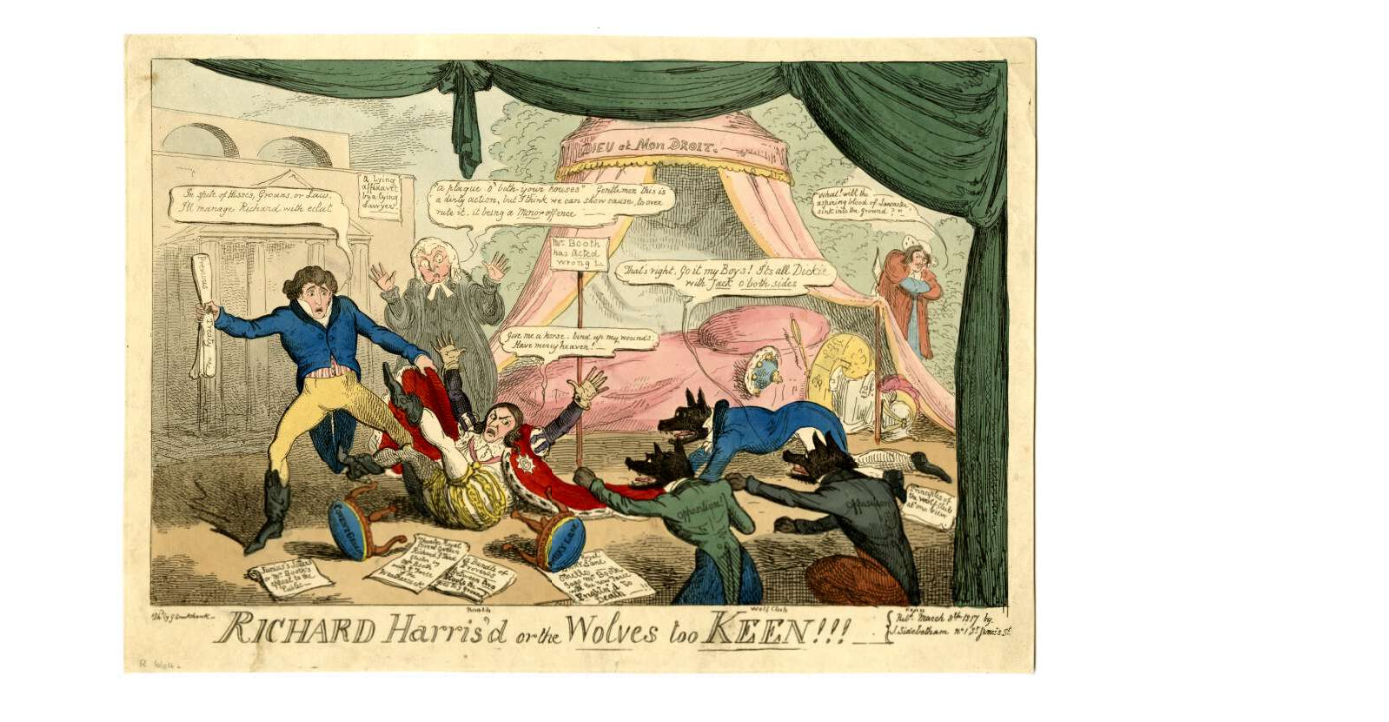
The Wolves Club had stopped meeting by 1817 when Junius Booth tried to star in a production of Richard III at Covent Garden. Unfortunately, a few nights earlier, Booth had disappointed a packed audience at Drury Lane, where he had been scheduled to act opposite Kean in Othello. Kean's fans took this as a slight, especially since Richard was a role associated with their hero, so they all showed up at Covent Garden, less than pleased.

Apparently, Booth couldn't even be heard amid all the uproar. He tried to apologize to the audience, but they refused to be quiet long enough for him to do so. Eventually, he came out wearing a placard stating "I have acted wrong..." The disaster was the talk of the theatre world, and a great embarrassment for Thomas Harris, the manager of Covent Garden. The artist George Cruikshank created a satirical print making fun of the whole affair, showing the theatre fans as well-dressed wolves.


Two years later, another satirical print came out making fun of a dispute Kean and Drury Lane's manager, Alexander Rae, had with the playwright Charles Bucke. Poor Bucke's tragedy The Judgement of Brutus had been a failure, but then Kean starred in a suspiciously similar piece by John Howard Payne called Brutus; or, The Fall of Tarquin. Bucke kept at it, and submitted a play called The Italians which had a role explicitly written for Kean. While the play was in rehearsal, however, Kean refused to proceed, stating he would rather pay a thousand pounds than have to perform the role. Three wolves guard Kean in a rather funny cartoon on the matter.


Later, when Kean got embroiled in a lawsuit over his affair with Charlotte Cox, Cruikshank's brother Isaac Robert created a print showing a whole audience full of wolves watching Kean perform on stage. As you can see, wolf imagery was frequently associated with Kean and his fans.


Tuesday, October 6, 2020

O'Neill's London Debut

On October 6th, 1814, the actress Eliza O'Neill made her London debut at the Theatre Royal, Covent Garden. She played the role of Juliet in Shakespeare's Romeo and Juliet, and for years afterward, the night would not be forgotten.

One contemporary said of her that "for grace, sweetness, delicacy, and refinement, she was unequalled." The painter Sir Thomas Lawrence marveled at how natural O'Neill's acting was, comparing her (as many people did) to Sarah Siddons, who had retired from the stage by that time.

Born in 1791 into a theatrical family, O'Neill allegedly made her first stage appearance being carried onstage in her father's arms. The family performed for years in her native Ireland, going back and forth between the Drogheda and Dundalk Theatres. These were decidedly small affairs, so she was quite fortunate to be spotted by a talent scout and invited to perform in Belfast.

O'Neill insisted that her entire family join her in Belfast, so her father, three brothers, sister, and a sister-in-law were all given engagements at the new theatre. It was O'Neill, however, who was undoubtedly the star, and the newspapers in Belfast were extremely favorable in their revues. After two years, the whole family moved to Dublin, where a dispute between a theatre manager and a star actress led to O'Neill getting an opportunity to appear as Juliet at the Crow Street Theatre.

After her successful appearance as Juliet, the manager of the theatre offered her a contract, agreeing to take on her father and brother as well. It was in Dublin that John Philip Kemble first spied the actress. "She has great talent and some genius," was Kemble's assessment. He offered her an engagement in London. Again, O'Neill asked that she be able to take her family with her. Kemble refused to employ them, but did agree to allow her brother Robert to accompany her as a personal protector and to have access to the theatre's green room.

And so it was that O'Neill was finally able to bring her celebrated Juliet to London. The actor William Charles Macready, recalling O'Neill's debut, hailed her "beauty, simplicity, and grace," as well as her "native elegance" and "feminine sweetness." Others commented on how as Juliet her character blossomed after she fell in love, and then fell into a heart-breaking despair. If she was ever perceived in a negative light, it was because audiences found her too boisterous and vehement for an era that still extolled classicism.

In fact, O'Neill helped to usher in a new era of Romantic acting. That January, Edmund Kean had made his debut at Drury Lane, and audiences were looking for a more emotional approach to the stage than had been taken by the previous generation. O'Neill obliged them, at least until 1819. That was when she left the stage to marry William Wrixon Becher, Esq., who soon after the marriage became a baronet. Thus, the once impoverished actress ended her life as Lady Becher.

Many theatre fans no doubt wished she had continued on the stage, but the former actress seemed happy in her retirement. She and her husband raised a family in Ireland, and she ended up living to the ripe age of 81. In any case, the revolution in acting she helped to bring about continued, and performers throughout the rest of the nineteenth century tended to adopt her emotion-filled style.

Monday, August 3, 2020

The Black Doctor

Ira Aldridge is one of those remarkable people we've known about for a long time, but who has been in recent years increasingly getting the attention he deserves.

Aldridge was born in 1807 in New York, though he later claimed to be from Africa, probably in a bid to appeal to European audiences who wanted to view him as a more "exotic" foreigner than just another American ex-patriot.

His father sold straw for a living, but also was a lay preacher. Later scholars have speculated that young Ira might have gotten his first vocal training from his father, who not only had to have a strong voice to preach, but who also hawked his straw from a cart he took around New York City, which meant he must have needed a strong voice to attract customers.

Aldridge's real theatrical training came from the African Grove Theatre, though. William Alexander Brown founded the theatre in 1821 to perform amateur productions of plays by Shakespeare and others, including Brown himself, whose play King Shotaway was sadly lost. The actors were of African ancestry, including William Hewlett, the star of the company, who was particularly famous for playing Richard III.

At the African Grove Theatre, Aldridge played such parts as the Inca warrior Rolla in Richard Brinsley Sheridan's Pizarro, but the company did not last long. The year the African Grove Theatre began offering their performances in downtown Manhattan, the Park Theatre was rebuilt in the same neighborhood.

The Park Theatre offered professional performances by white actors for a predominately white audience, though African Americans like Aldridge did watch shows from the upper balcony. When white audience members saw how good the productions at the African Grove were, though, they started patronizing the amateur company, and this was too much for the managers of the Park Theatre to take. They began to harass Brown's company, and the African Grove Theatre was eventually burned down, likely at the instigation of the management of the Park Theatre.

Aldridge probably saw that if he was going to have any success as an actor, it wasn't going to be in his home country. He emigrated to Britain, and had some success playing roles including Othello. That's when the most famous portrayer of Othello on the British stage, Edmund Kean, collapsed during a performance playing opposite his son Charles and died a couple months later. The theatre needed a new Othello, and Aldridge was chosen for the part.

What happened next is recounted in Lolita Chakrabarti's wonderful play Red Velvet. Reviews of Aldridge's Othello were mixed, and some were openly hostile and explicitly racist. Aldridge ended up leaving London, instead touring provincial theatres in Britain as well as larger venues on the European continent. There, he won great renown not just in Othello, but also Richard III, The Merchant of Venice, and King Lear, as well as dramas by Matthew G. Lewis, Charles Robert Maturin, and others.

In 1846, the hack dramatist Auguste Anicét-Bourgeois wrote a play called Le Docteur Noir. Anicét-Bourgeois seems to have written the play together with Philippe François Pinel Dumanoir, a melodramatist who would go on to adapt Uncle Tom's Cabin for the Théâtre de l'Ambigu-Comique in Paris. Le Docteur Noir might not have been great literature, but it did provide moments for great acting, and it appeared on the London stage in a translation by John Vilon Bridgeman and further adapted by Thomas Hailes Lacy.

In Bath, Bristol, and Dublin, Aldridge began performing another adaptation of the play by Thomas Archer. Aldridge's adaptation of The Black Doctor gives particular emphasis to race and class, according to theatre scholar Keith Byerman, who did a thorough analysis of different texts.

The play begins on the Isle of Bourbon, now known as Réunion, in the Indian Ocean near Madagascar. In the first scene, we hear of Pauline de la Reynerie, a French noblewoman whose life was saved by Fabian, the titular black doctor played by Aldridge. Pauline's mother was on a ship that is assumed to be wrecked, but it was her mother's wish that Pauline marry the Chevalier St. Luce. Meanwhile, Fabian has mysteriously disappeared, though some say "he has been observed wandering on the cliffs, but always avoiding anyone who appeared to seek him."

Scene Two takes place in Fabian's hut, where Pauline tracks him down and gives him a purse full of gold to distribute to the poor since he has refused payment for his services. She also tells him that a mysterious man has been sighted near her house, and we understand that the stranger is Fabian himself, who is in love with her. Pauline's mixed-race foster sister Lia is in love with a white clerk, and when Pauline says she will help her to marry the man in spite of racial prejudice, Fabian begins to have hope for his own prospects.

The brief third scene concerns some minor characters, and prepares the audience for the thrilling climax of the act, illustrated on the first page of the published play. Fabian, hearing that Pauline has been betrothed to St. Luce, takes her to a grotto down by the sea, hoping the ocean will kill them both when the tide comes in and floods the grotto.

Wait... the doctor who saved her is now going to murder her? Well, it isn't much different from Othello killing Desdemona, is it? Unlike Othello, though, Fabian takes pity on his victim. Pauline, thinking she will die, confesses, "I have long, long loved you!" Hearing this, Fabian carries her to a rock where they are saved by a passing ship.

Act Two takes place at the house of Pauline's family in Paris. It turns out that her mother the Marchioness is not dead after all. Fabian and Pauline have been secretly married, but he is officially employed by her family as a servant, and the Marchioness clearly thinks very little of him. Instead, she wants Pauline to marry St. Luce so she can become a lady of honor to the Queen. (This is presumably Marie Antoinette, as the next act takes place at the outset of the French Revolution.) Pauline, distraught, tries to take poison rather than abandon her husband, but Fabian grabs the poison from her and flees from the room, promising the Marchioness he will restore her daughter to her since that is the only way to save his beloved Pauline.

The dramatic curtain at the end of the second act is exceeded in drama by a third act that takes place in the Bastille on the historic day of its storming in 1789. Both St. Luce and Fabian have been imprisoned in different cells in the Bastille. St. Luce is portrayed as a stuck-up fop, enraged that he can't get luxuries while in prison. Fabian, on the other hand, has been living in misery and trying to communicate with his friend Andre to get news of what is happening outside the prison. Revolutionaries storm the Bastille, freeing the prisoners, but it is too late for Fabian. Thinking Pauline is dead, he falls into an insanity, and the act ends with the cannons of the revolution sounding.

In the fourth and final act, we are transported forward to the year 1793, during the Reign of Terror. Pauline is considered an enemy of the people, since it was her family who was responsible for crimes against Fabian, the good black doctor who is now revered. Andre has been taking care of Fabian, who is still insane. When the mad doctor sees Pauline, it looks like she will be saved from the mob, but then Fabian sees St. Luce beside her, as well as a portrait of the Marchioness. Still thinking the Marchioness is alive and will kill Pauline if they are together, Fabian denies being her husband. A man in the mob fires a gun at Pauline, but Fabian throws himself in front of her, taking the bullet. With his dying strength, Fabian produces the proof of their marriage, saving Pauline at the cost of his own life.

If the play sounds melodramatic, well, it is in fact a melodrama, even including a musical chord at the moment Pauline sees her husband in the final act. Aldridge might not have been a great playwright, but he was a great actor, and the play he adapted no doubt provided a suitable vehicle to display his own talents.

Monday, September 30, 2019

Romanticism and Theatrical Experience

I recently read Jonathan Mulrooney's book Romanticism and Theatrical Experience. It provides an excellent analysis of the actor Edmund Kean, the critic William Hazlitt, and the poet and playwright John Keats. It also delves into how each of these three figures in turn influenced one another.

The first part of the book is divided into two sections, one on theater and the daily news, and another on Britain's theatrical press during the first three decades of the nineteenth century. As Mulrooney observes, the eighteenth century had always had people writing about the theater in periodicals, but it wasn't until the end of that century that audiences were able to read day after day the events that had just taken place in the playhouses at Drury Lane and Covent Garden.

According to Mulrooney, the role of the reviewer shifted from being an advertiser to being an independent reporter. Reviews became longer and more substantial. A watershed moment came with the Old Price Riots, when audiences at Covent Garden disrupted performance night after night to protest an increase in ticket prices. After that, reviewers took to both giving their aesthetic judgments on plays and reporting how they saw audiences respond during the evening. Even people who were not there that night could then participate in the performances vicariously.

Mulrooney next details the different theatrical periodicals available in London from 1800 to 1830. The Theatrical Gazette, for instance, though it didn't last long, was able to give accounts of both Drury Lane and Covent Garden throughout the 1815-1816 season, focusing on alternating houses each night. Of more lasting importance was the Examiner, founded by Leigh and John Hunt. Mulrooney finds the Examiner to be "the most innovative periodical to publish theatrical criticism in the Romantic-period" because it represented theater "as a public experience equal to politics and commerce."

Perhaps no figure in Romanticism was as much a creature of the theatrical press as Edmund Kean, who created a sensation after he appeared at Drury Lane as Shylock in 1814. Mulrooney sees Kean as troubling class differences, since he came from and appealed to the working class. According to Mulrooney, he "embodied a kind of theatrical bad taste, a mobile, sexually ambiguous, working-class and even Cockney subject." Unlike the great John Philip Kemble, Kean avoided stately orations and statuesque gestures. Instead, his acting seemed natural, almost improvised. This made his performances best viewed from the pit, not the expensive boxes.

The same year Kean took to the stage at Drury Lane, Hazlitt began working as critic for both The Examiner and The Morning Chronicle. Mulrooney sees Hazlitt's writing as playing a role in the shift not just from the acting style of Kemble to that of Kean, but in "a fundamental change in the understanding of what a 'mental state' is, what a self is, and how that self is to be represented on stage." Hazlitt focused on cultural receptions to performances. Kean's class-defying performances in turn allowed him to write not just about theatre in the hallowed halls of the patent theaters, but also about jugglers, boxers, and other entertainers not generally covered in the press.

Kean influenced Keats, as well, as can be seen in his famous "negative capability" letter written in December of 1817. As Mulrooney notes, "the letter begins with Kean" and "represents a vital connection between Keats's theatrical experience and his poetry." Keats also wrote three substantial theater reviews in the Champion, covering for his friend John Hamilton Reynolds when he was out of town. Though some critics see Keats as a bit of a social climber, his championing of Kean firmly allies him with the working class.

Unfortunately, the list price for the book is almost $100, but that's what libraries are for, after all. If you get a chance, it's a compelling read for anyone interested in Romantic drama.