Showing posts with label Charles Kean. Show all posts

Wednesday, September 10, 2025

Kean, Dumas, Sartre

Edmund Kean has been called the greatest actor of the Romantic era, perhaps even the greatest actor of all time. (Kean wouldn't disagree with that.) However, his genius also attracted other geniuses, and he became the subject of a play by Alexandre Dumas that was later adapted for the 20th-century stage by Jean-Paul Sartre.

Dumas's play Kean is a comedy, while the actual Kean's life was more of a tragedy. (Like Molière, he collapsed onstage and subsequently died.) The play premiered in 1836--just three years after Kean's death--at the Théâtre des Variétés in Paris. No mention of the actor's famous death is made in the piece, as Dumas's play ends happily. It originally starred Frédérick Lemaître in the title role. Lemaître was a highly respected performer, and would go on to originate another title role in Victor Hugo's play Ruy Blas.
The play opens at a society soirée attended by the Danish ambassador and his wife, Elena, who is rumored to be in love with Edmund Kean. The fact is Kean had many lovers, but I'm not familiar with his ever being linked with the wife of a Danish ambassador. It hardly matters, since the scene is an excuse for Kean to at first decline an invitation to the party, and then show up and make a brilliant speech, entreating Elena to read aloud a letter. He then quietly asks her to flip the letter over and read the other side, which is an invitation to a private assignation with him.

Act II takes place in Kean's chambers. (In Sartre's adaptation, it's explicitly his dressing room at the theatre.) Dumas's stage directions state: "Au lever du rideau, le théâtre présente toutes les traces d’une orgie." (As the curtain rises, the theatre presents all the signs of an orgy.) A woman arrives in disguise, but it's not Elena, rather another woman, Anna, who wants to learn acting from Kean.

The third act takes place at the tavern of Peter Patt, which is called the Black Horse in Sartre's adaptation. This might be based on the Coal Hole, a pub Kean frequented with the members of his infamous Wolves Club. Kean agrees to act the role of Romeo at a benefit for a performer down on his luck. Kean was considered weak in that part, so Sartre changed it to Othello.

The performance is a disaster and causes a scandal which Kean is only extricated from by Anna. The French versions of Kean's life--both Dumas's and Sartre's--are historically inaccurate and leave out his wife Mary and son Charles. Still, they are a great deal of fun.

Friday, October 25, 2024

Sardanapalus

Last night, Red Bull Theater produced a staged reading of George Gordon Byron's Romantic tragedy Sardanapalus.

The play remained unperformed during Byron's lifetime, but it premiered in 1834 with William Charles Macready in the title role. Ellen Tree played Myrrha, a Greek slave who inspires the Assyrian emperor to rise to new heights.

At the time, no one in England had any idea what an Assyrian looked like, but excavations of Nineveh in the 1840s meant that ruins began to go on display at the British Museum. When Charles Kean staged a revival of the play in 1853, he could employ designers to meticulously reproduce Nineveh with a new level of historical accuracy never before seen.

Sketches for the sets--which were designed by William Gordon, J. Dayes, and Frederick Lloyds--can be found today in the collection of the Victoria and Albert Museum. Gordon painted scenery for the first and second acts of the play, showing an ancient city on the shores of a river. A second set, designed by Dayes, showed a chamber in the Royal Palace. Lloyds' image of the Great Hall of Nimrod shows the final scene of the play before the whole set appeared to burst into flames.


How the designers achieved this effect is a mystery. We do know that four years later the dramatist and theatre manager Dion Boucicault achieved a similar effect in his play The Poor of New York using quick burning "flash torches" which illuminated a large piece of fabric on which flames had been painted. This cloth was kept in constant motion to make the flames appear as realistic as possible.

However it was that set designers managed the feat, it was realistic enough to cause the insurers of the Princess's Theatre where the show was playing to send investigators to verify that the bursts of flames and falling rafters seen on stage did not actually constitute a threat to the building. Sadly, Red Bull did not have the resources to achieve such technical effects for a staged reading.

Still, the reading was quite enjoyable. Amir Arison played Sardanapalus while Shayvawn Webster took on the role of Myrrha. When she recited the monologue in Act III beginning "Now I am alone" (an echo from Act II, scene ii of Hamlet) I was entranced. From that moment on, the play seemed to move quickly from plot point to plot point right up to the grand finale.

This morning, I spoke on a roundtable about the play with noted scholar Michael Gamer and chaired by Omar Miranda. This was a part of the annual Stuart Curran Symposium. Mariam Wassif also delivered a great paper on the play there, noting how Byron's drama presented its protagonist as both an alternative to modernity and a warning about empire.

Sardanapalus has a lot to say to us here in the 21st century. I hope Red Bull will do a full production of it in the future. If they do, you won't want to miss it!

Sunday, June 5, 2022

Sad Stories of the Death of Kings

               For God's sake let us sit upon the ground
               And tell sad stories of the death of kings:
               How some have been depos'd, some slain in war,
               Some haunted by the ghosts they have deposed...

That speech doesn't appear until Act III of William Shakespeare's Richard II, but it opens the production by Hudson Classical Theater Company currently playing at the Soldiers' and Sailors' Monument in Riverside Park.

Hudson is a mixed bag, but sometimes their stagings of Shakespeare, such as 2019's Antony and Cleopatra, are well worth seeing. The location, in an idyllic open-air setting, tends to work well, in spite of the uncomfortable stone-step seating and the constant plague of helicopters.

Nathan Mattingly is well cast as Richard, the spoiled pretty-boy who becomes his own worst enemy, but can't help but become sympathetic by the end. The role has attracted a variety of actors through the years, from Charles Kean to David Tennant. Richard is a better poet than he is a king, but that just means he has some of the best verse in the play.

Opposing Richard is Bolingbroke, played in this production by Dominic Williamson, who quickly gets everyone on his side through his willingness to take decisive action while Richard dithers. For those who know what happens in the next few plays of the tetralogy, however, this action will bode ominously, since once you start deposing kings, you open up a dangerous precedent.

When Richard finds himself abandoned and begins reciting the same lines that opened the production, they don't feel repeated. Instead, we find ourselves listening to the same words in a new way. Director Nicholas Martin-Smith should be commended for making this work, as well as for finding innovative ways of using the space.

If you're interested in seeing the show, it's playing at 6:30 pm Thursdays through Sundays until June 26th. Admission is free, but they do take donations, so please be generous. The company also provides cushions for the seating, but they can't control the weather, so try to go on a clear night!

Monday, August 3, 2020

The Black Doctor

Ira Aldridge is one of those remarkable people we've known about for a long time, but who has been in recent years increasingly getting the attention he deserves.

Aldridge was born in 1807 in New York, though he later claimed to be from Africa, probably in a bid to appeal to European audiences who wanted to view him as a more "exotic" foreigner than just another American ex-patriot.

His father sold straw for a living, but also was a lay preacher. Later scholars have speculated that young Ira might have gotten his first vocal training from his father, who not only had to have a strong voice to preach, but who also hawked his straw from a cart he took around New York City, which meant he must have needed a strong voice to attract customers.

Aldridge's real theatrical training came from the African Grove Theatre, though. William Alexander Brown founded the theatre in 1821 to perform amateur productions of plays by Shakespeare and others, including Brown himself, whose play King Shotaway was sadly lost. The actors were of African ancestry, including William Hewlett, the star of the company, who was particularly famous for playing Richard III.

At the African Grove Theatre, Aldridge played such parts as the Inca warrior Rolla in Richard Brinsley Sheridan's Pizarro, but the company did not last long. The year the African Grove Theatre began offering their performances in downtown Manhattan, the Park Theatre was rebuilt in the same neighborhood.

The Park Theatre offered professional performances by white actors for a predominately white audience, though African Americans like Aldridge did watch shows from the upper balcony. When white audience members saw how good the productions at the African Grove were, though, they started patronizing the amateur company, and this was too much for the managers of the Park Theatre to take. They began to harass Brown's company, and the African Grove Theatre was eventually burned down, likely at the instigation of the management of the Park Theatre.

Aldridge probably saw that if he was going to have any success as an actor, it wasn't going to be in his home country. He emigrated to Britain, and had some success playing roles including Othello. That's when the most famous portrayer of Othello on the British stage, Edmund Kean, collapsed during a performance playing opposite his son Charles and died a couple months later. The theatre needed a new Othello, and Aldridge was chosen for the part.

What happened next is recounted in Lolita Chakrabarti's wonderful play Red Velvet. Reviews of Aldridge's Othello were mixed, and some were openly hostile and explicitly racist. Aldridge ended up leaving London, instead touring provincial theatres in Britain as well as larger venues on the European continent. There, he won great renown not just in Othello, but also Richard III, The Merchant of Venice, and King Lear, as well as dramas by Matthew G. Lewis, Charles Robert Maturin, and others.

In 1846, the hack dramatist Auguste Anicét-Bourgeois wrote a play called Le Docteur Noir. Anicét-Bourgeois seems to have written the play together with Philippe François Pinel Dumanoir, a melodramatist who would go on to adapt Uncle Tom's Cabin for the Théâtre de l'Ambigu-Comique in Paris. Le Docteur Noir might not have been great literature, but it did provide moments for great acting, and it appeared on the London stage in a translation by John Vilon Bridgeman and further adapted by Thomas Hailes Lacy.

In Bath, Bristol, and Dublin, Aldridge began performing another adaptation of the play by Thomas Archer. Aldridge's adaptation of The Black Doctor gives particular emphasis to race and class, according to theatre scholar Keith Byerman, who did a thorough analysis of different texts.

The play begins on the Isle of Bourbon, now known as Réunion, in the Indian Ocean near Madagascar. In the first scene, we hear of Pauline de la Reynerie, a French noblewoman whose life was saved by Fabian, the titular black doctor played by Aldridge. Pauline's mother was on a ship that is assumed to be wrecked, but it was her mother's wish that Pauline marry the Chevalier St. Luce. Meanwhile, Fabian has mysteriously disappeared, though some say "he has been observed wandering on the cliffs, but always avoiding anyone who appeared to seek him."

Scene Two takes place in Fabian's hut, where Pauline tracks him down and gives him a purse full of gold to distribute to the poor since he has refused payment for his services. She also tells him that a mysterious man has been sighted near her house, and we understand that the stranger is Fabian himself, who is in love with her. Pauline's mixed-race foster sister Lia is in love with a white clerk, and when Pauline says she will help her to marry the man in spite of racial prejudice, Fabian begins to have hope for his own prospects.

The brief third scene concerns some minor characters, and prepares the audience for the thrilling climax of the act, illustrated on the first page of the published play. Fabian, hearing that Pauline has been betrothed to St. Luce, takes her to a grotto down by the sea, hoping the ocean will kill them both when the tide comes in and floods the grotto.

Wait... the doctor who saved her is now going to murder her? Well, it isn't much different from Othello killing Desdemona, is it? Unlike Othello, though, Fabian takes pity on his victim. Pauline, thinking she will die, confesses, "I have long, long loved you!" Hearing this, Fabian carries her to a rock where they are saved by a passing ship.

Act Two takes place at the house of Pauline's family in Paris. It turns out that her mother the Marchioness is not dead after all. Fabian and Pauline have been secretly married, but he is officially employed by her family as a servant, and the Marchioness clearly thinks very little of him. Instead, she wants Pauline to marry St. Luce so she can become a lady of honor to the Queen. (This is presumably Marie Antoinette, as the next act takes place at the outset of the French Revolution.) Pauline, distraught, tries to take poison rather than abandon her husband, but Fabian grabs the poison from her and flees from the room, promising the Marchioness he will restore her daughter to her since that is the only way to save his beloved Pauline.

The dramatic curtain at the end of the second act is exceeded in drama by a third act that takes place in the Bastille on the historic day of its storming in 1789. Both St. Luce and Fabian have been imprisoned in different cells in the Bastille. St. Luce is portrayed as a stuck-up fop, enraged that he can't get luxuries while in prison. Fabian, on the other hand, has been living in misery and trying to communicate with his friend Andre to get news of what is happening outside the prison. Revolutionaries storm the Bastille, freeing the prisoners, but it is too late for Fabian. Thinking Pauline is dead, he falls into an insanity, and the act ends with the cannons of the revolution sounding.

In the fourth and final act, we are transported forward to the year 1793, during the Reign of Terror. Pauline is considered an enemy of the people, since it was her family who was responsible for crimes against Fabian, the good black doctor who is now revered. Andre has been taking care of Fabian, who is still insane. When the mad doctor sees Pauline, it looks like she will be saved from the mob, but then Fabian sees St. Luce beside her, as well as a portrait of the Marchioness. Still thinking the Marchioness is alive and will kill Pauline if they are together, Fabian denies being her husband. A man in the mob fires a gun at Pauline, but Fabian throws himself in front of her, taking the bullet. With his dying strength, Fabian produces the proof of their marriage, saving Pauline at the cost of his own life.

If the play sounds melodramatic, well, it is in fact a melodrama, even including a musical chord at the moment Pauline sees her husband in the final act. Aldridge might not have been a great playwright, but he was a great actor, and the play he adapted no doubt provided a suitable vehicle to display his own talents.

Saturday, January 26, 2019

Edmund Kean's Shylock

On this day in 1814, Edmund Kean appeared as Shylock on the stage of the Theatre Royal, Drury Lane.

It would launch Kean's career, but it was not the first time he had appeared on a London stage. Writing 72 years later in the October issue of The Theatre, Percy Fitzgerald recalled Kean's "most extraordinary career." According to Fitzgerald, Kean "had been literally reared on the stage" and had "performed the young Arthur to Mrs. Siddon's Constance" in William Shakespeare's King John.

Childhood appearances with Sarah Siddons were not the actor's only experience in London prior to his Drury Lane triumph. Fitzgerald recounts an appearance at the Theatre Royal, Haymarket on 30 July 1806, when Kean appeared as "Clown" in the farce Fortune's Frolic. Playing the role of Dolly in that production was "Mrs. Gibbs" whom I take to be Maria Gibbs, née Logan, who made her London debut at the Haymarket in 1783.

After his appearance as "Clown" Kean returned to touring the provinces, and it was in Dorchester that he was rediscovered. Robert William Elliston invited him back to London to act in one of the "minor theatres." Fitzgerald writes that a certain "Dr. Drury" recommended Drury Lane hire Kean instead, and one "Mr. Arnold" came out to see the actor for himself. On 14 November 1813, Kean acted in The Mountaineers with "few people in the pit and gallery and three persons in the boxes." In spite of the small house, Kean determined to play his best, and his efforts were rewarded. He was given the opportunity to appear at Drury Lane, a pleasure mixed with sorrow, as his son Howard was very ill at the time.

Soon after Kean received news he would have a London engagement, Howard died. "His grief was such that he did not care for the brilliant opening," Fitzgerald writes. Kean had to stay longer in Dorchester than he anticipated in order to attend to the business of his son's death. When he arrived in London, he appeared "defiant, suspicious, jealously independent, very poor, almost to squalor" and the committee at Drury Lane saw him as a "listless, shabby postulant." They apparently rebuked Arnold and tried to use Kean's bargain with Elliston as an excuse to void their own agreement with him. Kean engaged in "desperate exertion" to free himself from his engagement to perform at a minor theatre, and according to Fitzgerald, "it was said Elliston was rather glad to be free."

After a "single rehearsal, it was pronounced that it would be a certain failure," Fitzgerald writes. The day of his performance was "wet and miserable" and Kean that night "arrived soaked through" at his shared dressing room. His fellow performers noticed something curious about the way Kean dressed himself for Shylock: "he was putting on a black wig instead of the traditional red one." In the eighteenth century, Shylock had generally been played as a clown. (After all, Shakespeare's The Merchant of Venice is in fact a comedy.) The actor Charles Macklin had pushed back against that tradition, but the red wig had remained. What was wrong with this guy? Didn't he even know which costume he was supposed to wear? The stage manager at the performance gave Kean up as "hopeless," Fitzgerald says.

The cast of The Merchant of Venice that night boasted some of the actors who had premiered S.T. Coleridge's drama Remorse the previous year. Alexander Rae, who had played Ordonio in Coleridge's tragedy, appeared as Bassanio, and Sarah Smith, who originated the role of Teresa in Remorse, came on in the choice role of Portia. Smith was once considered the most promising actress in Britain, but by 1814 she had turned out to be a disappointment. Thus, Kean had few fellow actors in the cast who could compete with his performance. After the first act, people began to realize that Kean's Shylock was "a great success." He went home afterward and reportedly said of his son Charles Kean, "Charley, my boy, you shall go to Eton!"

The younger Kean did in fact go to school at Eton, but later fell so far in life he had to resort to acting, just like his father. That, however, is another story.

Saturday, July 28, 2018

Father and Son


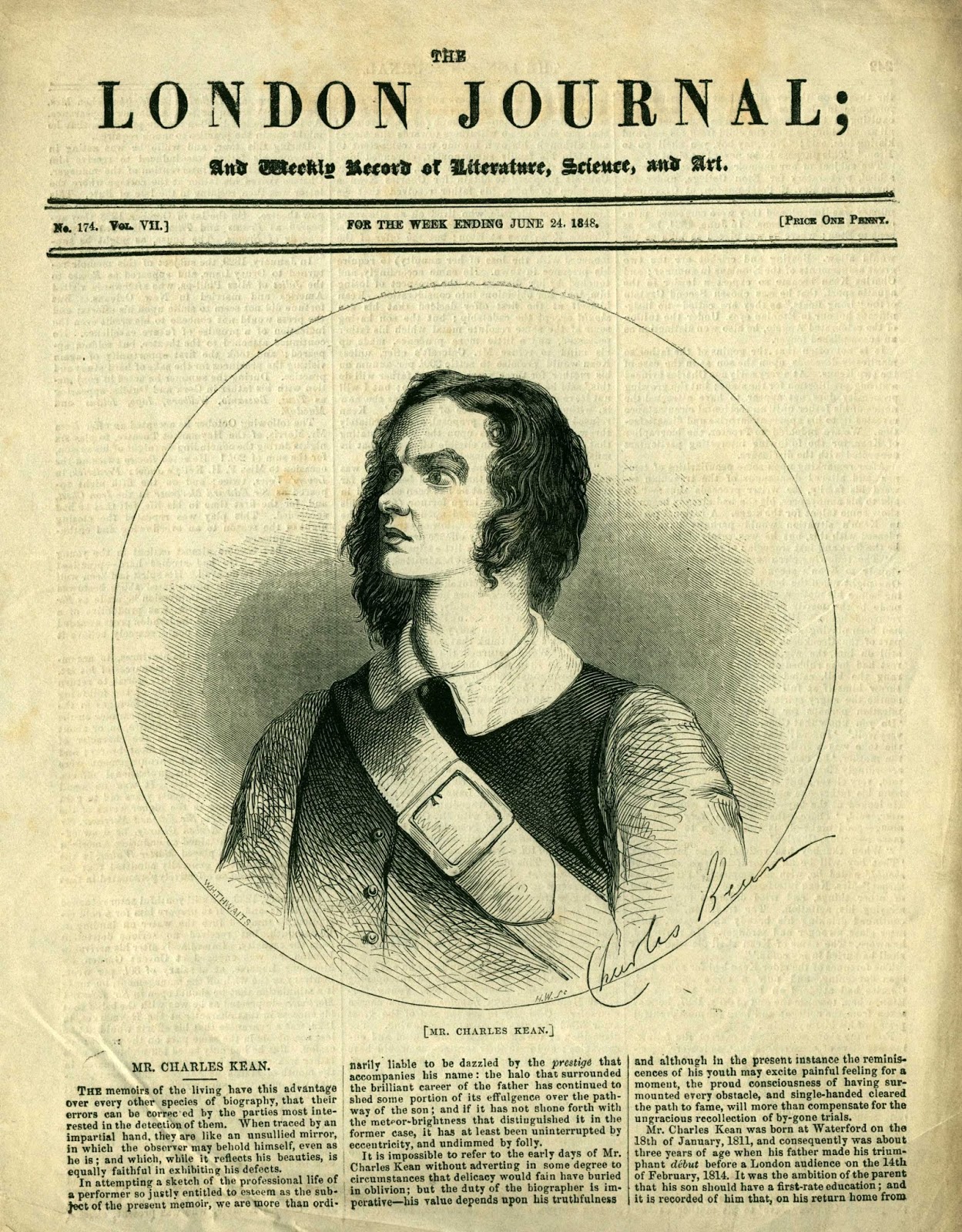
The actor Charles Kean, in spite of all his accomplishments in the theatre, was always known--and probably always will be known--as the son of Edmund Kean, one of the greatest actors of the Regency period.

In a memoir of Charles Kean published in 1848 in The London Journal, the paper noted that "the halo that surrounded the brilliant career of the father has continued to shed some portion of its effulgence over the pathway of the son," adding, "if it has not shone forth with the meteor-brightness that distinguished it in the former case, it has at least been uninterrupted by eccentricity, and undimmed by folly."

Edmund Kean was, quite frankly, a lecher and a drunk. His son was only three years old when the father rocketed to fame playing Shylock in Shakespeare's The Merchant of Venice at Drury Lane. Edmund didn't want the boy to have to stoop to acting, so he made sure Charles had (in the words of The London Journal) "a first-rate education." When Edmund came home from his triumphant debut as Shylock, he reportedly kissed his son and said: "Now, my boy, you shall go to Eton."

Indeed, Charles did attend the prestigious preparatory school in Eton, and supposedly "was placed as high as the rules of the institution, having reference to age, would allow." There he excelled at boating as well as academics, and distinguished himself in fencing (a skill that would come in handy during his later career as an actor). Unfortunately, the elder Kean's star dimmed in in the 1820s, and in 1827 he was forced to take his son out of school. Edmund still under no circumstances wanted his son to become an actor, though.

Charles Kean was offered a cadetship in India, but he was reluctant to go, given that his parents by that point were estranged, and he wanted to make sure someone could provide for his mother. When Edmund declined to increase his wife's allowance, Charles refused the position in India. His father was furious, and told Charles he would have to fend for himself. At only 16 years of age, with only an incomplete education and few skills other than his natural talent for acting, the son had little choice other than to pursue a career on the stage.

He first appeared at Drury Lane on 1 October 1827 as Young Norval in John Home's tragedy Douglas. Audiences were curious to see the son of the most celebrated actor alive try his hand at the family business. Reviewers were harsh, but Charles appeared a few more times at Drury Lane before touring the provincial circuit. According to The London Journal, he even appeared with his father on stage in Glasgow in Howard Payne's tragedy Brutus. In 1829, Charles returned to Drury Lane after improving his acting on the road. In the fall, he appeared at the Haymarket for the tail end of that theatre's season, finally finding success in The Iron Chest by George Colman the Younger.

Charles toured the provinces again, and then America. Returning to London in 1833, he was engaged not by Drury Lane, but by the rival patent theatre at Covent Garden. Soon thereafter, his father was hired by Covent Garden as well. Edmund Kean appeared first as Shylock, and then it was announced he would play one of his most powerful and well-known roles: Othello. The plan was for Ellen Tree to play Desdemona and for Charles to take the role of Iago.

There were no rehearsals, as all of the actors knew their parts already, but Edmund called his son into his dressing room for a private conference. The elder Kean was dreadfully ill and did not think he would be able to perform that night. Charles tried to cheer him up, and on the Ides of March 1833, father and son shared the same stage once again.

It was to be their last time, as well. In the middle of Act III, Edmund collapsed, crying out: "O God, I am dying. Speak to them, Charles." He died a few days later. Charles went on to become a great theatre manager, but his acting always remained in the shadow of his father.