Showing posts with label Ellen Tree. Show all posts

Friday, October 25, 2024

Sardanapalus

Last night, Red Bull Theater produced a staged reading of George Gordon Byron's Romantic tragedy Sardanapalus.

The play remained unperformed during Byron's lifetime, but it premiered in 1834 with William Charles Macready in the title role. Ellen Tree played Myrrha, a Greek slave who inspires the Assyrian emperor to rise to new heights.

At the time, no one in England had any idea what an Assyrian looked like, but excavations of Nineveh in the 1840s meant that ruins began to go on display at the British Museum. When Charles Kean staged a revival of the play in 1853, he could employ designers to meticulously reproduce Nineveh with a new level of historical accuracy never before seen.

Sketches for the sets--which were designed by William Gordon, J. Dayes, and Frederick Lloyds--can be found today in the collection of the Victoria and Albert Museum. Gordon painted scenery for the first and second acts of the play, showing an ancient city on the shores of a river. A second set, designed by Dayes, showed a chamber in the Royal Palace. Lloyds' image of the Great Hall of Nimrod shows the final scene of the play before the whole set appeared to burst into flames.


How the designers achieved this effect is a mystery. We do know that four years later the dramatist and theatre manager Dion Boucicault achieved a similar effect in his play The Poor of New York using quick burning "flash torches" which illuminated a large piece of fabric on which flames had been painted. This cloth was kept in constant motion to make the flames appear as realistic as possible.

However it was that set designers managed the feat, it was realistic enough to cause the insurers of the Princess's Theatre where the show was playing to send investigators to verify that the bursts of flames and falling rafters seen on stage did not actually constitute a threat to the building. Sadly, Red Bull did not have the resources to achieve such technical effects for a staged reading.

Still, the reading was quite enjoyable. Amir Arison played Sardanapalus while Shayvawn Webster took on the role of Myrrha. When she recited the monologue in Act III beginning "Now I am alone" (an echo from Act II, scene ii of Hamlet) I was entranced. From that moment on, the play seemed to move quickly from plot point to plot point right up to the grand finale.

This morning, I spoke on a roundtable about the play with noted scholar Michael Gamer and chaired by Omar Miranda. This was a part of the annual Stuart Curran Symposium. Mariam Wassif also delivered a great paper on the play there, noting how Byron's drama presented its protagonist as both an alternative to modernity and a warning about empire.

Sardanapalus has a lot to say to us here in the 21st century. I hope Red Bull will do a full production of it in the future. If they do, you won't want to miss it!

Saturday, November 12, 2022

Talfourd's ION

In the latest issue of Theatre Notebook, Christopher Butcher has an excellent article on William Charles Macready bringing Thomas Noon Talfourd's play Ion to the stage.

Though the play shares its title with a tragedy by Euripides, Talfourd's take is quite different, and involves the young prince Ion sacrificing his own life for the good of the state. The author had the piece printed privately and circulated it among a number of notables, including Macready.

The actor was excited about the play, but recognized that audiences might consider him too old to play a young character like Ion. However, impressed by Macready's performance in another tragedy on classical themes, Virginius, Talfourd requested the star actor to appear in the starring role. Macready was only too happy to oblige.

Originally, the play was supposed to be performed for Macready's benefit night at the Theatre Royal, Drury Lane. Unfortunately, Macready had a violent quarrel with the theatre's manager, Alfred Bunn. Macready had to turn to Talfourd for legal advice in the matter. The actor wanted out of his contract at Drury Lane, and so he ended up using Ion as a pretext for gaining his own dismissal. He wrote to Bunn demanding that the play be brought into rehearsal as soon as possible. Bunn fired Macready for his impudence, which is precisely what the actor wanted.

Even before Bunn had fired him, Macready had begun negotiations to appear at the rival Theatre Royal, Covent Garden. Included in his contract was a stipulation that Ion be performed. Eventually, the date of the premiere was set for May 26, 1836, which was also Talfourd's birthday. Macready wanted the painter Clarkson Stanfield to provide the scenery, though he was unfortunately unavailable.

Ellen Tree agreed to play the role of Clemanthe, and the piece was advertised as being for one night only. Joanna Baillie, the most highly regarded dramatist of her day, was in the audience, as were William Wordsworth, Walter Savage Landor, Henry Crabb Robinson, Henry Hart Milman, Robert Browning, Sheridan Knowles, and Charles Dickens.

The play was a success, with the audience calling for the author to take a bow. Talfourd received numerous letters congratulating him, and plans were made for a lengthier run, rather than just the one-night-only event. Macready had introduced cuts that greatly reduced the role of Clemanthe, and when the play later began its official run, Helen Faucit replaced Ellen Tree. At first, Faucit was disappointed by her own performance, but Talfourd wrote her a kind letter that buoyed her spirits.

Ion was performed June 1, 3, 6, 8, 9, 10, and 11 at Covent Garden, and would have run longer, except Macready had engagements elsewhere. It even led to a minor revival in Greek themes on the London stage. Though the play has been largely forgotten, Butcher's article brings new attention to this important moment in theatrical history.

Incidentally, if you want to read more about Macready, you can find plenty of information about him in my new book, Romantic Actors, Romantic Dramas. Though I don't have a full chapter on Macready, his career is discussed at length, as is the work of Baillie, Browning, Faucit, Knowles, Milman, and others.

And though I don't have an article in this issue of Theatre Notebook, my article "War, Pandemic, and Immortality: 1918 and the Drama of Eternal Life" appears in the latest issue of Shaw. Check it out!

Saturday, July 28, 2018

Father and Son


The actor Charles Kean, in spite of all his accomplishments in the theatre, was always known--and probably always will be known--as the son of Edmund Kean, one of the greatest actors of the Regency period.

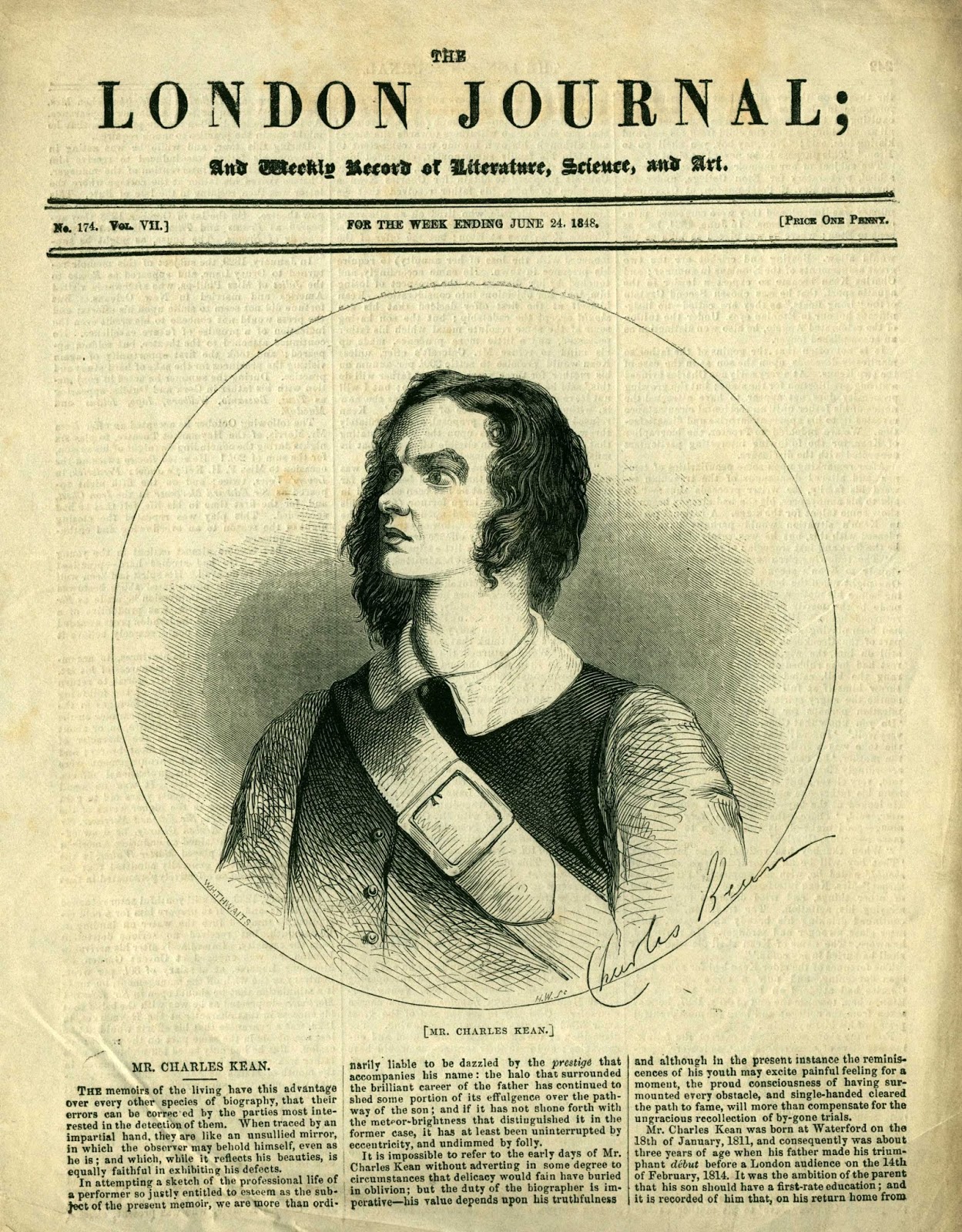
In a memoir of Charles Kean published in 1848 in The London Journal, the paper noted that "the halo that surrounded the brilliant career of the father has continued to shed some portion of its effulgence over the pathway of the son," adding, "if it has not shone forth with the meteor-brightness that distinguished it in the former case, it has at least been uninterrupted by eccentricity, and undimmed by folly."

Edmund Kean was, quite frankly, a lecher and a drunk. His son was only three years old when the father rocketed to fame playing Shylock in Shakespeare's The Merchant of Venice at Drury Lane. Edmund didn't want the boy to have to stoop to acting, so he made sure Charles had (in the words of The London Journal) "a first-rate education." When Edmund came home from his triumphant debut as Shylock, he reportedly kissed his son and said: "Now, my boy, you shall go to Eton."

Indeed, Charles did attend the prestigious preparatory school in Eton, and supposedly "was placed as high as the rules of the institution, having reference to age, would allow." There he excelled at boating as well as academics, and distinguished himself in fencing (a skill that would come in handy during his later career as an actor). Unfortunately, the elder Kean's star dimmed in in the 1820s, and in 1827 he was forced to take his son out of school. Edmund still under no circumstances wanted his son to become an actor, though.

Charles Kean was offered a cadetship in India, but he was reluctant to go, given that his parents by that point were estranged, and he wanted to make sure someone could provide for his mother. When Edmund declined to increase his wife's allowance, Charles refused the position in India. His father was furious, and told Charles he would have to fend for himself. At only 16 years of age, with only an incomplete education and few skills other than his natural talent for acting, the son had little choice other than to pursue a career on the stage.

He first appeared at Drury Lane on 1 October 1827 as Young Norval in John Home's tragedy Douglas. Audiences were curious to see the son of the most celebrated actor alive try his hand at the family business. Reviewers were harsh, but Charles appeared a few more times at Drury Lane before touring the provincial circuit. According to The London Journal, he even appeared with his father on stage in Glasgow in Howard Payne's tragedy Brutus. In 1829, Charles returned to Drury Lane after improving his acting on the road. In the fall, he appeared at the Haymarket for the tail end of that theatre's season, finally finding success in The Iron Chest by George Colman the Younger.

Charles toured the provinces again, and then America. Returning to London in 1833, he was engaged not by Drury Lane, but by the rival patent theatre at Covent Garden. Soon thereafter, his father was hired by Covent Garden as well. Edmund Kean appeared first as Shylock, and then it was announced he would play one of his most powerful and well-known roles: Othello. The plan was for Ellen Tree to play Desdemona and for Charles to take the role of Iago.

There were no rehearsals, as all of the actors knew their parts already, but Edmund called his son into his dressing room for a private conference. The elder Kean was dreadfully ill and did not think he would be able to perform that night. Charles tried to cheer him up, and on the Ides of March 1833, father and son shared the same stage once again.

It was to be their last time, as well. In the middle of Act III, Edmund collapsed, crying out: "O God, I am dying. Speak to them, Charles." He died a few days later. Charles went on to become a great theatre manager, but his acting always remained in the shadow of his father.


Friday, January 6, 2017

A Legend of Florence

The poet Leigh Hunt was not known for his business acumen. In fact, Charles Dickens famously satirized Hunt's impecuniousness with the character of Harold Skimpole in Bleak House.

However, in 1840, Hunt finally met with some success. After several abortive attempts at drama, Hunt had his play A Legend of Florence premiered at the Theatre Royal at Covent Garden. Ten years later, Samuel Phelps revived the piece at Sadler's Wells, and Queen Victoria later ordered a command performance of the piece at Windsor Castle.

Hunt's one big theatrical hit starred Ellen Tree at Covent Garden. Tree would later marry Charles Kean, but in 1840 she was famous in her own right, and A Legend of Florence gave her a star vehicle in which to shine. The play, as its name indicates, comes from a Florentine legend of a woman who wandered the streets in her grave clothes after awaking in a tomb, having been mistaken for dead. (Edgar Allan Poe would have loved it.)

The play begins with a light-hearted conversation of a poet and a papal official, in which they recount the sorrows of Ginevra, a noblewoman in a miserable marriage. Though the noble Florentine Antonio Rondinelli loved her, Ginevra was instead married off to Francesco Agolanti, a bitter and jealous man who treats her horribly. Pope Leo X is returning to his hometown of Florence with much festivity, but Ginevra must stay inside. Still, she accepts her fate with equanimity, saying:

Well, dear Diana, should my husband's judgement
Encourage me to think my health would bear it,
I would fain venture, but—I hear him coming.
At all events, the windows will be gladly
Filled with your pleasures; the report of which
Will afterwards make them mine.

Agolanti is incensed when he learns that Rondinelli has sent letters to Ginevra, even though she has refused to open them. Ginevra has been weakened by a "late sharp illness." Still, her husband continues to torment her. Hunt prepares the audience for Ginevra's physical collapse, having her complain to her husband:

You make the blood at last mount to my brain,
And tax me past endurance. What have I done,
Good God! what have I done, that I am thus
At the mercy of a mystery of tyranny,
Which from its victim demands every virtue,
And brings it none?

Rondinelli, concerned that the woman he adores is being hounded to death by her husband, arranges a meeting with Agolanti to try to talk some sense into him, but as the two men argue, the passing bell marks Ginevra's death. All who hear it remove their caps, except for her hard-hearted husband, who only takes off his hat when he is chastised. The Act III curtain falls on a scene of gloom and despair.

In Act IV, Ginevra, having awakened in her tomb and walked through the city streets, piteously entreats entrance into her own home, but Agolanti, filled with guilt, orders the doors shut against what he takes to be a ghost. She then goes to Rondinelli's, having nowhere else to turn. When he suggests returning her to her husband, her answer is firm:

Never. The grave itself has been between us;
The hand of Heaven has parted us, acknowledged
By his own driving me from his shrieking doors:
And none but thy door, and a convent's now,
To which thy honourable haste will guide me,
Shall open to me in this world again.

Agolanti eventually hears of what has occurred and goes to Rondinelli, demanding the return of his wife. At one point, Ginevra starts to go with him, but when he triumphs in his mastery over her, it is too much for her to bear. Bravely standing up to him, she cries:

Madness will crush my senses in, or speak:
The fire of the heavenward sense of my wrongs crowns me;
The voice of the patience of a life cries out of me;
Every thing warns me. I will not return.
I claim the judgement of most holy church.
I'll not go back to that unsacred house,
Where heavenly ties restrain not hellish discord,
Loveless, remorseless, never to be taught.

Agolanti draws his sword, and when he threatens others, they decide he must be killed before he can harm anyone else. The death of the villain is not exactly tragedy, but it is satisfying.

Wednesday, April 16, 2014

Red Velvet

Last night I saw Tricycle Theatre's wonderful production of Red Velvet at St. Ann's Warehouse. This new play by Lolita Chakrabarti tells the story of the great nineteenth-century actor Ira Aldridge. It's definitely worth seeing, especially for the performance of Adrian Lester, who plays Aldridge.

The play begins in Poland, where Aldridge died, and where his grave is still honored and revered. A  female Polish journalist sneaks backstage and proceeds to try to get an interview, but the aging and cantankerous Aldridge will have none of it. Why, she wonders, did Aldridge, one of the greatest Shakespearean actors alive, play Covent Gardens only twice? He doesn't want to tell her, but the play flashes back to 1833, showing the audience just what Aldridge has against London.

Chakrabarti takes some liberties with history, but always to heighten dramatic effect. What is true is that Aldridge--an African-American actor who could not get recognized in his home country and had been touring the provinces in Great Britain--was asked to take over the role of Othello at Covent Garden following the collapse of the great Edmund Kean. Poor Kean had been playing Othello when he collapsed on stage, calling for his son Charles, who was playing Iago at the time.

In the play, Charles Kean refuses to go on as Iago opposite Aldridge due to the American actor's race. In reality, he probably didn't play Iago due to the shock of his father's terrifying collapse less the two weeks previously. In fact, Charles Kean had already played Iago to Aldridge's Othello in Belfast in 1829. The play gets around this by claiming Kean was engaged for the performance, but had to cancel due to illness.

It might not be fair to tar poor Charles Kean as a racist, but in Chakrabarti's hands, he makes a wonderful antagonist, especially as his fiancé, Ellen Tree, is performing the part of Desdemona opposite Aldridge. Kean becomes intensely jealous (hints of Othello). Tree, though hesitant at first, comes to appreciate the passionate and more naturalistic acting style of Aldridge, and the play gives us a wonderful glimpse into some of the acting debates of the 1830s.

For whatever reason, Aldridge only performed the role of Othello twice at Covent Garden, and a few days later the theatre went dark for less than a week. The play builds off of these facts to weave a brilliant back-stage drama in which Aldridge descends into his own personal tragedy. Even if Chakrabarti has to conjure up some of the details, however, it is certain than Aldridge left London with a bitter taste in his mouth and preferred acting on the Continent in the future, where his performances were much better received.

Some historical information I picked up at the performance quoted one of my own heroes, Eliza O'Neill, greatly complimenting Aldridge. "During my professional and private life," the retired actress wrote, "I never saw so correct a portraiture of Othello amidst the principal luminaries of my age."

Aldridge was one of the greatest Shakespearean actors of the Victorian era, and it's wonderful to see that he now has a play of his own!

Sunday, August 25, 2013

The Jealous Wife

I recently read The Jealous Wife by George Colman the Elder. Coleman was an eighteenth-century playwright whose son of the same name also wrote plays, hence his title as "the elder." Here's a portrait of him done in the style of Joshua Reynolds, though apparently not by that great artist.


It is perhaps fitting that his portrait should just be "in the style of" a great artist. I think few people would argue that Coleman himself was a great artist, even though he did sometimes capture the style of superior writers.

The Jealous Wife appears to be Coleman's second play, produced in 1761, the year after his first dramatic work, Polly Honeycomb.  Though genuinely funny, The Jealous Wife is reminiscent of Henry Fielding's work, particularly Tom Jones. It also might have benefited from suggestions and cuts made by Coleman's friend, David Garrick. In any case, after the play premiered at Drury Lane, it made Coleman famous.

The first act sets up Mrs. Oakly as the titular jealous wife. She intercepts a letter intended for her husband, at first suspecting that it is a love note from a woman, in spite of the fact that the address is written in a man's handwriting. Mr. Oakly reads the letter and finds out it is a complaint by Henry Russet, whose daughter has eloped. Mrs. Oakly madly claims that he husband has run off with the girl, while the more likely culprit is Charles, an orphaned nephew of Mr. Oakly's. As it turns out, Charles was in love with Miss Russet, but he is innocent of this particular offense. She did not elope with anyone, but rather ran away from her father to avoid a forced marriage to Sir Beagle. (Got all that?) Young Harriet Russet makes the unwise decision to take refuge with her aunt, Lady Freelove. The woman's name alone should have been a hint she was not of good character!

Act II begins with Mrs. Oakly again complaining that her husband must be intriguing to have an affair. She pretends to make up with him, but she becomes enraged whenever she hears anything about Harriet. Mrs. Oakley sends her servant, the unfortunately named Toilet, to let the porter know she will not see anyone for the day. Mr. Oakly comments that she will sit all day feeding on her own suspicions. Exercising her prerogative to change her mind, however, Mrs. Oakly then orders a chariot so she can go out.

The second scene of Act II takes place at the home of Lady Freelove, who has been trying to arrange a match between Harriet and Lord Trinket. When Lady Freelove leaves her niece together with the lord, he tries to force himself upon her, and she is only saved by the timely arrival of Charles, who draws on Lord Trinket. Harriet escapes, but Charles looks bad, having arrived unannounced at Lady Freelove's house and promptly getting into a brawl. The situation is made worse when Mrs. Oakly arrives. Lady Freelove sees that her visitor is a jealous type, and takes advantage of the situation, planting hints that Mr. Oakly is having an affair with the girl, though this is clearly so she can get Charles out of the way.

In the third scene of Act II, we return to Oakly's home, where Harriet has fled, hoping to find some protection from Lord Trinket. Mrs. Oakly returns to find her husband speaking with this beautiful young woman and decides to hide and listen in on their conversation. Unfortunately, she only half-hears what they say. Mr. Oakly tries to arrange for a place for Harriet to stay without being under the same roof as Charles, but to Mrs. Oakly it sounds like he is setting her up to be a kept woman. Mr. Russet arrives, and Harriet collapses into Mr. Oakly's arms. Russet drags his daughter out of the house as the curtain falls.

The first scene of Act II shows Mrs. Oakly in her dressing room giving contradictory orders to the unfortunately named Toilet. Her suspicions of her husband are stronger than ever, and she resolves not to see him for three days. Given how many different things she has claimed she will do, however, the audience knows that this is not going to last.

In the final scene, Russet learns that Sir Beagle has decided he does not want a loveless marriage and has agreed to swap Harriet to Lord Trinket in exchange for a brown horse named Nabob. Mr. Oakly's brother manages to explain the whole mess to Russet, who agrees to allow his daughter to marry Charles. All that remains is for Mr. Oakly to stand up to his wife and cure her of jealousy. Taking his brother's advice, Oakly rails at his wife and cowers her into submission. His patriarchal supremacy reestablished, everything ends happily, and Mrs. Oakly proclaims that she has not merited her husband's kindness.

This play is not exactly a model of feminist enlightenment, but it does have some funny moments, and Mrs. Oakly is a great part for a comic actress, provided she's willing to partake in what is clearly a chauvinistic play. Hannah Pritchard originally played the role acting opposite Garrick, who played Mr. Oakly. In 1855, Charles Kean famously revived the piece with himself as Oakly and the actress Ellen Tree, by that point Mrs. Kean, in the title role.