Showing posts with label David Garrick. Show all posts

Sunday, May 15, 2022

What Doesn't Go up in Smoke

I have no affection for cigarettes. When I was growing up, both of my parents smoked, and wanting to be like them, I wanted to smoke, too. One day, sitting on my mother's lap, I asked her if I could have a puff of her cigarette. She handed it to me. I took a puff. I have never wanted to smoke anything ever again.

What I do have a fascination for, however, is cigarette cards. These cards were originally added to cigarette packages to stiffen them, and by the 1880s, manufacturers were printing advertisements on them, often including popular images that could be collected by consumers. Those images could be of sports stars, famous Native American leaders, national flags, exotic animals, or sometimes actors and actresses.

These cards can sometimes be found on Internet auction sites, and I've purchased a few in recent years, wanting to have images of performers from the Regency era. The first one I bought was when I saw for sale a cigarette card of the actress Eliza O'Neill identical to one in the collection of the New York Public Library. The card, issued by Chairman Cigarettes, probably dates to the 1920s. The reverse side gives information about O'Neill, including that she excelled in the roles of Belvidera, Juliet, and Mrs. Beverley.

Chairman Cigarettes appears to have been based in England at the beginning of the 20th century, but I've found scant information on them. Recently, I obtained a number of cigarette cards issued by Player's Cigarettes. John Player & Sons was based in Nottingham, but it merged with Imperial Tobacco Group in 1901. Under the ownership of Imperial, Player's issued a number of trading cards, though it had issued its own cards as far back as 1893. Probably around the same time Chairman issued the card showing O'Neill, Player's issued a series of 25 cards showing miniature portraits of great painters. (I've seen 1923 given as the year for this series, but cannot verify it.)

Many (though not all) of those miniature portraits displayed images of actresses. This one shows Sarah Siddons, who according the the reverse side was "one of our greatest tragic actresses." Siddons first appeared on the London stage in 1775, but her first great success did not come until seven years later, when she appeared at Drury Lane as Isabella in an adaptation of Thomas Southerne's The Fatal Marriage. The Player's card calls this performance "a triumph almost unequalled in the history of the English stage."

Siddons introduced her most famous role, Lady Macbeth, in 1785. This portrait by Sir Thomas Lawrence, however, appears to show her in the role of Mrs. Haller from The Stranger, an adaptation Benjamin Thompson did of a melodrama by August von Kotzebue. Siddons was long the reigning tragic actress on the London stage. It was only after the retirement of Siddons that O'Neill came to London from Dublin, taking over many of the elder performer's roles, including Isabella and Mrs. Haller. Neither actress, however, had much of a gift for comedy. The great comedic actress of the period was Dora Jordan.

Here's a Player's trading card showing Jordan. As the card states, the image is based on a painting by George Romney. Jordan's real name was Dorothea Bland, but for obvious reasons, the actress changed it. Like O'Neill, she was born in Ireland and rose to fame in Dublin. Jordan made her London debut at Drury Lane in 1785, the same year Siddons first wowed audiences as Lady Macbeth. Rather than competing with the great tragedienne, Jordan gravitated toward comic roles, making her London debut in the role of Peggy, the protagonist of David Garrick's bowdlerized version of The Country Wife

Jordan was just as famous for her personal life off of the stage as she was for the roles she played on stage. In 1790, she became the mistress of the Duke of Clarence, a younger son of the reigning monarch, George III. They had ten children together, but sadly, the Duke could not marry her. After all, she was a humble Irish actress, and he was in line to ascend the throne. In fact, when his elder brother died in 1830, the Duke became King William IV. By that time, poor Jordan was dead. Her body was buried in a cemetery on the outskirts of Paris.

Another Regency actress, Maria Foote, appears on this Player's card, based off of a portrait by George Clint. Foote made her London debut at Covent Garden in 1814, as did O'Neill, but while O'Neill went on to massive fame as an actress, Foote did not. As the reverse side of her trading card puts it, she was "more celebrated for her beauty than for her acting." After her debut in The Child of Nature by fellow actress Elizabeth Inchbald, Foote went on to perform numerous Shakespearean roles, including Miranda in The Tempest, Lady Percy in Henry IV, and Helena in A Midsummer Night's Dream.

Foote also played a key role in Virginius, a new play by James Sheridan Knowles that after a brief run in Glasgow made its London premiere at Covent Garden in 1820. Foote played Virginia, the virtuous daughter of the title character. Virginia falls in love with Icilius, but the tyrant Appius lusts for her, and claims she is secretly the daughter of one of his slaves, sold to Virginius's now conveniently dead wife, since she was allegedly barren. The play made the new British king, George IV, rather nervous, since he was known for treating his wife and numerous mistresses not terribly well.

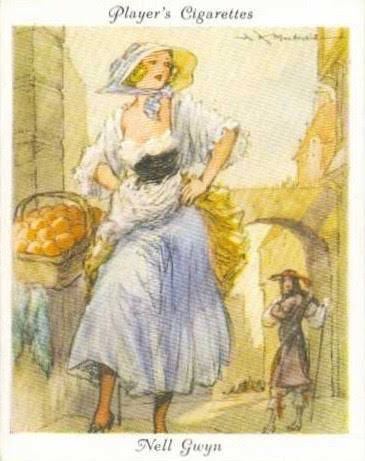
When I bought several Player's cards from a vendor, he kindly sent for free this 1930s card as a thank you. The card shows Nell Gwyn, who according to the reverse side of the card rose from being "a fruit hawker in the precincts of Drury Lane Theatre" to eventually becoming "enrolled a member of the King's Company of Players." This was during the Restoration under Charles II, and the king himself "fell a victim to her charms" as the card says. It was allegedly Gwyn who persuaded the king to complete the construction of Chelsea Hospital to provide a home for discharged soldiers.

The card is one of a series of 25 "Famous Beauties" taken from drawings by A.K. Macdonald. Other "beauties" drawn by Macdonald included Catherine the Great, the Queen of Sheba, and Pocahontas, so including the actress is quite a compliment. Gwyn was a close associate of the playwright Aphra Behn, who dedicated her play The Feigned Courtesans to the actress.

While I certainly am not a fan of the cigarettes that led to the creation of these cards, I'm glad many of the cards are still around today. They give us a fascinating glimpse not just of the world that created them, but also of the way that world looked back upon its own past.

Saturday, November 6, 2021

London's 1782-83 Season

I was recently asked to give a presentation on the London theatre season for 1782-1783. This was the season that Sarah Siddons returned to the Theatre Royal at Drury Lane and revolutionized British acting.

Even before Siddons made her return, the public was primed for great things. All three London patent houses--Drury Lane, Covent Garden and the summer theatre at the Haymarket--had been redecorated, welcoming audiences to grander, more opulent interiors.

Covent Garden's renovation had been the most extensive. A contemporary account in Universal Magazine claimed that "Nothing remains of the old structure but the outside walls." Seating was increased, and boxes replaced the side doors to the stage, finally moving side entrances fully behind the proscenium.

The Theatre Royal at Covent Garden benefited from something else, as well. Frances Abington, the previous leading lady at Drury Lane, left in 1782 for Covent Garden, where she continued to perform until her retirement. When Drury Lane opened its season with a production of The Clandestine Marriage, a comedy David Garrick co-wrote with George Colman the Elder, the female lead was played by Priscilla Brereton, who was never considered a particularly strong actress. The receipts that night only totaled 200 pounds and four shillings.

By contrast, Covent Garden opened its season with Susanna Centlivre's comedy The Busy Body. That evening brought in a whopping 314 pounds and 18 shillings. While you might expect a theatre's opening night of the season to be a hit, Covent Garden continued to perform well for the rest of the month, too. They followed up their initial success with a production of Isaac Bickerstaff's musical drama The Maid of the Mill. That play brought in more than 270 pounds, easily beating out anything Drury Lane put on that month, including on its opening night of the season.

Drury Lane tried to draw audiences in with a production of William Shakespeare's Twelfth Night, which they had not done for three years, and featuring a new actress making her Drury Lane debut in the role of Viola. In spite of a strong cast that included Elizabeth Farren as Olivia, and the novelty of a new actress making her debut, receipts only totaled 144 pounds and 11 shillings. The next week Drury Lane brought out a production of Shakespeare's Hamlet. Receipts were better, but still couldn't break above 200 pounds. Only on its opening night had Drury Lane managed that feat.

The next month, though, Drury Lane scored a palpable hit with Siddons. The actress was returning to London after a long absence, having performed principally at Bath following her inauspicious debut at Drury Lane in 1775. In Bath, Siddons had honed her craft and developed a devoted following for her dramatic style. When she reappeared on the stage of Drury Lane in October 1782, this time in the title role of Isabella in Garrick's adaptation of Thomas Southerne's The Fatal Marriage, she was an immediate sensation.

On the nights Siddons appeared on stage at Drury Lane, receipts were frequently over 200 pounds more than they were on evenings when she did not appear. Given that during the month of September, Drury Lane only just made it to collecting 200 pounds on opening night, and then never made that amount again for the rest of the month, we can see that the presence of Siddons more than doubled the amount the theatre took in on a given night.

Covent Garden collected nearly 36,000 pounds for the season as a whole, though, while Drury Lane took in something closer to 34,000 pounds. While Covent Garden's box office returns were larger, both houses had introduced substantial alterations to their physical buildings. Those investments were not included with ordinary expenses, and were made with an eye toward the long-term success of the ventures.

We might look at the introduction of Siddons in a similar way that we view the capital improvements to the theatre buildings themselves. Though in the short run, Siddons was unable to make Drury Lane more profitable than Covent Garden, she was laying the groundwork for Drury Lane to become a more prestigious, and hopefully more profitable theatre in future seasons.

Thursday, October 7, 2021

Peg Woffington's Lothario

Nicholas Rowe's play The Fair Penitent, based loosely on Philip Massinger and Nathan Field's The Fatal Dowry, contains an excellent role for actors specializing in villains: Lothario!

But what if the actor who played the villain was... an actress! Well, the most recent issue of Theatre Notebook contains an excellent article by Annette Rubery on the 18th-century actress Peg Woffington playing the role.

Woffington had a long and productive artistic partnership with David Garrick, primarily appearing in comic roles, but she also played Lady Randolph in the London premiere of John Home's tragedy Douglas. It was in 1753, however, four years before she excited audiences in Douglas, that Woffington appeared at the Smock Alley Theatre in Dublin as Lothario, the villain of Rowe's tragedy.

Though Woffington's performance as Lothario was not considered a success, it was famous enough to be recorded in paint by the artist John Lewis, whose depiction of her in the role is now owned by the National Portrait Gallery in London. She also was not the first woman to play Lothario, as that distinction belongs to Charlotte Clarke, the eccentric daughter of the actor and dramatist Colley Cibber.

Rubery argues that Woffington played Lothario in an effort to seriously show off her talents as a performer. Women who appeared as men in comedies were not expected to act entirely realistically, and part of the fun for the audience was to see a person they knew to be female in a male role. This could actually reinforce gender binaries rather than fight against them, since a woman playing a man was being held up as something inherently comic.

When a woman played a man in a tragedy, however, which was thought of as more realistic, she was expected to make the audience forget her sex and enter more fully into the illusion of the play. This, Rubery argues, made Woffington's appearance as Lothario a bit scandalous. She quotes a rather interesting poem that commemorated the performance:

     All adroit, each taper Thigh enclos'd
     In manly Vestments, with Parisian step;
     Light as the bounding Doe she tripp'd along,
     The gay LOTHARIO, in his Age of Joy.
     Venus surpriz'd, thus whisper'd 'Let me die,
     If dear ADONIS wore a lovelier Form.'
     Then clasp'd the Youth-dres'd Damsel to her Breast,
     And sighing, murmur'd, O that for my Sake
     Thou wert this Instant what thou represents.

Perhaps the realism of Woffington's Lothario was a bit too much for audiences to take. In the play, Lothario is a heartless seducer of women. How much worse it might have been in the minds of some audience members if that heartless seducer of women was another woman!

Wednesday, March 10, 2021

Frances Abington

Frances Abington, born Frances Barton in 1731, is probably best remembered for originating the role of Mrs. Teazle in Richard Brinsley Sheridan's play A School for Scandal. While that was one highlight of her career, she actually had a long and varied life upon the British stage.

According to biographer Austin Brereton, young Frances, known as "Nosegay Fan," could be seen daily as a girl selling flowers in St. James's Park. As she got older, she began reciting the works of Shakespeare and other authors in the piazza at Covent Garden. She later "became a servant to a French milliner in Cockspur Street, acquiring thereby a taste for dress, afterwards of great service to her," Brereton writes.

Numerous authors have remarked on the actress's fashion sense, which must have come in handy at a time when performers were usually asked to provide their own costumes. Miss Barton made her stage debut at the Haymarket Theatre in 1755, appearing as Miranda in Susanna Centlivre's comedy The Busybody. From there she went to Bath, and the following summer she played in Richmond, where someone from Drury Lane spotted her and hired her for London's most prestigious theatre company.

It was while working at Drury Lane that Miss Barton became Mrs. Abington, marrying James Abington, her music-master and one of the trumpeters in the Royal service. The marriage does not appear to have been a particularly happy one, and Frances left London for Dublin, where she acted at the Smock Alley Theatre, playing such roles as Mrs. Sullen in George Farquhar's The Beaux' Stratagem and Kitty in James Townley's High Life Below Stairs. While acting these parts, "so nice was her taste in dress that the 'Abington cap' was the rage among the Dublin ladies," Brereton claims.

In 1762, Abington returned to Drury Lane, but she clashed with the theatre's manager, David Garrick. In 1782 she went over to the rival patent theatre at Covent Garden. She made her last public appearance on stage there on April 12, 1799, when she acted as Lady Racket in Arthur Murphy's comedy Three Weeks After Marriage in a benefit performance for Alexander Pope (the actor, not the poet).

Abington excelled in numerous Shakespeare roles, including Beatrice in Much Ado About Nothing, Portia in The Merchant of Venice, and Olivia in Twelfth Night. Here's an engraving of her playing Rosalind in As You Like It.

Tuesday, February 16, 2021

The Debut(s) of Sarah Siddons

When David Garrick heard about "a Mrs. Siddons" who might "be a valuable acquisition to Drury Lane" he sent his friend the Reverend Bate to scout her.

Bate's letter to Garrick, dated August 21, 1775, praised the beauty of the actress, but spent more time emphasizing her magnificent control of her body and voice:

Her face, if I may judge from whence I saw it, is one of the most beautiful for stage effect ever I beheld; but I shall surprise you when I shall assure you that these are nothing to her action and general stage deportment, which are remarkably pleasing and characteristic--in short, I know no woman who marks the different passages and transitions with so much variety, and, at the same time, propriety of expression.

It's interesting to note that according to Bate's letter, Sarah Siddons's voice itself was "rather dissonant" and perhaps even "grating" at times. That seems amazing to us, who now think of the Siddons voice as legendary. We also generally think of Siddons's appearances as Hamlet as coming late in her career, but Bate claimed even back in 1775 that the actress "plays Hamlet to the satisfaction of the Worcestershire critics."

Garrick wrote back that Bate should "secure the lady" to appear at Drury Lane after she had her "lie in," as Siddons was heavily pregnant at the time. He also requested a list of roles that the actress had played, and Bate obliged, naming such parts as Jane Shore, Roxana (presumably from The Rival Queens), Calista (presumably in The Fair Penitent), and a number of Shakespearean roles, including Juliet, Cordelia, Horatio, Portia, and Rosalind, the last of which Bate had seen her perform.

In November, Siddons gave birth to a girl, apparently a bit earlier than expected. At the end of the following month, she made her debut at Drury Lane, billed as "A Young Gentlewoman" playing Portia in The Merchant of Venice. Unfortunately, the debut was not a success, and reviews were hostile. She later appeared as Lady Anne in Richard III, but the press attacked her again.

Garrick retired in 1776, and the new manager of Drury Lane, Richard Brinsley Sheridan, unsurprisingly chose not to reengage Siddons. It was years later that Sheridan's father Thomas saw Siddons performing in a provincial theatre. The decision was made to give the actress another chance, and her second debut at Drury Lane was set for October 10, 1782. She would be playing the leading role of Isabella in Garrick's adaptation of The Fatal Marriage by Thomas Southerne.

Two days before the big night, Siddons reportedly "was seized with a nervous hoarseness." Her voice came back on the morning of the performance, though, and so thorough was her triumph that by the end of the play "every speech was interrupted by bursts of applause," according to accounts. The rest is history.


Sunday, January 24, 2021

The Orphan of China

When I was visiting the Tate Britain a couple years ago, I came across Tilly Kettle's portrait "Mrs. Yates as Mandane in The Orphan of China." The piece captures a nearly forgotten moment of transcultural drama in the 18th century.

Beginning in 1731, zaju drama from China began being translated into European languages, causing a burst of excitement in the West. The first translation of a Chinese drama to be published in Europe was a French version of Ji Junxiang's The Orphan of Zhao.

Though The Orphan of Zhao was written in the 13th century, like most zaju plays, it takes place in the distant past, telling the story of how the Zhao clan was almost wiped out, but one child was saved and hidden away from the family's enemies. After many sacrifices are made to preserve the child, the orphan returns to avenge the Zhao clan and restore their authority.

In 1741, William Hatchett published the first English adaptation of The Orphan of Zhao, but it was seen as an attack on the British Prime Minister, Robert Walpole, so it was never performed. The most famous version of the story was the one the French dramatist Voltaire penned in 1753. Known as L'Orphelin de la Chine, this version reset the play during the Mongol period. The adaptation quickly spread across Europe.

Voltaire's play adheres to unities of time, place, and action, something zaju drama rarely if ever did. In his version, the orphan is already grown, and everything takes place in the same imperial palace. All of this was done to comply with the rules of neoclassicism. The rules were supposed to make drama more realistic, though to us neoclassical plays often feel ridiculously improbable. In any case, it was Voltaire's version of the story that inspired the British dramatist Arthur Murphy to write his own adaptation in 1756.

"Enough of Greece and Rome," Britain's poet laureate William Whitehead wrote in the play's prologue, remarking:

     On eagle wings the poet of to-night
     Soars for fresh virtues to the source of light;
     To China's eastern realms: and boldly bears
     Confucius' morals to Britannia's ears.

Thus, the play's Chinese-ness was one of its main selling points. That's probably apparent, too, in the costume Mary Ann Yates is wearing as Mandane in Kettle's portrait. Is the costume authentically Chinese? Of course not. However, it attempts to evoke an idealized East that is "the source of light" and that upholds morals the decadent West had forgotten. That moralizing can sometimes make the play's dialogue feel stilted, as when Mandane's husband Zamti praises "sacred laws by hoary elders taught."

Zamti has raised the heir to the throne as his own son, while sending his biological son Hamet to Korea. This serves to distract Timurkan, the Emperor of the Tartars, from the real heir. David Garrick played Zamti in the original production of Murphy's play. Echoing the values of the Age of Reason, he declares in Act II: "Priestcraft and sacerdotal perfidy / To me are yet unknown: religion's garb / Here never serves to consecrate a crime..."

In the play's third act, Zamti reveals to his adopted son Etan that the boy is actually Zaphimri, heir to the throne of China. Being naturally good, however, the boy refuses to allow Zamti's biological son Hamet to die in his place. This is a big change from the original zaju drama, where tons of people are sacrificed in order to protect the young orphan. Though Murphy's play is staunchly monarchal, it looks for a justification beyond the mere Divine Right of Kings. As Zamti puts it:

                                   Tho' rufian pow'r
     May for a while suppress all sacred order,
     And trample on the rights of man, the soul
     Which gave our legislation life and vigour
     Shall still subsist, above the tyrant's reach.

All deaths are kept for the play's final fifth act, where they decorously take place offstage, out of the direct view of the audience. This might not be as exciting for us as the original, but it allowed London audiences in the 18th century to feel more comfortable with the play, since it conformed to conventions of the time. 

Perhaps it was necessary for audiences of the period to have some elements of the play rendered familiar so they could better enjoy the elements of the Chinese-inspired play that were unfamiliar and exotic to them.

Tuesday, June 30, 2020

A Clown for All Seasons

Joseph Grimaldi was one of the great clowns of the early nineteenth century. His life story would have been fascinating no matter who recorded it. As luck would have it, though, his memoirs were put together by the greatest English writer of his day: Charles Dickens.

In 1838, the publisher Richard Bentley came out with two volumes of Memoirs of Joseph Grimaldi that had been "Edited by 'Boz'," with the Boz in question being none other than Dickens. The cover page is perhaps misleading, since "Boz" had already "edited" The Pickwick Papers and was currently at work "editing" both Oliver Twist and Nicholas Nickleby. In those cases, "edited" meant wrote from scratch. However, Grimaldi did leave a manuscript behind recalling his life story, so in this case, Dickens actually did just edit it (though he took a strong hand in the job).

A "clown" in Grimaldi's day was one of a number of stock characters on the British stage derived from commedia dell'arte, including "Harlequins, Pantaloons, and Columbines," as Dickens notes in his introductory chapter. These characters appeared together in the elaborate shows known as pantomimes that were staged every year around Christmas, often lasting until Easter. As a boy, Dickens had loved these shows, which is why when he was given a chance to edit Grimaldi's memoirs, he was "in a perfect fever" to undertake the job. Changing Grimaldi's first-person narrative into a third-person biography, Dickens was able to utilize the actor's personal recollections while combining them with his own writing style.

According to the account in the Memoirs, Grimaldi's father was a native of Genoa who became both a dentist and a dancing master in England, as well as playing the role of clown himself. His son, young Joe Grimaldi, was born in 1779, the same year the famous actor David Garrick had died. He made his debut on the stage of the Theatre Royal, Drury Lane at the age of one year and eleven months. He also began to perform at Sadler's Wells in 1783, appearing in the "arduous character of a monkey." He would frequently appear onstage with his father, and on one occasion, his father was so angered, he beat the boy in earnest right in front of the audience. As the memoir relates, "This was all taken by the audience as a most capital joke; shouts of laughter and peals of applause shook the house."

The artist George Cruikshank provided illustrations for the Memoirs. One of these shows a famous incident where Joe was playing a monkey and his father was supposed to swing him around by a chain. According to the story: "One evening, when this feat was in the act of performance, the chain broke, and he was hurled a considerable distance into the pit, fortunately without sustaining the slightest injury; for he was flung by a miracle into the very arms of an old gentleman who was sitting gazing at the stage with intense interest."

Grimaldi's father died in 1788 and was buried in the churchyard of Exmouth Street Chapel. While he provided handsomely for his two children, the executor of his will, Joseph Hopwood, invested all of the family's money in his own business and subsequently went bankrupt. The family was left destitute, and it was up to young Joey to support the family as a child actor. The following year, his younger brother set sail as a cabin boy on a ship and disappeared.

As a teenager, Joey fell in love with Maria Hughes, who also happened to be the daughter of his employer at Sadler's Wells. On the very day that Grimaldi delivered his first love letter to her, there was a tremendous accident at the theatre, and a heavy platform fell on him, injuring his shoulder. The next day, Maria rushed to his bedside, much to the delight of Joey. Eventually, he obtained the consent of her parents, and the two were married at St. George's in Hanover Square.

In 1799, things couldn't have been going better for Grimaldi. He had a successful career, a wife he adored, and what was more, the couple was expecting a child. Unfortunately, it was not an easy pregnancy, and after many difficulties, Maria died, leaving Joey with neither child nor wife. Maria's body was buried in the Hughes family vault at St. James's Church, Clerkenwell. Two months later, the Christmas season demanded another pantomime, and Grimaldi had to once again go onstage and play the clown.

Eventually, Joey did remarry. After he injured his foot onstage, a certain actress identified in the Memoirs as "Miss Bristow" tended him in his illness, and the two ultimately wed, spending more than thirty years together before the lady died. This was Mary Bristow, who married Grimaldi on Christmas Eve, 1801, and within a year bore him a son, Joseph Samuel, known as J.S. In 1803, Grimaldi's family life was momentarily turned upside down when his brother mysteriously returned from a life at sea, though Joey had long given him up for dead. Strangely, however, the brother appeared for only one evening, and then vanished again forever.

During the early part of his career, Grimaldi performed at Drury Lane, as well as minor theatres like Sadler's Wells. In 1806, however, he gave up Drury Lane to appear at the rival patent house at Covent Garden. His first appearance at that theatre was not as a clown, but as Orson in the Romantic melodrama Valentine and Orson by Thomas Dibdin. Grimaldi frequently appeared in melodramas and other entertainments as well as pantomimes, though it was always as a clown that he was best remembered.

Two years after he joined the Covent Garden company, the theatre burned down, and the company had to perform in smaller venues until it could be rebuilt. When the new building opened in 1809, its manager (John Kemble) tried to raise ticket prices, which had remained fixed by tradition for many years. The result was a massive protest known as the O.P. Riots. The Memoirs describe the disturbances as "the great O.P. Row" and note that "noises made by the audience utterly overwhelmed every attempt that the actors could make to render themselves audible." A few audience members even "brought live pigs, which were pinched at the proper times, and added considerably to the effect of the performances."

Given the impossibility of performing dialogue in such an environment, Kemble asked Grimaldi to perform in a pantomime version of Don Juan. Grimaldi took the role of Scaramouch, as he typically did in Don Juan, and the first night he performed the piece, there was great applause when he entered and very little disturbance afterward. Kemble thought he had finally found a way to win over the audience, and asked Grimaldi to play the same role the next night. However, on the second night of Don Juan, the disturbances recommenced, and they did not let up until Kemble agreed to lower the prices.

In 1812, Joey was invited to dine with nobility at Berkeley Castle, and it was there that he first met Lord Byron, who had usually patronized Grimaldi's benefit performances at Covent Garden. Byron praised the famous clown in such lofty terms, that at first he thought the lord was being facetious. Later, Byron gave Grimaldi an engraved snuff box, which the actor cherished for the rest of his life.

Joey's son was getting older now, and eventually the elder Grimaldi took on the role of Don Juan while J.S. played Scaramouch. In 1823 Joey's health took a turn for the worse, and he was forced to stop performing. J.S. became the company's principle clown, which greatly pleased his father. Unfortunately, upon finding success, J.S. "abandoned himself to every species of wild debauchery and riot," according to the Memoirs.

After years of hard living, J.S. died. The coroner said that "his body was covered with a fearful inflammation" and he had been found in "furious madness, rising from his bed and dressing himself in stage costume to act snatches of the parts to which he had been most accustomed." Two years later, Grimaldi's wife Mary died as well.

The concluding chapter Dickens provided for the Memoirs recounts how Grimaldi himself passed away on May 31st, 1837. The cause of death was apparently natural, and the coroner's jury declared that he "had died by the visitation of God." He was buried at St. James's Chapel on Pentonville Hill. The graveyard where his body was laid to rest is now a public space known as Grimaldi Park.


Thursday, October 17, 2019

Stooping to Conquer

In a famous essay in 1772, the author Oliver Goldsmith tried to make a comparison between laughing and sentimental comedy.

Borrowing the definition from Aristotle, Goldsmith called comedy "a picture of the frailties of the lower part of mankind, to distinguish it from tragedy, which is an exhibition of the misfortunes of the great."

The problem was, in Goldsmith's view, British comedy had taken to detail the calamities of people in the middle classes rather than poking fun at their foibles, as had been done by comic writers of the Restoration, such as Colley Cibber and John Vanbrugh.

He also claimed to have history on his side. Though the Roman playwright Terence sometimes had his comedies approach the quality of tragedy, Goldsmith observed that Terence always stopped short of rendering his characters truly pathetic. In Goldsmith's opinion, the only advantage of sentimental comedy was its novelty.

More importantly, he warned of what we might be losing in giving up the genre of laughing comedy for a comedy of sentiment:

It is true that amusement is a great object of the theater, and it will be allowed that these sentimental pieces do often amuse us; but the question is, whether the true comedy would not amuse us more? The question is, whether a character supported throughout a piece, with its ridicule still attending, would not give us more delight than this species of bastard tragedy, which only is applauded because it is new?

Goldsmith tested this hypothesis with his own play, She Stoops to Conquer, which opened the following year at the Theatre Royal, Covent Garden. George Coleman the Elder was manager of Covent Garden at the time, and he did not particularly care for the piece. Neither did David Garrick, who had turned down the play for Drury Lane.

On the advice of Samuel Johnson, though, Coleman put the play into rehearsal with the actress Mary Bulkley in the leading role of Kate Hardcastle. It ended up a success, and the theatre even chose to use it for their season closer later that year.

At the end of his essay, Goldsmith had written:

It is not easy to recover an art when once lost; and it will be but a just punishment, that when, by our being too fastidious, we have banished humor from the stage, we should ourselves be deprived of the art of laughing.

Fortunately for us, no such calamity occurred, and She Stoops to Conquer continues to delight audiences to this very day.

Sunday, May 26, 2019

Battle of the Juliets


In 1750, the patent theatres at Drury Lane and Covent Garden went head-to-head, producing rival productions of Romeo and Juliet in what came to be known as the Battle of the Romeos. According to Chelsea Phillips' article in the latest issue of Theatre Survey, however, perhaps the incident should be known as the Battle of the Juliets instead.

David Garrick had adapted Shakespeare's play for performances at Drury Lane with Spranger Barry playing Romeo and Susannah Cibber as Juliet. Cibber left the company in 1749, however, giving birth to her last child. When she returned to the stage the next year, it was not to Drury Lane, but to the rival company at Covent Garden, and joining her was none other than Barry.

What made Cibber switch houses? We can't be sure, but Phillips points out that in the spring of 1749 Cibber became ill, possibly as a result of her pregnancy or possibly due to a persistent stomach problem that plagued her until her death in 1766. The playwright Aaron Hill wanted Cibber to play the lead in his new play Merope, and she was a natural choice, since Cibber had launched her career as a tragic actress with Hill's previous play Zara in 1736. Cibber said she wanted the role, but didn't want to perform it until the following season. Garrick, however, scoffed at the idea of a delay, and Hannah Pritchard went on in the title role instead.

Cibber's move to Covent Garden led Garrick to poach another tragic actress from that theatre to join his own company at Drury Lane. George Ann Bellamy had been the leading tragic actress at Covent Garden. In 1749, Bellamy gained notoriety when she left in the middle of a performance to run off to Yorkshire with her lover, George Montgomery Metham. The reason for the flight north might have been Bellamy's own pregnancy, for after her child was born, she returned to Covent Garden, where she played many of the same roles Cibber was known for, including the heroines in Thomas Otway's tragedies Venice Preserved and The Orphan.

With Cibber now at Covent Garden, Bellamy was looking at the prospect of losing some of her choicest roles. She had also recently expanded her repertoire, taking on the role of Juliet at Covent Garden opposite Henry Lee. She had previously played the role in Dublin, but this was the first time the Covent Garden company had mounted Romeo and Juliet, and Bellamy had shined in the play. Now she was facing losing that role to Cibber, too. By July of 1750, both Cibber and Barry were contracted to appear at Covent Garden and Garrick had managed to snag Bellamy for Drury Lane. The two leading ladies had effectively swapped companies, and Cibber had taken her Romeo with her.

Garrick himself took on the role of Romeo opposite Bellamy's Juliet. Though he was considered too short to play such a romantic leading role, he was determined to go head-to-head against the new Romeo and Juliet at Covent Garden, which Garrick saw as for all intents and purposes his play. It was his adaptation of Shakespeare's text that they used, and he had personally coached both Cibber and Barry in their roles. Garrick made further revisions to the play, including adding an elaborate funeral procession for Juliet that became a staple well into the nineteenth century. Perhaps the most important addition to Drury Lane's new Romeo and Juliet, though, was Bellamy, who like Juliet had herself precipitously forsaken everything for her lover, as audiences well knew.

After twelve nights of both patent theatres producing rival productions of the same play, Cibber announced she was ill and would not be able to continue as Juliet. Most audiences had already concluded that Drury Lane had the better production, anyway. History has recorded the event as a victory for Garrick, but Phillips hints that the credit might belong more to Bellamy.

Thursday, December 27, 2018

Kitty Clive

I'm currently in London visiting my sister for the holidays, and today I went to The Foundling Museum, in part to see a small exhibit on the 18th-century actress Kitty Clive.

No, Clive was not a foundling, but the museum also houses a collection related to the composer George Frederick Handel, who was intimately involved with concerts raising money for the Foundling Hospital in London. Clive participated in these concerts, and in fact sang in the first London performance of The Messiah.

Clive was also a playwright, but of short dramatic sketches like Every Woman in Her Humour rather than full-length works. Her acting gained the respect of Horace Walpole, Henry Fielding, and other great writers. She played Portia opposite the Shylock of Charles Macklin, and later acted regularly with David Garrick.

Before she was discovered, Clive was lodging in a house across the street from where the Beefsteak Club, a collection of men involved with the theatre, used to meet. She was supposedly singing a song while washing the steps to the house, and the members of the Beefsteak Club, having their windows open, heard her and were immediately enchanted. In 1728, at the age of 17, she joined the company at Drury Lane, the most prestigious theatre in the country,

Clive did not always get along with management, however. Eventually, she had to defend herself and her right to make a livelihood in a pamphlet called The Case of Mrs. Clive Submitted to the Public. Some scholars have speculated that Fielding might have aided her with the prose, but the general consensus is that the force behind the pamphlet was Clive herself.