Showing posts with label Goethe. Show all posts

Friday, January 10, 2025

J.B.

Until the nineteenth century, nearly all tragedies were written in verse. Even at the beginning of the Victorian era, some dramatists, including Robert Browning, John Westland Marston, and Thomas Noon Talfourd, were still writing verse dramas.

The "New Dramas" that became prominent in the second half of the century introduced greater levels of realism while also probing important social issues. Verse dramas fell out of favor, but with the dawn of the twentieth century many poets attempted to return to the old format, albeit with a modern twist.

Following the lead of such writers as Edna St. Vincent Millay, the American poet Archibald MacLeish, attempted numerous verse dramas, at last penning a major hit with J.B., a dramatization of the Biblical story of Job that in 1959 won both the Pulitzer Prize for drama and the Tony Award for Best Play.

In addition to taking inspiration from the Bible, the play also draws on Goethe's Faust, which is itself indebted to the Book of Job. After a dedication, Faust has a prelude in a theatre, in which a playwright, a director, and a comic actor have a discussion about the piece they are about to perform. Similarly, MacLeish begins J.B. with the following exchange:

MR. ZUSS:    This is it.
NICKLES:                    This is what?
MR. ZUSS:    Where they play the play, Horatio!
NICKLES:    Bare stage?
MR. ZUSS:                    Not in the least.

The old actor Mr. Zuss (whose name sounds suspiciously like Zeus) then takes on the role of God while his companion Nickles (or perhaps "Old Nick") plays Satan. This is similar to the Prologue in Heaven that Goethe provides for Faust in which Satan and God discuss a good man much as they do Job in the Bible, and of course in J.B. as well. MacLeish has the two actors put on masks and ascend to a platform before they set the scene for Job, now known as J.B.

Rather than being a figure from the distant past, J.B. is a successful American businessman with a large family, all of whom are thankful for what they have. In fact, the play even stages a traditional Thanksgiving meal, with J.B. carving a turkey for his family. His wife worries, though, that his gratitude in only superficial. She tells him:

                A child shows gratitude the way a woman
               Shows she likes a pretty dress --
               Puts it on and takes it off again --
               That's the way a child gives thanks:
               She tries the world on. So do you.

As in the Biblical story, J.B. then loses everything. His children are all killed, his body is afflicted by disease, and the whole world becomes a hellscape not unlike the earth after World War Two. J.B. is visited by three friends, like Job, but they are dressed like tramps who formerly were a clergyman, a doctor, and perhaps a historian.

Though the action of the play closely follows the Biblical story, MacLeish links it to his own audience, which had gone through a Great Depression, a global war, and even the nuclear annihilation of Hiroshima and Nagasaki.

It's a play that might be ripe for a revival in 2025.

Saturday, July 27, 2024

BARS 2024

I’ve been in the United Kingdom for the 2024 conference of the British Association for Romantic Studies in Glasgow.
 
The conference kicked off on Tuesday with a talk by Michelle Levy on women writers and publishing. Though we often think of authors in the 18th and 19th centuries as selling their copyrights outright, Levy noted that this often was not the case. She gave particular attention to the poet Phillis Wheatley, who appears to have received half of the print run of her poems to sell herself for her own profit.
 
Next, I chaired a panel on Faustian Romanticism. Three speakers addressed how the Faust dramas of Christopher Marlowe and Johann Wolfgang von Goethe influenced British Romantic writers. Martin Potter discussed Faustian elements in Mary Shelley’s Frankenstein, while also addressing the E.T.A. Hoffmann short story “The Sandman.” Liz Wan talked about how William Godwin’s novel St. Leon could be read as a Faust story, and Maddy Potter addressed Faustian elements in both John Polidori’s The Vampyre and Charles Robert Maturin’s Melmoth the Wanderer.
 
Later in the afternoon, I went to a panel on P.B. Shelley, since multiple speakers were scheduled to address Shelley’s play The Cenci, with which I have a particular interest. Anna Mercer compared the play to Mary Shelley’s novel Valperga, which also features a Beatrice who suffers a horrible fate. She mentioned that Mary Shelley even quoted from her husband’s play in her journal long after he had died. Nora Crook later went into detail about the various manuscripts that the Shelleys might have had access to that discussed the story of Beatrice Cenci. She also drew parallels between the play and G.E. Lessing’s Emilia Galotti.
 
The final panel I attended on Tuesday was on remediating the supernatural. Natalie Tal Harries mentioned that Walter Scott collected books on witchcraft and demonology and justified his use of superstition in a note on his poem The Lady of the Lake. Orianne Smith also discussed Scott, focusing on his novel Guy Mannering, a book from which Sarah Siddons often performed readings after her retirement from the stage. The character of Meg Merrilies in the book became a favorite in stage adaptations of the novel. Haya Alwehaib spoke last, comparing Mary Shelley’s Frankenstein with The Arabian Nights. We then headed over to Glasgow City Chambers for a drinks reception in a beautiful setting.
 
Wednesday there was a plenary roundtable with Elizabeth Edwards, Craig Lamont, and Tim Fulford. My big activity for the day, though was chairing a session on Romanticism’s legacies in fantasy literature. Will Sherwood talked about William Blake’s influence on J.R.R. Tolkien, noting that while most people focus on how Tolkien’s work as a medievalist influenced his fiction, he was greatly influenced by Romantic writers as well. Annise Rogers discussed the Romantic legacy in Ben Aaronovitch’s fantasy series The Rivers of London. Jason Whittaker then spoke on the influence William Blake had on Glasgow’s own Alasdair Gray, who like Blake was both a writer and a visual artists. That evening, the conference banquet was held at Òran Mór, a restaurant in a former church that is graced by murals designed by Gray.
 
My own paper was scheduled for Thursday. I began the day at a panel on the Gothic. Samiha Begum discussed Ann Radcliffe, a writer who appears as a character in my own play The Mysteries of the Castle of the Monk of Falconara. Radcliffe, who was influenced by the paintings of Claude Lorrain and Salvator Rosa, was propelled to fame with her novel The Romance of the Forest and received 500 pounds for her next book, The Mysteries of Udolpho at a time at which the average royalty payment for a novel was only 80 pounds. Interestingly enough, gossip recorded by Anna Seward held that Radcliffe had written Joanna Baillie’s anonymously published Plays on the Passions. I was also interested to hear Jakob Lipski speak on the 1803 historical novel Thaddeus of Warsaw and Laura Eastlake discuss links between vampires and volcanos.
 
In my completely neutral, unbiased, unprejudiced opinion, however, my panel was the best. It began with Bethan Elliott discussing the plays of Baillie (not Radcliffe). She quoted from an 1804 letter Baillie wrote to fellow dramatist William Sotheby. Though Sotheby (who had not had the success on stage that Baillie achieved) urged her to focus on “reading” plays rather than “acting” plays, Baillie held that the qualities that make a play good for acting also make it good for reading. Baillie was not snobbish about how her plays were performed, either, and in 1810 wrote to Walter Scott about being pleased that one of her plays had been performed at a fair. The one play Baillie wrote that she did not think was fit for performance was The Martyr, but that was because of its religious subject matter, not because she didn’t deem it an “actable” piece.
 
My paper was on J.H. Amherst’s play The Death of Christophe King of Hayti. Its depiction of armed women was naturally interesting to the third panelist, Sarah Burdett, who has written extensively on that subject. Her paper was on stage adaptations actresses had written of the poems of Walter Scott. Sarah Smith, who was a favorite of Scott’s, wrote adaptations of both The Lay of the Last Minstrel and The Lady of the Lake performed at the Crow Street Theatre in Dublin. Eliza Macauley, an actress who had a difficult relationship with the Crow Street Theatre, wrote an adaptation of Scott’s Marmion that took a character who only appears in a single Canto of the poem and made her the center of the adapted drama.
 
On Friday, conference delegates could opt for a trip to New Lanark and the Falls of Clyde, which provided some very dramatic landscapes. All in all, it was a wonderful conference!

Sunday, April 23, 2023

Shaw's Critique of Eugenics

A few years ago, Reinhard G. Mueller concluded that the playwright Bernard Shaw had an "ambivalent stance on eugenics." One of the dramatist's later plays, however, is fairly unequivocal in its condemnation of the eugenics movement.

Shaw, who believed in a Life Force that drove evolution, had warned people in previous plays like Man and Superman and Back to Methuselah that evolution needed to take its own course, free from conscious manipulation by governments or powerful authority figures

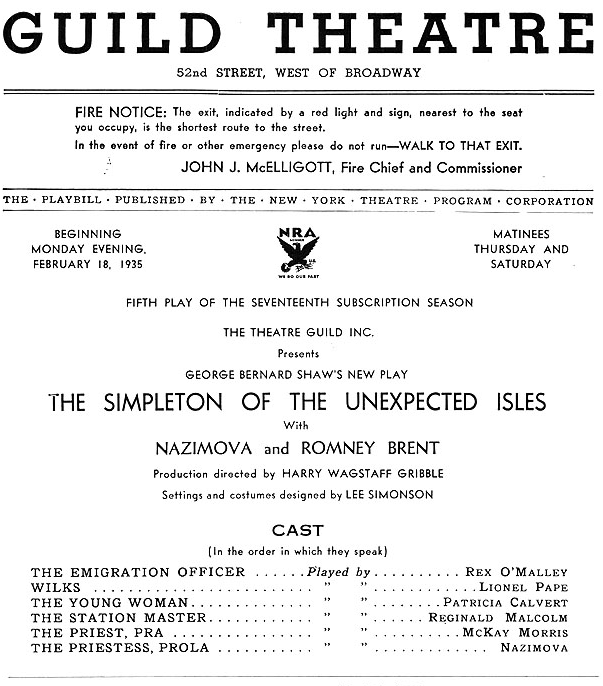
It was in his 1934 play The Simpleton of the Unexpected Isles, however, that Shaw explicitly depicted a eugenic experiment, dramatizing its failure. In a preface to the play written the following year, he warned readers that just because he was depicting eugenicists, that did not mean he was one, stating he wanted to guard himself "against the assumption" he was "advocating the immediate adoption of" the methods he described in his comedy.

In the play, the character of Lady Farwaters refers to the practice of eugenics as "a little domestic experiment." Later, another inhabitant of the play's titular Unexpected Isles explicitly calls their selective breeding program "a eugenic experiment." This selective breeding produces four children raised collectively on their island home: Maya, Vashti, Janga, and Kanchin. The collective parents of the four need an outsider male to breed with Maya and Vashti, and they select a simple clergyman, who is nicknamed Iddy for his simple-mindedness.

The choice of a simpleton to intermarry with individuals selected for eugenic elevation might seem odd. As Pra (another one of the eugenicists) explains, though the children all "have artistic consciences, and would die rather than do anything ugly or vulgar or common, they have not between the whole four of them a scrap of moral conscience." Tending to biology alone, it turns out, is not enough. As Pra puts it, "biological chemists have not yet discovered either the gland that produces and regulates the moral conscience or the vitamins that nourish it."

In the play's second act, the simple clergyman shows moral advancement, but his two wives seem to be sinking into lethargy, and their brothers are no better. With some help from Pra, Iddy proposes the rest of humanity must be convinced to "live in a world of original ideas" instead of being governed by conventional belief. The problem is that most people are incapable of coming up with original ideas. Iddy's solution is to convince them to go along with the ideas of others. But what if they won't? The four eugenically created children all come up with the same answer: "Kill."

It is at this moment that an Angel descends to proclaim Judgment upon the world. The eugenic experiment is tolerated, until it turns to imposing its will upon the world through murder. The Judgment of the Angel is no less swift and fearsome, but the Angel comes not to force others to agree with the ideas of the eugenically enhanced, but instead to eliminate from the world all those who are useless. This includes the products of the eugenic experiment, who all begin talking like fascists, praising "flag" and "country" as well as the "soil" and "glory" of a new empire they plan to create.

The Angel proclaims, "The lives which have no use, no meaning, no purpose, will fade out." After the islanders hear about the effect of this Judgment on the rest of the British Empire, the eugenic children resume their proto-fascist tirade, rebelling against their elders and glorifying war, even war against heaven itself. After they exit, Lady Farwaters laments the fact that they have taught the children "everything except how to work for their daily bread." This should be a clue that the products of eugenics have no use, meaning, or purpose, and are destined to fade away, which is precisely what they do.

Iddy runs on terrified by the fact that Maya simply disappeared while in his arms, and her three siblings likewise vanish. The islanders who remain compare the disappearance of the children to the vanishing of Euphorion in the second part of Goethe's Faust, but instead of disappearing in highest flight, they vanish in boredom. This is where eugenics leads, and Pra predicts, "The coming race will not be like them."

In the Unexpected Isles, as in everywhere else, things never work out the way they are planned. Eugenics tries to plan life, but the play advises that we instead allow life to come to us. As in Shaw's Man and Superman and Back to Methuselah, those who try to bend nature to their will fail. The only way forward is to trust to the Life Force and prepare for whatever it may bring.

Tuesday, February 28, 2023

Goethe on the Theater

I recently wrote a post about beginning a translation of Nathan the Wise by G.E. Lessing. That's not the only German play I've tried to translate, though, and I've previously blogged about a translation I did of a song from Faust by J.W. Goethe.

At the rate I'm going, it will take me years to translate the whole of Faust, but I wanted to share some of my translation because it relates to Goethe's view of the German stage in his time. In the prelude to the play, Goethe shows a conversation amongst a director, a playwright, and a comic actor.

The director is most concerned with commerce rather than art. He asks the writer and actor what play they should do, not seeming to care much, so long as it pleases a paying audience. In a typical passage towards the beginning he says:

I very much want to please the crowd,
For as they live, they give us our living.
The posters are up, we've cried the play aloud
And everyone waits to see what play we're giving.
They're seated already, with expectant faces,
Wondering, now, what exactly our play is.
I know how to keep the people happy,
Though what this crowd expects no one knows.
Something to keep gramps there from feeling too nappy.
I bet he's seen some awful shows.
What shall we do that's fresh and new
And will have some meaning to it, too?

The writer, who is described as a dramatic poet, is an idealist. He wants nothing to do with the practicalities of the stage. Instead, he imagines a more exclusive drama that has spiritual meaning. He rails at the director, saying:

O do not talk to me about the crowd,
Or in an instant the spirit shall fly away!
For the masses, my head remains unbowed,
For they'd run for strudel soon as hear a play.
No, drive me to where heaven's silence is allowed,
Where only the poet and his friends can stay,
Where love and friendship our hearts unfold
And the Hand of God may our spirits mold!

The actor, who is described as a comedian, is even more cynical than the director. Still, he seems to understand what will make a good play. Bringing the playwright back to earth from his poetic flights of fancy, the actor asks:

Who will entertain the folks right here?
That's what they want, and they should get it.
A brave knave is the thing to fit it.
That's me, always ready to appear.
Who knows how to be pleasant and please,
Needs not be bitter about people's taste;
He wishes to bring in lots of fees,
By moving the masses with great haste.
Be only brave and master a smile,
Give into fantasy, and have a good cheer,
Believe, understand, and feel for a while,
But mark you well, with a laugh and a jeer.

The fact that the actor always does everything "with a laugh and a jeer" associates him with the character of Mephistopheles in the play proper, while the playwright's idealism makes him similar to Faust. Indeed, some productions double those roles in performance.

While I haven't completed the full translation, if you'd like to see more, please contact me. It would be great to see my translation of Faust actually performed!

Saturday, February 25, 2023

Pieces of Pushkin

Alexander Pushkin is generally regarded by Russians as the greatest author in the Russian language, but his work doesn't always find a place on stages in the U.S.

That's why I was excited when I heard that the Russian Arts Theater and Studio would be presenting the best-known of Pushkin's "Little Tragedies": Mozart and Salieri.

As you might have guessed from the play's title, Pushkin's drama helped inspired Peter Shaffer's hit Broadway show (and later film adaptation) Amadeus. In two simple scenes, it portrays the jealousy of the composer Antonio Salieri and re-enacts the murder he later claimed to have committed, poisoning his artistic rival W.A. Mozart.

Riccardo Ripani plays Salieri in the production currently running in New York, and it is perhaps fitting that he is outshone by the charismatic Di Zhu who plays the more famous Mozart. Zhu actually plays Mozart in more than one sense of the word, since she provides live piano music throughout much of the performance. This is no mean feat, since the onstage piano is literally spun about the stage by two angels (Semion Kashirin and Anthony Nikitopoulos) as she plays it.

After performing Mozart and Salieri, the company provides an interlude, consisting of passages from Pushkin's poem Ruslan and Ludmila, recited in both English and Russian. That is the only Russian in the show, however, as the cast then performs in English Pushkin's comical Scene from Faust, a send-up both of the poet Goethe (a central figure of German Romanticism) and his admirer Lord Byron.

Ripani plays Faust in this scene, while Zhu plays Mephistopheles in a demonically good costume. If you're interested in seeing it yourself, the show is playing until April 1st.

Friday, May 27, 2022

Shaw Conference in Spain... at last!

Back in 2020, I was supposed to attend a conference on Bernard Shaw in the town of Cáceres in Spain. Well, the conference got delayed two years, but I finally made it!

I arrived in Madrid on Tuesday and took the train out to Cáceres, a beautiful city with lots of medieval architecture. The conference began on Wednesday, with a plenary lecture by Audrey McNamara. She spoke about how Shaw represented "Woman as Nation" but not in the idealized manner of W.B. Yeats in such plays as Cathleen Ni Houlihan.

Edurne Goñi-Alsúa kicked off the first session, discussing "geolect" in Spanish translations of Pygmalion.  Guadalupe Nieto Caballero talked about the reception of Shaw in Spain, and I was fascinated to learn that a production of Shaw's play The Devil's Disciple was performed in the midst of the Spanish Civil War. Gustavo A. Rodríguez Martín--who organized the conference--also spoke about his Online Shaw Concordance.

In the second session, I was glad to hear Peter Gahan discuss Shaw and the Germans. Shaw claimed that he mostly just knew Goethe and Schiller among German authors, though he was clearly familiar with a few others, as well. In Germany, Shaw's reputation during his lifetime was as a radical socialist, which informed the talk given by Virginia Costello on Shaw, Maxim Gorky and Emma Goldman. While Goldman became disillusioned with the Soviet Union after being transported there by the U.S. Army aboard the Buford, Shaw remained consistent in his support for the Russian Revolution.

Unfortunately, Jean Reynolds did not make it over for the conference, but she joined us over Zoom to officially launch her new book on Major Barbara and Pygmalion. She discussed how in Major Barbara Andrew Undershaft admires his predecessor in the arms trade, whom he refers to as his master. He quotes maxims of the business, but Reynolds said these maxims fall apart once you start to really think about them. She also brought up that when Andrew comes to his own home after being away for years, the butler Morrison doesn't know how to classify him. Should he announce him as a visitor or treat him as one of the family?

Wednesday night, we had a guided tour of Cáceres. We wondered at the old Moorish tower, the plaque on the ground marking the old Jewish quarter, and other amazing sights. The conference started up again on Thursday morning, with a plenary lecture by Brad Kent on Shaw and world literature. I learned that when Shaw accepted the Nobel Prize for Literature, he used the prize money to set up an organization to encourage translation of Swedish literature into English. The organization gives out a prize each year for the best translation. Kent also spoke on Shaw's relationship to Max Reinhardt, who directed some of Shaw's plays, including a production of Saint Joan that included Bertolt Brecht.

The third session of the conference contained some Zoom talks, as well as Vishnu Patil (live and in person) discussing Shaw in India. He noted that India's first Prime Minister, Jawaharlal Nehru, attended talks given by Shaw, and the two later met formally in 1949, the year before Shaw's death. After a brief coffee break, we had a fourth session, which featured Justine Zapin discussing The Tragedy of an Elderly Gentleman, which she referred to as Shaw's last Irish play. She noted that in the play Shaw creates an Irish landscape in the minds of the audience without engaging in a mimetic representation of place in the physical theatre space.

After a book launch for Bernard Shaw and the Spanish-Speaking World, we had a fifth session in which Miguel Cisneros Perales discussed Spanish adaptations of Pygmalion and Óscar Giner spoke on links between Saint Joan and Calderón de la Barca’s Golden Age play The Constant Prince. Both plays present exceptional incarnations of the life force, he said. Giner also mentioned that Shaw's hero, P.B. Shelley, had partially translated Calderón's The Prodigious Magician, which remains perhaps the best English translation of that play. We also had some entertainment, with Brian Freeland performing his one-man show Bernard Shaw: Playing the Clown.

Today, I gave my own talk on Shaw and Sarah Bernhardt. There were also presentations by Luis Tosina Fernández, R.A.F. Ajith, and Soudabeh Ananisarab. It's been an exhausting conference, but one I was very glad to be able to attend!

Monday, February 21, 2022

There was a king in Thule...

J.W. Goethe's two-part poetic drama Faust is perhaps the greatest work of German Romanticism, which is why it's such a shame there aren't better translations of it.

A while back, I began writing my own translation of Faust, and I even posted my version of the Dedication to this blog. Perhaps my translation still leaves something to be desired, but I wanted to capture the raw power of the original.

Recently, I've been revisiting Faust, and I was stuck by the ballad Goethe has Gretchen sing in the scene entitled "Abend" or Evening. The song begins "Es war ein König in Thule" and tells the story of a king who lived in the mythical land of "Ultima Thule" at the northernmost edge of the world.

Thule has two syllables, making it rather tricky to rhyme in English. (What does one use? School-day?) No English translation of the ballad matches the simplicity and emotionality of Goethe's language. The verse is in trimeter, with an ABAB rhyme structure, and packs a great deal of meaning into a few simple words.

I decided to try my hand at translating the passage. English is rarely as concise as the language in the poem, but this is how I rendered it:

                    The King of Thule

               The King in Thule above
               Was true unto the grave,
               His dying Queen and Love
               A golden cup to him gave.

               He kept it always near,
               Grasped it at every meal;
               His eyes would swell and tear,
               For how it made him feel.

               And as he came to die,
               He gave away cities and land,
               All to his son on high,
               But he kept the cup in his hand.

               He sat with advisers all,
               The knights who followed him free,
               There in his ancestors' hall
               In the castle above the sea.

               But then he rose him up,
               And drank with the last of his blood,
               Then threw the holy cup
               Down into the raging flood.

               He saw it plunge and drink
               The waters that lapped at the shore,
               His heavy eyes did sink,
               He drank not one drop more.

I'm still not completely satisfied with it, but perhaps it's getting there....

Saturday, November 28, 2020

Herr Tartüff

Molière's comedy Tartuffe has produced numerous adaptations, but perhaps few as original as F.W. Murnau's silent film Herr Tartüff.

Murnau is one of those directors who has always fascinated me. After serving in the German army during the First World War, he made the terrifying horror film Nosferatu, based on Bram Stoker's Dracula. He later filmed the innovative comedy The Last Laugh as well as his re-imagining of Tartuffe, before adapting for film what is probably an even more famous play, Goethe's Faust.

Herr Tartüff really is a reimagining, as it departs significantly from Molière's play. The film uses a framing device in which an old man is being slowly poisoned by his housekeeper. The old man's grandson comes for a visit, but gets thrown out for being a good-for-nothing actor. Being an actor, however, he is able to disguise himself and visit the house with a traveling cinema. He then shows a film based on Tartuffe and exposes the housekeeper's hypocrisy.

Because the silent film can't use Molière's witty dialogue, it has to find other ways to tell the story. I was mainly watching to see the scene in Act IV of the play where Orgon hides under a table while the hypocrite Tartuffe tries to seduce his wife. In the film, Orgon hides behind a curtain, and just when the hypocrite is about to make his move, he sees the husband's face in a reflection. Immediately, he resumes his pious act, and Orgon becomes more convinced of his friend's saintliness than ever before.

That just stretches the action out longer, though, as the film has another scene that takes place that night, where Orgon's wife Elmire goes even further with Herr Tartüff, this time in a room that contains a bed! The faithful maid Dorine forces Orgon to watch through a keyhole, though, and the impostor is unmasked.

Lil Dagover, who played the heroine in The Cabinet of Dr. Caligari, takes on the part of Elmire, and is stunning in the role. If you're interested, you can watch the whole film here.

Thursday, March 28, 2019

Faust 2.0

Last night I saw the Mabou Mines production of Faust 2.0 at 122 Community Center, formerly known as P.S. 122.

P.S. 122 first became a performance space in 1980, taking over the former home of Public School 122. It was always a dirty, dingy building where you could see magnificent theatre. I remember catching a great production of Bertolt Brecht's Saint Joan of the Stockyards there with a huge cast of young, fully committed actors.

A few years ago, the whole building was shut down to be extensively remodeled. Last night, I walked into the box office, which is now around the side of the building and fully handicapped accessible, rather than up the steep steps I remembered from before the renovation. The place was so... clean! Not a speck of dust or dirt to be seen.

The second part of Goethe's Faust is a notoriously difficult text, but this adaptation by Matthew Maguire ambitiously tries to pack as much of it into a brief time span as it can. The first scenes in the show are actually from the first part of Faust, where Mephistopheles makes a bet with God and then forms his pact with the melancholy Doctor Faust.

In the traditional version of the story, as told by Christopher Marlowe, Faust is given unlimited knowledge and power for 24 years, after which time he must surrender his body and soul to the devil. Goethe changes the bargain to Faust agreeing to give himself up if he ever lies down in inaction. As he says in the David Luke translation:

               If ever to the moment I shall say:
               Beautiful moment, do not pass away!
               Then you may forge your chains to bind me,
               Then I will put my life behind me,
               Then let them hear my death-knell toll,
               Then from your labours you'll be free,
               The clock may stop, the clock-hands fall,
               And time come to an end for me!

In German, the phrase that is supposed to bring about Faust's damnation is "Verweile doch, du bist so schön!" Literally it means "Stay there! You are so beautiful!" Maguire renders this as something like, "Stop, linger there a while." It might not be the most exact translation, but it captures the spirit, and is better than Walter Kaufmann's overly poetic "Abide, you are so fair" which has become something of a standard version.

After setting up the situation, Faust 2.0 launches into the second part of Goethe's massive dramatic poem. The first act of Faust Part Two deals with Faust and the Emperor, who is of course the Holy Roman Emperor of a Christian Europe, but in the Mabou Mines production, director Sharon Ann Fogarty portrays him as a classical ruler of the Roman Empire. He is played campily by Greg Mehrten, who appears on video screen. Most of the cast, in fact, appears only on screen, lending the production an air of artificiality that corresponds with the self-consciousness of the second part of Goethe's epic drama.

Faust 2.0 basically skips over the second act of Goethe, eliminating the Homunculus and the classically inspired Walpurgisnacht. Instead, we go to the magnificent third act where Faust brings back Helen of Troy, played here by Angelina Impellizzeri. She and Faust have a son, Euphorion, played by 7th grader Oliver Medlin. Goethe probably meant Euphorion to be based upon Lord Byron, whose youthful spirit flamed out in an early death, and the boy's destruction weighs heavily on his parents. Helen sinks down into Hades, and Faust (played rather feelingly in this moment by Benton Greene) becomes distraught.

After the death of his son, Faust turns to war, aiding the emperor in a battle against his rival, and then in the final act to attempting to improve the world by driving back the sea. At last achieving something he deems worth doing, Faust utters the forbidden phrase and dies. Paul Kandel, who plays Mephistopheles, is wonderful as he gloats over the fallen Faust, but he doesn't have the last laugh, as readers of Goethe know.

It isn't every day you get to see a production of Faust Part Two, so if you're interested in this modern reimagining, be sure to get your tickets.

Tuesday, October 31, 2017

The Rise of Melodrama

The playwright René-Charles Guilbert de Pixérécourt pioneered melodrama in France, with such dramas as The Ruins of Babylon and The Dog of Montargis. These plays gave equal billing to their composers, as they relied just as much on dramatic music and acting dumb shows as on dialogue.

In 1802, the British playwright Thomas Holcroft adapted Pixérécourt's play Coelina, or The Child of Mystery as A Tale of Mystery, calling it "A Mélo-Drame In Two Acts." The melodrama had arrived in England, and was haunting Germany as well, where J.W. Goethe's rival August von Kotzebue had a string of hits, including The Ruins of Athens, Misanthropy and Repentance, and The Spanish in Peru.

These plays were tightly plotted, with succinct, functional dialogue designed to help the audience follow the plot, but the language of melodrama attempts little else and lacks the poetic qualities of Romantic drama. Also, while melodrama can be political, it is usually aimed at leading the audience to simplistic conclusions. Romantic dramas, by contrast, dealt seriously with political and moral issues, often giving equal voice to opposing views. Also, Romantic dramas provided towering characters suited for actors like Edmund Kean. The melodramas that overtook Romantic plays forced actors into roles of virtuous heroes or conniving villains in an effort to get the audience to focus on sensationalistic plot twists instead.

In England, the actress and theatre manager Jane Scott turned the Sans Pareil Theatre into a powerhouse of melodrama. The Sans Pareil was known as a "minor theatre" since it was licensed to perform musical entertainments, but was not allowed to perform purely spoken drama. Scott penned a series of plays that incorporated music and song, getting around the monopoly on spoken drama enjoyed by the patent theatres in London. She wrote more than 50 plays in all, many of them designed to show off her own talents as the leading performer. Her most famous, The Old Oak Chest, was originally a star vehicle for herself, but unlike her other works it was published, which allowed it to continue to be performed long after Scott retired from the stage in 1819.

Melodramas frequently drew inspiration from the Gothic novels of the period. Gothic tales frequently had exotic or medieval settings. They could have supernatural events, like Matthew G. Lewis's hit play The Castle Spectre, or they could portray apparently supernatural occurrences that get explained rationally, as happens in The Old Oak Chest. The most famous Gothic novel, Mary Shelley's Frankenstein, was first adapted as a melodrama by Richard Brinsley Peakes in 1823 as Presumption, or The Fate of Frankenstein. The play initially ran for 37 performances and continued to be revived until the middle of the century.

Meanwhile, the official patent theatres in London saw their audiences dwindle, and they increasingly turned to melodrama themselves. The actor William Charles Macready took over the management of the patent theatre at Drury Lane in 1841 pledging to revive the drama to its former glory. Unable to compete with the minor theatres, however, he asked the owners of the theatre for a decrease in rent, and when they declined he petitioned parliament to end the monopoly held by the patent theatres. In 1843, parliament agreed and passed the Theatres Act, which kept censorship in place, but allowed minor theatres to perform any type of play they wanted. Rather than the minor theatres turning to spoken drama, however, the old patent theatres turned to melodrama, making it the dominant theatrical form of the nineteenth century.


Wednesday, May 31, 2017

Egmont

J.W. Goethe's play Egmont is probably best known for the overture by Beethoven it inspired, but it's worth reading in its own right.

Goethe finished the play in 1788, on the eve of the French Revolution, and Egmont definitely gives the feeling that something momentous is about to happen. It was written in prose during the "storm and stress" period that preceded the advent of German Romanticism.

The story involves the events leading up to the 80-year-long war for Dutch independence. It was the execution of Count Egmont, together with the Count of Horn, that precipitated that war. Goethe begins the action in 1568, the last year of Egmont's life. Margaret of Parma, daughter of the former Holy Roman Emperor, had been governing the Netherlands as regent for her half brother, Phillip II of Spain. The king replaces her, however, with the notorious Duke of Alba.

Margaret appears in Goethe's play as a sympathetic figure. In the first act, she struggles to deal with Dutch iconoclasts who were desecrating cathedrals, while at the same time trying to prevent her brother from introducing the Inquisition to the Lowlands. At one point she laments: "Oh, what are we, then, the great on the crest of humanity's wave? We think that we rule its fury, but it bears us up and down, to and fro."

Egmont does not even appear until the second act, though his name is on everyone's lips. Like the first entrance of Shakespeare's hero in Othello, as soon as Egmont appears, he puts down a potential brawl in the streets. Though a lofty noblemen, he remembers individuals among the commoners and counsels them each to keep the peace in difficult times. In a scene with his secretary, we then see him ruling justly if perhaps a bit naively, unwilling to submit to the world of realpolitik.

In the third act, we get word that Alba is coming with his massive army. Egmont is concerned, but finds comfort in the arms of his mistress, Clare. Goethe gives Clare one of the most strikingly poetic moments in the play. Waiting in her mother's house, she sings:

               Gladdened 
               And saddened
               And troubled in vain,
               Longing
               And thronging
               With wavering pain,
               Raised up to heaven,
               The deeper to fall,
               Happy alone
               Is whom love has in thrall.

Act IV has the famous betrayal scene, where the Duke of Alba invites Egmont to his palace only to have him arrested and executed for treason. As a member of the famed Order of the Golden Fleece, Egmont should have been immune to any judgement other than a trial before his peers of the order. Alba does not care, and demands that Egmont immediately surrender his sword, which he does, declaring: "It has served me more often to defend the King's cause than to protect this body."

As Act V descends into darkness, Clare commits suicide and Egmont's remaining hopes of rescue or escape vanish. However, when he falls asleep in the dungeon, Egmont has a vision of his own eternal victory. Goethe gives these stage directions:

Liberty in heavenly raiment, shining, rests upon a cloud. She has Clare's features and bows down towards the sleeping hero. She expresses a feeling of compassion, she seems to commiserate with him. Soon she calms herself and, with an enlivening gesture, shows him the quiver of arrows, then her staff and helmet.

Though Egmont will die, he will live on as a martyr for Liberty.

Saturday, April 22, 2017

Manfred at 200

Lord Byron published his drama Manfred in 1817. Now, 200 years later, a number of people are taking advantage of the piece's bicentennial to take a closer look at the work.

Thursday night, Red Bull Theater performed a staged reading of the play with Jason Butler Harner in the title role. And yesterday, New York University held a symposium organized by Omar Miranda to take a more academic look at Manfred.

After I saw the reading, I spoke with Miranda, and he invited me to the symposium. I have to teach on Fridays, so I missed much of it, but I managed to make it over in time to hear Emily Bernhard Jackson from the University of Exeter talk about Manfred, Byron, and incest.

Jackson noted that the character of Manfred expresses guilt, and that incest was a central concern both for Manfred and for his creator, Lord Byron. (Byron likely had a sexual relationship with his half sister, and Manfred loved a woman named Astarte, who also seems to have been related to him.) However, she observed that Manfred's guilt does not necessarily come from incest.

Even if Manfred did commit incest, did that cause his guilt? No, Jackson argued. The source of his guilt was Astarte's death. Manfred does not regret that he loved Astarte. Rather, his real regret lies in her response to that love. Jackson pointed out that Byron's poem Don Juan jokes about sibling incest, and his play Cain portrays incest as natural. Manfred's guilt doesn't come from the incest, she argued, but from the result of that incest, Astarte's mysterious death.

Jackson was followed by Richard Lansdown talking about Manfred and suicide, and Alice Levine comparing the play to the Don Juan legend. Lansdown mentioned that the arrival of modernity can be judged by when the suicide rate surpasses the homicide rate. That occurred around 1680 in London, but only recently in a part of Italy where organized crime has dominated for years. Levine's talk was equally interesting, as she observed that Mozart's Don Giovanni has more in common with Manfred than it does with Byron's Don Juan.

After a break, Jeffrey Cox and Michael Gamer kicked off a new panel on Manfred, performance, and theater. They compared Manfred with melodrama, a genre which Cox called a machine built for speed, and that speedily consumes everything in its way. He noted that in the wake of the French Revolution, there were 30,000 performances of the melodramas by Rene-Charles Guilbert de Pixerecourt. In Germany, the melodramas of August von Kotzebue received more performances than all of the plays by Friedrich Schiller and Johann Wolfgang von Goethe combined!

Gamer filled in some more information on melodrama. Thomas Holcroft, who adapted Pixerecourt to the English staged, was praised by his contemporaries for his ability to capture real life. What made melodrama a genre, however, was not its style but its form, in that it utilized music. Popular melodramas of the early nineteenth century borrowed music from ballet and pantomime to create mood. Similarly, he said, Byron used singing in Manfred, working in music as he tried to revive tragedy.

Jonathan Gross then spoke about the Freemason imagery in Manfred, and Miranda compared Manfred  to Percy Shelley's Prometheus Unbound. The keynote address, however, was given by Jerome McGann. He noted the similarity between Astarte's name and the name of Byron's half sister, Augusta. For all the parallels to Byron's life, through, Manfred remains deeply obscure, deeply ambiguous, and deeply suggestive, he said.

Most exciting for me, however, was at the reception afterward getting to meet Frederick Burwick. I've very much enjoyed reading some of Burwick's books, but I did not know how many Romantic-era plays he had directed! He and Paul Douglass have also made a great number of the songs used in Romantic plays available online.

Do yourself a favor and check out their site, Romantic-Era Songs. It's wonderful!

Thursday, December 29, 2016

Elliston as Manager

I recently finished Christopher Murray's biography of the actor and theatre manager Robert William Elliston. It's amazing the number of things Elliston managed to accomplish, including in 1815, lighting the exterior, saloon, and part of the auditorium of the Olympic Theatre with gas lighting.

Frederick Albert Windsor had patented gas lighting in 1804, when it was first used to light the facade of the Lyceum Theatre. It was not until 1817 that gas lights were first used to illuminate a London stage. (The previous year, the Chestnut Street Theatre in Philadelphia had used gas lighting.)

So Elliston's illumination of the Olympic was a dubious first. He had greatly expanded a technology already in use, but not brought it to its full capability. The same could be said about many aspects of Elliston's management. He dragged the London theatre forward (sometimes kicking and screaming), but only so far.

Throughout his life, Elliston managed a number of theatres, both in and outside of London. Murray devotes one chapter to Elliston's management of the Birmingham Theatre Royal, where he attracted such luminary performers as Eliza O'Neill. According to Murray, hundreds of people had to be turned away from the theatre when O'Neill appeared, and many "settled for a glimpse of the adored actress coming or going at the Royal Hotel."

Later, when Elliston was managing the Theatre Royal at Drury Lane in London, he fared considerably poorer with dramatists than he did with actors. He tried to get Walter Scott and Thomas Moore to write plays for him, but both declined. Of course, he received unsolicited scripts from John Keats, Percy Shelley, and Leigh Hunt, and rejected them all. Alas, the tyranny of the slush pile is nothing new! Without a friend on the inside, even the best writers of the nineteenth century couldn't get their work taken seriously.

Elliston was managing Drury Lane when King George III died at the beginning of 1820. The sad event closed the theatres out of respect for the nation's mourning, but it also opened up a new possibility. Since the king had gone mad, no one had dared perform King Lear (for obvious reasons). Elliston rushed a production of Lear to the stage after the theatres were allowed to reopen in February. Though he for the most part followed the adaptation by Nahum Tate with its absurd happy ending, he did restore some of Shakespeare's text to the heath scene and to Lear's recognition of Cordelia.

The following year, Elliston gained notoriety for staging Lord Byron's play Marino Faliero without the author's permission. Again, Elliston rushed the piece into production, securing a copy of the play while it was still going to press and not even completing casting until a week before the show opened. Elliston had secured permission to perform the play from the Lord Chamberlain's office, so he legally had a right to do it whether Byron wanted him to or not. Alas, the controversy was not enough to sell tickets, and the play was ultimately deemed a financial and critical failure.

Later at Drury Lane, Elliston staged the first English-language version of Goethe's Faust. After a collapse in health (and finances) Elliston lost his lease on Drury Lane, but he did not give up on theatrical management. In 1827, he took over a theatre in Surrey, where he staged melodramas by popular writers like Edward Fitzball, William Thomas Moncrieff, and Douglas Jerrold. Elliston also staged the only play by Walter Scott to be performed in the writer's lifetime, The House of Aspen. As was the case with Marino Faliero, the production was without the author's permission.

Elliston is perhaps best known as an actor, a fine Romeo and the original Alvar in Samuel Taylor Coleridge's Remorse. However, Murray makes a good case that Elliston's greatest achievements were not as a performer, but as a manager.

Friday, May 27, 2016

German Romanticism

The year 1789--when Parisian mobs stormed the Bastille, breaking into the prison than symbolized the old feudal order and setting its prisoners (and by extension, themselves) free--is an important marker in the history of Western civilization, as well as for Western drama. However, even before the outbreak of the French Revolution, the stirrings of a new outlook toward art began in Germany in the form of the so-called "Storm and Stress" movement. Friedrich Klinger gave the movement its name with his play Sturm und Drang (German for "Storm and Stress"), which premiered in Leipzig in 1777. The previous year, Klinger had submitted his play The Twins to a contest at a theatre in Hamburg, winning first prize and gaining an appointment at the Seyler Theatre Company. The Twins depicts a man who kills his weaker twin, claiming his brother will not allow him to fully develop his own nature. Whether or not Klinger actually embraced such a viewpoint, this type of thinking seemed something entirely new and different to audiences of the day.

In a Storm and Stress play like The Robbers by Friedrich Schiller, the action produces a series of spectacular events that seem beyond the realm of moral judgment. Schiller's villain, Franz Moor, tricks his father into disinheriting Franz's elder brother, Karl. Egged on by his libertine friend Spiegelberg (whose name indicates he is a mirror--"Spiegel"), Karl leads a band of robbers who wage war on civilization. In the forests of Bohemia, he urges his followers on to victory over a surrounding army, convincing them to fight rather than turn him over to the authorities in exchange for pardon. Karl then returns home to claim his promised bride, only to discover that Franz has imprisoned their father, who was long thought to be dead. During the final act of the play, recognitions and reversals happen with dizzying speed. Though the final moments of The Robbers suggest a return to the rule of law, the play's original audiences were more struck by its compelling action than any putative moral.

Like Schiller, the poet Johan Wolfgang von Goethe began as a Storm and Stress writer, penning such plays as Götz von Berlichingen and Egmont. Heavily influenced by Shakespeare, Egmont marks a turn toward a new style, one that celebrated powerful emotions and political freedom. This new movement, born around the same time as the French Revolution, came to be known as Romanticism. Instead of looking back just to the classics for inspiration, Romanticism valued the vernacular literature of the middle ages and the Renaissance, especially the tales of chivalry and adventure that had come to be known as Romances. No longer valuing just popular sentiment or cold reason, Romanticism sought to remake the world through powerful, intense feeling.

Feeling is never lacking in Schiller's mature Romantic plays Don Carlos, the Wallenstein Trilogy (Wallenstein's Camp, The Piccolomini, and Wallenstein's Death), and Mary Stuart. The plays' skepticism about any type of absolute values can be seen in their ambivalent relationship with religion. In Don Carlos, Catholicism is the symbol of repression while Protestantism represents liberation, while in Mary Stuart the roles of those two religions are reversed. Wallenstein, though it takes place during the religious wars of the seventeenth century, remains aloof from religious questions. Schiller seems less concerned with what people actually believe than with how those beliefs shape them as human beings.

Schiller's later plays, The Maid of Orleans, The Bride of Messina, and William Tell, all reflect the influence of his friend Goethe. Goethe's play Torquato Tasso romanticizes the life of the sixteenth-century Italian poet who--following a difficult relationship with his patron the Duke of Ferrara--was imprisoned in a madhouse. Though Goethe began the piece during his Storm and Stress period, he was ultimately able to reach a higher level of poetic sophistication in the play, marking his entrance into the new style of Romanticism. While working on Torquato Tasso, he was also engaged in writing the drama that would become his masterpiece. In 1808, he finally published the first part of his massive poetic drama Faust.

Faust, Part I is the archetypal Romantic drama. Instead of being divided into acts, the play simply has a succession of scenes, with each scene written in a different verse style. Goethe carefully matches the meter and rhyme scheme of each scene to the emotions he is trying to convey. The poetry reaches a crescendo during Walpurgis Night, when Faust joins a group of witches and fantastic beasts celebrating a Bacchanalia in the Harz Mountains. In a dream, Faust witnesses the wedding of the Fairy King and Queen, Oberon and Titania. The following scene, written entirely in prose, shows the gloomy letdown from the event, as Faust realizes he has forgotten his precious Gretchen, the woman he loves. With the aid of his demonic companion Mephistopheles, Faust rushes to free Gretchen from prison, only to find she prefers to die there and be redeemed in the next life rather than to live with Faust and lose her soul.

Other German Romantic playwrights include Johann Ludwig Tieck and Heinrich von Kleist. Like many Romantic writers, Tieck was enthralled by fairy tales. His play Puss in Boots stages the popular children's story in a meta-theatrical manner, with characters constantly commenting upon the action. Kleist was far unhappier, both in his life and his art. His tragedy Penthesilea gruesomely depicts the fatal love of an Amazon queen. Though Goethe thought Penthesilea could never be staged, he himself put on a production of Kleist's comedy The Broken Jug. Kleist's most famous play, The Prince of Homburg, was not staged until after the author's suicide in 1811

After completing Faust, Part I, Goethe underwent a conversion of sorts and renounced Romanticism. Faust, Part II, not published until the time of Goethe's death in 1832, embraces the classical world. Faust convinces the bankrupt Holy Roman Emperor he can raise all the funds he needs by claiming an ancient treasure that has been buried since classical times, hinting at a revival of Germany through an embrace of the values of ancient Greece. The play uses a classic five-act structure, and includes a re-staging of the Walpurgis Night scene, but this time with motifs from Greek and Roman mythology. The third act of the play is a virtual hymn to classicism in which Faust wins Helen of Troy.

Romanticism continued in Germany, in spite of Goethe's later turn toward classicism. Writing after Goethe's death in the 1830s, Georg Büchner gave a Romantic exploration of the French Revolution in Danton's Death. What matters in Büchner's vision of Romanticism is not so much what one's values are, but that individuals dedicate themselves to those values with their entire beings. Büchner's last drama, Woyzeck, left unfinished at the time of his death, looks forward to modernism and later became a staple of twentieth-century theatre.

Friday, October 9, 2015

Romanticism (It's All in the Name...)

Three books, all with the same title, Romanticism, deal with the same topic. Indeed, all employ the same key word in discussing the art and philosophy of the late eighteenth and early nineteenth centuries. Yet each of the books' three authors, Aiden Day, David Blayney Brown, and Michael Ferber, understand the term "Romanticism" in slightly different ways.

Day's work, published as a part of the New Critical Idiom series by Routledge, begins its introduction by quoting heavily from M.H. Abrams, whose book The Mirror and the Lamp helped to illuminate Romanticism for the 20th century. In his first chapter, "Enlightenment or Romantic?", Day then sets up the dichotomy between Enlightenment thinking and Romanticism that is often rehearsed by scholars. On the Enlightenment side are figures like William Godwin, who "argued that human beings act in line with reason and that it is impossible for them to be rationally persuaded by an argument without their conduct being regulated accordingly." Romanticism, by contrast, in the works of William Wordsworth and Samuel Taylor Coleridge, is a "celebration of subjectivity."

The second chapter looks at constructions of the term "Romantic" which first appeared in the 17th century. Thomas Shadwell wrote disapprovingly of all things "Romantick" in the preface to his 1668 play The Sullen Lovers. By 1820, debates over Romantic literature raged on the European Continent, but Lord Byron declared he saw no conflict between the "Classical" and the "Romantic" among English writers. Later critics latched on to the term "Romantic" to describe a variety of authors in Britain, but Day warns against dubbing movements in retrospect. "Literature is not" he contends "something which can be regarded as occupying a 'trans-historical' space, but something which must be read as subject to the discourses and ideologies of a particular time and place."

Day's project is best summed up by the title of his third chapter: "Enlightenment AND Romantic." For Day, these two movements are inextricably linked. On the one hand, writers of the Romantic era continued to work towards the progressive social justice championed by Enlightenment figures like Godwin, while at the same time their focus did shift to that of the interior rather than the external world. A key figure here is Percy Bysshe Shelley, whose commitment to social change informed his "study of solitary imagination." Mary Shelley's novel Frankenstein can even be read as a defense of Day's "and" proposition, since the broodingly interior Frankenstein must ultimately face the consequences of the creature he has unleashed onto the world. As Day puts it, "the writings of those who have formerly been defined as Romantic are not necessarily anti-Enlightenment in any simple sense."

Though that might seem a fitting conclusion, Day includes a final chapter on "Gender and the Sublime" analyzing some of the consequences of Romantic theory first postulated in the eighteenth century by Edmund Burke. Certainly, Burke genders the sublime as masculine and its companion "beautiful" as feminine. Day's point, however, is that this gendering continued to influence Romantic poets. For instance, Wordsworth gendered Nature as feminine, but the female Nature only aided him in apprehending a higher "invisible world." This higher world, Day argues, is associated with the interior mind of the poet, and is thus gendered as masculine. Such arguments break down when the author is a woman, but Day contends that female writers of the period were skeptical of feelings of the sublime and instead focused on nature herself.

David Blayney Brown takes a different approach to Romanticism. While Day focuses on poets and novelists, Brown is interested in painters. He begins his introduction with an examination of Eugène Delacroix's painting The Death of Sardanapalus. He claims the "moral vacuum" at the heart of the piece is "all the more shocking for ignoring the message of the play by the English poet Lord Byron from which he had taken his subject." Notice that Day, discussing literature, ignores drama, while Brown, examining the visual arts, pays close attention to the theatre.

Brown finds a literary parallel for Delacroix's Romanticism in Victor Hugo, whose 1827 preface to his play Cromwell "advocated a rich variety of expression and experience to reflect the complexity of the world and the self, rather than the cold formalism of classical drama, and recognized the value of the ugly or grotesque in engaging the senses, rather than beauty in winning only admiration." For Brown, The Death of Sardanapalus is a "pictorial equivalent" to Hugo's theoretical preface.

Day emphasizes the continuity between the Enlightenment and Romanticism, but Brown stresses how revolutionary the new movement was. He claims: "Not since the Renaissance had such a profound change come over the Western consciousness." Instead of incorporating a collective ideal, the Romantic artists "emphasized individual experience, feeling, and expression." This, of course, came from the French Revolution, which Day emphasizes, but also from the rise and fall of Napoleon. As Brown puts it: "Romanticism was born in opposition and sorrow, in social or national crisis and in individual trauma."

Brown traces the term "Romantic" to Friedrich Schlegel, who in the first issue of the journal Athenaeum in 1798, identified the Romantic with "progressive universal poetry" not based on "inherited and culturally specific forms." Schlegel was writing in the German university town of Jena, which became a hotbed of Romanticism. Though not in Jena, the German writer Johann Wolfgang von Goethe contributed greatly to the movement as well, and Brown cites Goethe's 1789 play Torquato Tasso as an inspiration for Delacroix's Tasso in the Madhouse, painted fifty years later.

Tasso was a Renaissance poet and playwright, but more modern poets also provided inspiration to Romantic artists. Brown cites Thomas Chatterton, a poet whose suicide in 1770 inspired Henry Wallis (painting in the 1850s) to create the magnificent Death of Chatterton, now hanging in the Tate Gallery in London. The cult of Chatterton was not confined to England, either, as Brown observes that the French writer Alfred de Vigny turned the poet's story into the play Chatterton, which "was a hit in Paris in 1835."

So while Day is interested in Romanticism as a philosophical movement in dialogue with the Enlightenment, Brown sees it as an artistic movement born of political turmoil. Michael Ferber wrestles with both of these concepts in his Romanticism, which bears the subtitle A Very Short Introduction. For him, Romanticism is both an intellectual movement and an artistic movement, and while he sees both sides as distinct, he does not seem to emphasize one over the other. Both of these elements, the philosophical and the aesthetic, are present in the pre-Romantic movement Ferber identifies as Sensibility.

Sensibility is a term that was much more in use in the eighteenth century than "Romantic" or "Romantick." It was associated with such works of "storm and stress" as Goethe's The Sorrows of Young Werther and with Gothic writers, including Horace Walpole and Matthew G. Lewis. Ferber also connects it to poets like Mary Robinson, as well as the hugely influential critic and novelist Madame de Staël.

While Ferber successfully traces elements of Sensibility into Romanticism, he definitely seems to be coming at Romanticism from a position of greatly misunderstanding the period's drama. I can overlook his calling Shelley's Prometheus Unbound the poet's "greatest work" as that is a matter of taste. Downright strange, however, is Ferber's comment that Byron's Manfred is "unperformable." Is Ferber really unaware of the many, many successful performances there have been of Manfred? Samuel Phelps was probably the most famous actor to produce the play, but Manfred became so popular that toy theatre versions were made.

For all its faults, though, Ferber's book does give a decent introduction to Romanticism. It attempts to be more balanced than either Day or Brown, gazing into the philosophical and the aesthetic alike. In the end, as Ferber suggests, neither side can be fully understood without the other.

Thursday, August 20, 2015

Making the Scene

In their book Making the Scene: A History of Stage Design and Technology in Europe and the United States, Oscar Brockett, Margaret Mitchell, and Linda Hardberger give a comprehensive view of the history of scenic design. The beautifully illustrated volume includes photographs of classical theatres, like this Hellenistic stage in Priene, Turkey:


It also has Renaissance scenic designs, like this illustration by Serlio for a comedy:


However, I want to talk about the books chapter on Neoclassicism and Romanticism. The authors use Mozart's opera The Magic Flute to demonstrate this rivalry of opposites. A key figure here is Johann Wolfgang von Goethe, who opened the Weimar Court Theatre in 1791.

Goethe first became known for writing pre-Romantic Sturm und Drang plays like Goetz von Berlichingen. He also wrote the greatest play of the Romantic Era, Faust, the first part of which was published in 1808. However, the style he developed at the Weimar Court Theatre came to be known as Weimar classicism. Here's a design he did for The Magic Flute in 1794:


The classical motifs are unmistakable, and the image's restraint is characteristic of Goethe's style. Not all neoclassical designers held with Goethe's simplicity, however. Consider this 1815 design by Karl Friedrich Schinkel done for the same Queen of the Night scene in The Magic Flute:


Everything is still perfectly ordered, balanced, and harmonized, but the lesson here seems to be that more is more.

When it came to excess, Romanticism could always do the neoclassical style one better. That pesky order went out the window, though, as emotion and drama reigned. In 1818, the Romantic scenic designer Simon Quaglio came up with this idea for a production of The Magic Flute at the Royal Theatre in Munich:


Movement replaces stasis, and feeling undoes balance. They're both lovely, but ultimately I prefer Quaglio's design.