Showing posts with label Yeats. Show all posts

Friday, February 2, 2024

John Bull's Other Island

Last night, I took part in a spirited public discussion of Bernard Shaw's play John Bull's Other Island sponsored by the W.B. Yeats Society of New York and hosted by Gingold Theatrical Group.

William Butler Yeats commissioned Shaw to write the play for the group that eventually became the Abbey Theatre in Dublin. Plays by Yeats and Shaw had previously been staged together at the Avenue Theatre in London, when Yeats's The Land of Heart's Desire was performed as a short curtain raiser before the premiere of Shaw's Arms and the Man.

The stipulation was that the play should have an Irish theme, and Shaw at first struggled to write it. In a letter to Lady Gregory, one of Yeats's artistic partners in founding the Abbey Theatre, Shaw wrote in June of 1904 that he had "Not a word of the play yet on paper" but he was "Seething in the brain." The play he eventually came up with had four acts and six different scenes, which would have undoubtedly been a challenge for the small company just trying to start out in the world.

At the end of August, Shaw wrote to Yeats to see if the new theatre might have "a hydraulic bridge" to accomplish the two scene changes that occurred in the middle of acts. Eventually he did finish the play, but it proved to be too long and difficult to stage for the company. The "inevitable cutting" Yeats wrote back, would adversely affect the "seriousness" of the play. Ultimately, the theatre allowed Shaw to look for another home for the piece.

This was not difficult, as Shaw was a successful playwright by 1904, and John Bull's Other Island was premiered instead by the Royal Court Theatre in London, with the actor Harley Granville Barker playing the defrocked priest Peter Keegan.

Saturday, January 20, 2024

Irish Poetic Drama

Prior to the Anglo-Irish Treaty of 1921, Ireland did not have a recognized independent state, but even before the country was recognized as a nation, activists strove to create a national Irish theatre.

In 1897 a trio of artists, Isabella Augusta Gregory, William Butler Yeats, and Edward Martyn, published a manifesto calling for an Irish literary theatre that could present high-quality drama on Irish themes. The three teamed up with the writer George Moore to officially establish the Irish Literary Theatre in 1899, renting concert rooms to put on Yeats's controversial verse drama The Countess Cathleen.

From the beginning, the Irish Literary Theatre was involved in controversy. A critic circulated a pamphlet condemning The Countess Cathleen, and the highest-ranking catholic prelate in Ireland wrote to newspapers attacking the play. Many Irish nationalists supported the piece, however, and so many supporters and detractors showed up on opening night that the police were called in as well, just in case there was trouble.

The Irish Literary Theatre produced a play co-written by Yeats and Moore, Diarmuid and Grania, and later regrouped under the name of W.G. Fay's Irish National Dramatic Company. This theatre presented Cathleen Ni Houlihan, another controversial play by Yeats in which he credited Gregory as a collaborator. Though at first glance the play appears to be naturalistic, its title character personifies Ireland itself, first as an old, worn-out woman, and then as a young girl who walks like a queen.

The following year, the company reformed again with funding from the theatre manager Annie Horniman, establishing what came to be known as the Abbey Theatre. In addition to reviving Cathleen Ni Houlihan, the Abbey premiered another Yeats play, On Baile's Strand, along with a play by Gregory, Spreading the News, and a new play called In the Shadow of the Glen by a previously unknown writer named John Millington Synge.

Synge's plays became an important if controversial part of the Abbey's repertoire. His one-act drama Riders to the Sea depicted the lives of poor fishing families in the west of Ireland, and his full-length comedy The Playboy of the Western World offended so many people that the audience rioted when the Abbey premiered it in 1907. Tragically, Synge died two years later, his life cut short at the age of 37.

After Ireland gained independence, the nation fell into a civil war between rival factions. The new nation's turbulent history was recorded in the plays of Sean O'Casey, whose trilogy of plays set in Dublin, The Shadow of a Gunman, Juno and the Paycock, and The Plough and the Stars, recount political events with both humor and pathos.

These plays retain much of the poetic lyricism of Gregory, Yeats, and Synge. Yeats continued to write verse drama, and finished his last plays, The Herne's Egg, Purgatory, and The Death of Cuchulain, shortly before he died in 1939.

Friday, May 27, 2022

Shaw Conference in Spain... at last!

Back in 2020, I was supposed to attend a conference on Bernard Shaw in the town of Cáceres in Spain. Well, the conference got delayed two years, but I finally made it!

I arrived in Madrid on Tuesday and took the train out to Cáceres, a beautiful city with lots of medieval architecture. The conference began on Wednesday, with a plenary lecture by Audrey McNamara. She spoke about how Shaw represented "Woman as Nation" but not in the idealized manner of W.B. Yeats in such plays as Cathleen Ni Houlihan.

Edurne Goñi-Alsúa kicked off the first session, discussing "geolect" in Spanish translations of Pygmalion.  Guadalupe Nieto Caballero talked about the reception of Shaw in Spain, and I was fascinated to learn that a production of Shaw's play The Devil's Disciple was performed in the midst of the Spanish Civil War. Gustavo A. Rodríguez Martín--who organized the conference--also spoke about his Online Shaw Concordance.

In the second session, I was glad to hear Peter Gahan discuss Shaw and the Germans. Shaw claimed that he mostly just knew Goethe and Schiller among German authors, though he was clearly familiar with a few others, as well. In Germany, Shaw's reputation during his lifetime was as a radical socialist, which informed the talk given by Virginia Costello on Shaw, Maxim Gorky and Emma Goldman. While Goldman became disillusioned with the Soviet Union after being transported there by the U.S. Army aboard the Buford, Shaw remained consistent in his support for the Russian Revolution.

Unfortunately, Jean Reynolds did not make it over for the conference, but she joined us over Zoom to officially launch her new book on Major Barbara and Pygmalion. She discussed how in Major Barbara Andrew Undershaft admires his predecessor in the arms trade, whom he refers to as his master. He quotes maxims of the business, but Reynolds said these maxims fall apart once you start to really think about them. She also brought up that when Andrew comes to his own home after being away for years, the butler Morrison doesn't know how to classify him. Should he announce him as a visitor or treat him as one of the family?

Wednesday night, we had a guided tour of Cáceres. We wondered at the old Moorish tower, the plaque on the ground marking the old Jewish quarter, and other amazing sights. The conference started up again on Thursday morning, with a plenary lecture by Brad Kent on Shaw and world literature. I learned that when Shaw accepted the Nobel Prize for Literature, he used the prize money to set up an organization to encourage translation of Swedish literature into English. The organization gives out a prize each year for the best translation. Kent also spoke on Shaw's relationship to Max Reinhardt, who directed some of Shaw's plays, including a production of Saint Joan that included Bertolt Brecht.

The third session of the conference contained some Zoom talks, as well as Vishnu Patil (live and in person) discussing Shaw in India. He noted that India's first Prime Minister, Jawaharlal Nehru, attended talks given by Shaw, and the two later met formally in 1949, the year before Shaw's death. After a brief coffee break, we had a fourth session, which featured Justine Zapin discussing The Tragedy of an Elderly Gentleman, which she referred to as Shaw's last Irish play. She noted that in the play Shaw creates an Irish landscape in the minds of the audience without engaging in a mimetic representation of place in the physical theatre space.

After a book launch for Bernard Shaw and the Spanish-Speaking World, we had a fifth session in which Miguel Cisneros Perales discussed Spanish adaptations of Pygmalion and Óscar Giner spoke on links between Saint Joan and Calderón de la Barca’s Golden Age play The Constant Prince. Both plays present exceptional incarnations of the life force, he said. Giner also mentioned that Shaw's hero, P.B. Shelley, had partially translated Calderón's The Prodigious Magician, which remains perhaps the best English translation of that play. We also had some entertainment, with Brian Freeland performing his one-man show Bernard Shaw: Playing the Clown.

Today, I gave my own talk on Shaw and Sarah Bernhardt. There were also presentations by Luis Tosina Fernández, R.A.F. Ajith, and Soudabeh Ananisarab. It's been an exhausting conference, but one I was very glad to be able to attend!

Thursday, April 14, 2022

Irish One Acts

Last night I saw Irish Repertory Theatre's production of Two by Synge, which consists of the one-act plays The Tinker's Wedding and In the Shadow of the Glen, both by Irish dramatist John Millington Synge.

I mainly knew Synge from another one act of his, Riders to the Sea, which was inspired in part by time he spent out on the Aran Islands. Both The Tinker's Wedding and In the Shadow of the Glen are far less bleak. Synge claimed that The Tinker's Wedding was founded on an actual incident that occurred in County Wicklow. In the Shadow of the Glen, which was his first play to ever be performed, also takes place in County Wicklow, but is purely fiction.

Both plays turn on unexpected events. Characters form unlikely alliances, and then shift their allegiances just when we least expect them. Holy man and sinner, law abider and criminal, married and unmarried, even the quick and the dead seem interchangeable in these plays. The Irish Rep production also benefits from a game cast, which includes Ciaran Bowling, who recently appeared in The Daughter-in-Law at the Mint, as well as Terry Donnelly and John Keating, whom I saw in Lady G right before New York went into lockdown.

Synge died young, at only 37, but he lived a remarkably productive life as one of the co-founders of Dublin's Abby Theatre, along with Lady Gregory and William Butler Yeats. Both Gregory and Yeats frequently wrote one-act plays as well. Yeats's one act Deirdre transforms Celtic myth into a poetic meditation on life, death, and longing. Mrs. Patrick Campbell originally played the title role in the play, using a set designed by Lady Gregory's son Robert. Yeats later dedicated the published play to the two of them.

Back in 2018, Irish Rep put on an evening called Three Small Irish Masterpieces, which consisted of Riders to the Sea, Lady Gregory's The Rising of the Moon, and The Pot of Broth, which Yeats wrote in collaboration with Lady Gregory. It would be nice, though, to see an evening just of Yeats's own one-act plays (perhaps with Deirdre as the centerpiece). Just putting it out there...

Thursday, January 13, 2022

O'Flaherty and the Gregorys

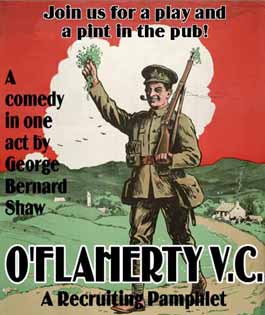
Yesterday, the latest issue of The Shavian landed in my mailbox, and an article by James Moran reminded me of the links between Bernard Shaw's play O'Flaherty VC and the family of Lady Gregory.

O'Flaherty VC
is one of a handful of short plays Shaw wrote during the First World War. His opposition to the war at its outbreak had turned Shaw into something of a pariah in England, and it was while staying at the home of his friend Lady Gregory in Ireland that he wrote O'Flaherty VC, which likewise takes place in Ireland.

Lady Gregory was a distinguished playwright and one of the co-founders of the Abbey Theatre in Dublin. It was at her estate, Coole Park, that Shaw wrote his tale of an Irish soldier who is awarded the Victoria Cross and then is sent back to Ireland to participate in a recruitment drive. Since Shaw intended the play to be done at the Abbey, which had few resources at the time, he kept production requirements to a minimum. The play requires a simple set and just four cast members.

Unfortunately, the Abbey kept running into trouble with the authorities during its early years. The British government, which had previously tried to stop the Abbey from producing Shaw's The Showing-up of Blanco Posnet in 1909, stepped in again, and the theatre was forced to withdraw the play in spite of plentiful advance ticket sales. That meant the first production of O'Flaherty VC was not in Ireland, but in Belgium--right near the front lines of the very war is was satirizing!

That production was put on by some amateurs who belonged to the Royal Flying Corps. Men took on the two female roles, and O'Flaherty's girlfriend Teresa was played by Lady Gregory's son Robert. Sadly, Robert Gregory did not survive the war. His Sopwith Camel went down over Italy in 1918. Lady Gregory's friend William Butler Yeats later memorialized Robert in the poem "An Irish Airman Foresees His Death."

The play was not professionally produced until after the war, when the Stage Society presented it in London. O'Flaherty VC was later broadcast over the radio in 1924, with Shaw himself performing all of the roles in different voices. An estimated four million people are thought to have tuned in for that broadcast. None of this would have happened had it not been for the support of Lady Gregory.

Monday, January 3, 2022

Ulysses in Nighttown

James Joyce is known for his prose fiction, not for drama, though he did pen the 1918 play Exiles, rejected by W.B. Yeats for the Abbey Theatre.

A more famous play by Joyce was not intended as a play at all. When he wrote the "Circe" section of his novel Ulysses, Joyce decided to craft it in the form of a play, complete with character headings, dialogue, and stage directions.

That "play" never meant for performance has been staged, however, most famously in Marjorie Barkentin's adaptation Ulysses in Nighttown. Jonathan Greenberg gives an excellent account of the 1958 premiere of the play in a recent issue of PMLA.

Apparently, the producers of Ulysses in Nighttown originally wanted to cast Irish actors in the play "to insure fidelity to Joyce's characters and atmosphere," according to a press release. When stars of the Dublin stage proved unavailable, Barkentin instead offered the leading role to Burgess Meredith.

Meredith instead wanted to direct the play, bringing John Astin on board to assistant direct. (As Greenberg slyly notes in his article "Springtime for Ulysses," that means "for fans of the TV show Batman, the production was in the hands of the Penguin and the Riddler.") To play the protagonist, Leopold Bloom, Meredith hired Zero Mostel, a move that reinvigorated Mostel's career.

Both Meredith and Mostel had been blacklisted following their uncooperative appearances before the House Un-American Activities Committee. (Mostel--in a loud stage whisper--had referred to the chairman of the committee as a "schmuck" during the hearings.) This would be their chance to do on stage what Hollywood no longer allowed them to do in front of a camera. The venue was the Rooftop Theater on Houston Street. Yes, the theatre was literally on the roof, with the ground floor of the building being a cinema that had previously been home to a prominent Yiddish theatre company. (The second floor was the headquarters for a bagel workers union. Only in New York....)

The play featured not only Mostel, but also Carroll O'Connor as Buck Mulligan, Anne Meara as Mrs. Breen, and Bea Arthur as Bella Cohen. Mostel received an Obie Award for his performance. The broad comedy of his acting fit with the source material, since Joyce frequently referenced popular entertainers in Ulysses, including Marie Kendall, Jenny Lind, and Herbert Beerbohm Tree.

Success in Ulysses in Nighttown allowed Mostel to work again after years of being blacklisted, and it also endowed him with a new reputation for interpreting avant-garde absurdist drama. He played Estragon in a television adaptation of Waiting for Godot by Joyce's former research assistant Samuel Beckett, and was in Eugene Ionesco's Rhinoceros.

In 1962, Mostel played Pseudolus in A Funny Thing Happened on the Way to the Forum, and then in 1964 he played Tevye in Fiddler on the Roof. Those who never saw him on stage probably remember him best, however, as Max Bialystock in Mel Brooks's 1967 film The Producers. The name of the other producer in that movie? Leo Bloom.

This was no coincidence. As Greenberg points out, Brooks himself has said he chose the name Leo Bloom in tribute to the Leopold Bloom of Joyce's novel. Sometimes, influences pop up even where you least expect them.

Wednesday, March 17, 2021

The Aran Islands

Last night, I watched Irish Repertory Theatre's digital production of The Aran Islands, a one-man play with Brendan Conroy based on a non-fiction account by John Millington Synge.

At the suggestion of fellow writer William Butler Yeats, Synge lived for a while out on the stark, remote islands off Ireland's west coast. The idea was to give Synge a better understanding of rural Irish people and their native language.

Synge's account of his stay there, first published in the New Irish Review in 1898, describes a hardened but life-filled people, prone to superstition and brimming with stories to tell. Conroy relates many of these yarns, including an account of a child stolen by fairies, and a folk-tale that contains elements from The Decameron as well as Shakespeare's Cymbeline and The Merchant of Venice.

Other stories Synge picked up in the Aran Islands made their way into his one-act plays Riders to the Sea and In the Shadow of the Glen. The remote location in western Ireland also inspired Synge's most famous play, The Playboy of the Western World.

Joe O'Bryne adapted and directed The Aran Islands, which can be viewed as part of the online performances offered by Irish Rep. The production is currently running through March 28th.

Sunday, February 16, 2020

Lady Gregory

Last night, I saw Irish Repertory Theatre's production of Lady G: Plays and Whisperings of Lady Gregory. The piece explores the life and work of Augusta Gregory, one of the most important figures of the 20th-century theatre.

Lady Gregory is also the subject of an upcoming exhibit at the New York Public Library. Together with the poet William Butler Yeats and Sinn Fein activist Edward Martyn, she founded the Abbey Theatre in Dublin. Yeats also freely credited her with contributing to his play Cathleen Ni Houlihan. It was she, he said, who was responsible for getting the dialect of the local peasantry right.

Though she was born into the Protestant Ascendancy in Ireland and married into an aristocratic family, her sympathies were always with the common people, and she relished the Irish language, in spite of being forbidden from learning it as a child. After her husband Sir William Henry Gregory died in 1892, she threw herself into collecting folklore and trying to establish an Irish national theatre.

When the Abbey Theatre officially opened in 1904, it performed her short play Spreading the News along with Yeats' On Baile's Strand and Cathleen Ni Houlihan. Her biggest challenge as a producer came when the Abbey put on John Millington Synge's The Playboy of the Western World. The audience rioted, and when the company toured the United States, the play suffered the same fate in New York.

Irish Rep's piece goes over much of this history, with Una Clancy portraying Lady Gregory and a trio of other actors taking on a variety of roles. The production also fully stages two of Lady Gregory's one-act plays: Workhouse Ward and McDonough's Wife. These are rarely performed works, so get your tickets now!

Sunday, March 10, 2019

Juno and the Paycock

Last night, I saw Sean O'Casey's Juno and the Paycock at Irish Repertory Theatre. It's part of a trio of O'Casey plays the company is putting on through May. Right now, just Juno is running, but all three will be playing in rep May 11-25.

I'd already seen Irish Rep's production of The Shadow of a Gunman, which stars Meg Hennessy and James Russell in a story about the Irish War of Independence. Both Hennessy and Russell do excellent jobs in a play that starts out as a witty comedy and turns devastatingly tragic.

Juno and the Paycock similarly has tonal shifts, but rather than simply beginning as a comedy and turning into a tragedy, it deftly weaves together different dramatic strands into a tapestry that can be stunning in its beauty. The Shadow of a Gunman was O'Casey's first play to be professionally produced, so it's only natural that he should have learned a thing or two for his second big play.

Instead of experiencing a sophomore slump, O'Casey had a hit with Juno and the Paycock, which like The Shadow of a Gunman opened at the Abbey Theatre in Dublin. The Abbey had been involved with a number of controversial plays, including William Butler Yeats' Cathleen Ni Houlihan, John Millington Synge's The Playboy of the Western World, and George Bernard Shaw's The Showing-Up of Blanco Posnet. What they didn't have was financial success.

All that changed when they discovered O'Casey. The Abbey had rejected O'Casey's play The Frost in the Flower but encouraged him to keep writing. When he sent them The Shadow of a Gunman, they knew they had something special. The play's success was exceeded, however, by Juno and the Paycock. That play opened in 1924, a year after a ceasefire had ended the Irish Civil War that had followed the nation's independence. O'Casey dealt explicitly with the Civil War in his play, but allowed audiences to sympathize with all those who had died, which was perhaps a key to its popularity.

Militants who rejected the peace with Britain, who wanted to keep fighting until Ireland was out of the Commonwealth and the counties in Northern Ireland joined the Republic, were known as Diehards. They continued to wage war against the new national government just as they had against the British. Meanwhile, those who sided with the newly independent Irish Free State were known as Staters, and both sides were subject to assassination. In O'Casey's play, Juno Boyle fails to sympathize with a neighbor when her son is killed for being a Diehard, but then her own son is taken by the Diehards for being a Stater.

"Ah, why didn't I remember that then he wasn't a Diehard or a Stater, but only a poor dead son!" she says toward the end of the play. "Sacred Heart o' Jesus, take away our hearts o' stone, and give us hearts o' flesh! Take away this murdherin' hate, an' give us Thine own eternal love!" That must have resonated after the close of the Irish Civil War, just as it resonates today in the shadow of so much war and death.

Maryann Plunkett does an exceptional job as Juno in what is her Irish Rep debut (though she has a long list of Broadway and off-Broadway credits). Director Neil Pepe, best known for being the Artistic Director of the Atlantic Theater Company, helms the production, and Irish Rep regular Ciarán O'Reilly plays Captain Jack Boyle, who struts around like a "paycock" in the play.

Special kudos go to scenic designer Charlie Corcoran, who has managed to turn the interior of the theatre at Irish Rep into a set of early-20th-century tenements that can be used for all three O'Casey plays the company is doing. The third play, The Plough and the Stars, will begin performances April 20th.

To find out more about the shows, check out Irish Rep's website.

Saturday, January 27, 2018

The Patrician's Daughter

When J. Westland Marston's tragedy The Patrician's Daughter is remembered today, it's usually due to Charles Dickens. The novelist wrote a prologue for the play to be spoken by William Charles Macready, who played the role of Mordaunt in the original production at Drury Lane in 1842.

Dickens's verse prologue emphasizes the contemporary nature of the play, and praises the author for choosing a modern setting:

  Its solemn music he does not pursue
  To distant ages out of human view;
  Nor listen to its wild and mournful chime
  In the dead caverns on the shore of Time;
  But musing with a calm and steady gaze
  Before the crackling flames of living days,
  He hears it whisper through the busy roar
  Of what shall be and what has been before.
  Awake the Present! Shall no scene display
  The tragic passion of the passing day?

Though playwrights in the nineteenth century occasionally still wrote tragedies in blank verse, they usually did not set these poetic dramas in modern times. This was the innovation of The Patrician's Daughter that Dickens was praising. The phrase "Awake the Present" appears no fewer than three times in his prologue, which can be best summed up in its final three lines:

  Learn from the lessons of the present day.
  Not light its import and not poor its mien;
  Yourselves the actors, and your homes the scene.

In the first scene of the play, the heroine, Lady Mabel, is bemoaning the fact that women have so few choices in modern society. Still, she is determined to make the most of what agency she has. She tells her father:

  Women who marry seldom act but once;
  Their lot is, ere they wed, obedience
  Unto a father; thenceforth to a husband;
  But in the one election which they make,
  Choice of a mate for life and death, and heaven,
  They may be said to act.

Mabel is interested in Mordaunt, who is wealthy, though not of high birth like her. (She's the daughter of an earl.) She seems to regret that her life is not more romantic, though. In the play's second act, she laments to Mordaunt:

  O, would that I had lived in ancient days,
  The times of old romance! Do you not think
  I should have been a heroine?

His response to her is, "Why not be one now?" If women could be romantic heroines in the past, why not today, in modern drawing rooms wearing the clothes of today, not some bygone fashion? Marston's lines seem particularly self-conscious here, as it was the modernity of his verse tragedy that struck people as so novel. Mordant even uses a theatrical metaphor when he says later in the scene:

    Life's great play
  May, so it have an actor great enough, 
  Be well performed upon a humble stage.

We today would not consider Mordaunt from a humble background, but to Mabel's family, he is downright plebeian. Mabel's Aunt Lydia (originally played by Mary Warner) is so set against Mordaunt forming an alliance with her niece she concocts a plan to make him believe Mabel has already professed her love for him. When he asks to be accepted as an official suitor, Lydia tells Mabel that Mordaunt asked for her hand as part of a business transaction. Mabel is repulsed, and the courtship falls apart before it can even begin.

The fourth act skips ahead five years, and Mabel and Mordaunt are now engaged. During a painful scene with a notary, Mordaunt breaks off the engagement as an act of revenge, thinking Mabel and her family had betrayed him in the past. Mabel falls ill, and Lydia comes to regret her actions. In the first scene of Act Five she declares: "I am my niece's murderer!" Eventually, Mordaunt figures out what happened and asks for Mabel to take him back, but by that point it is too late, and she dies in his arms.

The Patrician's Daughter lasted only 11 performances. The experiment with modern verse tragedy did not catch on in the nineteenth century, though numerous poets (like W.B. Yeats) experimented with it in the twentieth.

Sunday, October 18, 2015

Shaw Conference Continues

Today was day three of "Shaw in New York," the conference of the International Shaw Society held at Fordham University and the New York Library for the Performing Arts. Today, however, all of the events were at Fordham, where conference goers had almost 12 hours of Shavian musings.

Joseph Hassett was the featured speaker this morning, addressing the struggle between George Bernard Shaw and William Butler Yeats over the actress Florence Farr. In 1890, Farr had appeared in John Todhunter's play A Sicilian Idyll in the role of an ancient priestess. Yeats said he had never heard anyone recite verse better than she did in the play. Shaw didn't care much for the play, but was considerably taken by the actress's good looks.

At Shaw's urging, Farr played Rebecca West the next year in a production of Henrik Ibsen's Rosmersholm. Yeats believed the prose play was a waste of her powers and feared it would draw her away from poetic drama. The following year, Farr originated the role of Blanche in Widowers' Houses. Shaw appeared to be winning the tug-of-war.

At a Christmas party thrown by Todhunter, Farr asked Yeats to write a play for her, and that play eventually became The Land of Heart's Desire, which premiered in 1894 at the Avenue Theatre. Originally, Shaw was supposed to write a play to be performed with that piece, but when his play remained unfinished, the theatre replaced it at the last minute with a lightweight Todhunter work, A Comedy of Sighs.

Furious at Shaw, Farr insisted that he complete the piece he had agreed to write. Sitting outdoors on the embankment, Shaw finally completed the play, his classic Arms and the Man. The play was done at the Avenue with Farr in the role of Louka. It was such a hit that Richard Mansfield produced it later that year at the Herald Square Theatre in New York City. Shaw's career seemed to be secured, largely due to the efforts of Farr.

Here's the part where Hassett answered the question I had yesterday about Aubrey Beardsley's illustration used to advertise The Land of Heart's Desire. It seems that previously Farr owned the illustration. While she had not appeared in the original version of the play, Yeats dedicated The Land of Heart's Desire to her, so she obviously had a close association with it. Later in life, when Farr was hard up for funds, she sold Beardsley's artwork to Shaw, and it remains to this day in the writer's former home, Shaw's Corner.

After Hassett's wonderful talk, Ellen Dolgin spoke about Shaw's relationship with The Theatre Guild in New York. The Guild produced Heartbreak House in 1920, and then requested the author provide them with another great play. Shaw responded by sending them the massive five-play cycle Back to Methuselah, which the Guild produced in 1922. The following year, they staged the first English-language production of Saint Joan.

Michael O'Hara spoke about Shaw and the Federal Theatre Project, which at its height employed thousands of people and brought drama to Americans all across the country. Because the FTP required that the bulk of a production's expenses go to the workers producing it, there was little money left for royalties. Shaw, however, agreed to allow the organization to produce his works without his usual royalties, provided the top ticket price be no higher than 55 cents. The FTP responded by producing Great Catherine, Pygmalion, On the Rocks, and Androcles and the Lion, with many of the performances actually free.

Other scholars delivering papers today included Michel Pharand, J. Ellen Gainor, Larry Switzky, Jennifer Buckley, Mark Lepitre, and Gustavo Rodriguez Martin. In many ways, however, the highlight of the day was a musical presentation of songs by Shaw performed by Brigitte Bogar, with commentary by Christopher Innes.

Tomorrow the conference continues, followed by a Project Shaw reading of The Doctor's Dilemma at Symphony Space.

Saturday, October 17, 2015

Shaw in New York Conference Begins

The International Shaw Society's "Shaw in New York" conference is off and running!

Last night, David Staller, artistic director of The Gingold Theatrical Group, kicked off the conference with a keynote address about his work with Project Shaw. For nine years now, GTG has been giving concert readings of the plays of George Bernard Shaw and his contemporaries. This Monday, they will be presenting The Doctor's Dilemma at Symphony Space. I'm looking forward to it!

After the keynote, Terry Teachout, drama critic for The Wall Street Journal, gave a wonderful reflection on the state of Shaw productions today. Teachout praised Theatre Bedlam's landmark production of Saint Joan, which I had the good fortune of seeing in 2013. Director Eric Tucker got four talented actors (including himself) to perform all of the parts. The production was in modern dress with an innovative set and the audience's configuration changing periodically. Teachout said the production should change the way we do Shaw.

He compared the way we see Shakespeare produced with the way we normally see Shaw's plays. Shakespeare can be set in any period, but Shaw is almost always set in vaguely Edwardian times. With Shakespeare, we expect avant-garde techniques, whereas Shaw is always done with simple, straight-forward Realism. Shakespeare's plays can be trimmed back, but Shaw's are almost always performed uncut from their published versions, even though those texts were rarely performed in their entirety during Shaw's time. We expect double-casting with Shakespeare, but require large, expensive casts for Shaw. That means while producing Shakespeare can be affordable, the economics make Shaw's plays a rare event for most theaters.

The solution, Teachout said, is to start treating Shaw's plays like Shakespeare's. Granted, directors' concepts don't always work for Hamlet, so they won't always work for Saint Joan, either. The point is we need to allow ourselves to try things. If Shakespeare's texts are not sacred, why should Shaw's be? Most of his important plays are in the public domain anyway, so there is no need to get permission from an estate. Let's start seeing Shaw liberated from a single way of producing his work, and maybe he will become as much our contemporary as Shakespeare seems to be.

Today, the conference continued, with legendary Shaw scholar Stanley Weintraub introducing some of Shaw's playlets that occur outside the plays, in various essays, articles, and prefaces. Four professional actors read scenes from these playlets at the Bruno Walter Auditorium of the New York Public Library for the Performing Arts. My favorite was a scene between Jesus and Pontius Pilate penned in 1933 for the preface to On the Rocks. Weintraub said this scene could be read as a continuation of Shaw's early Passion Play, a blank verse drama he began in 1878 but never finished.

Later that morning, Anne and Martin Wright gave a presentation of a new interactive on-line tour of Shaw's Corner, the author's home in Ayot St. Lawrence. I was fascinated by seeing in the house a design by Aubrey Beardsley that I immediately recognized as the illustration used on the poster advertising the premiere of The Land of Heart's Desire by William Butler Yeats. Originally, The Land of Heart's Desire had been done as a curtain raiser for John Todhunter's A Comedy of Sighs at the Avenue Theatre in March of 1894. What was the original artwork doing in Shaw's House?

Well the month after Yeats' play premiered, it was performed again at the Avenue Theatre, this time together with the world premiere of Shaw's Arms and the Man. It seems that the Avenue Theatre continued to use the design for other posters as well, including (apparently) Arms and the Man, though I have yet to be able to verify this.

After the Wrights' presentation, we all walked over to the Lincoln Center campus of Fordham University for lunch and the afternoon sessions. I was a part of a session chaired by Jean Reynolds, which included Howard Einsohn talking about Shaw's political address to the American people given at the Metropolitan Opera House in New York in 1933. He was followed by Virginia Costello speaking about how Dorothy Day had dealt with the challenges of charity that Shaw presented in his play Major Barbara. I gave my talk on how Shaw was influenced by Percy Bysshe Shelley's play The Cenci, and Charles Del Dotto finished up the session talking about Shaw and the sublime.

After that, I attended a session on Pygmalion chaired by Ellen Dolgin. Jean Reynolds began the discussion with a paper on the play as meta-drama. She pointed out that it begins with theatergoers having just left a show and Henry Higgins being asked if the trick he does analyzing people's speech allows him to make a living in a music hall. Peter Conolly-Smith then spoke about the history of the German language version of Pygmalion, which actually premiered prior to any English production.

The play was presented for 25 performances in Vienna, then ran for 107 nights in Berlin, before it made its American premiere at the Irving Place Theatre in New York... in German! In fact, the play was also performed in unauthorized productions in Polish and Hungarian (translated from the German) before its London premiere. An American pirated version of the play even appeared in English, horribly reverse-translated from the German version, in some disreputable paper called The New York Times.

Tomorrow, the conference continues with Joseph Hassett speaking about Shaw and Yeats. Michael O'Hara will also be talking about Shaw and the Federal Theatre Project, and both Jennifer Buckley and Mark Lepitre will be speaking on Back to Methuselah. I'm looking forward to it!

Wednesday, September 30, 2015

Shaw in New York

The autumn issue of The Shavian this year includes a review of Stanley Weintraub's new book Bernard Shaw Before His First Play: The Embryo Playwright. This is quite fortuitous, as Dr. Weintraub will be a featured speaker at the "Shaw in New York" conference at the New York Public Library for the Performing Arts this upcoming month.

I myself will be giving a paper at the conference, and on a topic somewhat related to Dr. Weintraub's book. During a breakout session, I'll be speaking about how the infamous debut of The Cenci by Percy Bysshe Shelley helped to make Shaw into a playwright. I'll be sharing the session with Howard Einsohn from Middlesex Community College, Virginia Costello from the University of Illinois Chicago, and Charles Del Dotto from Duke University.

In addition, there will be talks on Shaw and Edith Wharton, Shaw and W.B. Yeats, and Shaw and the Federal Theatre Project, among other topics. The conference will be held October 16-19 at Lincoln Center. You can find out more here:

SHAW SOCIETY

Tuesday, September 22, 2015

The Dramatic Imagination of William Butler Yeats

William Butler Yeats always had a dramatic imagination. Many of his early works, including The Island of Statues, The Seeker, and Mosada, he labeled "dramatic poems," though these were never intended for performance. Yeats' first muse was his cousin Laura Armstrong, whom he called "Vivien," and who inspired a number of these early pieces, including the "dramatic poem" Time and the Witch Vivien. That play (which ends with the death of his muse's namesake) shows an ambivalence toward the woman he credited with inspiring his dramatic output. That same ambivalence can be seen in his approach to drama itself.

Today, a creative director could very well stage Yeats' "dramatic poems." However, these pieces must have seemed impossible dreams to the literally minded theatre of the 1880s when they were first published. The Island of Statues, for instance, calls for an arrow to fall on stage, landing right next to one particular flower. When the hero Almintor pulls the flower, he "becomes stone." Later, his beloved Naschina rescues him, using magic to bring back to life not only Almintor, but also other adventurers who have been turned to stone. However, Naschina has paid a price for her magic and now lives an existence apart from that of ordinary mortals. Yeats makes this clear in a stage direction that would challenge even the most skillful lighting designers:

The rising moon casts the shadows of Almintor and the Sleepers far across the grass. Close by Almintor's side, Naschina is standing, shadowless.

Even with today's lighting instruments, having one actor out of many appear without a shadow would be a challenge, to say the least.

Much like the stage directions of other Symbolist dramas, Yeats' words defy staging, seeming to openly challenge the theatre to perform the un-performable. In fact, during the 1880s, Yeats seemed to avoid drama entirely. In 1887, he confided in a letter to his friend Katherine Tynan, "I am not fond of the Theatre." Yet two years later, in 1889, he began work on his first serious play, The Countess Cathleen. For this play Yeats took inspiration from another muse, Maud Gonne, the statuesque Irish actress who soon had the poet under her spell.

Though another actress ultimately played the title role in that play, Yeats dedicated the printed version to Gonne. Years later, she would originate the title role in Cathleen Ni Houlihan. For this new stage of Yeats' development as a playwright, writing not just "dramatic poems" but more practical, stage-worthy plays, Gonne was the dominant muse inspiring his work.  The strong, ethereal heroines of Yeats' first performed plays likely owe a great deal to Gonne. Included among those heroines is Mary Bruin, the ill-fated young wife in Yeats' 1894 one-act play The Land of Heart's Desire.

For a variety of reasons (including the play's controversial subject matter) The Countess Cathleen was not fully staged until 1899. The Land of Heart's Desire thus became Yeats' first professionally staged play when it opened on March 29, 1894 as a curtain raiser for John Todhunter's A Comedy of Sighs at London's Avenue Theatre. The play, like many Symbolist dramas, was engaged with the visual arts, as can be seen in its poster designed by Aubrey Beardsley. The poster showed a spotted curtain partially concealing a dark-haired beauty, the curtain revealing and obscuring at the same time.

A satirical poem in the magazine Punch failed to appreciate the invocation of the unseen. Accompanied by an illustration labeled "Venus Domina" that showed Beardsley's spotted curtain as rows of dominoes, the poem declared:

A simple maid au naturel
Is worth a dozen spotted ghouls.

Published anonymously but attributed to Owen Seaman, the poem also lambasted the figure as a "Japanee-Rossetti girl." Though cruel, the poem does capture two of Yeats' influences early in his career, a fascination for all things Japanese and the Pre-Raphaelite imagery of Dante Gabriel Rossetti. In spite of the criticism in Punch, the publisher T. Fisher Unwin used Beardsley's illustration for the cover design of the published version of the play issued the following month.

The play itself did not cause nearly as much furor as Beardsley's illustration. It is written in verse, but utilizes a natural dialogue that makes it sound contemporary, in spite of Yeats setting the play "at a remote time." The action of the play at first seems realistic, portraying a typical family gathered around a fire in their home, but then a child appears "strangely dressed, perhaps in faery green." The child gradually gains sway over the family, and before they are fully aware of her supernatural origins, she casts a spell over them and tries to lure away the newly married bride, Mary. The faery child tempts Mary to follow her:

Where nobody gets old and crafty and wise,
Where nobody gets old and godly and grave,
Where nobody gets old and bitter of tongue,
And where kind tongues bring no captivity;
For we are but obedient to the thoughts
That drift into the mind at a wink of the eye.

Mary cannot live in this faery world, though. She dies in the blossom of her youth, and the child disappears.

The Land of Heart's Desire is by many measures a conventional play, but before rehearsals began Yeats made a journey to Paris that would send him deeper into the thrall of Symbolism. It was in Paris, accompanied by the inspirational Maud Gonne, that Yeats attended the landmark production of Philippe Auguste Villiers de l'Isle-Adam's play Axel. After seeing the play and closely studying the text, Yeats published a commentary for the literary journal The Bookman called "A Symbolical Drama in Paris." In it, he attacked Naturalism, complaining that many people in Britain "write and talk as if the imaginative method of the great dramatists, of Kaladasa, of Sophocles, of Shakespere, and of Goethe was to let its house on a lease for ever to the impassioned realisms of M. Zola and of Dr. Ibsen." France, he wrote, was a different story.

After praising the early plays of Maurice Maeterlinck, Yeats goes on to describe the production of Axel as an even greater portent of the new, non-Naturalistic dramas to come. He focuses his analysis on the play's fourth act, and condenses its moral as this: "The infinite is alone worth attaining, and the infinite is the possession of the dead." This could also be the message of The Land of Heart's Desire, if we see Mary's death as an escape from the everyday to the transcendent beauty possible only in death. However, Yeats' play still has one foot firmly in the ordinary. By contrast, "a grim and difficult play" like Axel, Yeats writes, "brings us a little nearer the heroic age."

Not coincidentally, the next play Yeats wrote, The Shadowy Waters, takes place in the heroic age. Also not coincidentally, it borrows heavily from Axel in showing a pair of lovers who choose certain death over the glories of this world. The sailor Aibric tries to talk sense into his captain, urging him to abandon his quest for a woman who "can cast no shadow." Though the play does not use the impossible stage directions of The Island of Statues, Yeats still uses the poetic image of the shadowless woman. This time, however, he creates the image purely in the imagination.

The imagery in the play even evokes the Rosicrucian philosophy of Axel, as the captain, Forgael, imagines a "red rose" upon "the two shafts of the cross." Parallels with Axel become even stronger when the captured queen Dectora appears, coldly demanding vengeance, much as in Villiers' play the mysterious Sara seems emotionless as she attacks the title character with pistol and dagger. Like Axel, Forgael at first resists the strange woman he encounters, but is soon struck by her beauty. When Axel triumphs over Sara, she determines to commit suicide using the poison in her "deadly ring." Similarly, Dectora declares she has no fear "While there's a rope to run into a noose / Or wave to drown."

In such a situation, it might seem impossible for a woman, first murderous then at the point of suicide, to turn suddenly and love the man she a moment ago wanted dead. That is precisely what happens both in Axel and The Shadowy Waters.  Within moments of wanting to kill Axel, Sara has reversed herself, kissing him and offering him her soul. In a similar way, Dectora falls in love with Forgael in spite of the fact that he is responsible for her husband's death. She simply does not care, claiming, "it was yesterday and not to-day / I loved him."

What remains in both plays is for the characters to undergo the ordeal by gold and love, in which the lovers must overcome the temptation to return to a world with unimaginable treasures. In Axel, Sara rhapsodizes for several pages about the deeds the pair could accomplish with the gold they have discovered. In Yeats' play, Aibric is more succinct in his description of the treasure, but as in Axel, it is "so great / Imagination cannot reckon it." Instead of embracing the treasure as a means to spend out the rest of his life with his love, both Axel and Forgael reject it. Sara must struggle before she can willingly join her lover in death, but Dectora is quick to choose Forgael and his journey to the edge of the sea, even over a life together with infinite possibilities.

The Shadowy Waters was not produced for a number of years, though in 1900 it was published in The North American Review and later in book form. By that time, however, The Countess Cathleen had made it at last to the stage. The newly formed Irish Literary Theatre produced the play in 1899, renting out a concert hall in Dublin that usually hosted musical events. Just as Paul Fort had created a literary journal to accompany his own Théâtre d'Art, the Irish Literary Theatre issued a journal called Beltaine, named after the Celtic spring festival that coincided with the opening of the company. The talented actress Florence Farr signed on as general manager of the theatre and also acted the important role of the bard Aleel in the play. Everything seemed to be going well. Then the play opened.

Based on an old Irish legend, The Countess Cathleen tells the story of a woman who sells her own soul in order to relieve the suffering of peasants. Demons disguised as merchants strike up the foul bargain with the countess. At the end of the play, she lies dying, asking that the money she has given so much to obtain be distributed to the poor. After she dies, there is thunder and lightning, and the world is enveloped in darkness. Light breaks through the darkness, and angels appear, armed for battle. One of the angels proclaims that Cathleen's soul is saved after all, declaring:

The light beats down; the gates of pearl are wide;
And she is passing to the floor of peace,
And Mary of the seven times wounded heart
Has kissed her lips, and the long blessed hair
Has fallen on her face; The Light of Lights
Looks always on the motive, not the deed,
The Shadow of Shadows on the deed alone.

In writing the play, Yeats had even consulted with two priests who were noted theologians, and both approved of the play and its miraculous ending. Others would not be so open-minded.

One Frank Hugh O'Donnell published a pamphlet called Souls for Gold condemning the play. After reading the pamphlet (but not seeing the play) Cardinal Michael Logue, the highest-ranking catholic prelate in Ireland, wrote a letter to several newspapers attacking The Countess Cathleen and Yeats personally. On opening night, both supporters and critics showed up to voice their opinions, and a large contingent of police showed up in case there was trouble. Yeats later wrote that Arthur Griffith, the founder of the Sinn Fein nationalist movement, brought in a bunch of rough characters "and told them to applaud everything the Church would not like." Much to the playwright's dismay, what was supposed to be an artistic statement was overshadowed by political and religious controversies.

After his early involvement with the Irish Literary Theatre, Yeats returned to London where he collaborated with the hack writer George Moore on the prose play Diarmuid and Grania. The uneven script attracted the attention of the star actress Mrs. Patrick Campbell, who went on to originate the role of Eliza Doolittle in Pygmalion. In a letter to Lady Augusta Gregory, Yeats recalled how Campbell had praised some parts of the play while denigrating others, mainly those written by Moore. "I am sure I know what part you have done & what part he has done," she said, "for sometimes the words are so beautiful & sometimes they are like a French novel & spoil everything." Though Yeats appears to have known she was right, he did not have the courage to stand up to Moore, who was an accomplished dramatist in spite of his rather atrocious dialogue.

The play opened on October 21, 1901 at the Gaiety Theatre in Dublin and was favorably reviewed by the local press. However, a college student named James Joyce saw the production and was dismayed. Though he had previously intended to submit a play of his own to the Irish Literary Theatre, he wrote an article attacking the play and the company. When a college magazine rejected his article, he had it published as a pamphlet, together with an essay by a friend condemning the university for censorship. The Irish Literary Theatre, Joyce said, "must now be considered the property of the rabblement of the most belated race in Europe."

Perhaps the best thing to come out of the play was the incidental music composed by Edward Elgar. The play's funeral march is particularly well regarded as an example of early twentieth-century symphonic music. Diarmuid and Grania was the first play for which Elgar had written a score, and the composer went on to write other fine pieces of theatrical music. Having music from such a prodigious talent as Elgar might have influenced Yeats as well. For his later plays, he frequently sought out composers to work with him on productions.

Diarmuid and Grania ended up being the final play produced by the Irish Literary Theatre, though many of the people behind the company regrouped under the title of W.G. Fay's Irish National Dramatic Company. This group, which went through many name changes and was an eventual precursor to the Abbey Theatre, presented Cathleen Ni Houlihan on April 2, 1902 as a companion piece for George Russell's full-length play Deirdre. Like Diarmuid and Grania, Cathleen Ni Houlihan is written chiefly in prose. Fortunately for this new play, however, Yeats was able to secure a more fitting collaborator. As Yeats freely admitted in a preface to a collection of his plays, he relied on Lady Gregory's "knowledge of the country mind and country speech" to help him with the dialect of the characters.

Cathleen Ni Houlihan at first glance could almost be taken for a naturalistic play. Instead of being set in a mythic past, it takes place in the "Interior of a cottage close to Killala, in 1798." The play's Irish audience would have immediately recognized the location as the scene of an anti-British rebellion precipitated by the landing of French troops. The historical roots are very clear, the cottage setting is familiar, and the play itself is quite brief. According to a prompt book now owned by the Abbey Theatre, performances lasted only 20 minutes.

Yet within those 20 minutes, Yeats packed in many of the themes from his earlier plays. Like The Countess Cathleen, the play calls for personal sacrifice for the good of an oppressed collective. As in The Shadowy Waters, the protagonist embraces death rather than the comforts of love and wealth. Much like The Land of Heart's Desire, the play portrays a young couple, though in this case about to be married instead of recently married. However, like in The Land of Heart's Desire, one person in that couple abandons a beloved to rush off into death rather than settling down into the ordinary course of life. It is as if all of Yeats' previous plays were leading up to this one work.

Completing this crowning achievement was Yeats' muse Maud Gonne finally performing in one of his plays. The Irish nationalist got to play Ireland herself, personified in the title character. Though she had to play an old woman, Gonne had the opportunity to use her own attractiveness and charisma to make the painful service Cathleen asks for sound attractive. Tempting the young groom-to-be with promises of difficulty rather than ease, she says:

It is a hard service they take that help me. Many that are red-cheeked now will be pale-cheeked; many that have been free to walk the hills and the bogs and the rushes will be sent to walk hard streets in far countries; many a good plan will be broken; many that have gathered money will not stay to spend it; many a child will be born and there will be no father at its christening to give it a name. They that have red cheeks will have pale cheeks for my sake, and for all that, they will think they are well paid.

The pay she offers is of a different kind than the hundred pounds the young man has just received for his bride's dowry, and it is because it is a different kind of payment that the he runs off to give his life for Cathleen Ni Houlihan.

The rewards of this world will not last. The young man remarks earlier in the play that a dowry "only lasts for a while, but the woman will be there always." Even earthly love, however, eventually dies. Only by giving himself over to a cause that is more than the life of one man can he achieve immortality. As Cathleen sings toward the end of the play:

They shall be remembered for ever,
They shall be alive for ever,
They shall be speaking for ever,
The people shall hear them for ever.

In rushing off to join the rebellion, the young man is likely running off to his death, but he is also rising into immortality.

Such sentiments were dangerous in occupied Ireland during the early twentieth century. If it seems unbelievable that the British could have allowed such a politically treasonous play to be performed, that is because they didn't. After a week of performances, the authorities evicted the company from Saint Teresa's Hall where they were performing. Though production of the play was suppressed, Cathleen Ni Houlihan later became a staple of patriotic drama in the independent Republic of Ireland. For Irish nationalists, the play became a sacred work.

Since Nora's famous door slam at the end of A Doll House, Realism had been the preferred form for revolutionary drama. Cathleen Ni Houlihan, though it contains some Realist trappings, openly embraces a mysterious, supernatural figure that can only be interpreted in symbolic terms. At the end of the play, the boy gazing out at Cathleen says he no longer saw an old woman, but rather "a young girl, and she had the walk of a queen." The rejuvenated Cathleen is a young Ireland, confident in her eventual renewal as an independent state. She is also a rejuvenated theatre, eternally old, but made young again by a new dramatic style, that like Ireland in 1902, was still attempting to come into being.