Showing posts with label Herbert Tree. Show all posts

Monday, January 3, 2022

Ulysses in Nighttown

James Joyce is known for his prose fiction, not for drama, though he did pen the 1918 play Exiles, rejected by W.B. Yeats for the Abbey Theatre.

A more famous play by Joyce was not intended as a play at all. When he wrote the "Circe" section of his novel Ulysses, Joyce decided to craft it in the form of a play, complete with character headings, dialogue, and stage directions.
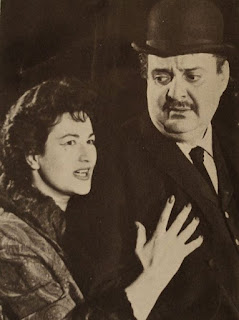
That "play" never meant for performance has been staged, however, most famously in Marjorie Barkentin's adaptation Ulysses in Nighttown. Jonathan Greenberg gives an excellent account of the 1958 premiere of the play in a recent issue of PMLA.

Apparently, the producers of Ulysses in Nighttown originally wanted to cast Irish actors in the play "to insure fidelity to Joyce's characters and atmosphere," according to a press release. When stars of the Dublin stage proved unavailable, Barkentin instead offered the leading role to Burgess Meredith.

Meredith instead wanted to direct the play, bringing John Astin on board to assistant direct. (As Greenberg slyly notes in his article "Springtime for Ulysses," that means "for fans of the TV show Batman, the production was in the hands of the Penguin and the Riddler.") To play the protagonist, Leopold Bloom, Meredith hired Zero Mostel, a move that reinvigorated Mostel's career.

Both Meredith and Mostel had been blacklisted following their uncooperative appearances before the House Un-American Activities Committee. (Mostel--in a loud stage whisper--had referred to the chairman of the committee as a "schmuck" during the hearings.) This would be their chance to do on stage what Hollywood no longer allowed them to do in front of a camera. The venue was the Rooftop Theater on Houston Street. Yes, the theatre was literally on the roof, with the ground floor of the building being a cinema that had previously been home to a prominent Yiddish theatre company. (The second floor was the headquarters for a bagel workers union. Only in New York....)

The play featured not only Mostel, but also Carroll O'Connor as Buck Mulligan, Anne Meara as Mrs. Breen, and Bea Arthur as Bella Cohen. Mostel received an Obie Award for his performance. The broad comedy of his acting fit with the source material, since Joyce frequently referenced popular entertainers in Ulysses, including Marie Kendall, Jenny Lind, and Herbert Beerbohm Tree.

Success in Ulysses in Nighttown allowed Mostel to work again after years of being blacklisted, and it also endowed him with a new reputation for interpreting avant-garde absurdist drama. He played Estragon in a television adaptation of Waiting for Godot by Joyce's former research assistant Samuel Beckett, and was in Eugene Ionesco's Rhinoceros.

In 1962, Mostel played Pseudolus in A Funny Thing Happened on the Way to the Forum, and then in 1964 he played Tevye in Fiddler on the Roof. Those who never saw him on stage probably remember him best, however, as Max Bialystock in Mel Brooks's 1967 film The Producers. The name of the other producer in that movie? Leo Bloom.

This was no coincidence. As Greenberg points out, Brooks himself has said he chose the name Leo Bloom in tribute to the Leopold Bloom of Joyce's novel. Sometimes, influences pop up even where you least expect them.

Wednesday, April 30, 2014

Pygmalion at 100

This year marks the centennial of the premiere of the classic play Pygmalion by George Bernard Shaw. Recently, I joined the International Shaw Society, and as a member, I’ve been receiving e-mails with all sorts of information on Shaw. One e-mail the society sent out earlier this month included the original London Telegraph review of the play from 1914.

I won't quote the entire review, but I wanted to share some choice tidbits. It starts out like this:

Here is Mr. Shaw in his most benign mood. He could not here find it in his heart to give anything sharper than a genial thrust at his dearest enemies. For once, he lets off with a caution even the middle-classes, even morality. It would have been too great a sacrifice not to bring them into court. The hero is permitted to assure us without a glimpse of irony visible that a sneer spoils the look both of the face and the soul.

I'm not sure Shaw would have taken "genial" as a compliment, but it certainly does describe the play, perhaps in spite of the playwright's own desires. According to the review, Sir Herbert Tree, who played Higgins, made a speech after the curtain fell, claiming "there had been so much laughter that Mr. Shaw had left the theatre in despair." Whether that was literally true or not, Shaw was famous for requesting that his very funny plays be received in respectful silence, an absolute impossibility when it comes to a piece as funny as Pygmalion.

The review also notes the elaborate staging of the play, including "massive pillars" and "most realistic rain" as well as "a taxicab as large as life." It saved most of its praise, however, for the actors, including Tree as Higgins, Edmund Gurney as Alfred Doolittle, and Mrs. Patrick Campbell as Eliza. The review said of the star actress:

Mrs. Patrick Campbell disguised herself excellently in the flower girl's primitive squalor, and her cockney accent was (to one who cannot distinguish a hundred and thirty vowel sounds) exactly right and supremely funny. The whole attitude of the girl was excellently managed. With very delicate art we had the gradual progress of Eliza suggested, and throughout the scene in which the small talk of the gutter comes with slow, elaborate beauty, Mrs. Campbell's comedy was rich and rare. Afterwards, as a fine lady, she played with any amount of fire.

Playing with fire is precisely what the play does so well. It should be no wonder that a hundred years later the piece is still burning brightly.

By the way, if you're interested in learning more about the Shaw Society, go here:

International Shaw Society

http://www.shawsociety.org/