Showing posts with label Stephen Sondheim. Show all posts

Friday, January 30, 2026

Passion

The first Stephen Sondheim musical I ever saw on Broadway was Passion, his 1994 collaboration with director and book writer James Lapine.

In spite of winning the Tony Award for Best Musical, the play closed at the beginning of the next year, earning it a less-than-stellar reputation. Lately, however, I've found multiple students talking about the piece, having seen the filmed version of the original staging that aired on PBS and has subsequently become more widely available.

Recently, I picked up a used copy of the DVD of this version, which I watched today. It was my first time seeing Passion since 1994, though I've listened to the cast recording countless times. As some of the original artists mention on the commentary track of the DVD, the recording is one of the best ever done of a stage musical, in part because it was shot on film in an empty theatre after the show closed, so it was possible to get very high-quality close-up shots.

Passion famously opened with a nude scene.  The audience got to see the characters Giorgio and Clara in bed making love, with no attempt to cover up the woman's breasts with one of those odd, L-shaped sheets that seem only to exist on network television. For the filmed version, however, up comes the sheet, sparing the viewer the sight of Marin Mazzie's breasts. Mazzie went on to greater fame, playing Mother in Ragtime and appearing in a revival of Kiss Me Kate, but she was also stunning in Passion.

The more interesting part in the show, however, is Fosca, a role originated by Donna Murphy. I loved her when I first saw her in Passion, and was greatly impressed by her range when I later saw her in Wonderful Town. (Younger fans probably know her as the voice of Mother Gothel in Tangled.) The production also boasted Sondheim veteran Tom Aldridge, who had previously played the Narrator and Mysterious Old Man in the original production of Into the Woods. In Passion he plays a doctor who induces Giorgio to take an interest in the sickly Fosca, with some disastrous results.

Sondheim wanted to write the piece after seeing the Italian film Passione d'amore directed by Ettore Scola. The film was itself based on an 1869 novel called Fosca by the Gothic writer Iginio Ugo Tarchetti. The character of Fosca is remarkable both in how repulsive she is and how fascinating at the same time. In a pivotal scene, she shows up on a train in which Giorgio is trying to flee from her. I remember how when I saw the play on Broadway, she asked Giorgio if he wanted her to leave his compartment on the train, and the man behind me uttered under his breath, "YES."

It's the play's ability to elicit that kind of gut-level reaction that makes me really admire the piece. The good news is, a whole new generation is getting to experience it now, thanks to the availability of the filmed version.

Sunday, August 17, 2025

Sunday in the Park with George

I’ve been visiting friends in Pittsburgh, and last night I had the opportunity to see Front Porch Theatricals’ production of Sunday in the Park with George at the New Hazlett Center for Performing Arts.

The New Hazlett doesn’t have the fly space to make set pieces entirely disappear like in the original production of this classic musical. The theatre also didn’t have the high-resolution projections used for technical wizardry in the more recent Broadway revival. However, director Rob James came up with some creative solutions to perform theatrical magic with the resources he had available.

Much of the credit probably belongs to scenic designer Johnmichael Bohach. In his versatile set, the tree frequently alluded to in the first act becomes part of the 20th-century art installation in the second before transforming back into a tree, all with help from an illuminating lighting design provided by Forrest Trimble. The costumes designed by Michelle Nowakowski elegantly evoke both the 1880s and the 1980s without feeling forced. (This was a welcome change from the Broadway revival which telegraphed the 1980s rather than portraying them authentically.)

All in all, I actually preferred this production to the Broadway revival with all its technical marvels. Saige Smith found a way to play Dot with charm and originality, but without constantly reminding us of Bernadette Peters, who not only originated the role but made it almost fully her own. Aaron Galligan-Stierle gave a colorful performance as George, making the artist fascinating to watch even as he makes questionable choices.

Stephen Sondheim deservedly receives credit for his magnificent music and lyrics in the piece, but James Lapine’s book is also a model for dialogue that’s both deeply emotional and surprisingly economical. Just a few lines can make a character come to life when played by a skilled actor, as Ben Nadler showed with the small role of Dennis, and Adelyne Anderson showed with the even smaller role of Elaine.

This production is running until August 24th. Many performances are selling out, so see it if you can. It’s a reminder that some of the best theatre in America is being done far outside of New York City.

Sunday, December 31, 2023

Top Plays of 2023

Once again, I'm compiling a list of the top ten plays I saw in New York City that opened in 2023.

Last year, the musical Paradise Square topped my list, though critics were mixed in their reviews of the show, and it ended up closing at a financial loss.

Alas, I can't claim that this is the year theatre came back in New York, but a number of good shows did open in 2023, a couple of which are still running, so see them while you can!

10. The Smuggler - Irish Rep had an ambitious season this year, but the best thing I saw there was a very small show, Ronán Noone's one-man verse drama about a Massachusetts bar tender who ends up getting involved in human trafficking.

9. The School for Scandal - Hudson Classical Theatre Company continued its tradition this year of bringing solid productions of classical plays to the Soldiers' and Sailors' Monument in Riverside Park. This year's staging of Richard Brinsley Sheridan's The School for Scandal brought together delightful acting with a creative costume design.

8. The Mind Mangler - This year the team that brought us The Play That Goes Wrong opened a new show in their franchise featuring Henry Lewis as an inept mentalist. The show is funny, which I expected, but also successfully pulls off a couple of brilliant magic tricks, which I wasn't expecting. Best of all, though, it has a tremendous heart that is no illusion at all. (Still playing!)

7. Crumbs from the Table of Joy - Keen Company's revival of Lynn Nottage's break-out play from 1995 was another unexpected delight, in part due to the performance of Shanel Bailey as Ernestine, a young woman in 1950s New York struggling to deal with changes both in the world and in her own family. Bailey definitely had a good year in 2023, as she appeared in another great revival on my list as well.

6. The Knight of the Burning Pestle - I directed this Jacobean classic when I was in college, so I knew I'd have to see a co-production by Red Bull and Fiasco Theater. Paco Tolson led the cast as a grocer's apprentice who becomes the titular Knight of the Burning Pestle. What made the piece a sheer joy, however, was the interaction of the ensemble, including Ben Steinfeld, Royer Bokus, and Teresa Avia Lim.

5. Here We Are - Stephen Sondheim's collaboration with David Ives finally made it to the stage this year. Even with flawed direction, the piece soars with a cast that includes Jeremy Shamos, Amber Gray, Bobby Cannavale, Rachel Bay Jones, Steven Pasquale, Micaela Diamond, and David Hyde Pierce. Whether or not you've seen any of the surrealist films of Luis Buñuel that inspired the piece, you should be able to appreciate the play's existential musings on modern life. Hurry to see the show before it closes on January 21st.

4. Arms and the Man - Shanel Bailey came back to Theatre Row this fall to appear as Raina in Gingold Theatrical Group's magnificent production of Shaw's anti-war classic Arms and the Man. Director David Staller brought together a wonderful cast that also included Keshav Moodliar, Ben Davis, Delphi Borich, Thomas Jay Ryan, Evan Zes, and Karen Ziemba. As someone who is a fan of toy theatres, I also loved the set designed by Lindsay G. Fuori to resemble a paper stage from the Victorian era. I'm looking forward to seeing what GTG does next in 2024!

3. Hamlet - The Public Theater chose Kenny Leon to direct the last production of Shakespeare in the Park before the Delacorte Theatre is shut down for renovations. Beowulf Boritt's set playfully echoed the one he previously designed for Leon's Much Ado About Nothing. The biggest joy, though, was seeing famed Shakespearean actor John Douglas Thompson play the most engrossing Claudius I've ever seen. Ato Blankson-Wood was able to hold his own as young Prince Hamlet, and the cast also included Lorraine Toussaint as Gertrude, Daniel Pearce as Polonius, and Solea Pfeiffer as Ophelia.

2. The Great Gatsby - The immersive production of The Great Gatsby was criminally underrated. The piece contained a couple of more traditional scenes, such as the tea Jay Gatsby prepared for Daisy, where the entire audience was assembled in one place. What was most interesting, though, was the way we were all divided into small groups to wander through side scenes, having interactions with various characters, sometimes with other audience members, and sometimes one-on-one. The live music was an added bonus. Sadly, the show closed in New York, but there's a chance it might come back, if not here, in another city.

1. Becomes a Woman - My top choice this year is likely to surprise a lot of people, but the Mint Theater Company performed an immense service in bringing Betty Smith's long forgotten play to the stage at last. Before Smith penned her 1943 novel A Tree Grows in Brooklyn, she wrote Becomes a Woman, but this was 1931, and no theatre wanted to touch a play with a feminist bent so far ahead of its time. In the Mint's long overdue production, Emma Pfitzer Price starred as Francie Nolan, a character whose name Smith later used as the heroine of her classic novel. Other strong performances were delivered by Jeb Brown, Peterson Townsend, Gina Daniels, Jason O'Connell, and Duane Boutté.

So that's my list! I'm looking forward to more great theatre in 2024.

Saturday, December 30, 2023

The End of the World

Whether or not the end of the world really does come in Stephen Sondheim and David Ives's musical Here We Are, a feeling of impending doom permeates the play, which is perhaps fitting since it was the last piece Sondheim worked on before he died.

Currently, the show is playing in an ambitious but imperfect production at The Shed, the ambitious but rather imperfect arts monstrosity erected at Hudson Yards, not far from the Vessel. (At least The Shed hasn't induced anyone to commit suicide... yet.)

It would be a shame to dwell on Joe Mantello's uneven direction of the piece, as the play itself really is quite good, and deserves to have a great future. Inspired by the films of surrealist director Luis Buñuel, Here We Are uses the dream-like qualities of surrealism to explore the unsettling nature of human existence.

And what humans the play gives us! Plastic surgeon Paul Zimmer (played by Jeremy Shamos) and his wife Claudia (played by Amber Gray) arrive at the home of the wealthy and glamorous Leo and Marianne Brink (Bobby Cannavale and Rachel Bay Jones). They bring with them the flamboyant ambassador Raffael Santello Di Santicci (Steven Pasquale) and the gender-ambiguous radical Fritz (Micaela Diamond).

Everyone is expecting brunch, but no brunch has been prepared. Fortunately, money is no object to this class of people, so they decide to go out for brunch, only to find a succession of absurd situations preventing them from eating. They encounter a variety of servants and waiters, all played by the hysterical Tracie Bennett and Denis O'Hare. They eventually make their way to Raffael's embassy, picking up along the way a Colonel (Francois Battiste), a Soldier (Jin Ha), and a Bishop (David Hyde Pierce).

While the first act of the play roughly mirrors Buñuel's 1972 film The Discreet Charm of the Bourgeoisie, the second act is inspired by an earlier piece, The Exterminating Angel, which has also been made into an opera by composer Thomas Adès. I'm not familiar with Adès's music, but I am with that of Sondheim. This score is unmistakably his, particularly reminiscent of Sunday in the Park with George, for which he won a Pulitzer Prize for Drama in 1985.

Unfortunately, this production pipes the music in from an orchestra playing offstage. The volume of the music coming through the speakers sometimes overwhelms the actors, which is surprising given how strong some of the singers are. Amber Gray has already made a name for herself with Great Comet and Hadestown, but future audiences will want to keep an ear out for the amazing voice of Jin Ha.

Here We Are is only scheduled to run through January 21st, so see it while you can!

Saturday, December 17, 2022

Into the Woods

When I was younger, I saw a touring production of Into the Woods by Stephen Sondheim and James Lapine. I adored the show and bought the cast album on audio cassette. I listened to it so much, I eventually wore out the tape. I later got another copy. I think I wore out that one, too.

So it's safe to say that I'm fairly familiar with the music in the show. I missed the sold-out run at Encores, but the play is on Broadway again, this time at the St. James Theatre, so of course I had to go. The production is minimalistic, as one would expect for a transfer from an Encores reading, so the real draw for the production is the dream-team cast.

Last night I saw understudies Delphi Borich and Paul Kreppel as Little Red Ridinghood and the Narrator. Both were brilliant, so I've no complaints there. Nor can I complain about other replacement cast members who have now taken over for the performers who opened the show this summer. Patina Miller was no doubt an excellent Witch, but I got to see Joaquina Kalukango, who I loved in Paradise Square.

Sara Bareilles opened as the Baker's Wife, but that role is currently being played by Stephanie J. Block, one of the hardest-working performers on Broadway and my favorite singer in the show. She plays opposite Brian d'Arcy James, who was brilliant in Something Rotten, but was somewhat outshone last night by Block, whose emotional interpretation of songs like "Moments in the Woods" made him seem almost cold by comparison.

The opening-night cast for this production included Phillipa Soo as Cinderella. She was brilliant both in The Great Comet of 1812 and Hamilton, so I'm sorry I missed her, but I was glad I got to see Denée Benton in the role instead. (Benton also performed the part for Encores.) This isn't the first time Benton and Soo have swapped a role. After Soo originated the role of Natasha in Great Comet off-Broadway, Benton stepped in as the new Natasha in the Broadway version. I missed her when I saw the show on Broadway, as the understudy went on that night, so this was my first time seeing Benton live on stage.

Last night's audience went wild for the the two princes, played by Gavin Creel and Joshua Henry. They've been with the show since its opening night, as have been Sondheim veterans Annie Golden and Nancy Opal, who played Cinderella's Mother and Stepmother respectively. Making their Broadway debuts with the opening of this production were Cole Thompson as Jack and Alysia Velez as Rapunzel. They're still with the show as well, and both performed admirably, but the star is really Jack's cow, Milky White, a magnificent puppet operated by Kennedy Kanagawa.

Lear deBessonet, who has staged some dreamy Shakespeare in Central Park, directed the production. If you want to see it, Into the Woods is still playing until January 8th.

Tuesday, October 11, 2022

The Worst Pies and Best Acting

As Mrs. Lovett in Sweeney Todd, Angela Lansbury was known for the worst pies in London, but she was a consummate performer, even if you wanted to avoid what came out of that oven...

I grew up not just watching Lansbury in TV shows and movies, but also hearing about her legendary stage career. One director who influenced me in my early years acting used to tell the story of how Lansbury would run out onto the stage during curtain calls, never keeping the audience waiting even for a moment.

In 2009, Lansbury returned to Broadway as Madame Arcati in Noel Coward's Blithe Spirit. I happened to see her in it during a visit with my good friend Herb Moskovitz, who also passed away this year. At the time, Lansbury was a spry young woman still in her 80s, dancing and twirling around the stage with abandon. She was a joy to watch.

It wasn't even her last appearance on Broadway. She returned later that year as Madame Armfeldt in A Little Night Music, and then again in 2012 in Gore Vidal's The Best Man, appearing alongside John Larroquette, Candice Bergen, and James Earl Jones. (That was another memorable production!) She will be very much missed by the New York theatre community.

Though other people might remember Lansbury for her television and film appearances, I will always think of her as one of the greatest interpreters of the work of Stephen Sondheim. Not only did she appear in Sweeney Todd and A Little Night Music, but she also originated the role of Cora Hoover Hooper in Anyone Can Whistle and played Mama Rose in a legendary revival of Gypsy.

Goodnight, Angela. And thanks for everything.

Thursday, January 20, 2022

Martin Chuzzlewit and Sweeney Todd

Sweeney Todd, the demon barber of Fleet Street made famous by the Stephen Sondheim/Hugh Wheeler musical, first made his appearance as a character in the anonymous penny-dreadful novel The String of Pearls, published in installments between 1846 and 1847.

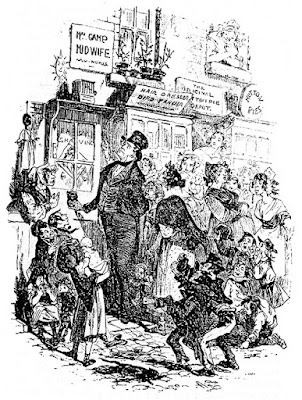
However, stories of Londoners who murdered people and baked them into meat pies predated the publication of The String of Pearls. The urban legend appears in the Charles Dickens novel Martin Chuzzlewit (published 1843-1844), which includes a non-murderous barber named Poll Sweedlepipe.

In chapter 26 of Dickens's novel, we even learn of a "sympathy between beards and birds" that "frequently impels a shaver of the one to be a dealer in the other." Though Poll doesn't keep a green finch, linnet bird, nightingale, or blackbird, he does house gamecocks, bantams, owls, and smaller birds in the same building where he has his shop.

When Hablot Knight Browne (using the pseudonym "Phiz") illustrated Poll Sweedlepipe's shop, he included next to the "EASY SHAVING" and "HAIR DRESSED" advertisements (yup) signs for mutton pies. That's right! The barber was located right next to a shop that sold meat pies. Though there's no evidence in the novel that Dickens's barber is up to anything nefarious, Browne might have been alluding to a well-known folk belief.

And how widespread were Victorian tales of urban cannibalism? Well, Dickens alludes to them at the end of chapter 36 of Martin Chuzzlewit when the character Tom Pinch worries that his friend will think he has "strayed into one of those streets where the countrymen are murdered" and has "been made meat pies of, or some such horrible thing." Not letting the issue drop, Dickens begins the next chapter with the line: "Tom’s evil genius did not lead him into the dens of any of those preparers of cannibalic pastry, who are represented in many standard country legends as doing a lively retail business in the Metropolis."

What's interesting to me is that in Martin Chuzzlewit the urban legend of people being baked into meat pies is represented as having its origins in the country. It is only rural folks who believe such fantastic accounts of city dwellers feeding upon one another. Dickens was a city dweller himself, and he shows London as a place of opportunity for Tom Pinch rather than a location of danger.

The novel does contain other references to cannibalism, though, as when the innkeeper Mrs. Lupin regrets that a character went off to the United States rather than "to some of those countries which are not quite barbarous; where the savages eat each other fairly, and give an equal chance to every one!"

Well, as Mrs. Lovett and Sweeney sing, "How gratifying for once to know / That those above will serve those down below!"

Wednesday, December 29, 2021

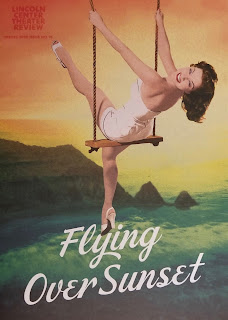
Flying Over Sunset

Before our entire society shut down in 2020, I had been looking forward to seeing James Lapine's new musical Flying Over Sunset.

I mean Lapine, who had collaborated with Stephen Sondheim on Sunday in the Park with George, Into the Woods, and Passion had a new musical? Sign me up!

With music by Tom Kitt, who wrote Next to Normal? Of course I'm coming. You don't have to tell me what it's about! Wait, it's about Aldous Huxley, Clare Boothe Luce, and Carey Grant on an acid trip? Seriously? As they say, take my money, already!

Huxley has been a fascination of mine ever since I read Brave New World when I was in high school. I even wrote a play called The Four Doctors Huxley that was produced by a theatre in Jersey City. As for Luce, it's hard not to admire the technical brilliance of her play The Women, even if her right-wing politics tended to be revolting. And Grant? Who doesn't love Carey Grant, perhaps the greatest leading man Hollywood ever produced?

Well, the collapse of civilization as we knew it prevented the show from opening in 2020, but it's back now at Lincoln Center, and I finally got a chance to see it last night. The audience was sparse, due to the twin disasters of an omicron spike and bad reviews, but I enjoyed myself thoroughly. Choreographer Michelle Dorrance provides percussive movements that supplement Kitt's score, and the set by Beowulf Boritt works magic on stage.

What we're really here to see, though, is this trio of celebrities--so very different, yet so alike in many ways--interact with each other while tripping on a psychedelic drug. The problem is, people on psychedelic drugs don't necessarily interact. The journeys they go on are journeys within, which doesn't always lend itself to interpersonal connections. This means that Flying Over Sunset is about three individuals, not about finding community, which might make it an appropriate show for an individualistic society where community is considered suspect unless modified by the word online.

The first act in fact presents our three protagonists separately. First we meet Huxley, played by Harry Hadden-Paton, experiencing LSD for the first time while on a mundane trip to an L.A. drug store. He spots an art book being displayed alongside a plethora of other objects on sale, and his gaze at Botticelli's Judith with the Head of Holofernes becomes the operatic musical number "Bella Donna Di Agonia." Instead of dropping us immediately into a surreal hallucination, the show slowly builds to stranger and stranger visions, then gradually brings us back, much like the effects of a drug that build, peak, and fade.

Grant is the next to trip, taking the drug in a psychiatrist's office at the behest of his wife, Betsy Drake. This provides Dorrance with the opportunity to choreograph her most compelling tap number of the show, "Funny Money," in which Grant, played by Tony Yazbeck, dances with his younger self, played by Atticus Ware. Yazbeck has a particular challenge, playing the iconic Grant, since we all know the face of the man he is playing, but his dancing chops encourage us to suspend our disbelief and indulge in the fantasy. In real life, Grant famously described an acid trip he once had in which he imagined he was a giant penis launching into space. Naturally, the musical later stages this moment in the song "Rocket Ship."

The real star of the show, though, is Carmen Cusack, who plays Luce. We see Luce, by then a former congresswoman as well as the former ambassador to Italy, as she faces hearings in the U.S. Senate to be confirmed as ambassador to Brazil. No longer exuding the confidence she once had, though, Luce turns down the ambassadorship. At her estate in Connecticut, she takes LSD under the guidance of the writer and guru Gerald Heard (played by Robert Sella) and stops the show with her rendition of the title song "Flying Over Sunset."

At the end of the first act, the three protagonists meet up at the legendary Brown Derby restaurant in Los Angeles and decide to have an experience together at Luce's Malibu beach house. It is there, in a psychedelic garden, that Luce encounters her dead mother and daughter, both in "heaven" but different heavens, since her virginal daughter and not-so-virginal mother could never occupy the same astral plane in Luce's mind.

Flying Over Sunset, for all its pyrotechnics, is ultimately a quiet, simple show, about simple moments rather than grand gestures. Perhaps it is no coincidence that the moments of true connection between the characters happen only after the effects of LSD have abated. In our own world, fragmented and isolated by politics, disease, and other traumas, those moments of connection are more important than ever.

Sunday, May 10, 2020

A Shaw Summer After All

Earlier this year, I was very excited to announce that my paper on Sarah Bernhardt and Bernard Shaw had been accepted to a conference in Cáceres, Spain.

Well, that conference was supposed to be later this month, and it should surprise no one that it has been postponed indefinitely due to the COVID-19 pandemic.

I had planned to discuss how Bernhardt's performance in Victorian Sardou's La Tosca influenced Shaw to write a very different role in Captain Brassbound's Conversion, crafting the part of Lady Cicely to be acted by a sort of anti-Bernhardt.

Though that Shaw conference was nixed, the International Shaw Society's annual symposium in Niagara-on-the-Lake was still accepting proposals. I had wanted my Bernhardt talk in Spain to be part of a larger project to include all of Shaw's Three Plays for Puritans, and it so happened that the Shaw Festival in Niagara was planning on performing the first of those plays, The Devil's Disciple, during the symposium.

It wasn't hard for me to pitch a talk on Judith in The Devil's Disciple and another Bernhardt role Shaw wrote about, Magda in Hermann Sudermann's Heimat. I had been planning on writing about that anyway, just not so soon. Well, I pitched the idea, and it was accepted. I even received a generous scholarship and travel grant from the ISS enabling me to attend. Though the Shaw Festival has cancelled all performances before July, they are still planning on going ahead with their production of The Devil's Disciple. Could there be a Shaw summer after all?

The simple answer is yes. The more complicated one is that it might not be in Canada. No one can be sure if the border between the U.S. and Canada will even be open in late July when the conference is scheduled. If getting together physically isn't possible, though, the symposium's organizers have committed to running a virtual conference. One way or another, I plan on giving that paper!

I greatly enjoyed attending the Shaw Festival in 2017, and if it's still on this year, I could get a chance to see not just The Devil's Disciple, but also Desire Under the Elms by Eugene O'Neill, Trouble in Mind by Alice Childress, and Assassins by Stephen Sondheim and John Weidman.

Even if the summer season is cancelled, Gingold Theatrical Group is planning a production of The Devil's Disciple in New York City this fall. One way or another, I'll be getting my Shaw in this year!

Wednesday, September 26, 2018

More Praise for FOLLIES

Congratulations to the Astoria Performing Arts Center, whose production of Follies cleaned up at the New York Innovative Theatre Awards this week.

In addition to winning for Best Ensemble, the revival of the classic Stephen Sondheim/James Goldman musical also picked up awards for choreographer Sara Brians, costume designer Jennifer Jacob, and actress LaDonna Burns.

I had the pleasure of seeing the production, directed by Dev Bondarin, this past May. It was also the last production APAC produced in their former space. For next season, they'll be moving to the Variety Boys & Girls Club of Queens, just down the street from their old place.

Incidentally, Dev will be directing a staged reading of my one-act play The Love Songs of Brooklynites next month, presented by Emerging Artists Theatre. Hope you can make it!


Sunday, May 27, 2018

Last Follies

Yesterday, I attended Astoria Performing Arts Center's production of Follies, a musical that takes place in a theatre about to be torn down.

The set design by Ann Beyersdorfer was perfect, and conveyed the dilapidated nature of the play's setting. The production was made all the more poignant, however, by the fact that this was the last day of the last production APAC would ever perform in that theatre.

APAC's theatre space, by the way, is a church gymnasium, which worked perfectly for their production of The 25th Annual Putnam County Spelling Bee, but has also been memorably transformed for Merrily We Roll Along and other shows. Both of those productions were directed by Dev Bondarin, who also helmed this wonderful Follies.

What was wonderful about it? Well, let's start with Stephen Sondheim's lyrics being perfectly articulated by a cast of veteran actors. Victoria Bundonis made sure you understood every last syllable of "I'm Still Here," and Greg Horton (who played Karl Lindner in last year's production of Raisin at APAC) gave one of the most insightful performances of "Buddy's Blues" I've ever heard (with help, of course, from younger performers Mandarin Wu and Kathleen LaMagna).

My favorite performance, though, came from Tina Stafford (who was a memorable Mrs. Corney in Shakespeare Theatre of New Jersey's Oliver Twist) as Sally Durant Plummer. Her rendition of "Losing My Mind" was heartbreaking. Her younger doppelganger, Andrea Dotto, was a magnificent Young Sally, and clearly has a bright future ahead for herself.

Where is APAC off to next? They haven't announced where they'll be performing next season, but keep your eye out for them. If Follies is any indication, we should be expecting great things from them in the future.


Sunday, December 31, 2017

Best Plays of 2017

It's that time again when I look back on the best new productions that opened in New York City over the past year.

This list is only for plays in the five boroughs, so great productions farther afield like The Secret Theatre and Romeo and Juliet as well as the productions at the Shaw Festival are ineligible. My own play Capital which opened in Detroit this year doesn't qualify either, even though it was named one of the Best of the Season for southeastern Michigan.

Also not included are shows that opened in 2016 but that I didn't get to see until this year, like Dear Evan Hansen and the Broadway production of Natasha, Pierre, and the Great Comet of 1812. Last year, A Doll's House, Butler, and Hadestown topped the list. But what were the best productions of 2017? Read on to find out!

10. The Liar - Truth is, this adaptation by David Ives of the classic comedy by Pierre Corneille was one of the best (and first) plays I saw in 2017.

9. Fucking A - Of the three Suzan-Lori Parks plays the Signature Theatre Company produced this year, this was by far the best. A riff off of The Scarlet Letter, the play had its first off-broadway run back in 2003, but its dystopian view of a society where abortion is legal but practitioners are literally branded seems all-too prescient.

8. Once on This Island - This beloved Ahrens-Flaherty musical is currently getting an amazing production, so get your tickets now. Lea Salonga is excellent as Erzulie, the goddess of love and beauty, but the rest of the cast is strong as well, and Dane Laffrey's set makes the most of Circle in the Square's intimate space. If you're concerned about seeing a play in the round, don't worry. Director Michael Arden makes sure there isn't a bad seat in the house.

7. The Government Inspector - The Red Bull Theater Company is dedicated to the aesthetic of Jacobean drama, but this year they put on Nikolai Gogol's nineteenth-century farce about a minor bureaucrat mistaken for the Inspector General from the capital. The split-level set was best viewed from further back in the audience, but even if you sat up front like I did, you got to see some amazing performances from the likes of Michael Urie, Mary Testa, Michael McGrath, and Talene Monahon.

6. A Midsummer Night's Dream - It wasn't too long ago (ten years) that The Public Theater previously did Shakespeare's supernatural romantic comedy in Central Park, but the 2017 production was indeed a dream. Annaleigh Ashford gave a stand-out performance as Helena, which is saying a lot, considering that the show's headliner was Phylicia Rashad as a queenly Titania. The most memorable aspect of this production was having the attendant fairies played by older actors wandering around the forest in what looked like their pajamas. It was creepy in all the right ways.

5. Ernest Shackleton Loves Me - Two-person musicals are hard to pull off, and it's difficult to imagine this one with anyone else in the lead but Val Vigoda, the show's lyricist who also acts, sings, and plays the drums, keyboard, banjo, and electric violin! The book by Joe DiPietro tells the story of a sleep-deprived single mom composing music for video games who tries Internet dating and ends up being matched with the early-twentieth-century explorer Ernest Shackleton. Who cares that they're 100 years apart and he's currently in Antarctica? This witty and wonderful piece was a ray of sunshine in a dark year.

4. Desperate Measures - Speaking of witty and wonderful new musicals, the surprise hit of 2017 was Peter Kellogg and David Friedman's Desperate Measures, which sadly closes today at the the York Theatre Company. Based very loosely on Shakespeare's problem comedy Measure for Measure, the play is reset in the Old American West, where an un-elected governor is able to abuse his power and try to force a virtuous young woman about to enter a convent to sleep with him. If she refuses, her brother will hang. That might not seem like the stuff of musical comedy, but joyous music and dialogue in perfect rhyming couplets keep the laughs coming even through bleak material.

3. Julius Caesar - No doubt the most controversial production in New York this year was also one of the best. Conservative snowflakes cried foul over a play showing a Trump-like figure being assassinated. (Never mind the numerous past productions of Julius Caesar with Clinton and Obama stand-ins as Caesar.) Few--if any of them--actually saw the production. Had they gotten off of their hypocritical high horses long enough to actually see the show, they would have witnessed a biting critique of the left, and a warning that political violence, as tempting as it may seem, only leads to more violence, and ultimately despotism. The brutal assassination scene left some audience members physically sick to their stomachs. Julius Caesar was truly visceral theatre.

2. HOME/SICK - This collaborative project by The Assembly has been around for a while. (The group first workshopped it in 2010.) However, the production that opened this year at JACK in Brooklyn benefited from a long incubation process and past exploratory runs across the country. The story it tells of the Weather Underground in no way romanticizes the movement. Instead, much like the Public's Julius CaesarHOME/SICK presents a cautionary tale of what happens when well meaning people turn to violence. During intermission, the audience watched a recreation of an event members of the Weather Underground had planned to bomb. It was chilling. Director Jess Chayes deftly led her cast to explore the complexities of taking on the injustices of the world when you yourself might through your own strident militancy become part of the problem.

1. Sweeney Todd - While Ernest Shackleton Loves Me and Desperate Measures were massively entertaining, and Julius Caesar and HOME/SICK were deeply disturbing, the Tooting Arts Club production of Sweeney Todd at the Barrow Street Theatre managed to be both. The show is still playing through the end of May, though sadly not with Norm Lewis, who opened this New York production as Sweeney. Fortunately, you can still catch Carolee Carmello as a hilarious and horrifying Mrs. Lovett. The Stephen Sondheim musical has a brilliant score, and you might think a stripped-down version in a reproduction of an actual London pie shop would lose something. Instead, this intimate production allows you to appreciate the music in a deeply personal way. Having the actors literally leap up onto tables right in front of you is shocking, but no more so than some of the acting choices, which remind you of the true trauma some of the characters suffer in this story.

So those are my picks for this year. Honorable mentions go to The Tempest at St. Ann's Warehouse, Everybody at the Signature, and the Metropolitan Opera's production of Fidelio. Hopefully 2018 will be an even better year for theatre in New York City!

Saturday, June 24, 2017

More Meat Pies!

Last night, I had the pleasure of seeing Norm Lewis as the title character in Sweeney Todd at the Barrow Street Theatre.

This production of the Stephen Sondheim/Hugh Wheeler musical thriller had its origins with Tooting Arts Club. The neighborhood company produced Sweeney in 2014 at Harrington's Pie and Mash Shop, the oldest such establishment in London.

After the production in an out-of-the-way southern part of London became a hit, producers moved it to the West End, and now it comes to New York, where Harrington's has been recreated inside the Barrow Street Theatre. You really feel like you're in a cozy pie shop, and for an extra fee, you can even buy a pie (not Mrs. Lovett's recipe) to eat before the show.

Of course, the tables have to be cleared before the show starts, since the cast will be dancing on top of those tables. A lot of productions in recent years have been billed as "immersive" when they really aren't, but Sweeney Todd actually does surround the audience, and the intimate setting means the reduced-size cast and orchestra still fill the space. The three-piece band never sounds thin, and the cast continually pops up in different parts of the audience creating an electric atmosphere.

Norm Lewis is an incredible singer, but instead of resting on his melodious voice, he frequently spits out lines to add to the threatening mood of the piece. His interpretation of the role is a bit different than those I've seen before, but the more I watched him, the more I loved what he was doing. His Sweeney is human and sometimes even vulnerable, but this just makes him all the more frightening when he turns to murder.

Carolee Carmello is equally good as Sweeney's accomplice, Mrs. Lovett. Her humor adds a great deal to the production, particularly in the song "A Little Priest" at the end of the first act. I was also impressed by Alex Finke as Johanna. Even before she gets shut up in an asylum, we notice something a bit off about Johanna.

But of course that's exactly what you would expect for someone raised by Judge Turpin (played by Jamie Jackson). Turpin is always creepy, but Jackson plays him as particularly threatening. His henchman Beadle Bamford (Brad Oscar) provides a perfect foil with his well-timed humor.

As wonderful as it is to hear Sondheim's music with a full orchestra, this intimate production captures the grandeur and the beauty of the show and is not to be missed.

Friday, May 19, 2017

Raisin

The 1974 Tony Award for Best Musical went to Raisin, an adaptation of Lorraine Hansberry's A Raisin in the Sun. Never seen it? Well now is your chance!

Astoria Performing Arts Center--which has revived other overlooked musicals like Stephen Sondheim and George Furth's Merrily We Roll Along--is currently performing the first fully staged New York revival of Raisin since... well... ever!

Dev Bondarin directed the piece, and it has a wonderful cast, including Warren Nolan Jr. as Walter Lee Younger, Ebony Marshall-Oliver as his mother Lena, Brandi Knox as his wife Ruth, and Sarita Amani Nash as his little sister Beneatha.

The musical streamlines the story, eliminating the whole plot line concerning Ruth's pregnancy, and getting rid of Beneath's boyfriend George Murchison. We don't miss him one bit, though, since that gives more time for Beneatha's other love interest, Joseph Asagai, played winningly by Cartreze Tucker. His song "Alaiyo" is one of the highlights of the show.

While the musical strips down the plot of the original, it also expands the cast, giving us a chorus of neighborhood regulars who provide transitional numbers like "Runnin' to Meet the Man" and "Booze." We also get to meet the offstage scoundrel Willie Harris, played in all is dodgey grandeur by Billy Lowrimore. Tony Perry plays a pastor who embodies Lena's deep faith in the number that begins Act II, "He Come Down This Morning."

Finding songs in pre-existing plays can be challenging. Hansberry's classic has one memorable moment with music where Walter Lee dances on a table to the sounds of a record playing traditional African music. As Hansberry describes in the stage directions: "He sees what we cannot, that he is a leader of his people, a great chief, a descendant of Chaka, and that the hour to march has come." In the number "African Dance," Raisin allows the audience to see this, too, with the chorus coming on dressed in traditional African clothes provided by costume designer Jeannipher Pacheco.

The best song in the show, though, is the satirical "Not Anymore" in which Walter, Ruth, and Beneatha recount the visit they received from the "welcoming committee" of the new neighborhood where they hope to move. Alas, the depiction of barely beneath the surface racism is all too topical now in 2017.

If you're interested in seeing the show, get your tickets soon. Raisin runs only through May 27. For more information check out:

Astoria Performing Arts Center


Friday, May 8, 2015

Our Time

When Merrily We Roll Along opened on Broadway in 1981, audiences didn't know what to make of it. The play's structure, moving backward from a cynical and depressing present to a time in the past filled with hope and optimism, must have seemed horribly pessimistic, as if the show's creators only wanted to twist the knife in the gut of America, reminding it of all it could have been and had failed to be.

Seeing the show last night, in the wonderful production Dev Bondarin directed at the Astoria Performing Arts Center, I felt the opposite. This beautifully written play refuses to take away the charm and joy of youth, and the reverse chronological order makes the piece oddly optimistic. That might not have been apparent in 1981, but in a society surfeited on cynicism, wary from experience, but longing for something pure and true, perhaps this play can finally find a home.

Collaborators Stephen Sondheim and George Furth based the musical on a 1934 play of the same name by George S. Kaufman and Moss Hart. When that show opened, almost 50 years before the premiere of the musical, the Great Depression was still raging. I imagine audiences must have been inclined to think harshly of the play's sell-out protagonist, whose path is traced back to the time he graduated from college, spouting self-confidently, "To thine own self be true."

But the musical adds something vital... music! No matter how the audience might think about the play rationally, the music exerts an emotional force that resists the impulse toward cynicism. Traditionally, a musical will have a bright, happy version of a song in the first act, then a sad, melancholy reprise in the second. Merrily We Roll Along famously reverses this order. For instance, the character Beth (played wonderfully in this production by Rachel Rhodes-Devey) sings a horribly depressing version of "Not a Day Goes By" in Act I as she's going through a nasty divorce. Then in Act II, she sings the same song filled with love and joy on her wedding day.

What is the effect of this device? One might be tempted to laugh at poor Beth, to deride her as a fool for ever having dreams. However, Sondheim's music won't let you. Watching the show at APAC, it wasn't as though I didn't feel the joy of Beth's wedding day. Instead, I felt the joy of her wedding day AND the pain of her divorce at the same time. I couldn't dismiss the joy, but rather wanted to hold on to it all the tighter.

That goes double for the play's final scene, as the three friends who ultimately will tear each other apart share a magical moment on a rooftop watching the world's first satellite fly overhead. A moment in the past is not any less real, any less meaningful for having gone by. The emotions the characters feel, and that we feel, are still valid, even if they are doomed to dissipate and die.

Merrily We Roll Along is playing at APAC until May 23rd, so be sure you get a chance to see it. The central trio of composer Franklin Shepard, lyricist Charley Kringas, and novelist Mary Flynn are portrayed with pathos by Jack Mosbacher, Nicholas Park, and Ally Bonino respectively.

Just be warned: You won't be able to get the score out of your head. In spite of what a certain producer in the play says, this show has plenty you can hum.

For more information, go to:

Astoria Performing Arts Center