Showing posts with label Beowulf Boritt. Show all posts

Tuesday, June 17, 2025

The Imaginary Invalid

Molière's final play, The Imaginary Invalid, is difficult to perform as written. Prior to last night, the only time I'd seen the piece on stage was in a creative re-imagining by Mabou Mines.

One of the biggest challenges of the play is that its plot-based scenes alternate with balletic musical sequences in the pastoral style. How on earth do you stage those interludes, especially when love-lorn shepherds no longer have the cultural power they used to enjoy?

The solution playwright Jeffrey Hatcher came up with for the adaptation Red Bull Theater Company now has playing at New World Stages is kind of brilliant. The play's characters end up singing some of the most stereotypically French songs ever composed with re-written lyrics all about sheep.

This goofiness is right at home on Beowulf Borritt's ridiculously fanciful set. The result is not exactly Molière, but very much in the comic spirit of the original play. Molière famously collapsed on stage while playing the hypochondriac lead Argan, later dying without receiving last rites, thanks to the controversy surrounding his earlier play Tartuffe. In the current production, the leading role goes to Mark Linn-Baker. (Who, unlike Molière, will hopefully outlive the run of the show!)

In many ways, though, the best role in the play is Argan's maid, Toinette. Red Bull's production features the tremendously talented Sarah Stiles as the put-upon servant who understands things far more clearly than her master. Stiles, best known for her performance as Jessica in Hand to God, finds comic gold in a messed-up medical system, as does Arnie Burton, who plays not one but three different doctors, each with their own unique quirks.

Argan's daughter Angélique was originally played by Molière's wife, Armande Béjart. Emilie Kouatchou, most famous as the final Christine in The Phantom of the Opera on Broadway, takes on that role in the current production. (When Kouatchou sings re-written Phantom lyrics to extoll the virtues of sheep, those in on the joke go into hysterics.) Equally hilarious in this production is Angélique's stepmother Béline, played by Emily Swallow (whom you will not recognize as the Armorer on The Mandalorian).

The show, directed by Red Bull's artistic director, Jesse Berger, is only playing through June 29th, so see it while you can!

Sunday, December 31, 2023

Top Plays of 2023

Once again, I'm compiling a list of the top ten plays I saw in New York City that opened in 2023.

Last year, the musical Paradise Square topped my list, though critics were mixed in their reviews of the show, and it ended up closing at a financial loss.

Alas, I can't claim that this is the year theatre came back in New York, but a number of good shows did open in 2023, a couple of which are still running, so see them while you can!

10. The Smuggler - Irish Rep had an ambitious season this year, but the best thing I saw there was a very small show, Ronán Noone's one-man verse drama about a Massachusetts bar tender who ends up getting involved in human trafficking.

9. The School for Scandal - Hudson Classical Theatre Company continued its tradition this year of bringing solid productions of classical plays to the Soldiers' and Sailors' Monument in Riverside Park. This year's staging of Richard Brinsley Sheridan's The School for Scandal brought together delightful acting with a creative costume design.

8. The Mind Mangler - This year the team that brought us The Play That Goes Wrong opened a new show in their franchise featuring Henry Lewis as an inept mentalist. The show is funny, which I expected, but also successfully pulls off a couple of brilliant magic tricks, which I wasn't expecting. Best of all, though, it has a tremendous heart that is no illusion at all. (Still playing!)

7. Crumbs from the Table of Joy - Keen Company's revival of Lynn Nottage's break-out play from 1995 was another unexpected delight, in part due to the performance of Shanel Bailey as Ernestine, a young woman in 1950s New York struggling to deal with changes both in the world and in her own family. Bailey definitely had a good year in 2023, as she appeared in another great revival on my list as well.

6. The Knight of the Burning Pestle - I directed this Jacobean classic when I was in college, so I knew I'd have to see a co-production by Red Bull and Fiasco Theater. Paco Tolson led the cast as a grocer's apprentice who becomes the titular Knight of the Burning Pestle. What made the piece a sheer joy, however, was the interaction of the ensemble, including Ben Steinfeld, Royer Bokus, and Teresa Avia Lim.

5. Here We Are - Stephen Sondheim's collaboration with David Ives finally made it to the stage this year. Even with flawed direction, the piece soars with a cast that includes Jeremy Shamos, Amber Gray, Bobby Cannavale, Rachel Bay Jones, Steven Pasquale, Micaela Diamond, and David Hyde Pierce. Whether or not you've seen any of the surrealist films of Luis Buñuel that inspired the piece, you should be able to appreciate the play's existential musings on modern life. Hurry to see the show before it closes on January 21st.

4. Arms and the Man - Shanel Bailey came back to Theatre Row this fall to appear as Raina in Gingold Theatrical Group's magnificent production of Shaw's anti-war classic Arms and the Man. Director David Staller brought together a wonderful cast that also included Keshav Moodliar, Ben Davis, Delphi Borich, Thomas Jay Ryan, Evan Zes, and Karen Ziemba. As someone who is a fan of toy theatres, I also loved the set designed by Lindsay G. Fuori to resemble a paper stage from the Victorian era. I'm looking forward to seeing what GTG does next in 2024!

3. Hamlet - The Public Theater chose Kenny Leon to direct the last production of Shakespeare in the Park before the Delacorte Theatre is shut down for renovations. Beowulf Boritt's set playfully echoed the one he previously designed for Leon's Much Ado About Nothing. The biggest joy, though, was seeing famed Shakespearean actor John Douglas Thompson play the most engrossing Claudius I've ever seen. Ato Blankson-Wood was able to hold his own as young Prince Hamlet, and the cast also included Lorraine Toussaint as Gertrude, Daniel Pearce as Polonius, and Solea Pfeiffer as Ophelia.

2. The Great Gatsby - The immersive production of The Great Gatsby was criminally underrated. The piece contained a couple of more traditional scenes, such as the tea Jay Gatsby prepared for Daisy, where the entire audience was assembled in one place. What was most interesting, though, was the way we were all divided into small groups to wander through side scenes, having interactions with various characters, sometimes with other audience members, and sometimes one-on-one. The live music was an added bonus. Sadly, the show closed in New York, but there's a chance it might come back, if not here, in another city.

1. Becomes a Woman - My top choice this year is likely to surprise a lot of people, but the Mint Theater Company performed an immense service in bringing Betty Smith's long forgotten play to the stage at last. Before Smith penned her 1943 novel A Tree Grows in Brooklyn, she wrote Becomes a Woman, but this was 1931, and no theatre wanted to touch a play with a feminist bent so far ahead of its time. In the Mint's long overdue production, Emma Pfitzer Price starred as Francie Nolan, a character whose name Smith later used as the heroine of her classic novel. Other strong performances were delivered by Jeb Brown, Peterson Townsend, Gina Daniels, Jason O'Connell, and Duane Boutté.

So that's my list! I'm looking forward to more great theatre in 2024.

Sunday, June 25, 2023

Hamlet in the Park

Last night, I had the good fortune of seeing the Public Theater's production of Hamlet at the Delacorte in Central Park.

It's directed by Kenny Leon, whose production of Shakespeare's Much Ado About Nothing in 2019 was such a hit. That production re-imagined the comedy in a near-future United States where a struggle for basic rights is ongoing. (As... well... as it just so happens... it is....)

When I walked into the Delacorte, it became clear that this production would be a sequel of sorts to Leon's last play in the park. The set--designed by Beowulf Boritt, who also designed Much Ado--looks like the estate we had seen previously in a comedy wrecked by some unknown cataclysm. The large brick house from Much Ado appears to be partially sunken into the ground. The flagpole that proudly waved Old Glory in the last production is tilted at an angle. While Much Ado featured an SUV rolling onto the stage, Hamlet shows an SUV mired in the earth.

Center stage at the beginning of the play is a flag-draped coffin, presumably of the dead King Hamlet, whose portrait also dominates the set. A quartet of vocalists comes out to sing, which fortunately also allows latecomers to be seated without disturbing the play too much. Then the play begins in earnest with the funeral of the dead king, and we get to meet the cast, led by Ato Blankson-Wood. As young Prince Hamlet, Blankson-Wood communicates the play's famous monologues in a straight-forward manner, clearly getting across the complex verse in a way that is relatable and easy to understand for the audience.

When it comes time for Hamlet to confront the ghost of his father, the production has a few tricks up its sleeve, which is why it's good Leon cut the opening scene of the script where some minor characters meet the ghost. Seeing this up front would have ruined the surprise later on in the play. Plus, Hamlet as we know it today is pieced together from three different texts, so it has to be cut if the audience is going to experience anything close to how the original play would have been performed. Overall, the production does a good job trimming the play, though some of the piece's most famous lines have to be altered to eliminate any references to it taking place in Denmark. (The production is whole-heartedly American.)

One of the joys of seeing Shakespeare in the Park is getting to watch a variety of tremendous actors in supporting roles, and this production is no different. The incomparable John Douglas Thompson (who recently won praise for his performance in Irish Rep's production of Endgame) plays Claudius, and he's easily the best Claudius I've ever seen. As the usurping king tries to pray for forgiveness, we see he is truly overcome by remorse, even as he is unable to take the next step and actually repent. His interactions with Lorraine Toussaint are sexy and filled with warmth, making us see immediately why she chose to marry him. Both of them have some comic interactions with Rosencrantz and Guildenstern, played perfectly by Mitchell Winter and Brandon Gill.

Additional comedy is provided by not just Greg Hildreth as the gravedigger, but by Daniel Pearce as Polonius. I previously saw Pearce as Macduff in a production the Public did of Shakespeare's Macbeth, and then later in another Public production, Jane Anderson's Mother of the Maid. As Polonius, Pearce milks the long-winded advisor for all he's worth. Fine performances are also delivered by Solea Pfeiffer who plays his daughter Ophelia and Nick Rehberger who plays his son Laertes.

This production also adds in some hip hop with Warner Miller's Horatio and with the players, led by Colby Lewis, reminding us that even gods cry. This summer will also be your last chance to see Shakespeare in the Park at the old Delacorte before it gets completely redone, so make sure you don't miss this wonderful production! 

Sunday, November 27, 2022

Ohio State Murders

Adrienne Kennedy is currently making her Broadway debut with Ohio State Murders, thanks to the star power of Audra McDonald, who plays the lead in this not-quite-one-person play.

McDonald also helped another great American playwright, Lanie Robertson, make it to Broadway when she starred in another not-quite-one-person play, Lady Day at Emerson's Bar and Grill. It's a reminder of how consequential stars can be, and how McDonald has used her influence to bring deserving plays to the boards.

Ohio State Murders also benefits from the direction of Kenny Leon, who has scored hits recently with his productions of Much Ado About Nothing and A Soldier's Play. Leon thrives when given quirky characters who behave in odd ways. He gives us just enough to have a glimpse at a character's hidden turmoil without having his performers rant and rail.

That approach is necessary for Ohio State Murders, which portrays a writer names Suzanne Alexander returning to her alma mater of Ohio State to give a speech about why there is so much violent imagery in her work. The reason, it turns out, has to do with certain events that happened on campus decades ago when she was a student. McDonald plays Alexander both as the idealistic young student and as the wary older author, but in both the past and present scenes, she holds everything together, and doesn't give way to waves of pain, grief, or vengeance.

Leon's directing approach also works for Bryce Pinkham, famous for his comic role in A Gentleman's Guide to Love and Murder, but playing a much more somber part in Kennedy's play. As Robert Hampshire, a lecturer at Ohio State who barely speaks when he's not lecturing, he is a constant enigma. Never at ease, either with others or with himself, he keeps both Alexander and the audience guessing as to his true intentions.

The production also boasts a magnificent set designed by Beowulf Boritt, showing suspended library bookcases, a deep chasm, and whirls of snow that all contribute to the play's effect. This is a production you won't want to miss, so go see it now!

Wednesday, December 29, 2021

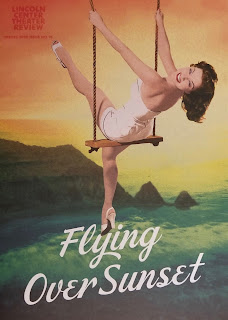
Flying Over Sunset

Before our entire society shut down in 2020, I had been looking forward to seeing James Lapine's new musical Flying Over Sunset.

I mean Lapine, who had collaborated with Stephen Sondheim on Sunday in the Park with George, Into the Woods, and Passion had a new musical? Sign me up!

With music by Tom Kitt, who wrote Next to Normal? Of course I'm coming. You don't have to tell me what it's about! Wait, it's about Aldous Huxley, Clare Boothe Luce, and Carey Grant on an acid trip? Seriously? As they say, take my money, already!

Huxley has been a fascination of mine ever since I read Brave New World when I was in high school. I even wrote a play called The Four Doctors Huxley that was produced by a theatre in Jersey City. As for Luce, it's hard not to admire the technical brilliance of her play The Women, even if her right-wing politics tended to be revolting. And Grant? Who doesn't love Carey Grant, perhaps the greatest leading man Hollywood ever produced?

Well, the collapse of civilization as we knew it prevented the show from opening in 2020, but it's back now at Lincoln Center, and I finally got a chance to see it last night. The audience was sparse, due to the twin disasters of an omicron spike and bad reviews, but I enjoyed myself thoroughly. Choreographer Michelle Dorrance provides percussive movements that supplement Kitt's score, and the set by Beowulf Boritt works magic on stage.

What we're really here to see, though, is this trio of celebrities--so very different, yet so alike in many ways--interact with each other while tripping on a psychedelic drug. The problem is, people on psychedelic drugs don't necessarily interact. The journeys they go on are journeys within, which doesn't always lend itself to interpersonal connections. This means that Flying Over Sunset is about three individuals, not about finding community, which might make it an appropriate show for an individualistic society where community is considered suspect unless modified by the word online.

The first act in fact presents our three protagonists separately. First we meet Huxley, played by Harry Hadden-Paton, experiencing LSD for the first time while on a mundane trip to an L.A. drug store. He spots an art book being displayed alongside a plethora of other objects on sale, and his gaze at Botticelli's Judith with the Head of Holofernes becomes the operatic musical number "Bella Donna Di Agonia." Instead of dropping us immediately into a surreal hallucination, the show slowly builds to stranger and stranger visions, then gradually brings us back, much like the effects of a drug that build, peak, and fade.

Grant is the next to trip, taking the drug in a psychiatrist's office at the behest of his wife, Betsy Drake. This provides Dorrance with the opportunity to choreograph her most compelling tap number of the show, "Funny Money," in which Grant, played by Tony Yazbeck, dances with his younger self, played by Atticus Ware. Yazbeck has a particular challenge, playing the iconic Grant, since we all know the face of the man he is playing, but his dancing chops encourage us to suspend our disbelief and indulge in the fantasy. In real life, Grant famously described an acid trip he once had in which he imagined he was a giant penis launching into space. Naturally, the musical later stages this moment in the song "Rocket Ship."

The real star of the show, though, is Carmen Cusack, who plays Luce. We see Luce, by then a former congresswoman as well as the former ambassador to Italy, as she faces hearings in the U.S. Senate to be confirmed as ambassador to Brazil. No longer exuding the confidence she once had, though, Luce turns down the ambassadorship. At her estate in Connecticut, she takes LSD under the guidance of the writer and guru Gerald Heard (played by Robert Sella) and stops the show with her rendition of the title song "Flying Over Sunset."

At the end of the first act, the three protagonists meet up at the legendary Brown Derby restaurant in Los Angeles and decide to have an experience together at Luce's Malibu beach house. It is there, in a psychedelic garden, that Luce encounters her dead mother and daughter, both in "heaven" but different heavens, since her virginal daughter and not-so-virginal mother could never occupy the same astral plane in Luce's mind.

Flying Over Sunset, for all its pyrotechnics, is ultimately a quiet, simple show, about simple moments rather than grand gestures. Perhaps it is no coincidence that the moments of true connection between the characters happen only after the effects of LSD have abated. In our own world, fragmented and isolated by politics, disease, and other traumas, those moments of connection are more important than ever.

Wednesday, June 19, 2019

Kenny Leon's Much Ado

Yes, theatre in the parks can be a challenge, as the weather doesn't always want to cooperate, but after much ado, I finally saw Much Ado About Nothing in Central Park last night.

The Public Theater gives out tickets to Shakespeare in the Park to those who show up early and wait in line. However, you can also try your luck with the online lottery run by TodayTix.

That's what I did. Thunderstorms were predicted, which might have meant not as many people were trying the lottery that day. In any case, I lucked out and got tickets. The opening of the show was delayed due to rain, and they had to pause the performance once during the play for some of the heavier showers to pass over us. Fortunately, I was dressed appropriately in a slick, rain-proof jacket. (Hint: You might want to do the same.)

These days, you have to announce whether or not the audience can take pictures. The Public told us we could take photos before the show, but not after the play started, so before any ado began, I snapped this picture of the set, designed by Beowulf Boritt. As you can see, this production sets the play in an imagined near future, when democracy is in danger during a hypothetical future election. The banner on Leonato's house proclaims "Stacey Abrams 2020" in spite of (or perhaps because of) the fact Stacey Abrams seems to be one of the few Democrats not running for President in 2020.

In my opinion, the show's politics seemed to be layered on top of the play rather than being integral to the piece. Director Kenny Leon said in a program note that Much Ado About Nothing is "a play in which love wins, and in our world today if love is winning, it doesn't matter how much hate is around us: we're still going to laugh and we're still going to love." This came through in the production, particularly during a quite moving closing sequence. Still, for most of the play, the emphasis was on the laughter and the love.

For that, chief credit belongs to the play's Beatrice and Benedick. Television star Danielle Brooks is a sassy, spirited Beatrice, but she plays her character with enough variety to prevent her broad style of humor from ever becoming just shtick. This Beatrice shows off her wit for her friends, but also harbors powerful feelings beneath the facade she's constructed for herself. Grantham Coleman, who plays Benedick, isn't nearly as well known to audiences, but hopefully this role will change that. His comic acting is a jewel and deserves to be on Broadway.

Leading the supporting cast is Chuck Cooper, a veteran actor I remember fondly for his performance in the short-lived musical Amazing Grace, but who won his Tony Award in Cy Coleman's The Life. Cooper plays Leonato, the pater familias in the show. He grounds the world of the play, providing its moral center, which is why it is downright frightening when that moral center turns violently on his own daughter, Hero (played here by Margaret Odette). Leonato's reconciliation with his daughter is often glossed over in performance, but in this production it became a moment of transcendental forgiveness. It was beautiful.

Much Ado About Nothing contains a number of songs, and these were very freely adapted and arranged by composer Jason Michael Webb, who also did the arrangements for Choir Boy on Broadway. You won't hear Shakespeare's "Sigh No More, Ladies" but instead a new, modern song that matches its tone and mood almost completely.

Unfortunately, the show closes Sunday night, so if you haven't seen it yet, make sure you do soon!


Wednesday, May 6, 2015

Hand to God

Sometimes you're lucky, and you see a hit Broadway show while it's still off-Broadway (Bloody, Bloody Andrew Jackson) or even off-off-Broadway (I tried to get tickets to the first workshop of Bloody, Bloody!), but sometimes you just can't get to it (in spite of all those times trying the Hamilton lottery).

Robert Askins' play Hand to God was one of those shows I should have seen while it was still off-Broadway, but (like Avenue Q) I just didn't. I corrected that last night at the Booth Theatre. Better late than never! This little play, which started out at E.S.T. and graduated to the off-Broadway mainstay MCC, is surprisingly at home on the Great White Way.

Comparisons to Avenue Q are inevitable, since both are hysterically funny as they utilize adult-themed puppets, but Hand to God is a very different play, and not just because it isn't a musical. In Avenue Q the puppeteers dress in black, and while they are in full view of the audience, we are meant to forget their presence at times. Hand to God offers a different conceit. We watch both the puppets and the puppeteers, unsure throughout whether they are really separate characters or not.

Steven Boyer does an amazing job playing both the mild-mannered teenager Jason and his seemingly possessed puppet Tyrone. Some of the scenes feature only Boyer and his puppet on stage, giving the audience a peek at some truly amazing acting. Like the puppeteers in Avenue Q, Boyer allows his mouth to move (as his character would have, anyway) but we quickly forget that his lips are in motion. Our attention is focused entirely on the id-filled Tyrone.

Also wonderful to watch is Avenue Q veteran Sarah Stiles, who plays Jessica, another teen with a penchant for puppetry. At the beginning of the play, Jessica is still building her puppet, and we do not see her creation until the second act. When she does enter, puppet in (on?) hand, the audience knows it is in for a treat. The scene that follows is really among four character, Jason, Jessica, and their respective puppets. In spite of the fact that they are apparently in control of their puppets (or are they?), Jason and Jessica are largely bored as their nasty alter-egos engage in behaviors they themselves wouldn't dream of doing.

The character/puppet dichotomy serves as a metaphor for adolescence, or perhaps for that long adolescence called life that frequently extends well past the teenage years, when supposedly adult human beings engage in behaviors they know they should have outgrown. (Jason's mother and Pastor, played by Geneva Carr and Marc Kudisch respectively, are cases in point.) The teenagers watch on, sometimes with indifference, and sometimes with horror, as a part of themselves goes crazy, trying to indulge in the darkest of desires.

Moritz von Stuelpnagel directs the show beautifully, and the multiple scene changes, which could have really slowed down the play, are handled wonderfully by the flexible set designed by Beowulf Boritt. I'm not sure how long a quirky show like Hand to God will last on Broadway, so see it soon!