Showing posts with label Thomas Southerne. Show all posts

Sunday, May 15, 2022

What Doesn't Go up in Smoke

I have no affection for cigarettes. When I was growing up, both of my parents smoked, and wanting to be like them, I wanted to smoke, too. One day, sitting on my mother's lap, I asked her if I could have a puff of her cigarette. She handed it to me. I took a puff. I have never wanted to smoke anything ever again.

What I do have a fascination for, however, is cigarette cards. These cards were originally added to cigarette packages to stiffen them, and by the 1880s, manufacturers were printing advertisements on them, often including popular images that could be collected by consumers. Those images could be of sports stars, famous Native American leaders, national flags, exotic animals, or sometimes actors and actresses.

These cards can sometimes be found on Internet auction sites, and I've purchased a few in recent years, wanting to have images of performers from the Regency era. The first one I bought was when I saw for sale a cigarette card of the actress Eliza O'Neill identical to one in the collection of the New York Public Library. The card, issued by Chairman Cigarettes, probably dates to the 1920s. The reverse side gives information about O'Neill, including that she excelled in the roles of Belvidera, Juliet, and Mrs. Beverley.

Chairman Cigarettes appears to have been based in England at the beginning of the 20th century, but I've found scant information on them. Recently, I obtained a number of cigarette cards issued by Player's Cigarettes. John Player & Sons was based in Nottingham, but it merged with Imperial Tobacco Group in 1901. Under the ownership of Imperial, Player's issued a number of trading cards, though it had issued its own cards as far back as 1893. Probably around the same time Chairman issued the card showing O'Neill, Player's issued a series of 25 cards showing miniature portraits of great painters. (I've seen 1923 given as the year for this series, but cannot verify it.)

Many (though not all) of those miniature portraits displayed images of actresses. This one shows Sarah Siddons, who according the the reverse side was "one of our greatest tragic actresses." Siddons first appeared on the London stage in 1775, but her first great success did not come until seven years later, when she appeared at Drury Lane as Isabella in an adaptation of Thomas Southerne's The Fatal Marriage. The Player's card calls this performance "a triumph almost unequalled in the history of the English stage."

Siddons introduced her most famous role, Lady Macbeth, in 1785. This portrait by Sir Thomas Lawrence, however, appears to show her in the role of Mrs. Haller from The Stranger, an adaptation Benjamin Thompson did of a melodrama by August von Kotzebue. Siddons was long the reigning tragic actress on the London stage. It was only after the retirement of Siddons that O'Neill came to London from Dublin, taking over many of the elder performer's roles, including Isabella and Mrs. Haller. Neither actress, however, had much of a gift for comedy. The great comedic actress of the period was Dora Jordan.

Here's a Player's trading card showing Jordan. As the card states, the image is based on a painting by George Romney. Jordan's real name was Dorothea Bland, but for obvious reasons, the actress changed it. Like O'Neill, she was born in Ireland and rose to fame in Dublin. Jordan made her London debut at Drury Lane in 1785, the same year Siddons first wowed audiences as Lady Macbeth. Rather than competing with the great tragedienne, Jordan gravitated toward comic roles, making her London debut in the role of Peggy, the protagonist of David Garrick's bowdlerized version of The Country Wife

Jordan was just as famous for her personal life off of the stage as she was for the roles she played on stage. In 1790, she became the mistress of the Duke of Clarence, a younger son of the reigning monarch, George III. They had ten children together, but sadly, the Duke could not marry her. After all, she was a humble Irish actress, and he was in line to ascend the throne. In fact, when his elder brother died in 1830, the Duke became King William IV. By that time, poor Jordan was dead. Her body was buried in a cemetery on the outskirts of Paris.

Another Regency actress, Maria Foote, appears on this Player's card, based off of a portrait by George Clint. Foote made her London debut at Covent Garden in 1814, as did O'Neill, but while O'Neill went on to massive fame as an actress, Foote did not. As the reverse side of her trading card puts it, she was "more celebrated for her beauty than for her acting." After her debut in The Child of Nature by fellow actress Elizabeth Inchbald, Foote went on to perform numerous Shakespearean roles, including Miranda in The Tempest, Lady Percy in Henry IV, and Helena in A Midsummer Night's Dream.

Foote also played a key role in Virginius, a new play by James Sheridan Knowles that after a brief run in Glasgow made its London premiere at Covent Garden in 1820. Foote played Virginia, the virtuous daughter of the title character. Virginia falls in love with Icilius, but the tyrant Appius lusts for her, and claims she is secretly the daughter of one of his slaves, sold to Virginius's now conveniently dead wife, since she was allegedly barren. The play made the new British king, George IV, rather nervous, since he was known for treating his wife and numerous mistresses not terribly well.
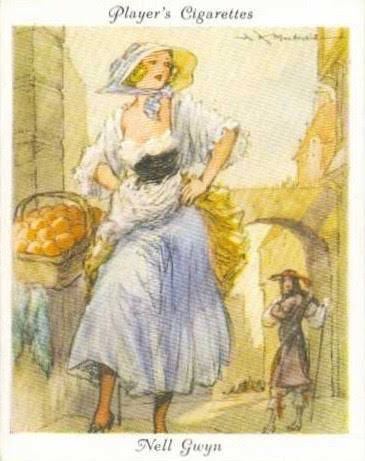
When I bought several Player's cards from a vendor, he kindly sent for free this 1930s card as a thank you. The card shows Nell Gwyn, who according to the reverse side of the card rose from being "a fruit hawker in the precincts of Drury Lane Theatre" to eventually becoming "enrolled a member of the King's Company of Players." This was during the Restoration under Charles II, and the king himself "fell a victim to her charms" as the card says. It was allegedly Gwyn who persuaded the king to complete the construction of Chelsea Hospital to provide a home for discharged soldiers.

The card is one of a series of 25 "Famous Beauties" taken from drawings by A.K. Macdonald. Other "beauties" drawn by Macdonald included Catherine the Great, the Queen of Sheba, and Pocahontas, so including the actress is quite a compliment. Gwyn was a close associate of the playwright Aphra Behn, who dedicated her play The Feigned Courtesans to the actress.

While I certainly am not a fan of the cigarettes that led to the creation of these cards, I'm glad many of the cards are still around today. They give us a fascinating glimpse not just of the world that created them, but also of the way that world looked back upon its own past.

Saturday, November 6, 2021

London's 1782-83 Season

I was recently asked to give a presentation on the London theatre season for 1782-1783. This was the season that Sarah Siddons returned to the Theatre Royal at Drury Lane and revolutionized British acting.

Even before Siddons made her return, the public was primed for great things. All three London patent houses--Drury Lane, Covent Garden and the summer theatre at the Haymarket--had been redecorated, welcoming audiences to grander, more opulent interiors.

Covent Garden's renovation had been the most extensive. A contemporary account in Universal Magazine claimed that "Nothing remains of the old structure but the outside walls." Seating was increased, and boxes replaced the side doors to the stage, finally moving side entrances fully behind the proscenium.

The Theatre Royal at Covent Garden benefited from something else, as well. Frances Abington, the previous leading lady at Drury Lane, left in 1782 for Covent Garden, where she continued to perform until her retirement. When Drury Lane opened its season with a production of The Clandestine Marriage, a comedy David Garrick co-wrote with George Colman the Elder, the female lead was played by Priscilla Brereton, who was never considered a particularly strong actress. The receipts that night only totaled 200 pounds and four shillings.

By contrast, Covent Garden opened its season with Susanna Centlivre's comedy The Busy Body. That evening brought in a whopping 314 pounds and 18 shillings. While you might expect a theatre's opening night of the season to be a hit, Covent Garden continued to perform well for the rest of the month, too. They followed up their initial success with a production of Isaac Bickerstaff's musical drama The Maid of the Mill. That play brought in more than 270 pounds, easily beating out anything Drury Lane put on that month, including on its opening night of the season.

Drury Lane tried to draw audiences in with a production of William Shakespeare's Twelfth Night, which they had not done for three years, and featuring a new actress making her Drury Lane debut in the role of Viola. In spite of a strong cast that included Elizabeth Farren as Olivia, and the novelty of a new actress making her debut, receipts only totaled 144 pounds and 11 shillings. The next week Drury Lane brought out a production of Shakespeare's Hamlet. Receipts were better, but still couldn't break above 200 pounds. Only on its opening night had Drury Lane managed that feat.

The next month, though, Drury Lane scored a palpable hit with Siddons. The actress was returning to London after a long absence, having performed principally at Bath following her inauspicious debut at Drury Lane in 1775. In Bath, Siddons had honed her craft and developed a devoted following for her dramatic style. When she reappeared on the stage of Drury Lane in October 1782, this time in the title role of Isabella in Garrick's adaptation of Thomas Southerne's The Fatal Marriage, she was an immediate sensation.

On the nights Siddons appeared on stage at Drury Lane, receipts were frequently over 200 pounds more than they were on evenings when she did not appear. Given that during the month of September, Drury Lane only just made it to collecting 200 pounds on opening night, and then never made that amount again for the rest of the month, we can see that the presence of Siddons more than doubled the amount the theatre took in on a given night.

Covent Garden collected nearly 36,000 pounds for the season as a whole, though, while Drury Lane took in something closer to 34,000 pounds. While Covent Garden's box office returns were larger, both houses had introduced substantial alterations to their physical buildings. Those investments were not included with ordinary expenses, and were made with an eye toward the long-term success of the ventures.

We might look at the introduction of Siddons in a similar way that we view the capital improvements to the theatre buildings themselves. Though in the short run, Siddons was unable to make Drury Lane more profitable than Covent Garden, she was laying the groundwork for Drury Lane to become a more prestigious, and hopefully more profitable theatre in future seasons.

Tuesday, February 16, 2021

The Debut(s) of Sarah Siddons

When David Garrick heard about "a Mrs. Siddons" who might "be a valuable acquisition to Drury Lane" he sent his friend the Reverend Bate to scout her.

Bate's letter to Garrick, dated August 21, 1775, praised the beauty of the actress, but spent more time emphasizing her magnificent control of her body and voice:

Her face, if I may judge from whence I saw it, is one of the most beautiful for stage effect ever I beheld; but I shall surprise you when I shall assure you that these are nothing to her action and general stage deportment, which are remarkably pleasing and characteristic--in short, I know no woman who marks the different passages and transitions with so much variety, and, at the same time, propriety of expression.

It's interesting to note that according to Bate's letter, Sarah Siddons's voice itself was "rather dissonant" and perhaps even "grating" at times. That seems amazing to us, who now think of the Siddons voice as legendary. We also generally think of Siddons's appearances as Hamlet as coming late in her career, but Bate claimed even back in 1775 that the actress "plays Hamlet to the satisfaction of the Worcestershire critics."

Garrick wrote back that Bate should "secure the lady" to appear at Drury Lane after she had her "lie in," as Siddons was heavily pregnant at the time. He also requested a list of roles that the actress had played, and Bate obliged, naming such parts as Jane Shore, Roxana (presumably from The Rival Queens), Calista (presumably in The Fair Penitent), and a number of Shakespearean roles, including Juliet, Cordelia, Horatio, Portia, and Rosalind, the last of which Bate had seen her perform.

In November, Siddons gave birth to a girl, apparently a bit earlier than expected. At the end of the following month, she made her debut at Drury Lane, billed as "A Young Gentlewoman" playing Portia in The Merchant of Venice. Unfortunately, the debut was not a success, and reviews were hostile. She later appeared as Lady Anne in Richard III, but the press attacked her again.

Garrick retired in 1776, and the new manager of Drury Lane, Richard Brinsley Sheridan, unsurprisingly chose not to reengage Siddons. It was years later that Sheridan's father Thomas saw Siddons performing in a provincial theatre. The decision was made to give the actress another chance, and her second debut at Drury Lane was set for October 10, 1782. She would be playing the leading role of Isabella in Garrick's adaptation of The Fatal Marriage by Thomas Southerne.

Two days before the big night, Siddons reportedly "was seized with a nervous hoarseness." Her voice came back on the morning of the performance, though, and so thorough was her triumph that by the end of the play "every speech was interrupted by bursts of applause," according to accounts. The rest is history.


Wednesday, January 18, 2017

The Rival Sisters

Arthur Murphy was a successful playwright of the 18th century. He adapted Voltaire's The Orphan of China (itself an adaptation of the Chinese zaju play The Orphan of Zhao) in 1759, and later penned the hit tragedy The Grecian Daughter.

Yet after Murphy wrote The Rival Sisters in 1783, he chose to publish it without having it performed. Murphy knew full well that a good production was often crucial to a play being favorably received. He wrote in the preface to the play that the piece had not received "The pomp of splendid scenery, and the illusions of the skilful performer" without which a play "in the leisure of the closet is not always supported."

In fact, a play being perceived as a closet drama can "excite a prejudice not easy to be surmounted," Murphy wrote. Audiences might well ask: "If it be of any value, why was it not produced in the usual form of a Public Exhibition?" However, he was equally clear that "the Play was written with a view to the Stage." The play is not a closet drama, and Murphy was acutely aware of the stigma that came with such a label.

The Rival Sisters is based on a 1672 play by Thomas Corneille, younger brother of Pierre Corneille, author of The Cid and The Liar. The legendary actress Marie Champmeslé (who later became the muse and mistress of Jean Racine) played the lead in the first production of that play. Murphy seemed highly aware of the fact that if his own play were to succeed on stage, it would require a performer of similar ability. He wrote in his preface: "When this country could, with pride, boast of an Actress equally followed, and perhaps with better reason, it occurred that a Tragedy, with the beauties of the original, but freed from its defects, might, at such a season, be acceptable to the Public."

For whatever reason (and Murphy remains quite coy in his preface), the author decided not to press The Rival Sisters to be performed by some grand British actress. Still, we can guess for whom it might have been intended. Murphy completed the play the year after the stunning appearance of Sarah Siddons at Drury Lane in the role of Isabella in Thomas Southerne's The Fatal Marriage. Siddons, who later that year also starred in Murphy's The Grecian Daughter at Drury Lane, took the theatre world by storm. She likely was the actress Murphy had in mind who might equal the grandeur of Champmeslé.

In fact, Siddons did perform in The Rival Sisters, though not until 1793. A decade after the play's composition, it finally made its premiere. The piece tells the story of Ariadne, abandoned by her lover Theseus on the island of Naxos in favor of her sister, Phaedra. Interestingly, Ariadne does not even appear until the second act, when she confidently proclaims:

                    No, from this day, from this auspicious day,
                    Theseus is mine; the godlike hero's mine.
                    With ev'ry grace, with ev'ry laurel crown'd,
                    The lover's softness, and the warrior's fire.

Ariadne trusts her lover and her sister, though both are false. Pathetically, she goes to Phaedra, entreating her help to win back her man from the temptress leading him astray:

                    You can detect the traitress; guide me to her.
                    If on this isle—ha!—why that sudden pause?
                    That downcast eye? why does your colour change?
                    Oh! now I see you know her: in your looks
                    I read it all.

Yet Ariadne still does not understand. She thinks Phaedra is concealing her rival, not that her sister actually IS her rival! When the truth becomes known and Theseus sails away with Phaedra, Ariadne starts to go mad, then stabs herself.

In many versions of the myth, Ariadne marries the god Dionysus after her abandonment. Murphy gives us no such consolation, but he does show his heroine rising to a higher plain as she exclaims:

                    Elysium is before me; let not Theseus
                    Pursue me thither; in those realms of bliss
                    Let my departed spirit know some rest.
                    Oh! let me feel ingratitude no more.
                    Keep Theseus here in this abode of guilt;
                    This world is his; let him remain with Phaedra;
                    Let him be happy; no, the fates forbid it:
                    They will deceive each other.

And as those who know other plays about Phaedra can tell you, she's right. Theseus and Phaedra will deceive each other, but that's a matter for a different play.

Sunday, June 12, 2016

Revising Isabella

Last week, I wrote about Thomas Southerne's play The Fatal Marriage; Or, The Innocent Adultery. As I mentioned, the play was also well known to later audiences through an adaptation by David Garrick called Isabella: Or, The Fatal Marriage. Notice that the provocative title has become a subtitle, and the even more provocative subtitle has completely disappeared.

Garrick eliminated the cross-dressing subplot in which Anne Bracegirdle had once excelled. An advertisement for Isabella condemned the comic scenes "not only as indelicate, but as immoral." Garrick also added some lines to the play, beefing up a few of the parts. According to the advertisement, Susannah Cibber, who played the title role in Garrick's production, did not perform everything written for her. As the advertisement puts it:

Many things please in the reading, which may have little or no effect upon the stage. When the passions are violent, and speeches long, the performers must either spare their powers, or shorten their speeches. Mrs. Cibber chose the latter; by which she has been able to exert that force and expression which has been so thoroughly felt, and so sincerely applauded.

Garrick's adaptation skips right to the third scene of Southerne's play, though he does provide a brief introduction to that scene, in which Villeroy and Carlos discuss Villeroy's desire to marry Isabella. Garrick also makes sure there can be no doubt about Carlos's villainy and his base motives for wanting that marriage. After Villeroy exits the stage, Carlos confides in the audience, "There is an evil fate that waits upon her, / To which, I wish him wedded--Only him: / His upstart family, with haughty brow...." Though Southerne's Carlos just wants to be rid of Isabella, Garrick has him desire revenge on Villeroy as well.

The rest of the scene closely follows Southerne, though Garrick does give Isabella one last line at the end: "Then heav'n have mercy on me!" Garrick revises the beginning of Act II, again to make Carlos appear more villainous. Villeroy is completely taken in by his enemy, even embracing Carlos as his friend. Garrick then settles into Southerne's words (with the subplot removed, of course) and proceeds to the scene at Isabella's house, and then to Villeroy paying off her creditors. The last scenes of Southerne's Act II, belonging to the subplot, are of course omitted.

Garrick begins his third act with a new scene between Carlos and his father, Count Baldwin. Though Carlos was just urging the marriage between Villeroy and Isabella, he now predicts disaster:

                    Soon he'll hate her;
                    Tho' warm and violent in his raptures now;
                    When full enjoyment palls his sicken'd sense,
                    And reason with satiety returns,
                    Her cold constrain'd acceptance of his hand,
                    Will gall his pride, which (tho' of late o'erpower'd
                    By stronger passions) will, as they grow weak,
                    Rise in full force, and pour its vengeance on her.

The wedding sequence is different in Garrick's version as well. In Southerne's play, characters from the subplot attend the wedding, but he replaces them with generic friends of the couple. Garrick also replaces the music at the wedding. No less a composer than Henry Purcell had provided settings for the songs "The Danger Is Over" and "I Sigh'd, and Own'd My Love" but Garrick swapped out those old-fashioned songs for some airs originally sung by a Miss Young and a Mr. Beard. When Isabella enters the scene, Garrick goes back to Southerne's dialogue, though he wisely trims some of Villeroy's lines and elevates the importance of Carlos.

Garrick's fourth act omits the opening scene with its subplot characters and skips right to Biron's return. Though this scene is nearly identical to Southerne's, Garrick adds a final line for Biron at the end, anticipating his reunion with Isabella. Biron also gets some extra lines in the reunion scene while Isabella is offstage. When she returns, Isabella retains most of her lines, but the eighteenth-century Garrick chose to strike out a reference about following her husband to bed. (The Restoration had no such scruples.) Garrick also got rid of some grisly lines about stabbing her husband in the heart and expanded Biron's closing couplet into a longer speech at the end of the scene.

Act V of the adaptation begins with a scene that is nearly word-for-word the same as Southerne's with the exception of a couple of judicious cuts. Isabella's lines get a few cuts in the following scene, including the removal of a reference to cuckolds. Garrick rewrites one of Biron's speeches, but to my mind does not improve it. Curiously, when Biron meets the villain Carlos in the next scene, Garrick cuts Carlos's order to his ruffians, "Be sure you murder him." Perhaps Garrick felt he had already made Carlos villainous enough.

The advertisement seems to imply that as Isabella, Susannah Cibber did not perform extra lines Garrick had penned for her. However, where are those extra lines in the script? Instead, Garrick's version omits the final lines of Isabella in Southerne's play: "The Waves and Winds will dash, and Tempests roar; / But Wrecks are toss'd at last upon the Shore." It would seem that Cibber might have chosen to omit not Garrick's lines, but Southerne's, having already worked herself up into a height of passion.

In any case, Garrick's adaptation shows that both he and Cibber acknowledged the importance of trimming when preparing works for the stage, even though we might question some of the individual choices they made.

Tuesday, June 7, 2016

The Fatal Marriage

Thomas Southerne wrote his play The Fatal Marriage with the actress Elizabeth Berry in mind. In his dedication of the play to Anthony Hammond, he wrote of Berry, "I made the Play for her part, and her part has made the Play for me."

Though Berry took on the leading role of Isabella, Anne Bracegirdle, who played the cross-dressing Victoria, also excelled in the original 1694 production at Drury Lane. It was Bracegirdle who recited the play's prologue, claiming:

                    For Criticks now a days, like Flocks of Sheep,
                    All follow, when the first has made the leap.
                    And, do you Justice, most are well enclin'd
                    To censure Faults you know not how to find...

Southerne had written two failed comedies before he found his niche writing tragedy with The Fatal Marriage, so it should come as no surprise he was skeptical of the critics. As it happens, though, The Fatal Marriage was a hit, not just in Southerne's day, but for future generations as well. In 1757, David Garrick revised the play for Susannah Cibber, retitling it Isabella after its leading character. Subsequent actresses including Sarah Siddons and Eliza O'Neill went on to star in this version.

The plot for The Fatal Marriage comes from Aphra Behn's novel The Fair Vow-Breaker, just as Southerne would subsequently adapt another Behn tale, Oroonoko, for the stage. Unlike Behn's heroine, however, Southerne has Isabella be honorable throughout the story, making the role a favorite with performers trying to emphasize their own respectability. Though supposedly widowed, Isabella puts off her suitor, Villeroy, since she is poor and "the Unfortunate cannot be Friends." Thus, she does her duty to her former husband, but seems to be looking out for Villeroy as well.

Isabella's father-in-law turns her out of his house, though, and even fires two servants for helping her. The unfortunate woman has a young son, and it seems to be for his sake that Isabella begins to consider Villeroy's proposal of marriage. He pays off her debts, asking nothing in return. Isabella is understandably grateful, and her brother-in-law Carlos (for his own reasons) urges the match. At last, she accepts him, but asks him never to press her to put off the mourning attire that accompanies her "melancholly thoughts."

When it comes time for her wedding day, though, Isabella does indeed take off her mourning clothes, sensing that "Black might be ominous." Indeed, the wedding has cause to be ominous, since in the following act, Isabella's first husband Biron returns, very much alive, despite supposedly having been killed in a war. When he confronts Isabella, she falls into a swoon. After she recovers, she becomes distracted, unable to tell him what has transpired since his departure.

The fifth act earns the play its designation as a tragedy. Isabella draws a dagger upon Villeroy as he is sleeping, but as if to make it clear she is mad, Southerne has her switch from poetry to prose at this moment. In any case, she is unable to do the deed, and in order to prevent herself from making such a fatal error again, even considers suicide.

Isabella eventually dies due to severe mental distress. Southerne pokes fun of himself in the play's epilogue:

                    Now tell me, when you saw the Lady dye,
                    Were you not puzled for a Reason why?
                    ...
                    We Women are so whimsical in Dying.
                    Some pine away for loss of ogling Fellows:
                    Nay some have dy'd for Love, as stories tell us.

Isabella, it seems, has died for love, and that, I think, is part of the reason the play came to be such a success. Everyone loves a good, tragic love story.