Showing posts with label Thomas Dibdin. Show all posts

Thursday, September 30, 2021

The Wags

The composer Charles Dibdin provided a great deal of the music for late Georgian theatre, and now his one-man comic opera, The Wags, is available for listening once again.

Dibdin originally performed the piece 108 times during the 1790-91 season, standing behind a piano and impersonating a variety of comic gentlemen. Now Retrospect Opera, which researches and records overlooked British theatrical music, has come out with a new album of The Wags featuring the versatile performer Simon Butteriss and pianist Stephen Higgins.

You can purchase the CD through Retrospect Opera's shop, and access the show online with visuals supplied by video artist Maria Anthony. It's worth checking out, not for its plot, which is slight to non-existent, but for Dibdin's delightful songs. Each song is sung by one of the group of wags in the play who gather at a house in town to swap stories and indulge their appetites.

My favorite song in the show is "The Joys of the Country" sung by the Irish character Mr. O'Gig. Jane Austen was apparently a fan, too, since the song was one of several of Dibdin's works in her personal collection of sheet music. The chorus proclaims:

          Oh the mountains, and vallies, and bushes,
          The pigs, and the screech-owls, and thrushes,
          Let bloods and let bucks to praise London agree,
          Oh the joys of the country, my jewel, for me!

Another Dibdin song, "My Poll and my Partner Joe," later got turned into a melodrama by John Thomas Haines. Incidentally, Dibdin's son, Thomas Dibdin, ended up writing some of his own melodramas, including Valentine and Orson, which is referenced frequently by Charles Dickens.

In any case, The Wags can be delightful at times. I'm glad Retrospect Opera is keeping this wonderful music alive!

Tuesday, June 30, 2020

A Clown for All Seasons

Joseph Grimaldi was one of the great clowns of the early nineteenth century. His life story would have been fascinating no matter who recorded it. As luck would have it, though, his memoirs were put together by the greatest English writer of his day: Charles Dickens.

In 1838, the publisher Richard Bentley came out with two volumes of Memoirs of Joseph Grimaldi that had been "Edited by 'Boz'," with the Boz in question being none other than Dickens. The cover page is perhaps misleading, since "Boz" had already "edited" The Pickwick Papers and was currently at work "editing" both Oliver Twist and Nicholas Nickleby. In those cases, "edited" meant wrote from scratch. However, Grimaldi did leave a manuscript behind recalling his life story, so in this case, Dickens actually did just edit it (though he took a strong hand in the job).

A "clown" in Grimaldi's day was one of a number of stock characters on the British stage derived from commedia dell'arte, including "Harlequins, Pantaloons, and Columbines," as Dickens notes in his introductory chapter. These characters appeared together in the elaborate shows known as pantomimes that were staged every year around Christmas, often lasting until Easter. As a boy, Dickens had loved these shows, which is why when he was given a chance to edit Grimaldi's memoirs, he was "in a perfect fever" to undertake the job. Changing Grimaldi's first-person narrative into a third-person biography, Dickens was able to utilize the actor's personal recollections while combining them with his own writing style.

According to the account in the Memoirs, Grimaldi's father was a native of Genoa who became both a dentist and a dancing master in England, as well as playing the role of clown himself. His son, young Joe Grimaldi, was born in 1779, the same year the famous actor David Garrick had died. He made his debut on the stage of the Theatre Royal, Drury Lane at the age of one year and eleven months. He also began to perform at Sadler's Wells in 1783, appearing in the "arduous character of a monkey." He would frequently appear onstage with his father, and on one occasion, his father was so angered, he beat the boy in earnest right in front of the audience. As the memoir relates, "This was all taken by the audience as a most capital joke; shouts of laughter and peals of applause shook the house."

The artist George Cruikshank provided illustrations for the Memoirs. One of these shows a famous incident where Joe was playing a monkey and his father was supposed to swing him around by a chain. According to the story: "One evening, when this feat was in the act of performance, the chain broke, and he was hurled a considerable distance into the pit, fortunately without sustaining the slightest injury; for he was flung by a miracle into the very arms of an old gentleman who was sitting gazing at the stage with intense interest."

Grimaldi's father died in 1788 and was buried in the churchyard of Exmouth Street Chapel. While he provided handsomely for his two children, the executor of his will, Joseph Hopwood, invested all of the family's money in his own business and subsequently went bankrupt. The family was left destitute, and it was up to young Joey to support the family as a child actor. The following year, his younger brother set sail as a cabin boy on a ship and disappeared.

As a teenager, Joey fell in love with Maria Hughes, who also happened to be the daughter of his employer at Sadler's Wells. On the very day that Grimaldi delivered his first love letter to her, there was a tremendous accident at the theatre, and a heavy platform fell on him, injuring his shoulder. The next day, Maria rushed to his bedside, much to the delight of Joey. Eventually, he obtained the consent of her parents, and the two were married at St. George's in Hanover Square.

In 1799, things couldn't have been going better for Grimaldi. He had a successful career, a wife he adored, and what was more, the couple was expecting a child. Unfortunately, it was not an easy pregnancy, and after many difficulties, Maria died, leaving Joey with neither child nor wife. Maria's body was buried in the Hughes family vault at St. James's Church, Clerkenwell. Two months later, the Christmas season demanded another pantomime, and Grimaldi had to once again go onstage and play the clown.

Eventually, Joey did remarry. After he injured his foot onstage, a certain actress identified in the Memoirs as "Miss Bristow" tended him in his illness, and the two ultimately wed, spending more than thirty years together before the lady died. This was Mary Bristow, who married Grimaldi on Christmas Eve, 1801, and within a year bore him a son, Joseph Samuel, known as J.S. In 1803, Grimaldi's family life was momentarily turned upside down when his brother mysteriously returned from a life at sea, though Joey had long given him up for dead. Strangely, however, the brother appeared for only one evening, and then vanished again forever.

During the early part of his career, Grimaldi performed at Drury Lane, as well as minor theatres like Sadler's Wells. In 1806, however, he gave up Drury Lane to appear at the rival patent house at Covent Garden. His first appearance at that theatre was not as a clown, but as Orson in the Romantic melodrama Valentine and Orson by Thomas Dibdin. Grimaldi frequently appeared in melodramas and other entertainments as well as pantomimes, though it was always as a clown that he was best remembered.

Two years after he joined the Covent Garden company, the theatre burned down, and the company had to perform in smaller venues until it could be rebuilt. When the new building opened in 1809, its manager (John Kemble) tried to raise ticket prices, which had remained fixed by tradition for many years. The result was a massive protest known as the O.P. Riots. The Memoirs describe the disturbances as "the great O.P. Row" and note that "noises made by the audience utterly overwhelmed every attempt that the actors could make to render themselves audible." A few audience members even "brought live pigs, which were pinched at the proper times, and added considerably to the effect of the performances."

Given the impossibility of performing dialogue in such an environment, Kemble asked Grimaldi to perform in a pantomime version of Don Juan. Grimaldi took the role of Scaramouch, as he typically did in Don Juan, and the first night he performed the piece, there was great applause when he entered and very little disturbance afterward. Kemble thought he had finally found a way to win over the audience, and asked Grimaldi to play the same role the next night. However, on the second night of Don Juan, the disturbances recommenced, and they did not let up until Kemble agreed to lower the prices.

In 1812, Joey was invited to dine with nobility at Berkeley Castle, and it was there that he first met Lord Byron, who had usually patronized Grimaldi's benefit performances at Covent Garden. Byron praised the famous clown in such lofty terms, that at first he thought the lord was being facetious. Later, Byron gave Grimaldi an engraved snuff box, which the actor cherished for the rest of his life.

Joey's son was getting older now, and eventually the elder Grimaldi took on the role of Don Juan while J.S. played Scaramouch. In 1823 Joey's health took a turn for the worse, and he was forced to stop performing. J.S. became the company's principle clown, which greatly pleased his father. Unfortunately, upon finding success, J.S. "abandoned himself to every species of wild debauchery and riot," according to the Memoirs.

After years of hard living, J.S. died. The coroner said that "his body was covered with a fearful inflammation" and he had been found in "furious madness, rising from his bed and dressing himself in stage costume to act snatches of the parts to which he had been most accustomed." Two years later, Grimaldi's wife Mary died as well.

The concluding chapter Dickens provided for the Memoirs recounts how Grimaldi himself passed away on May 31st, 1837. The cause of death was apparently natural, and the coroner's jury declared that he "had died by the visitation of God." He was buried at St. James's Chapel on Pentonville Hill. The graveyard where his body was laid to rest is now a public space known as Grimaldi Park.


Friday, August 14, 2015

Theatric Revolution

In 1819, the former actress Elizabeth Macauley wrote a pamphlet called Theatric Revolution, or Plain Truth Addressed to Common Sense. The pamphlet addressed the mistreatment of actors by the two patent theatres at Drury Lane and Covent Garden. Macauley argued that actors must band together for their common good, and for the common good of society.

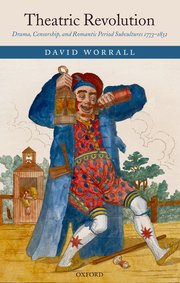
David Worrall, a professor of English at Nottingham Trent University, used Macauley's pamphlet as the title for his 2006 study of Georgian theatre Theatric Revolution: Drama, Censorship, and Romantic Period Subcultures 1773-1832. He argues that the close physical proximity of radical presses and seditious meeting-places to the great theatres in London was no mere coincidence. Both radical politics and its reactionary critique were intertwined with the theatre culture of the day.

In his first chapter, Worrall discusses the regulation of the theatres, examining both the patent system that gave Drury Lane and Covent Garden a monopoly on serious spoken drama, and the censorship system that gave an inordinate amount of power to one man, the Examiner of Plays. Beginning in 1824, the playwright (and son of a playwright) George Colman the Younger was the Examiner, which shows just how incestuous the whole system was. His first year in office, Coleman censored so many passages in Martin Archer Shee's tragedy Alasco that the playwright withdrew the piece from production at Covent Garden. He subsequently published the play with a preface objecting to Coleman's censorship, and by the end of the year Alasco was performed in New York.

Since the two patent theatres had a monopoly on spoken drama, minor theatres like the Royalty Theatre in the East End had to add music to plays, turning them into "melo-dramas" or "burlettas." Worrall's second chapter deals with attempts to suppress the Royalty, which the actor John Palmer built and opened in 1787. The theatre became the subject of a pamphlet war, with the partisans of the patent theatres arguing for its closure. The Royalty was denied a license in 1802, but then licensed again the following year.

Worrall examines the role of the Examiner of Plays in his third chapter. Prior to Geroge Coleman taking over in 1824, the Examiner was John Larpent, and by extension his wife, Anna Margaretta Larpent. According to Anna Larpent's diaries, the couple read aloud all of the plays submitted for performance, and she seems to have given her husband considerable input. In 1795 the Larpents prohibited performance of Lady Mary Eglantine Wallace's play The Whim, a comedy in which an aristocrat, after reading about the Roman custom of Saturnalia, decides that for a day his family will trade places with their servants. Even though the play ends with the confirmation of the social order, this was too much.

Chapter Four deals with the famous scenic designer Philip de Loutherbourg, who was also a Freemason. His 1773 extravaganza A Christmas Tale contained a great deal of Masonic symbolism. Charles Dibdin provided music for the piece, which had a text by David Garrick. After the outbreak of the French Revolution, some critics of Freemasonry linked the Masons to the radical Jacobins, and by the late 1790s the Masonic imagery in A Christmas Tale "had become politically dangerous." The play was not performed for many years, though the Surrey Theatre did stage it in 1817, after anti-Mason (and anti-Jacobin) hysteria had quieted somewhat.

In the fifth chapter, Worrall examines the censorship of The Two Farmers by Thomas Dibdin, Charles Dibdin's son. Though the play was scheduled for performance at Covent Garden in 1800, it ran afoul of the Larpents. Britain had recently experienced grain shortages, and many people blamed farmers for allegedly hoarding their crops. The Two Farmers introduced a villain named Locust who hoarded grain in order to raise prices and justified his actions as being "for the good of the nation." Larpent's blue pencil made quite a number of cuts, and ultimately the censor rejected the play in its entirely.

Chapter Six examines the return of Caroline of Brunswick, the wife of the Prince Regent who returned from self-imposed exile after George III died, making the Prince now King George IV, and Caroline--in theory at least--the queen. However, the king cruelly barred her from the coronation ceremony in 1821, and Caroline died only a few days later. Her return to England featured high-profile attendances at London theatres. At a private party in Montague House, Queen Caroline was even presented to guests as a statue that came to life, a scene consciously reminiscent of the last scene in Shakespeare's The Winter's Tale.

The following chapter looks at theatricalized popular British culture. Worrall notes that drama took place well outside even the "minor" theatres in London and official theatres of the provinces. For instance, the actor Peter Paterson performed a 12-minute version of Matthew G. Lewis's The Castle Spectre at fairgrounds around Birmingham. Audiences could also see spoofs such as W.T. Moncrieff's Frank-in-Steam, or, The Modern Promise to pay, which was performed in 1824, only a year after the English Opera House debuted Richard Brinksley Peake's Presumption; or, The Fate of Frankenstein, the first adaptation of Mary Shelley's novel.

Chapter Eight looks at two plays, the anonymous closet drama Plots and Placemen and James Powell's Drury Lane confection Harlequin Negro. Attributed to on "Zachary Zealoushead," Plots and Placemen satirizes the suppression of radicals during the Regency. The powerful foreign secretary Lord Castlereagh becomes "Callouswretch" and Lord Sidmouth, the widely reviled home secretary, becomes "Proudmouth." This might seem an odd pairing with Harlequin Negro, an 1807 play that Larpent approved without any excisions. However, Powell's play contains what Worrall calls "a vivid moment of empowerment changing the oppressed black Caribbean slave into a gorgeously costumed comic hero." Both plays, then, were furthering the agenda of Britain's radical progressives.

Worrall also includes a chapter on plays inspired by the infamous 1817 murder of 20-year-old Mary Ashford. The young woman went to a dance in Warwickshire one night, and the next day her body was found in a flooded sandpit, probably raped. In 1818, the anonymous three-act plays The Mysterious Murder and The Murdered Maid appeared in print. Two other plays based on the events appeared on the London stage: William Barrymore's Trial by Battle and John Kerr's Presumptive Guilt.

In the final chapter, Worrall looks at the performance of the radical play Swing at the Rotunda, an improvised theatre space where the well-known radical Richard Carlile staged Robert Taylor's five-act tragedy Swing; or, Who Are the Incendiaries? This "People's Tragedy" seems to have been performed with a cast of two, a man named Harrison and Taylor, who at one point appeared as himself under his nickname "Robert the Devil." The shockingly revolutionary play shows the proletarian Swing made king, but he then abdicates so that Britain can become a republic. Carlile hoped to collaborate with Taylor on a second play, but the latter's alcoholism rendered that impossible.

Overall, the picture that emerges of Georgian theatre in Theatric Revolution is one that is far different from the staid Shakespeare revivals people generally associate with that era. Writers like Martin Archer Shee, Eglantine Wallace, Thomas Dibdin, James Powell, and Robert Taylor were constantly pushing the envelope, staging--or attempting to stage--plays that engaged politically with the ever-changing world around them.