It's the end of the year, and like many others, I'm putting together a round-up of the best new productions I saw that opened in New York City in 2015. Some of my choices might seem unconventional, while others will surprise no one. Here they are, in reverse order:
10. Allegiance - With all the great new Broadway musicals opening this year, Allegiance is in danger of getting lost in the shuffle. It shouldn't be.
9. 'Tis Pity She's a Whore - Red Bull Theater Company usually does good work, and their production of John Ford's masterpiece was no exception. 'Tis Pity proved once again that you don't have to have the budget of The Royal Shakespeare Company to put on good classical drama.
8. Wolf Hall - Of course, if you do have the budget of the Royal Shakespeare Company, it doesn't hurt. The RSC's adaptation of Hilary Mantel's first two novels about the life of Thomas Cromwell didn't gain as much attention (or fill as many seats) as it did in London, but it was still worth seeing. Wolf Hall was a magnificent display of skilled theatre professionals doing precisely what they do well.
7. Amazing Grace - Speaking of shows not embraced by Broadway, Christopher Smith and Arthur Giron's fantasia on the life of John Newton drew the ire of critics, but thrilled those who had enough good since to ignore them and come anyway. I cried more at this show than at anything I've seen in years. As with Allegiance, the songs did not always rise to level one might hope, but the storytelling was both moving and timely.
6. Cymbeline - Though The Public Theatre seems to misfire with their Shakespeare productions as often as they produce a hit, this summer's Cymbeline was a delight. Hamish Linklater and Lily Rabe were hysterical as the play's romantic leads, but the best thing about this production was how the small cast came together to create a true ensemble. Tasteful audience interaction and superb music by Tom Kitt also served to make this a memorable production.
5. Something Rotten - Even more memorable than some of the many Shakespeare productions I saw this year was Something Rotten, the Broadway musical making fun of the Bard. Yes, I saw Fun Home, which beat it out for the Tony this year, but I found myself seated where that play's ill-conceived direction showed nothing but the actors' backs. Something Rotten by contrast has not only a great score, ingenious lyrics, and a creative book, it's also well directed and a pleasure to watch.
4. Freight: The Five Incarnations of Abel Green - Howard L. Craft's one-man play featuring J. Alphonse Nicholson, probably hasn't made it onto a lot of people's top-ten lists, but that's because they didn't see it. Beginning at the dawn of the 20th century and proceeding to the present day, Freight manages to examine the American experience (and more specifically the African-American experience) in ways that are constantly surprising. Each of the play's five scenes move forward through history, yet we seem to revisit the same set of characters over and over again, reminding the audience that even as some things change drastically, others remain tragically the same.
3. Nevermore: The Imaginary Life and Mysterious Death of Edgar Allan Poe - Though Nevermore came to New York once before, this creation by Catalyst Theatre had evolved since then, and it's production at New World Stages counted as a Broadway premiere. It didn't hurt that I saw the play on Mr. Poe's 206th birthday, but my own fan-boy-ing aside, this is one of the most creative and innovative plays I've ever seen. Bretta Gerecke's production design is a goth's dream come true, and Jonathan Christenson's text sounds so natural we hardly notice the play is almost entirely in verse. Like one of Poe's characters, Nevermore doesn't want to stay buried, and we should all be thankful for that!
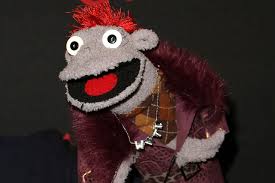
2. Hand to God - I admit that I came late to this party. Hand to God was a hit off-Broadway way before it opened this year on the Great White Way, but this production was astonishing. In spite of the fact that he is clearly one of America's great playwrights, a Broadway hit still has not allowed Robert Askins to give up his bar-tending job, but that's just the state of the economics of this country's theatre. Never mind. This tale of a high-school misfit engaging in "puppet ministry" in a church basement continually goes to darker and more unexpected places, and Askins' voice deserves to be heard. I'm a sucker for puppets, and this show uses puppetry in ways that are dirtier than Avenue Q and yet with more skill than is hardly ever seen.
1. Hamilton - Okay, no surprise here. Since it opened off-Broadway at the Public, Hamilton has been the hottest ticket in town, but not without reason. Lin-Manuel Miranda has crafted a magnificent show out of American history and American popular culture. The music is exciting, the lyrics are smart, and the story of Alexander Hamilton's life and death, even to those who already know it, is enough to break your heart. Count me along with politicians as diverse as Barack Obama and Dick Cheney as one of the many fans of this show. If you can't see it right away, get the cast album. Listening to it reminds you of so much that the American musical is and can be. Ten dollar tickets (a Hamilton for a Hamilton) are still available through a lottery before each show, but good luck getting them. Spring for a regular ticket. It's worth it.
So that's my list! Honorable mentions this year to Doctor Faustus, I Will Look Forward To This Later, and Spring Awakening!
Showing posts with label Allegiance. Show all posts
Wednesday, December 30, 2015
Sunday, November 29, 2015
Allegiance
Last night, I saw Allegiance, the new Broadway musical that tells the story of the Japanese internment camps during World War II. As the play shows, these camps sometimes split apart families, as some people resisted the government on principle, and others went off to fight in the Japanese-American 442nd Infantry Regiment of the U.S. Army.
It's difficult for me to imagine someone having the U.S. government take away everything they have and force their entire family behind barbed wire, and then that person turning around and saying, "I love America so much I'm willing to fight for it." The men who did so both honor the American democratic system and perpetually shame it for its abominable failures. Much like the African-American regiments during World War II, the 442nd was composed of men fighting for a country that treated them as second-class citizens.
Allegiance honors such men, but it also recognizes the heroism of those who chose not to go. In the play, Sammy Kimura (played by Telly Leung) tries to enlist after Pearl Harbor, is rejected because he is Japanese, and then gets sent off to an internment camp in Wyoming. In spite of the barbaric (and blatantly unconstitutional) treatment of his family, he still longs to serve, and when the 442nd is created, he jumps at the chance to serve. Meanwhile, however, his father (played by Christopheren Nomura) refuses to swear allegiance to the U.S. government on principal, and is shipped off for even harsher treatment. Both men are stubborn in their own ways, but both earn our respect.
Perhaps even more interesting is the character of Frankie Suzuki (played by Michael K. Lee) who organizes resistance to the draft after the government decides to start forcing internees to join the military. Frankie and company have the best song in the show, "Paradise," which comments bitterly on government's assertions that the camps are safe, clean, and humane. The polar opposite of Frankie is Mike Masaoka (played by Greg Watanabe), the spokesman for the Japanese American Citizens League. Historically, Masaoka and the JACL cooperated with the government in hopes that the internment process would be as humane as possible. Understandably, Masaoka became the focus of a great deal of criticism, but Allegiance portrays him, too, trying to do the right thing as best he can.
One of the show's two biggest stars is George Takei, who plays an older Sam Kimura, as well as that character's grandfather, Ojii-chan. The Star Trek actor, who was himself interned in the camps as a young boy, has been a major force in bringing the show to Broadway. The other big star is Lea Salonga, who plays Kei, Sammy's big sister who falls in love with the anti-authoritarian Frankie. Best known as the original Kim in Miss Saigon, Salonga has an amazing voice that composer Jay Kuo's music tries to highlight.
Sometimes the patriotic thing to do is fight, and sometimes it is to refuse. Allegiance makes us consider whether both sides might indeed be right. The play tells an important American story, and in a Broadway season already populated by other great shows like Hamilton and Spring Awakening, it deserves to be seen.
It's difficult for me to imagine someone having the U.S. government take away everything they have and force their entire family behind barbed wire, and then that person turning around and saying, "I love America so much I'm willing to fight for it." The men who did so both honor the American democratic system and perpetually shame it for its abominable failures. Much like the African-American regiments during World War II, the 442nd was composed of men fighting for a country that treated them as second-class citizens.
Allegiance honors such men, but it also recognizes the heroism of those who chose not to go. In the play, Sammy Kimura (played by Telly Leung) tries to enlist after Pearl Harbor, is rejected because he is Japanese, and then gets sent off to an internment camp in Wyoming. In spite of the barbaric (and blatantly unconstitutional) treatment of his family, he still longs to serve, and when the 442nd is created, he jumps at the chance to serve. Meanwhile, however, his father (played by Christopheren Nomura) refuses to swear allegiance to the U.S. government on principal, and is shipped off for even harsher treatment. Both men are stubborn in their own ways, but both earn our respect.
Perhaps even more interesting is the character of Frankie Suzuki (played by Michael K. Lee) who organizes resistance to the draft after the government decides to start forcing internees to join the military. Frankie and company have the best song in the show, "Paradise," which comments bitterly on government's assertions that the camps are safe, clean, and humane. The polar opposite of Frankie is Mike Masaoka (played by Greg Watanabe), the spokesman for the Japanese American Citizens League. Historically, Masaoka and the JACL cooperated with the government in hopes that the internment process would be as humane as possible. Understandably, Masaoka became the focus of a great deal of criticism, but Allegiance portrays him, too, trying to do the right thing as best he can.
One of the show's two biggest stars is George Takei, who plays an older Sam Kimura, as well as that character's grandfather, Ojii-chan. The Star Trek actor, who was himself interned in the camps as a young boy, has been a major force in bringing the show to Broadway. The other big star is Lea Salonga, who plays Kei, Sammy's big sister who falls in love with the anti-authoritarian Frankie. Best known as the original Kim in Miss Saigon, Salonga has an amazing voice that composer Jay Kuo's music tries to highlight.
Sometimes the patriotic thing to do is fight, and sometimes it is to refuse. Allegiance makes us consider whether both sides might indeed be right. The play tells an important American story, and in a Broadway season already populated by other great shows like Hamilton and Spring Awakening, it deserves to be seen.
Subscribe to:
Posts (Atom)