Showing posts with label Hugh Wheeler. Show all posts

Thursday, January 20, 2022

Martin Chuzzlewit and Sweeney Todd

Sweeney Todd, the demon barber of Fleet Street made famous by the Stephen Sondheim/Hugh Wheeler musical, first made his appearance as a character in the anonymous penny-dreadful novel The String of Pearls, published in installments between 1846 and 1847.

However, stories of Londoners who murdered people and baked them into meat pies predated the publication of The String of Pearls. The urban legend appears in the Charles Dickens novel Martin Chuzzlewit (published 1843-1844), which includes a non-murderous barber named Poll Sweedlepipe.

In chapter 26 of Dickens's novel, we even learn of a "sympathy between beards and birds" that "frequently impels a shaver of the one to be a dealer in the other." Though Poll doesn't keep a green finch, linnet bird, nightingale, or blackbird, he does house gamecocks, bantams, owls, and smaller birds in the same building where he has his shop.
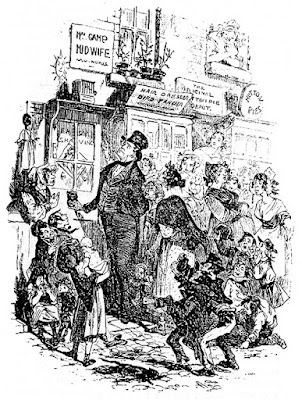
When Hablot Knight Browne (using the pseudonym "Phiz") illustrated Poll Sweedlepipe's shop, he included next to the "EASY SHAVING" and "HAIR DRESSED" advertisements (yup) signs for mutton pies. That's right! The barber was located right next to a shop that sold meat pies. Though there's no evidence in the novel that Dickens's barber is up to anything nefarious, Browne might have been alluding to a well-known folk belief.

And how widespread were Victorian tales of urban cannibalism? Well, Dickens alludes to them at the end of chapter 36 of Martin Chuzzlewit when the character Tom Pinch worries that his friend will think he has "strayed into one of those streets where the countrymen are murdered" and has "been made meat pies of, or some such horrible thing." Not letting the issue drop, Dickens begins the next chapter with the line: "Tom’s evil genius did not lead him into the dens of any of those preparers of cannibalic pastry, who are represented in many standard country legends as doing a lively retail business in the Metropolis."

What's interesting to me is that in Martin Chuzzlewit the urban legend of people being baked into meat pies is represented as having its origins in the country. It is only rural folks who believe such fantastic accounts of city dwellers feeding upon one another. Dickens was a city dweller himself, and he shows London as a place of opportunity for Tom Pinch rather than a location of danger.

The novel does contain other references to cannibalism, though, as when the innkeeper Mrs. Lupin regrets that a character went off to the United States rather than "to some of those countries which are not quite barbarous; where the savages eat each other fairly, and give an equal chance to every one!"

Well, as Mrs. Lovett and Sweeney sing, "How gratifying for once to know / That those above will serve those down below!"

Saturday, June 24, 2017

More Meat Pies!

Last night, I had the pleasure of seeing Norm Lewis as the title character in Sweeney Todd at the Barrow Street Theatre.

This production of the Stephen Sondheim/Hugh Wheeler musical thriller had its origins with Tooting Arts Club. The neighborhood company produced Sweeney in 2014 at Harrington's Pie and Mash Shop, the oldest such establishment in London.

After the production in an out-of-the-way southern part of London became a hit, producers moved it to the West End, and now it comes to New York, where Harrington's has been recreated inside the Barrow Street Theatre. You really feel like you're in a cozy pie shop, and for an extra fee, you can even buy a pie (not Mrs. Lovett's recipe) to eat before the show.

Of course, the tables have to be cleared before the show starts, since the cast will be dancing on top of those tables. A lot of productions in recent years have been billed as "immersive" when they really aren't, but Sweeney Todd actually does surround the audience, and the intimate setting means the reduced-size cast and orchestra still fill the space. The three-piece band never sounds thin, and the cast continually pops up in different parts of the audience creating an electric atmosphere.

Norm Lewis is an incredible singer, but instead of resting on his melodious voice, he frequently spits out lines to add to the threatening mood of the piece. His interpretation of the role is a bit different than those I've seen before, but the more I watched him, the more I loved what he was doing. His Sweeney is human and sometimes even vulnerable, but this just makes him all the more frightening when he turns to murder.

Carolee Carmello is equally good as Sweeney's accomplice, Mrs. Lovett. Her humor adds a great deal to the production, particularly in the song "A Little Priest" at the end of the first act. I was also impressed by Alex Finke as Johanna. Even before she gets shut up in an asylum, we notice something a bit off about Johanna.

But of course that's exactly what you would expect for someone raised by Judge Turpin (played by Jamie Jackson). Turpin is always creepy, but Jackson plays him as particularly threatening. His henchman Beadle Bamford (Brad Oscar) provides a perfect foil with his well-timed humor.

As wonderful as it is to hear Sondheim's music with a full orchestra, this intimate production captures the grandeur and the beauty of the show and is not to be missed.