Showing posts with label Bejart. Show all posts

Tuesday, June 17, 2025

The Imaginary Invalid

Molière's final play, The Imaginary Invalid, is difficult to perform as written. Prior to last night, the only time I'd seen the piece on stage was in a creative re-imagining by Mabou Mines.

One of the biggest challenges of the play is that its plot-based scenes alternate with balletic musical sequences in the pastoral style. How on earth do you stage those interludes, especially when love-lorn shepherds no longer have the cultural power they used to enjoy?

The solution playwright Jeffrey Hatcher came up with for the adaptation Red Bull Theater Company now has playing at New World Stages is kind of brilliant. The play's characters end up singing some of the most stereotypically French songs ever composed with re-written lyrics all about sheep.

This goofiness is right at home on Beowulf Borritt's ridiculously fanciful set. The result is not exactly Molière, but very much in the comic spirit of the original play. Molière famously collapsed on stage while playing the hypochondriac lead Argan, later dying without receiving last rites, thanks to the controversy surrounding his earlier play Tartuffe. In the current production, the leading role goes to Mark Linn-Baker. (Who, unlike Molière, will hopefully outlive the run of the show!)

In many ways, though, the best role in the play is Argan's maid, Toinette. Red Bull's production features the tremendously talented Sarah Stiles as the put-upon servant who understands things far more clearly than her master. Stiles, best known for her performance as Jessica in Hand to God, finds comic gold in a messed-up medical system, as does Arnie Burton, who plays not one but three different doctors, each with their own unique quirks.

Argan's daughter Angélique was originally played by Molière's wife, Armande Béjart. Emilie Kouatchou, most famous as the final Christine in The Phantom of the Opera on Broadway, takes on that role in the current production. (When Kouatchou sings re-written Phantom lyrics to extoll the virtues of sheep, those in on the joke go into hysterics.) Equally hilarious in this production is Angélique's stepmother Béline, played by Emily Swallow (whom you will not recognize as the Armorer on The Mandalorian).

The show, directed by Red Bull's artistic director, Jesse Berger, is only playing through June 29th, so see it while you can!

Wednesday, May 14, 2025

Versailles Impromptu

After the critical reception of his comedy The School for Wives, the French dramatist Molière wrote two one-act defenses of himself, The Critique of School for Wives and The Versailles Impromptu, the latter of which shows the playwright's own company attempting to rehearse a play for the king.

Molière, who originated the role of Arnolphe in The School for Wives, appears as himself, attempting to wrangle a troupe of actors into finishing the rehearsal on time. He is annoyed by a group of busybodies who constantly interrupt the rehearsal. The one-act comedy shows not just the rehearsal, but a play-within-the-play, in which characters discuss Molière's work, much as they had in The Critique of School for Wives. Silly characters speculate on who is being attacked in Molière's plays, while sensible ones take his comedies for being mere fictions.

To say all of this is a bit meta is perhaps an understatement. Molière had only recently married Armande Béjart, a young actress who had also appeared as Élise in The Critique of School for Wives. She appeared on stage as herself in The Versailles Impromptu, berating her husband (playing himself), who had also written the play. When he calls her names in exasperation, she remarks quite reasonably, "you wouldn’t have said that to me a year and a half ago" while he was still courting her. Though 
Molière wrote the play, he appears to give his wife the better argument.

Also appearing in the play is 
Mademoiselle Du Parc, an actress known more for her tragic portrayals than her comedy. When Molière tells her she is to play an affected young lady, she responds (presumably in an affected manner) "How could that be, when there’s nobody in the world less affected than I am?" I imagine that Du Parc was in on the joke, even if it was at her expense. Historically, she thrived as a part of Molière's company, though she later left (at the instigation of the tragic dramatist Jean Racine) to join a rival company at the Hôtel de Bourgogne.

The whole play is filled with in jokes. Most of the major actors in 
Molière's company make appearances as exaggerated versions of themselves, including Catherine de Brie, who originated the role of Agnès in The School for Wives, and Brécourt, who was the original Alain. We probably don't get half the jokes today, but it's still fun to read the play and envision what one of Molière's rehearsals was really like. I imagine they were quite dramatic, even if not quite as outrageous as the one in the play!

Saturday, January 15, 2022

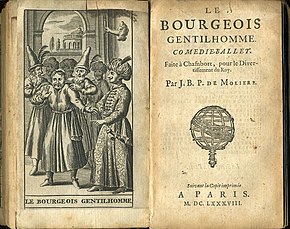
The Bourgeois Gentleman

We don't know exactly when the French playwright Moliere was born, but he was baptized on the 15th of January, 1622.

Of course, Moliere was his stage name, so he was baptized Jean-Baptiste Poquelin, not Moliere. In honor of the anniversary of his baptismal day today, I read his play Le Bourgeois gentilhomme, which is generally translated as The Bourgeois Gentleman.

The play premiered in 1670, at which point Moliere was already famous for writing The Blunderer, Sganarelle, and The School for Wives, and infamous for writing Tartuffe, Don Juan, and a scandalous adaptation of Amphitryon. This time, however, he would flatter the court of Louis XIV and make fun of the rising middle class.

Moliere himself played the titular character, Monsieur Jourdain, who is merely bourgeois, but has pretensions of being a gentleman. He receives lessons from a music master, a dancing master, a fencing master, and a philosophy master. Though Moliere was a magnificent poet, the play is mostly written in prose. This leads to a comic moment, when Jourdain famously exclaims: "On my conscience, I have spoken prose above these forty years, without knowing anything of the matter...."

Armande Bejart, who was married to Moliere, played Jourdain's daughter Lucile. As often happens in Moliere's plays, the protagonist's daughter is in love with one man, but he wants to marry her off to someone else. In this case, the social climbing Jourdain fixates on the idea of marrying his daughter to a son of the Ottoman Emperor. The year before, an Ottoman ambassador had refused to bow before the king, creating quite a scandal, so the play's aristocratic audiences probably enjoyed the idea of making fun of the Turks as well.

In the play, Lucile's lover dresses up as a Turk and pretends to be the son of the Ottoman Emperor. There's a lot of goofy fake Turkish, as he and his servant fool Jourdain into thinking that they're actually from the court of the Ottomans. The plan works, and all ends happily.

The composer Jean-Baptiste Lully composed music for the piece. The score survives, and what I've heard of it sounds fun. I'd love to see a production someday using the original music!

Friday, August 14, 2020

The Original Tartuffe

 Moliere's classic attack on religious hypocrisy, Tartuffe, originally premiered as a three-act play on May 12, 1664. The playwright's enemies were not impressed.

Immediately, the very people Moliere had criticized began to attack the play. The original script is now lost, so we don't know how much this early version resembles the text we have today. What we do know is that after it was performed at the Palace of Versailles, it was immediately condemned.

Tartuffe criticizes people who pretend to be pious, but actually are just after sex, money, and power. Religious conservatives urged King Louis XIV to ban the play, which he did, though he added that he did not doubt the good intentions of the author. Undeterred, Moliere not only revised the piece but actually expanded it into five acts.

This new version of the play premiered in November at the Chateau de Raincy outside of Paris. The King seems to have encouraged Moliere in his revising of the play, and in 1665 he even extended his patronage directly to Moliere's company. This did not stop calls to ban the piece, though, and the writer struggled to mount productions, often as private performances due to the extreme hostility toward the piece.

While Moliere was concerned with the social conditions surrounding the play, he was also concerned with providing a vehicle for the actors of his company, and they seem to have each left a mark on the piece. The writer himself played Orgon, the obsessed dupe who cares about nothing so much as his pseudo-holy  houseguest Tartuffe. Philibert Gassot, known by the stage name of Du Croisy, played the title character.

Armande Bejart, who was by then known as Mademoiselle Moliere, played Orgon's wife, Elmire, while Madeleine Bejart played the sassy maid, Dorine. Madeleine had co-founded the Illustre Theatre troupe with Moliere in 1643. Though the two were romantically involved on and off in the past, Moliere had ended up marrying Armande. And while Armande was supposedly the younger sister of Madeleine, in actuality she was her illegitimate daughter. (No, not by Moliere, though his enemies later insinuated this.)

With a cast like that, one can imagine some offstage drama rivaling what occurred onstage!

Tuesday, February 12, 2013

Thoughts on Moliere


Jean-Baptiste Poquelin, better known by his stage name, Moliere, began as an actor. In 1643 he co-founded with Madeleine Bejart the Illustre Theatre troupe. Two years later, the troupe went bankrupt and Moliere was briefly imprisoned for debt. After his release, he and Bejart got together again and eventually formed a new company known as The Troupe of Moliere. It was then that Moliere began writing short plays heavily influenced by commedia dell'arte. In 1658, the company performed for the first time before the new king, Louis XIV. They obtained the patronage of the powerful Duke of Orleans, and prospects were looking very bright.

The flowing year, Moliere premiered his first important play, The Affected Young Ladies, which poked fun at the pretensions of social climbers. In 1662, Moliere married Armande Bejart, a woman 18 years his junior who was supposedly the younger sister of Madeleine, but was in actuality her illegitimate daughter. The union does not seem to have troubled Madeleine, who remained on intimate terms with Moliere both before and after the marriage. However, opponents of Moliere would later use suspicions of incest as a tool to besmirch the playwright's name and drive away patrons.

The same year as his marriage, Moliere premiered The School for Wives. The hilarious comedy makes fun of men who--like Moliere himself--try to marry younger women. Critics attacked the play as scandalous, and in response Moliere wrote Rehearsal at Versailles, in which he defended not only himself, but also the theatrical profession in general. The controversy eventually died down after the king granted Moliere an annual pension, granting him tacit royal approval. However, the controversy over The School for Wives would soon be far surpassed by the coming furor over Tartuffe.

Originally performed in 1664 and rewritten repeatedly, Tartuffe tells the story of a religious hypocrite who insinuates his way into the home of the protagonist, Orgone, only to wreck havoc and threaten to ruin everyone. Moliere makes it clear that Tartuffe is an imposter and not a genuine priest, but conservatives saw the play as an attack on the clergy and perhaps on all religion in general. The Archbishop of Paris threatened to excommunicate anyone who performed, watched, or even read the play. Louis XIV intervened again in 1665, granting Moliere's company an annual subsidy and the title of The King's Troupe. Still, the play could not be publicly performed until 1669.

Moliere took on all forms of hypocrisy in his 1666 comedy The Misanthrope. The play's protagonist, Alceste, rails against every form of double-dealing in society and remains steadfast in telling the truth, no matter what anyone thinks of him. Ultimately, however, Alceste loses the woman he loves to a friend who is more flexible in his ideals. The play ends with Alceste enraged and at odds with both his friends and society. Though a failure at the time, it is now considered one of Moliere's greatest works.

In later years, Moliere adapted the works of Plautus in Amphitryon and The Miser. He collaborated with the court composer Jean-Baptiste Lully in pieces of musical theatre including The Bourgeois Gentleman. When Lully went his own way, taking with him all the best singers, Moliere went back to focusing on spoken drama and wrote The Learned Ladies. Though the play attacks the pretensions of women who focus on science and learning rather than on romance, the play is so delightful it has won over even feminist critics.

Moliere's health gradually worsened. His last play, The Imaginary Invalid, tells the story of a hypochondriac who, like the protagonist of The School for Wives, might have been a caricature version of Moliere himself. An actor to the end, Moliere collapsed onstage while performing the title role. He died without receiving last rites after two different priests refused to visit him.