Like so much of Japanese culture, traditional theatre in Japan was originally borrowed from China. In the eleventh and twelfth centuries, imported Chinese plays became adapted into a Japanese form called sarugaku. This form in turn split apart into two subtypes, hongei, or "principal craft," and nogei, "refined craft." The more refined plays eventually became known as Noh. The hongei, which kept the original humorous elements in sarugaku, evolved into short comic plays called kyogen.
In the fourteenth century, the actor and playwright Kanami Kiyotsugu began to codify Noh drama into the form in which it still exists today. Kanami led a sarugaku troupe for many years, eventually bringing the troupe to the Yamato province where he founded a special school dedicated to Noh performance. Kanami also introduced into Noh various dance forms, such as kusemai and dengaku, which were native to Japan. He trained his son, Zeami Motokiyo, to be a virtuoso performer. As their troupe's popularity spread, they began performing in the capital city of Kyoto, where Zeami caught the eye of the ruling shogun, Ashikaga Yoshimitsu. Shogun Yoshimitsu, the most powerful man in Japan, then became the troupe's patron, giving them all the resources they needed to perfect their art.
The spectacular rise of a family of strolling players to the inner circle of the shogun might seem like a fairy tale. Medieval Japanese society was highly regimented, and the sudden ascendancy of Kanami and Zeami must have seemed surprising to the court. However, once it had risen to a courtly art form, Noh itself became regimented. Parts were passed down from father to son, and performers had to be born into great acting families in order to have a chance at success. That success, in turn, could prove fleeting, as Zeami himself was to discover.
Zeami
After Kanami's death in 1385, Zeami took over the leadership of his father's troupe. He wrote dozens of plays, which still comprise the backbone of the Noh repertoire today. Zeami's plays are saturated with the language of Zen Buddhism, the religion of the warrior class he served. In addition, he wrote more than twenty treatises on the art of Noh drama, frequently expressing his views on theatre in spiritual terms. These treatises, particularly Fushikaden and Kakyo, document medieval performance and help to guide performance of Noh today.
Zeami composed his early treatise Fushikaden (which translates roughly as " Style and the Flower") around the year 1400. In it, he advocates going beyond mere imitation of a character, instead inhabiting a character so fully that a performance blossoms like a beautiful flower. According to Zeami, every actor should be able to express the qualities of hana and yugen. Hana is the fragile, transient essence of a human being, while yugen denote a mysterious beauty and grace. He also writes that each play must develop in three stages, which he identifies as jo-ha-kyu. Jo is the beginning stage, ha denotes an intensification, and kyu indicates a climactic ending.
In 1394, Shogun Yoshimitsu officially ceded power to his son, Ashikaga Yoshimochi. The new shogun was not as fond of Zeami, so the actor and his troupe sought patronage elsewhere. Following the example of his father, Shogun Yoshimochi ceded power to his own son, Yoshikazu, who died after ruling for only two years. Yoshimochi resumed power after the death of his son, but in 1428 he died leaving no sons and no clear heir. Eventually, his brother Yoshinori became shogun, but he was a violent man, and no friend of Zeami.
For reasons that remain unclear, in 1434 Shogun Yoshinori banished Zeami to Sado Island, and the great theatre artist remained in exile at least until after the shogun's assassination in 1441. It was on Sado Island that Zeami wrote much of his theoretical work, including Kakyo. The later treatise recounts some of Zeami's personal history and re-examines the claims of Fushikaden from a more mature, more nuanced perspective. Eventually allowed to return to the mainland of Japan, Zeami died in 1443. Whether he finally returned as permitted or died on Sado Island, Zeami was buried in Yamoto, the place where he spent his youth. The tragic latter part of his life seems to have been tinged with the same melancholy that ran through the plays he wrote throughout his career.
Noh Actors
Traditionally, all Noh actors have been male, though in the twentieth century, a number of established actors began training their daughters in Noh, and today it is not uncommon to see women on stage, though they are still a distinct minority. The leading actor is known as the shite, and he plays the protagonist. A second actor, the waki, acts as a counterpart of the shite. He is often a foil of the main character and frequently introduces the action. Each of these characters might have a companion, known as a shitetsure or wakitsure.
The shite (but not the waki) wears a mask, and any shitetsure might wear a mask as well, especially if he is representing a woman, ghost, or demon. The masks are carved out of wood and painted in such a way that when the actor moves his head and changes the angle of the mask, the expression on the face appears to change. For instance, when an actor holds his head up, the mask will appear to be smiling, while facing downward can reveal a sad or angry expression. Actors are elaborately dressed and usually hold a fan. Depending on how the fan is held, it can represent other props as well, such as a dagger or a lantern.
In addition, there is a chorus of about eight actors known as jiutai who sit on the side of the stage. Unlike a Greek chorus, the jiutai in Noh are not understood to be a group of separate characters. Rather, they sing or chant lines closely associated with the shite, often helping him with the narration and providing commentary on the action. Musicians, known as hayashi, also sit to the side of the stage. The four hayashi play a flute and three different types of drums, and their music is considered integral to Noh drama.
Types of Noh Dramas
There are five major types of Noh plays. In a typical Noh performance, one play of each type is performed in a set order, with short comic kyogen performed in between. The first play is usually the kami mono or "god play" featuring a sacred story, often set in a shrine. These plays are also known as Waki Noh, since they feature the waki, generally in the role of a priest encountering a supernatural being. The most famous kami mono is Zeami's play Takasago, sometimes known by the title Twin Pines. In the play, the waki comes across an elderly couple sweeping the ground beneath two pine trees that are joined together. Eventually, the waki learns that the harmonious old pair are actually the twin spirits of the conjoined tree.
After the kami mono, a company might perform a comic kyogen, then a shura mono, or "fighting play" featuring the death of a warrior. Another Zeami play, Atsumori, typifies the shura genre. Its title character is a young warrior so peaceful and courtly he carries a flute into battle. Long after the battle, his killer encounters Atsumori's ghost. Atsumori's story is thus recounted many years after the events took place, a technique used frequently in Noh drama.
A third type of play is the katsura mono or "wig play" featuring a female protagonist. A Kanami play (which Zeami considerably rewrote, turning it into a masterpiece) is Matsukaze. The story of the heroine--whose name means "wind in the pine"--is taken from The Tale of Genji, the 11th-century classic by Lady Murasaki that is often described as the world's first novel. Like Takasago, it begins with a visiting priest coming across a sacred pine tree, in this case a memorial to two dead sisters. The ghosts of the sisters rise to tell their stories, then disappear, leaving only the wind in the pine.
The fourth Noh play to be performed in the sequence is of a miscellaneous type. These can be "madness plays" or kyoran mono such as Zeami's Lady Han. They also can be plays featuring vengeful ghosts, onryo mono, such as Dojo Temple, a play possibly written by Kanami about the spirit of a spurned woman who must be exorcised from a temple. A third type of play, the genzai mono, takes place in the present day. These are also known as "bare face plays" because the shite does not wear a mask. Other miscellaneous plays, such as Zeami's Nakamitsu, might not fit into any category.
At the end of a Noh performance, the company will usually present the fifth type of Noh play, the oni mono, which deals with demons or other supernatural spirits. One of the most popular oni mono is Shojo, about a spirit that gets drunk on the goods of a wine merchant. The shojo performs an impressive dance, and while he drinks the merchant's wine, he leaves him with a gift far more valuable: a cask from which wine will flow continually, never running dry. Oni mono often feature special masks, and the shojo mask is an important part of that play's performance. Other oni mono have even more elaborate masks.
Kyogen
Just as trilogies of Athenian tragedies were followed by a comedic satyr play, dramatic Noh plays are alternated with comic kyogen. These plays are typically composed anonymously and then passed down from generation to generation, sometimes with significant variations. The most popular kyogen character is probably the taro kaja or "first servant." In taro kaja plays, the shite plays the servant, sometimes with only one other actor who plays the master or shu, providing a "straight man" for the shite's antics. In other cases, such as the taro kaja play The Delicious Poison, there might be additional characters, such as the jiro kaja, or "second servant."
Another character in kyogen is the warrior priest, or yamabushi. One yamabushi play is The Snail, in which an ignorant servant through a series of misunderstandings mistakes a warrior priest for a giant snail. The good-natured yamabushi plays along, singing and dancing a special snail song with the taro kaja. Other kyogen characters include the lord, known as the daimyo, and the son-in-law, called the muko.
Unlike Noh actors, kyogen actors rarely wear masks, and they traditionally do not wear make-up, either. Other than fans, the use few props, though their costumes can be quite elaborate. In the kyogen play Mushrooms, for instance, actors dressed as exotic mushrooms pop up all over the stage. Since kyogen are performed together with Noh plays, they are presented on the same stage, and these stages have a number of unique characteristics.
Noh Theatres
Originally, Noh was performed outside. Though the oldest Noh stages are outdoors, plays are more frequently done inside today. However, the Noh stage, known as the butai, retains elements of its outdoor past. A pillar-supported roof covers the stage, and the back wall is painted with a pine tree. According to legend, it was down a pine tree that the spirit of Noh passed from the heavens down to the earth.
At the back of the stage is a bridge known as the hashigakari, which leads off to the side to the actors' dressing room. During the play, ghosts and spirits might cross the hashigakari, making both a literal and figurative journey to the world presented on the stage. Three stylized representations of pine trees mark different places on the hashigakari where the actor might pause. Less dramatic entrances and exits can be made through a small "hurry door" or kirido located at the back of the stage. Three steps known as the kizahashi descend from the front of the stage, but they are not used during performance.
The butai is divided into distinct sections, and where an actor stands is often strictly codified by tradition. The audience sits on two sides of the butai experiencing different views of the performance. Traditionally, aristocratic audiences watched Noh throughout the day, taking lunch during a break in the performance. Today, performances are much shorter, and anyone can attend, not just aristocrats. However, Noh remains a relatively elitist entertainment.
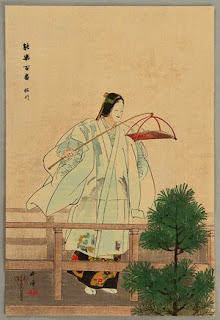 Sakuragawa
is the name of a river famous for its cherry trees. In the play, the heroine
scoops up petals of cherry blossoms out of the river, mourning the
disappearance of her beloved son, whose name Sakurago associates him with
cherry blossoms.


